The Brass Key
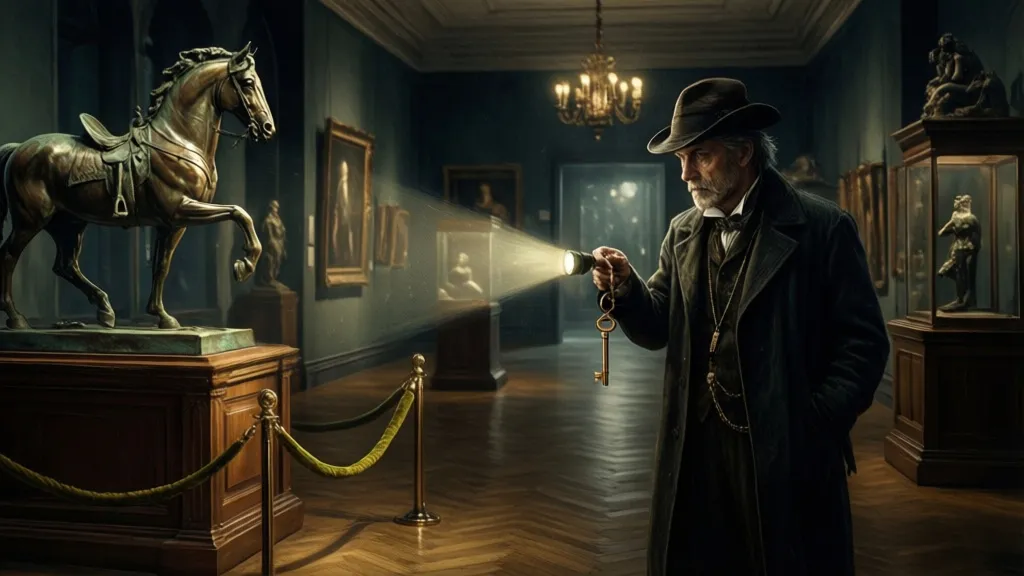
When Endo found the key for the first time, it was lying under the velvet rope in Gallery Three, half hidden in the shadow of a bronze horse.
He stopped with his torch angled low and stared at it for a moment before bending down. The museum was closed, the alarms on the display cases were set, and there should not have been anything loose on the floor except, perhaps, the occasional brochure escaped from a child’s hand. Certainly not a brass key with a narrow oval bow and three sharp teeth.
He picked it up between finger and thumb.
It was old enough to have weight and new enough to have use. Not decorative. Not obviously part of any display. A small white paper label had once been tied through the bow, but only the string remained, frayed to a pale whisker.
Endo glanced along the empty gallery. Marble emperors watched him with the same hard patience they had shown all week. The security lights made every polished surface look slightly damp.
He put the key in his breast pocket, wrote unidentified key, Gallery Three, 20:14 in his incident notebook, and continued his round.
At twenty-eight past eight he met Hoshino from cleaning outside the staff toilets.
"Lost property already?" she asked, seeing the notebook in his hand.
"A key. In Gallery Three."
"If it opens the deputy director’s mouth, keep it."
Hoshino pushed her trolley onward with the solemnity of a funeral horse. She was seventy if she was a day and believed all management to be a temporary mistake. Endo almost smiled. The museum after hours had a way of reducing everyone to types from an old play: the resentful cleaner, the overeducated receptionist, the donor who lingered too long beside labels carrying their own names.
Tonight they had also acquired Professor Makabe.
Retired Curator Emeritus, according to the brass plate in the entrance hall and according to himself several times over. He had come for the donors’ preview of the special exhibition, Ritual and Memory in Provincial Households, and had stayed after closing in the conservation office drinking tea that was certainly too cold by now. The deputy director had waved a hand at this arrangement. Professor Makabe was family, in the institutional sense that forgave much and prevented nothing.
Endo had seen him at seven, neat in a dark suit gone shiny at the cuffs, standing under the hanging scroll of cranes and telling a young patron that authenticity was mostly a matter of how confidently one lied about provenance. The young patron had laughed because she was not sure if he was joking.
He usually was, though not enough.
Endo completed the first floor, climbed the service stairs, and crossed the mezzanine overlooking the central atrium. Rain fretted at the skylight. The donor reception flowers had begun to lower their heads in crystal bowls below.
At nine o’clock he checked his pocket for the key before logging it in the security office.
His pocket was empty.
He stood very still. He had not stopped anywhere except the toilets corridor, the atrium desk, and the west stair. He was methodical by nature and by profession. Things did not leave his pockets by themselves.
He retraced his route at once.
The key was in Gallery One.
It stood balanced upright on the edge of a marble plinth as if someone had placed it there for a photograph. Beside it, in a glass case, an Edo-period writing box shone blackly beneath its own reflected lights.
Endo looked first for the person who had moved it. There was no one. The gallery doors were shut. The side windows were latched. The motion sensors over the emergency exits showed their ordinary green points.
He picked up the key again.
This time he did not pocket it. He wrapped it in a receipt from his wallet, put it inside the zip compartment of his bag in the security office, and wrote a second note beneath the first.
21:07 same key found Gallery One plinth after being secured on person. Unknown how moved.
He read the line back and disliked it. It sounded as though he had either been drinking or wished to begin.
Kanda, the younger guard on late shift, arrived at half past nine carrying canned coffee and a manner that suggested events should arrange themselves for his amusement.
"You look like a man who has seen culture," he said.
Endo showed him the key.
Kanda turned it over. "Old storage? Basement cupboards?"
"Perhaps. It moved."
"Without legs?"
"Without permission."
Kanda grinned, then saw Endo was serious and reduced the grin to civility. "All right. Who’s still in?"
They made the list together. Hoshino in the north wing. Two conservators cataloguing textile fragments on the second floor. The deputy director had left at eight forty-five. Professor Makabe remained somewhere in staff areas or galleries, with no schedule visible to God or man.
"And Miss Takanashi," Kanda added. "The donor in the green hat. I saw her talking to Makabe by the prints. She said she’d misplaced a raincoat check."
"She left at closing."
"Did she? She came back in from the courtyard around eight fifteen. Reception let her through because she knew everyone’s names. That sort usually does."
Endo considered this. Miss Takanashi was not young, not old, and dressed with the aggressive softness of expensive wool. She funded educational programs, attended every lecture, and looked at objects as if trying to remember where she had first met them.
"I’ll check the loading dock," Endo said.
The rain had strengthened by the time he crossed the service corridor behind the special exhibition rooms. The loading dock door was shut but not fully latched; a line of wet air came through at floor level. On the coat stand beside the deliveries desk hung one raincoat, pearl-grey, with the museum’s temporary visitor tag still clipped to its sleeve.
He knew the coat before he touched it.
The brass key was caught in the hem, as if the fabric had swept over it while walking.
For a second Endo felt something very close to anger. Not fear. Anger had cleaner edges. Someone was doing this deliberately, and carefully enough to remain unseen in a closed building patrolled on schedule.
Kanda whistled softly behind him. He had followed with his coffee in hand, because naturally he had.
"That’s her coat."
Endo detached the key. The hem was damp but not soaked. The coat had either been brought in recently or had not yet gone out into the rain.
He checked the visitors’ hooks, the bench, under the desk, the alcove containing packing crates. Nothing else.
"Where is Miss Takanashi now?" he said.
Kanda set down the coffee. "Good question."
They found no donor. They found Hoshino scolding a vacuum cleaner, one conservator asleep over accession forms, the other offended on principle by interruption, and no sign of Professor Makabe.
At ten fifteen Endo telephoned the deputy director at home.
The deputy director, whose name was Nishimura and whose talent lay in sounding burdened by realities that he had personally arranged, listened in silence.
"Makabe-sensei often stays late," he said at last. "He knows the building better than anyone. As for the donor, perhaps reception failed to note her departure. Keep looking. Don’t call the police yet. We do not need excitement."
Endo looked at the key on the desk between them. "We seem to have some already."
Nishimura pretended not to hear and rang off.
Endo disliked men who confused delay with control.
He locked the key in the top drawer of the security desk, tested the drawer twice, and kept the only drawer key on his person.
Then he and Kanda searched the museum properly.
A museum by day was a sequence of rooms. By night it became other things: distances, corners, maintenance hatches, the backs of walls. Endo knew where air moved and where it did not. He knew which staircase carried sound upward and which swallowed it. He had once worked in a hotel and had learned there that closed buildings were full of private geographies. The Suzuki Inn, where he had spent one disastrous winter season, had taught him that respectable architecture was often only a promise made to guests.
The museum was better built and no less deceptive.
They checked storage rooms, conservation labs, staff kitchen, lecture hall, cloakroom, workshop, archive, basement packing area, and the two courtyards whose paving held rain like dark lacquer.
In the staff kitchen they found a tray with three tea cups. One was clean, one had lipstick on the rim, and one had gone entirely cold. Endo drank the cold one without thinking while reading the note left beside the kettle.
For Makabe-sensei if he resurfaces. Do not let him near the grant committee biscuits.
The handwriting belonged to Arai from conservation.
Kanda watched him swallow. "How is it?"
"Punitive."
"Then certainly his."
Professor Makabe was nowhere.
At eleven forty they met Arai herself on the second floor. She was thirty, severe in silhouette, and wore linen in colours that suggested she expected dust to apologise when settling on it.
"No, I haven’t seen him since a little after eight," she said. "He came to the textile room to ask whether we still had the old ethnography cabinets downstairs. He seemed pleased when I said yes."
"Pleased?" Endo asked.
"In the manner of a man who has remembered where someone else was careless twenty years ago."
"Did he say anything else?"
Arai adjusted her glasses. "He asked whether Miss Takanashi was still in the building."
"And was she?"
"At that moment, yes. She was in the corridor with Nishimura. They were having one of those private conversations that take place in public because both parties enjoy the risk."
"Arguing?"
"Smiling. Much worse."
That was useful, though not enough.
Endo went down to the administration corridor. On the noticeboard outside the deputy director’s office hung floor plans for fire drills, the sort simplified for safety and therefore misleading. Across from them was a framed photograph from twelve years before: the museum on opening day, banners crisp, faces younger and less strategic.
Professor Makabe stood in the middle, hands folded. To his left was a much younger Nishimura. To his right, wearing a hat of severe elegance, was Miss Takanashi.
Not donor and curator, then, in any simple arrangement. Co-founders perhaps, or rivals patient enough to wear corsages together.
Kanda, peering over Endo’s shoulder, said, "He’s looking at her, not the camera."
"Yes," Endo said.
"And she’s looking at Nishimura."
"Yes."
Kanda took this in with the satisfaction of a man to whom other people’s difficulties were a form of free theatre.
The key remained in the security drawer until twelve twenty-three.
Endo discovered this because he checked.
The drawer was still locked. The key to the drawer was still in his pocket. But the brass key was no longer inside.
In its place lay a folded visitors’ map. On the blank back someone had written, in a brisk upright hand:
Not the obvious door.
Kanda read it and said, after a respectful pause, "That is not ideal."
The handwriting meant nothing to Endo. The instruction did.
Not the obvious door suggested that there was a door to be opened, and that someone expected him to understand the mistake available to him.
He laid the floor plans beside the visitors’ map. Public galleries, staff corridors, loading dock, archive, basement storage. Near the rear stairs, beyond the ethnography storeroom, was a shaded rectangle marked Former Study Collection / Restricted Access. On current staff lists it was called Room B-9 and used for obsolete display furniture.
Obvious door, he thought.
Anyone searching for an old key would choose a locked room in the basement. Anyone trying to direct or misdirect him would know that.
"Come on," he said.
They went down to B-9.
The corridor smelled of plaster and wet umbrellas. Room B-9 had a heavy iron-hasp door and, indeed, a lock of the right age for the brass key. Endo inserted it.
It fit.
He did not turn it.
Kanda looked at him. "Because of the note?"
"Because someone went to trouble to tell us this door was obvious."
He stepped back and examined the wall, the skirting, the frame. Old buildings taught their alterations if one looked without vanity. Here the paint around the lock plate was newer than the paint around the hinges. The hinges had dust in them. The threshold had no recent scuff marks. B-9 was real enough, but not recently used.
Across the corridor stood a narrower door almost hidden by a stack of folded display screens. It was marked Linen / Janitorial in faded lettering.
Obvious doors announced themselves. Wrong doors waited politely.
Endo moved the screens aside.
The janitorial door was unlocked. Inside were shelves of soap, mops, paper towels, and a second door at the back, painted over several times in the same institutional cream. No sign on it. No exterior handle, only an inset keyhole.
Kanda let out a low breath. "Well."
The brass key entered the painted-over lock as smoothly as if the two had missed each other.
When Endo turned it, the door released with a soft inward click.
Beyond lay a narrow passage, and at the end of it a room no longer on the public plans.
It had once been a study room attached to the ethnography collection. Cabinets lined one wall. A table stood under a single reading lamp. The air held that dry, shut smell old paper acquired when left alone with itself.
Professor Makabe was sitting at the table.
He looked up mildly, as if they had found him in a café after an agreed delay.
"Ah," he said. "The competent guard. Good."
Kanda spoke first, because astonishment made him informal. "Sir, people have been looking for you for hours."
"Yes," said Makabe. "That was the intention. Shut the door, if you please. Drafts are vulgar in hidden rooms."
Endo shut it, though not because he had been asked.
On the table before Makabe lay a document file, a museum inventory ledger, and a silver cigarette case that was being used to hold down loose papers despite the fact that no one in the building was permitted to smoke.
"You moved the key," Endo said.
"Three times," Makabe agreed. "Possibly four. Time becomes decorative after ten o’clock."
"How? It was locked in my desk."
Makabe’s mouth altered very slightly. He was pleased.
"My dear man, three different methods for three different occasions. The first was merely opportunism. You put the key in your breast pocket with half the bow still visible. I passed you on the mezzanine stairs, removed it, and set it in Gallery One so that you would understand this was not ordinary lost property. The second required Miss Takanashi. She took the key from your bag in the security office while asking Kanda whether reception had found her raincoat check, then hooked it into the hem of the coat she had left at the loading dock. The third disappearance was simpler still. Security desks are built by optimists. The back panel slides if the screws are loose enough, and they usually are. You noticed the right thing, however. Not that the key vanished. That a person wished to be followed, but not too quickly."
"Then why not tell us directly where you were?"
"Because Mr Nishimura would have come first. He has keys of his own, though less imagination. I wanted someone who writes things down."
This, Endo thought, was not exactly flattery. It was selection.
Makabe tapped the ledger with one forefinger.
"I have been waiting for the deputy director to decide whether to flee, deny, or improvise. He may still attempt all three. Since dawn is approaching and my knees object to secrecy, I will shorten matters. Miss Takanashi is not lost. She left at nine, by the loading dock, after retrieving her actual coat. The pearl-grey one on the stand was her second raincoat, left there deliberately with the visitor tag still attached. I placed the key there because I needed you to understand she was involved, but not endangered. The distinction matters."
"Involved in what?"
"In proving that our museum contains an object which should not be here and a record which proves why."
Endo looked at the file. Kanda, to his credit, had stopped making comments and started paying attention.
Makabe opened the file and drew out a typed letter yellowed at the folds. It was dated eleven years earlier. Signed by a local family whose private collection had partially formed the museum’s founding exhibition.
The letter described a lacquer shrine cabinet loaned for cataloguing. It also withdrew that loan after a dispute regarding provenance. In the inventory ledger beside it, however, the same object had later been entered as a permanent anonymous donation.
Entered by D. Nishimura.
"He altered the provenance," Endo said.
"He improved it," Makabe said dryly. "Which is to say, he falsified it. The object had been disputed within the family. One branch wanted it sold quietly. Another wanted it returned to a branch temple. Nishimura saw an elegant solution in acquiring it under a new story before either side settled itself. Miss Takanashi learned this recently because she was, at the time, attached to one of those branches by ties not reducible to kinship."
He spoke that sentence with great precision and no emphasis. Endo understood only what mattered: the relationship had been close enough to endure and inconvenient enough to omit.
"Why hide here?" Endo asked.
"Because I confronted him this evening. Because he asked me, rather too carefully, whether I had copies. Because I am retired, not dead, and dislike assisting other people’s panic. Miss Takanashi gave me the old key. This room was sealed from plans years ago, after a leak and some budgetary cowardice. Nishimura has forgotten it exists. I wished to see what he would do if I vanished with the ledger."
"And what did he do?" Kanda asked.
Makabe smiled without mirth. "First, he telephoned me three times. Then he sent a message to Miss Takanashi. Then, I suspect, he waited to hear whether the night staff found a body. Since no body appeared, he will presently arrive to manufacture concern."
As if summoned by bad taste, footsteps sounded in the corridor outside.
Nishimura’s voice came thinly through the painted door. "Endo? Kanda? Are you down there?"
Makabe sat back. "There. You see? Improvisation."
Nishimura entered the hidden room a minute later and stopped so abruptly that the expression he had arranged for anxiety remained on his face after its purpose had gone.
He was still in his raincoat, collar damp, hair beginning to fray at the temples. He looked not frightened but offended, as if events had exceeded his preferred level of management.
"Makabe-sensei," he said. "Thank God."
"An odd sequence," said Makabe. "But continue."
Nishimura saw the ledger, the file, and then Endo standing beside the table. Something in him made its calculations visible for a second, which was generous of him.
"This is unnecessary," he said. "If there are old cataloguing discrepancies, we can discuss them in the morning. Quietly."
"Quietly is how you made them," Makabe said.
Miss Takanashi appeared behind Nishimura in the passage, rain still pearled on her darker travelling coat, the one she had actually worn out into the weather. So there had been two. Endo revised his earlier certainty and admired, distantly, the economy with which she had used confusion.
She removed one glove. "I thought he might come down here. He never could resist the site of his own work."
Nishimura turned. "You had no right to involve staff in this."
"No," she said. "We involved staff because you had already done so for eleven years. Museums are made of staff. That is their tragedy."
There followed the kind of argument that no one won because the result had been decided before it began. Nishimura denied intention, then denied memory, then admitted only haste. The object had been in limbo. The family had been impossible. The museum had needed prestige. Everyone had benefited. No one had been harmed.
At that, Makabe looked almost kind.
"That is what people say when the harm has had time to become furniture."
Endo listened and thought of the key moving through the building like a finger tapping glass. Makabe had not hidden only himself. He had hidden the shape of the problem until someone patient enough to follow repeated small absurdities could see it whole.
When Nishimura finally understood that neither age, patronage, nor hours of darkness would contain the matter, he became very tired all at once.
"Call the board chair," Miss Takanashi said to Endo. "And if you please, not the deputy director’s home number. The proper one."
He did.
After that there were statements, arrivals, a board chair in an overcoat over evening dress, and the first colourless thinning of the sky beyond the loading dock. Dawn treated the museum without respect. It made expensive wood look dry and people look as if they had slept badly for years.
By six ten the immediate crisis had acquired forms to fill out. Nishimura had not been arrested; this was not that kind of story and seldom that kind of institution. But he was no longer deputy director in any practical sense. The ledger and file had gone upstairs with witnesses. Miss Takan