The Camphor Glove
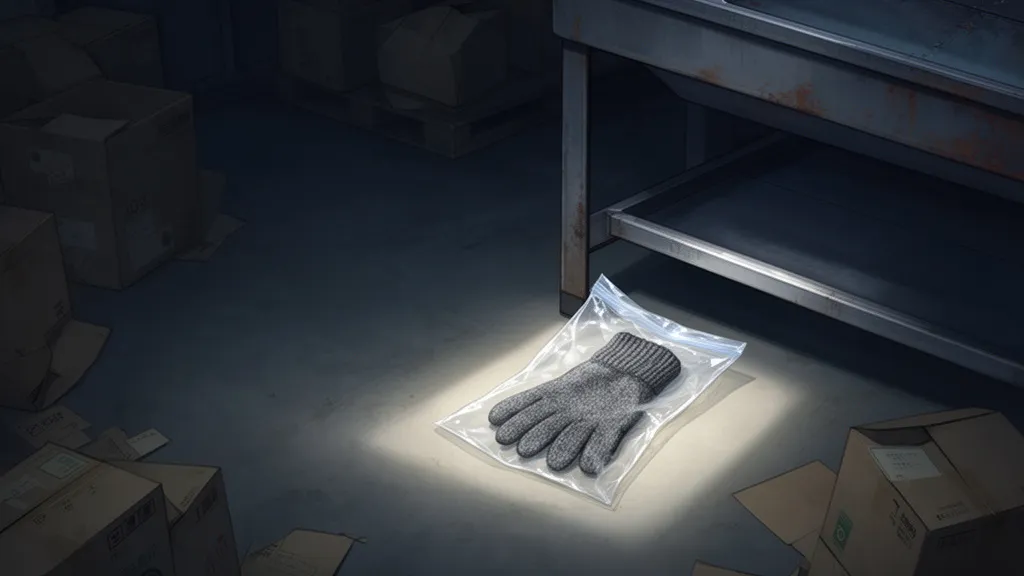
Ayaka found the glove between a sack of rinsed milk cartons and a broken rice cooker.
She was reaching under the sorting table for a fallen label clip when her fingers touched plastic, not paper. The thing had been pushed far back into the shadow where the concrete wall met the metal leg. She drew it out by one corner. It was a clear evidence bag, neatly sealed with red tape, and inside it lay a single left-hand glove of grey wool.
A white tag had been tied through the punched hole at the top.
MURAI KENJI, it said, in careful black ink.
Ayaka remained crouched for a moment, the bag in her hand. Behind her, the neighbourhood recycling centre went on with its usual, slightly absurd dignity. Bottles clinked into blue bins. Someone argued, with great principle and no expertise, about whether a cracked flowerpot counted as ceramic or general waste. Behind the chain-link fence at the rear, the document shredder hummed in a steady, important way, like an official who had been given only one sentence to say and intended to say it all day.
"Ayaka-san?" called Fujimoto, from the newspaper table. "If this is sports and this is travel, what category is a magazine entirely about carp?"
"Fish," she said.
"There is no fish."
"Then travel."
He accepted this.
Ayaka stood. The evidence bag was out of place in three ways at once. First, no one used evidence bags at the centre. Lost items went into an old biscuit tin or, if they were too large, onto the windowsill by the office kettle. Second, Murai Kenji had spent the last two days telling anyone who would listen that he had never set foot at the centre. Third, if one wished to hide a thing, one did not usually put the owner’s name on it.
Murai was by the weighing scale, talking to two town officers with the strained patience of a man who believed himself to be the victim of local incompetence. He taught calligraphy at the community hall, dressed like a retired banker despite never having been one, and had the kind of smooth hair that looked combed even by bad news. His missing car key had been found in the donation box that morning. It had then become a matter for the officers because Murai insisted the key had been planted and because the donation box, though unlocked during opening hours, was locked overnight.
Ayaka crossed to the folding table where the officers had arranged their little kingdom of paper. Forms. Tags. A ballpoint pen attached to a mug with red string. A half-drunk canned coffee. One officer, Sasaki, broad and pink about the ears, was taking statements from whoever happened to be nearest. The other, young Tobe, was trying to look as if tag placement was a police skill.
"I found this," Ayaka said.
Sasaki looked up. "Where?"
"Under the sorting table. Far back."
Tobe took the bag from her with exaggerated care, then read the tag. His eyebrows rose. Murai saw the movement and came over at once.
"What now?" he said.
Sasaki held up the bag. "Do you know this glove?"
Murai’s face changed, but only by a fraction. The eyes narrowed. The mouth did not move at all. "It is mine," he said. "Or was. I lost the pair last winter."
"And yet you said you had never been here."
"I have never brought that glove here."
It was an answer shaped like a side road.
Ayaka watched him. He smelled faintly of starch and expensive soap. There was no wool fluff on his sleeves, no haste in his breathing. What there was, in abundance, was offence. Genuine, not theatrical. Murai was a man who resented being made to explain himself, and some people only pretended at that well. He did it naturally.
Tobe turned the bag over. "Who tagged it?"
No one answered. The volunteers looked at one another with the guarded fascination of people grateful that a problem was, at least for the moment, not theirs.
Ayaka said, "May I?"
Tobe hesitated, then passed the bag back.
The glove itself was ordinary enough. Grey wool. Ribbed cuff. Men’s size. On the outside there was a little dirt at one fingertip, no more. But when Ayaka lifted the unsealed corner Tobe had carelessly worried loose and let a breath escape, she caught a faint smell.
Not perfume. Not mould.
Camphor.
It was old-fashioned, thin and sharp, a smell of stored winter clothes and careful households. She tilted the glove inside the bag and looked at the cuff. Dust clung there in a pale crescent, not street dust but the light, dry, fluffy sort that gathered in untouched places. There was a grain in it that looked fibrous, almost woody.
Ayaka lowered the bag.
"It doesn’t smell as if it was under that table for long," she said.
Sasaki frowned. "No?"
"No. It smells as if it was stored. Somewhere enclosed."
Murai gave a short laugh with no amusement in it. "At least someone here has a nose. My wife stored winter things with camphor tablets. After she died, I did not improve the system. If that proves I own the glove, we already knew that. It proves nothing else."
Nothing else, Ayaka thought, except that somebody had recently taken it out of storage.
The recycling centre occupied the side yard of an old primary school annex: one long concrete room open at the front, a fenced machinery area at the rear, and two small lockable rooms along the side corridor. One was the volunteer office, whose key hung from a nail beside the light switch. The other was the old storage room, kept locked because it contained spare bins, old signs, festival lanterns, cleaning chemicals, and, according to rumour, a box of municipal documents no one wanted to admit still existed.
Ayaka looked toward the corridor. The storage-room door was not visible from the sorting tables. Neither, she realised, was the place under the table where the glove had been found.
Tobe had already begun shuffling the tags on the evidence table into fresh importance.
"We’ll add this," he said. "Murai-san, please remain available."
"I have done nothing but remain available since lunch," Murai said.
Fujimoto approached with a stack of bundled newspapers and a face bright with borrowed urgency. "Officer, someone has put the aluminium in the steel cage again. This may affect the republic."
Sasaki went.
The centre filled, as centres did, toward the afternoon closing. Office workers on bicycles arrived with tied bundles of cardboard. A mother with two children deposited a kingdom of yoghurt tubs and left with one child’s mitten in her handbag by mistake. An elderly man presented six dead batteries wrapped individually in tissue, as if they had died respectably.
Ayaka moved through it all, sorting, directing, apologising for a scale that had never once displayed the correct number without emotional encouragement. She kept seeing the glove. Not the object itself, but the dust in the cuff.
Stored. Recently moved. Tagged by someone.
At three twenty, when the hum of the shredder deepened as another batch of confidential papers went through, she found Tobe at the folding table again. He had arranged the evidence tags in neat rows, perhaps from instinct, perhaps for comfort.
"Who brought the blank tags?" she asked.
"What?"
"These. We don’t keep them."
"From the station," he said. "Sasaki-san fetched supplies."
"How many tags did you bring?"
Tobe counted by sight. "Twenty. Why?"
"How many have been used?"
He looked less sure. "Three. The key, the glove, and the donation box label."
"And were there seventeen left?"
He stared at her. She was fond of that stare. It was the expression of a person to whom arithmetic had suddenly become a moral test.
"I didn’t count them," he said.
Ayaka nodded. "You might now."
He counted. Then counted again.
"Sixteen," he said.
"So one is missing."
Tobe straightened. "Someone took an evidence tag?"
"Or moved one." She glanced at the table. The string on the coffee mug had shifted; the pen now lay on the opposite side from where Sasaki preferred it. Tiny things, but tables had their habits as much as people did.
"Has anyone been touching this?"
He flushed. "Only— people come close. Murai-san was here. Fujimoto-san. That woman with the paper forms for the residents’ association. I was by the fence for a moment—"
"How long?"
"Two minutes."
That was enough time to move a tag and not enough time, on its own, to prove anything.
Ayaka looked again toward the side corridor.
The storage room key did not hang beside the office key. In fact, as far as she knew, it was kept by the centre coordinator, Hoshino, who was absent that day because her sister had broken an ankle in Sendai and families always managed their crises geographically. No one was supposed to have opened the room.
No one, therefore, would admit to opening it now.
At three thirty-five, Sasaki finally cornered Ayaka for her statement.
He wrote slowly, as if each word had to be negotiated with the page.
"You found the glove under the sorting table at approximately..."
"Three o’clock. A few minutes after."
"Condition?"
"Inside a clear bag, tagged. Slight smell of camphor. Dust in cuff."
He paused. "Dust?"
"Yes."
"You can mention the smell if you like, but let us avoid interpretations."
This was sensible. It was also inconvenient.
"Officer Sasaki," Ayaka said, "has anyone checked the storage room?"
He looked up. "Why would we?"
"Because the glove may have been kept there."
"Do you know that?"
"No."
"Then we do not say so yet. Also, the key is not here. Hoshino-san has it."
"Only her?"
"As far as I know."
As far as he knew, thought Ayaka, was a district so large one could build in it.
He finished the statement, had her sign, and was called away by a man who had attempted to put engine oil bottles into plastics after rinsing them with tea. Ayaka stepped back from the table. Tobe had gone to the gate. Murai stood alone by the scale, watching everyone with the injured grandeur of a dethroned swan.
She went to him.
"Murai-san," she said, "when did you last see the gloves?"
"In February. Perhaps March. In the wooden chest in my front room."
"With camphor?"
"Yes."
"And who has access to your house?"
He gave her a flat look. "I am not dead, Ayaka-san. People do not yet speak of my possessions as if they had floated free."
"No. But who has a key?"
A pause. "My niece. She waters the plants when I travel. And my former student Kida sometimes drops off notices from the hall. He has no key. Before you ask, no, I did not send either of them here with a glove."
"Did you lose anything else from the chest?"
That stopped him. He thought. Annoyance shifted, became attention.
"No," he said. Then, after another moment: "A packet of old incense may be gone. Or I may have used it."
"What kind?"
"Camphor wood. Very old. A gift."
There it was: one smell layered on another, enough to confuse certainty. Ayaka thanked him and moved away.
By the paper bins, Fujimoto was tying bundles with string so aggressively that the magazines seemed personally to have disappointed him.
"Did you go near the officers’ table?" she asked.
"Of course. I am a citizen."
"Did you move any tags?"
"No. Although I was tempted. They looked untidy." He lowered his voice. "Do you think Murai planted his own key?"
"No."
"That was fast."
"He enjoys innocence too much to decorate it."
Fujimoto considered this with respect due to a statement he did not understand but hoped was literary.
Ayaka left him and went down the side corridor. The office door stood open. Inside, a thermos sat on the desk beside a cup of tea Hoshino had poured before leaving, now cold enough to be punitive. Ayaka drank it anyway.
At the end of the corridor, the storage-room door faced her with municipal modesty: cream paint, metal handle, no sign. The dust along the threshold was broken.
Not dramatically. A thin drag, nothing more. But dust did not break itself in one clean curve unless a door had moved.
She crouched. There were also two tiny flecks of red near the jamb.
Tag string fibres.
Ayaka straightened, suddenly aware of the time. Pickup closed at four. After that the centre would empty quickly. If she told Sasaki now, he would come, frown, ask for Hoshino, call the station, perhaps send for a locksmith, perhaps not. Everything would become public and slow. If someone had hidden something in the room and had already begun moving the evidence tags, a delay would be useful to exactly the wrong person.
If she opened it herself and found nothing, she would have interfered with a police matter for no good reason.
She stood with her hand near, not on, the handle.
From the office came voices. Tobe, saying, "It was here." Sasaki, saying, "Then find it."
The missing tag had become noticed.
Ayaka went back to the office. The key nail held only the office key and a keyring with three anonymous brass copies for the exterior gate and bin cages. Hoshino was meticulous but not imaginative. If there had once been a spare key hidden for emergencies, she would have labelled it and then hidden it somewhere too sensible. Ayaka opened the desk drawer. Pens, forms, a packet of barley candy, rubber bands, a ledger, and under the ledger a narrow tin stamped with faded peonies.
Inside lay two keys and a folded note.
Spare storeroom key. Only if absolutely necessary.
If used, please write why.
Hoshino, faced with the problem of emergencies, had met it halfway.
Ayaka took the key and a blank scrap from the printer tray. On it she wrote, Borrowed at 3:46 to check possible connection to glove. — Ayaka Matsuda.
Then she went back to the corridor and unlocked the door.
The smell reached her first.
Camphor, yes, but also dry paper, old fabric, cardboard, and the faint medicinal edge of cleaning powder. The room was narrow and crowded. Stacked bins leaned against one wall. A coil of festival lanterns hung from a nail like a string of patient ghosts. Boxes of leaflets, tied newspapers from some forgotten drive, broken signboards, spare aprons, a mop bucket missing one wheel. Light came only from the corridor behind her.
No one could have hidden in the room. Something could easily have been hidden among everything else.
Ayaka stood still, letting the shapes separate. Near the back, on top of a chest of old uniforms, there was a square clear patch in the dust where a box had recently sat. Beside it lay a single red string tie, identical to the string used on the evidence tags.
She crossed the room carefully.
The chest held folded volunteer coats, a cracked clipboard, and a cardboard hat box. The hat box smelled strongly of camphor. Inside were winter donations set aside for the charity drive: scarves, mittens, three knitted caps, and one empty space in the shape of a pair of gloves. Dust from the box lining clung to the fibres. Pale, fluffy, woody.
The glove had come from here.
Under the coats, however, she found what mattered more.
A stack of old evidence bags. Not police property; merely transparent stationery envelopes of the same size. Beside them sat a bundle of unused white luggage tags and a black marker. On the top tag, pressed into the card by a heavy hand, was the faint mirrored impression of the name MURAI KENJI.
Someone had written the tag in this room.
Ayaka heard movement outside. Not footsteps in the corridor; quicker, lighter, then gone. She stepped to the doorway and looked out.
Empty.
From the front area came raised voices. Tobe’s, trying and failing to sound authoritative. Fujimoto’s, succeeding in sounding alarmed. The shredder hummed on.
Ayaka locked the storage room and put the key in her pocket. Then she returned to the main floor.
The folding table was in disorder now. The donation-box key sat by itself. The glove was gone.
"Who moved the bag?" she said.
Tobe swung round, colourless. "It was here. I only turned to answer the gate—"
Sasaki was already questioning the nearest residents with the doomed intensity of a man about to interview the weather. Murai had disappeared from the scale.
"Where is Murai-san?" Ayaka asked.
"To the toilet," said Fujimoto. "Or to resign from society. He did not specify."
Ayaka looked toward the rear fence. The shredder enclosure had its own gate, usually latched. Today it stood slightly open.
She crossed the yard at once. The machine took old documents from a feed table and chewed them into long grey confetti. Beside it was a cart for items awaiting destruction. On top lay tied bundles of papers, a box of old account books, and the clear evidence bag with the glove inside, half hidden under a stack of printed circulars.
Murai stood on the other side of the cart.
He had not touched the bag. He was, rather, staring at the man who had.
Kida Shun, twenty-six, assistant at the community hall, amateur actor, possessor of hair that seemed to apologise for itself. He held his hands up before anyone asked, which was nearly always incriminating.
"I was only moving it out of the way," he said.
"Toward the shredder?" Ayaka said.
"It looked unrelated."
"That was brave of you to determine."
Murai’s voice was quiet. "Shun. Why is my name written in your handwriting?"
Kida closed his eyes for one brief second. That was answer enough to several things.
Sasaki arrived then, Tobe at his shoulder, both breathing as if justice involved stairs.
The next ten minutes were noisy, and therefore not useful. Kida denied intent, then denied touching the tags, then admitted touching one tag but not the bag, then said he had only meant to help. Tobe became excited by the phrase tampering with evidence and repeated it with the enthusiasm of a child who had acquired a rare beetle. Murai grew colder and more exact with every sentence. Fujimoto watched from a tactful distance and nearly vibrated apart.
Ayaka said very little until Sasaki, overwrought and underinformed, asked, "Then what happened? Properly."
She took the glove bag from the cart and set it on the folding table again.
"Not here," she said. "In the corridor. With the storage room."
They went.
Sasaki unlocked the room this time, with the spare key Ayaka handed over and a look that promised he would later decide whether to scold her. The room, now that official attention had entered it, looked both less dramatic and more guilty.
Ayaka pointed first to the drag in the threshold dust, then to the red string fibres near the jamb, then to the clear patch atop the chest, the hat box with the winter donations, the envelopes and tags, and finally the impressed name on the top card.
"The glove was stored here," she said. "Recently. The dust in the cuff matches the box lining. The camphor smell comes from the winter donations, perhaps mixed with Murai-san’s own storage. Someone took one glove from his house, brought it here, bagged it, labelled it, and hid it under the table to be found later. The same person also moved the car key into the donation box this morning."
Sasaki looked at Kida. "Why?"
Kida’s face had gone very still. In stillness, people often began to resemble the age they actually were.
Ayaka continued before he could choose a lie.
"Because Murai-san was supposed to be discredited, not arrested. The planted key suggested he had secretly come here despite denying it. The glove was a second step, meant to prove a pattern. But the glove had been bagged and tagged in advance, then hidden until needed. When I noticed the smell and dust, whoever planted it understood that the storage room might be checked. So the evidence tag on the table was moved first, perhaps to create confusion, and when that was noticed, the bag itself was taken toward the shredder. Quietly, because panic attracts attention."
"You saw me by the table," Kida said to Ayaka.
"No," she said. "I only saw that someone had been there. But you are the one person who had access to Murai-san’s house without belonging naturally to it, and the one person foolish enough to think an evidence tag makes a thing convincing by itself. Also your hands smell of camphor."
He looked at his hands as if this were treachery.
Murai said, "My niece has a key."
"Yes,"