The Clock at 3:17
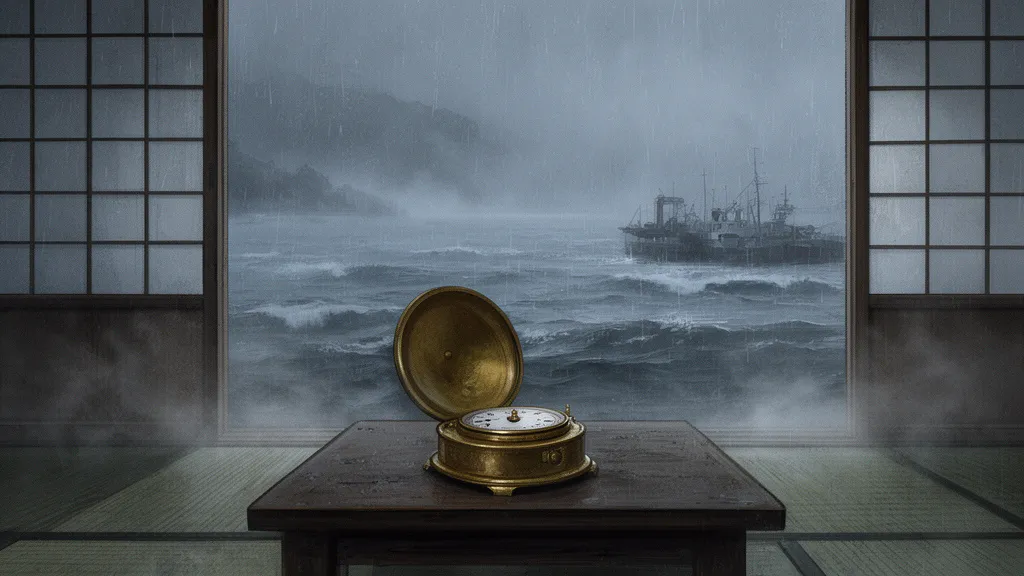
By the time Shinohara Kenji opened the brass clock, the sea had already got into the house.
It was in the towels by the back door, stiff where someone had hung them carelessly to dry. It was in the banister, tacky under his palm. It was in the air itself, folded into the smell of old tatami and grilled mackerel and lamp oil. The guesthouse stood on a small rise above the harbour, and in wet weather the wind brought the harbour indoors as if to inspect the rooms.
Kenji set the clock face-down on the low table and removed the back panel with his smallest screwdriver. He had retired eight years before and still carried his tools wrapped in a handkerchief, which struck his daughter as theatrical. She was probably right. One ought to arrive at retirement with fewer habits, not more.
The owner, Hiramatsu Fumie, had stood over him while he examined the clock, hands on narrow hips, saying, “It stopped this afternoon. At exactly 3:17. I dislike stopped things. They infect the whole building.”
Then she had been summoned to the kitchen by something burning, or claiming to burn, and had gone away in a brisk cloud of lavender water.
Now Kenji tipped the movement toward the lamplight and saw, behind the gears, where no sensible watchmaker would keep anything, a small folded ticket wedged against the inner case.
He paused. Then he took it out with tweezers.
It was a ferry ticket, the cheap grey kind used on the local route between the mainland and the island. The date stamp was that morning. Across the back, in pencil, someone had written Shinohara Kenji.
For a little while he merely looked at it.
Then he put the ticket on the table, beside the screwdriver, and listened to the guesthouse.
A woman laughed downstairs, once, in the strained way of someone demonstrating that she was not upset. Dishes touched each other in the kitchen. Overhead the wind found the eaves. On the narrow wooden stair outside the lounge, feet came up lightly: one, two, three steps, a pause on the fourth, then the rest in a hurry. Not Fumie. She planted her heels and resented every board in the building.
The door slid open.
“Have you fixed it?” asked the woman who ran the dining room, though she had introduced herself before supper as a ceramic artist “between kilns” and not staff at all. Her name was Maki, and she wore a man’s cardigan over a silk dress, the effect being either careless or expensive. In small guesthouses it was often both.
“Not yet,” said Kenji.
She looked at the opened clock, then at the ticket on the table. Her expression altered by a degree so slight he might not have trusted it in another line of work. But he had spent forty years studying tiny changes under magnifying lenses.
“You found something,” she said.
“Yes.”
“Was it inside?”
“Yes.”
“That’s strange.” She smiled. “Though this house is full of strange things. Fumie keeps receipts in the teapot.”
“Does she?”
“Did. Perhaps that was only last year.” Maki came in without being invited and glanced toward the hall. “Is she here?”
“No.”
“I can’t find her.”
“She was called to the kitchen.”
“That was an hour ago.”
Kenji looked at the clock again. The hands still indicated 3:17, severe and exact. “Then perhaps,” he said, “it is time to look more carefully.”
The guesthouse was called the Minato House, though it saw more rain than sun and more disappointed walkers than sailors. There were six guest rooms, a dining room with a painted screen of cranes, a narrow lounge where the clock had hung above the bookshelf, and a small annex reached by a covered path. Kenji had arrived that afternoon for two nights of sea air on his doctor’s advice and because sea air, unlike doctors, rarely insisted on being obeyed.
The other guests were few. Maki, who had already shown a proprietary concern for the crockery. Professor Toba, a marine biologist from Sendai with a moustache like a startled broom. A young man called Natsume, who wrote travel essays for magazines and had spent supper making notes on the pickles. And Aki and Rei, who had come, they said, to decide something. They did not specify what. Aki was a school music teacher with steady hands and a tired face. Rei had the elegant, overslept beauty of an actor in a provincial troupe, though later he turned out to design gardens for municipal buildings. Their relation to each other was not immediately legible, which was perhaps why everyone else kept trying to read it.
Fumie was not in the kitchen. She was not in the pantry, nor in her office behind the entrance, nor in the little private sitting room where a framed photograph showed her twenty years younger and no softer for it. Maki called; Professor Toba bellowed; no one answered.
The cook, an apologetic widower named Suda, emerged from the scullery wiping his hands on a salt-stiff towel.
“She went out,” he said.
“When?” Maki asked.
He blinked. “Did she? Perhaps not. She said she would just—”
He made a helpless movement with one hand, as if Fumie’s intention had been a small bird and had escaped him.
“Did she take an umbrella?” asked Kenji.
“Not hers. I saw one by the back door.”
“What colour?”
Suda looked wounded by the detail. “Black?”
“Everything in this house is brown, black, or old gold,” said Maki. “That tells us nothing.”
Kenji said, “When did you last see her?”
Suda considered this with painful sincerity. “At dinner service. Then when she brought you tea.”
At this Maki gave a short laugh. “That awful tea? Yes, that sounds like her. She likes to scald guests she respects.”
Kenji had indeed been brought tea in the lounge while examining the clock. It had been too hot to drink. He had left it untouched. The cup, when they returned to the lounge, remained on the side table beside his chair, now merely warm and skin-forming.
The ticket still lay where he had placed it. The clock, opened and disembowelled, sat on the table under the lamp.
Professor Toba, red in the face from calling, stopped dead. “What have you done to the wall?”
Kenji looked up.
“The wall,” said Toba. “What have you done to it?”
Above the bookshelf there was a pale rectangle where varnish had escaped the sun. Two hooks projected from the wood. The clock had plainly hung there for years.
“I took down the clock,” said Kenji.
“What clock?”
For the first time that evening, silence came cleanly.
Toba frowned at him, then at the empty hooks. “There was no clock there.”
Maki said, too quickly, “No, there wasn’t.”
Natsume, in the doorway with his notebook still in hand, added, “I would have noticed. I notice interiors.”
Aki and Rei exchanged a look. Then Aki said, “I don’t remember one.”
Rei said, “Neither do I.”
Suda stared from the hooks to the table and back, his mouth partly open. “Madam asked you to repair it,” he said to Kenji, as if defending him from the others. Then, with visible misery, “She told me, after she hung it, that if anyone asked there had been no clock at all. I thought she was joking.”
Kenji folded the ferry ticket and slipped it into his pocket.
There were moments when people lied and believed they had done so gracefully. This was not one of them. The awkwardness of it almost improved his opinion of the house.
He said, “Very well. Let us begin with what can be agreed. Mrs Hiramatsu is missing. You all wish that not to be odd. It is odd. So we shall be more exact.”
“Who are you?” said Toba.
“A retired watchmaker.”
“That is not usually the person who takes charge.”
“No,” said Kenji. “But I am the person who heard the stairs.”
He had no authority, which was often useful. People argued more freely in front of someone they did not think important.
They sat in the lounge because the dining room was too formal and the entrance hall too exposed to the draught. Suda made tea for everyone and brought Kenji his last, by which point it had become lukewarm from standing on the tray while the others took sugar, lemon, or offence. Kenji drank it anyway.
He asked them to describe the evening from supper onward.
At seven, they had dined together. At about eight, Professor Toba had gone to the bath. Natsume had sat in the lounge making notes on local expressions used by Suda, who was flattered enough to invent two. Maki had helped clear dishes, though whether from kindness or surveillance remained open. Aki and Rei had walked under the covered path to the annex and back because, as Rei put it, “we needed to continue disagreeing privately.”
“About what?” asked Toba, with gross interest.
Aki said, “Inheritance.”
Rei said, at the same time, “A piano.”
Kenji noticed both answers. So, he thought, had Maki.
Fumie had come and gone. She had spoken with Maki in the kitchen. She had brought tea to the lounge. She had asked Kenji whether old brass could become spiteful from neglect. After that, no one was certain.
“Except that there was no clock,” said Toba stubbornly.
Kenji said, “Describe the wall.”
“The bookshelf. The hooks. The ugly print of fishing boats.”
“There is no print of fishing boats.”
Toba looked up, startled. There was not.
Natsume said, “I remember the hooks because I thought something ought to be hanging from them. A wreath, perhaps.”
“Then you did see evidence of a clock.”
“That is not the same.”
“No. It is better.”
Maki crossed one leg over the other. “What exactly are you suggesting?”
“That someone wants me to doubt my own memory.”
“Is that so surprising? You found a ticket with your name hidden in an imaginary clock.”
“Inside a real clock,” said Suda, almost pleading.
Maki ignored him.
Kenji took out the ticket and laid it on the table. “Who wrote my name?”
No one answered.
“Who used the ferry today?”
Aki raised her hand slightly. “We did. Both of us.”
Rei nodded. “From the mainland this morning.”
“May I see your tickets?”
Rei produced two stubs from his wallet at once. Efficient, thought Kenji, or prepared. Aki glanced at him with an expression too tired to decipher.
The stamps matched the date. Different serial numbers, consecutive. Kenji’s own ticket, which he had used that morning and then misplaced before reaching the guesthouse, ought also to have been near in sequence. He turned the found ticket over. The number was three later than Rei’s second stub.
“Who else crossed this morning?” he asked.
“Me,” said Natsume. “Early ferry. I threw mine away.”
“Toba?”
“I came yesterday.”
“Maki?”
“I live on the island,” she said. “Sometimes.”
That adverb sat down among them and refused to explain itself.
Kenji said, “When I arrived, Mrs Hiramatsu asked my name before I signed the register. She could have written it on a ticket then. But why place it inside a clock and ask me to open it?”
“To involve you,” said Aki quietly.
They all looked at her.
She lowered her eyes to her teacup. “If she expected trouble.”
“From whom?” Toba demanded.
Aki did not answer. Rei put a hand flat on the tatami between them, not touching her, but close enough to be noticed by anyone who noticed distances.
Kenji said, “Let us leave motive for a moment. Let us have sound. This house speaks distinctly if one listens.”
Professor Toba stared. “Good God.”
“The stairs,” said Kenji. “They complain differently under different feet. Mrs Hiramatsu came down heel first. Mr Suda drags slightly on the landing. Miss Maki pauses on the fourth step when she comes up. Professor, you descend like a cabinet.”
Natsume laughed despite himself.
Kenji went on. “At some time after eight-thirty, while I worked on the clock, I heard someone come up lightly, pause on the fourth step, and then hurry. That was Miss Maki. Soon after, I heard heavier steps go down, careful but not familiar. Not Mrs Hiramatsu. Not Suda.”
“Mine?” said Rei.
“No. Yours are even. These steps tested each board as if avoiding noise.”
“Aki’s, then?”
“Aki’s left foot turns in very slightly.” He looked at her. “No.”
“Then whose?” said Toba.
Kenji looked at Natsume.
The young writer lifted both brows. “I was in the lounge.”
“Until when?”
“Until perhaps a quarter past nine. Then I went to my room.”
“Up these stairs?”
“Yes.”
“You carry your weight on the balls of your feet,” said Kenji. “You were once a runner.”
Natsume gave a reluctant smile. “University. Long ago.”
“And when you went upstairs, did you go to your room?”
The smile went out. “Eventually.”
Maki said softly, “Ah.”
Natsume set down his cup. “This is ridiculous.”
“Probably,” said Kenji. “Where did you go first?”
After a moment Natsume said, “To the office. I wanted aspirin. Mrs Hiramatsu had said there was some in the drawer.”
“Was she there?”
“No.”
“Did you see a clock on the wall when you passed through the lounge?”
His mouth tightened. “I did not pay attention.”
“That is not the same as there being no clock.”
“No.”
“Did you see the back door open?”
Natsume hesitated. “The hallway was dark. I think—I think I felt a draught.”
Suda said, “The back door sticks in wet weather. If it had been open, I’d have heard it bang.”
“Unless someone wedged it,” said Maki.
Kenji looked at the towels by the back passage in his mind: two ordinary bath towels and one smaller hand towel, stiff with salt and not fully dried. Not from rain. From sea water.
He rose.
“Where are you going?” Toba asked.
“To see what the sea has been asked to do.”
Behind the guesthouse, a path ran down through wind-bent pines to a narrow inlet of black stones and old mooring posts. The tide was past its height. The moon showed itself only as a diluted brightness behind cloud. Maki came with him carrying a lantern; she had put on rubber boots without comment, which suggested previous experience of searching for inconvenient truths in wet places.
“Do you often assist strange men at night?” Kenji asked.
“Only retired ones. They are less trouble.”
At the bottom of the path the wind freshened. The lantern shook. Something pale lay near the nearest mooring post.
It was a woman’s umbrella, black indeed, turned inside out and caught under a rope. Farther up the stones, half hidden between two weed-dark rocks, lay a leather slipper.
Maki drew in a breath. “That is hers.”
Kenji did not answer at once. He crouched instead and held the lantern low. The stones were slick. There were marks where something had slid, yes, but not the desperate disordered damage of a fall. More like a careful descent spoiled at the end. One set of prints had gone down. Two had come up. The second upward set was blurred and heavier, as if bearing weight.
“Maki,” he said, “how well do you know Mrs Hiramatsu?”
Maki kept the lantern steady with both hands. “Well enough to owe her money. Not enough to forgive her for mentioning it.”
“Did you quarrel tonight?”
“Yes.”
“About money?”
“Partly.” She looked out toward the sea. “Mostly about her nephew.”
“Natsume?”
She gave him a quick glance. “So she told you.”
“She did not. But she and the young essayist have the same way of pressing the lower lip when annoyed. Families repeat themselves.”
Maki smiled despite the shore, the umbrella, the slipper. “Yes. He is her sister’s son. He comes when he needs rescue and writes charmingly about hardship afterward. Fumie found that educational.”
“And you?”
“I was married to her brother once. Briefly. We have all remained in circulation.”
That explained some things and complicated others, which was often the mark of truth.
Kenji stood. “Mrs Hiramatsu is not in the sea.”
“How can you be sure?”
“If she had simply slipped here, there would be one broken pattern going down and one urgent rescue pattern coming up. Instead there is a deliberate descent to the waterline, the umbrella placed where it would be found, and a return climb made by two people taking care. The scene asks to be read before it is read honestly. Also, if one wished to disappear permanently, one would not first plant a ferry ticket in a clock and write my name on it.”
“So she staged this.”
“Not alone.”
They went back up. On the covered path to the annex, the boards were wet in patches from earlier footsteps. Here too the house preserved memory if one knew where to look. Outside the annex door was a tea ring, brown and perfect, on the wood.
Maki stopped. “That cup is from the lounge set.”
Inside the annex there was a sitting room used in summer and two spare rooms now shut. One room smelled faintly of damp futon. The other held trunks, disused screens, and, on a low table by the window, a teacup with a broken handle. There was cold tea at the bottom.
And Hiramatsu Fumie sat on the far side of the room with a blanket around her shoulders, looking offended at being discovered.
“Really,” she said. “You took your time.”
Back in the lounge, after the small chaos that follows a found missing person, people reverted rapidly to themselves.
Professor Toba became indignant on principle. Natsume went pale and then defensive. Suda cried quietly in the kitchen and sent out fresh tea. Aki and Rei sat together now without bothering to maintain the exact respectful distance they had held before. Maki leaned against the bookshelf under the empty hooks and looked at Fumie with the concentrated patience of one who has postponed a stronger emotion.
Fumie had changed into a dry kimono from the annex and accepted no one’s help with the sash. “I slipped,” she said. “Maki assisted me. I rested in the annex and fell asleep.”
“No,” said Kenji.
She gave him a level look. “You are very certain for a holidaymaker.”
“I am certain because you expected me to be.” He set the brass clock on the table between them. “You hid a ferry ticket with my name inside this case. You asked me to repair the clock, knowing I would open it. Then you removed yourself from the house in a manner meant to suggest danger but not death.”
“I did nothing of the kind.”
Maki said, “Fumie.”
Fumie ignored her.
Kenji touched the clock hands. “This clock was not hanging on the wall when I came down before supper. The hooks were empty. I remember because I noticed the sun-faded rectangle and thought something had been sold. After supper, the clock was there. Therefore someone hung it during the meal or soon after.”
He looked around the room. “When I took it down, everyone denied its existence. Poorly. Why? Because someone had already told them the clock must not, under any circumstances, be admitted.”
Suda made a despairing sound. Toba looked betrayed by the furniture. Natsume stared at his hands.
Fumie said, “This is becoming melodramatic.”
“Not particularly. The clue is mechanical.” Kenji opened the back again and held up the movement. “The clock did not stop at 3:17 this afternoon. It was set to 3:17 after it had already run down. There is dust under the minute hand where it was moved by fingers, not by the arbor. The spring is nearly unwound, as if it had been left neglected for months. This is not the lounge clock in regular use. It is an old clock from storage.”
Maki’s eyes moved, just once, toward the annex.
“The real lounge clock,” said Kenji, “must have been elsewhere. Broken? Missing? Or carrying some inconvenient association. This one was hung in its place. The fiction required witnesses who would later deny having seen it, so that I should conclude my own memory had failed and look harder at the object itself.”
Aki said quietly, “Why choose you?”
“Because watchmakers open clocks. And because I arrived alone, old enough to be