The Clock Room
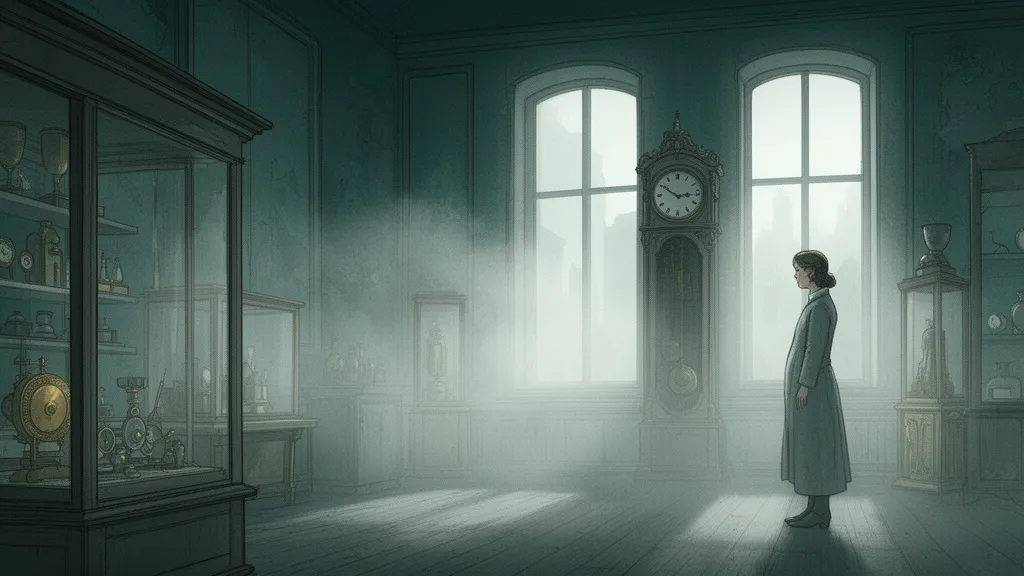
Mina Hoshino arrived with shellac under her fingernails and the distinct hope that nobody would notice.
The museum was still closed. Mist lay over the river behind the old textile warehouse that now called itself the Kurose Municipal Museum of Local Industry. The front court was empty except for a bicycle with a wicker basket and a florist’s delivery van whose driver slept with his cap tilted over his eyes. Mina let herself in through the side staff entrance, carrying her leather case and the memory of two stolen hours the night before.
She had repaired the gilt chapter ring on the Takamori regulator after everyone had gone. It had been an unauthorised kindness. The director disliked unauthorised kindnesses almost as much as authorised expenses.
At the end of the east corridor, she stopped.
The clock room door was shut. This was not unusual. The strip of paper pasted over the meeting seam was.
It had been gummed across the jamb in a ceremonious way, museum cream against dark wood, and stamped with the round seal used for temporary closures. Across it, in the assistant curator’s careful hand, someone had written: Do not open until Director present.
Mina looked at it for a moment, then at the brass key box hanging beside the door.
It stood open. Inside, on a square of green felt, the brass keys had been laid in a row by size, as neat as specimens. There were six. The seventh hook was empty.
Footsteps hurried down the corridor. Rika Nomura, the assistant curator, appeared carrying a clipboard like a shield.
She was twenty-eight, earnest, precise, and permanently on the edge of apologising for objects. This morning her fringe was crooked, which meant she had dressed in a hurry.
“You came early,” Rika said.
“So did someone else.” Mina nodded at the seal.
Rika lowered her voice at once, though there was nobody near enough to hear. “I found it like that. I thought the director should see it first. The inner key was in the room yesterday evening. Now it’s—” She glanced at the empty hook. “This is dreadful.”
“Who sealed it?”
“I did. After I looked through the transom and saw…”
She stopped, either for effect or because she had only just remembered she was frightened.
Mina set down her case. “Saw what?”
“The maintenance stool knocked over. The central display clock stopped. And the inner key on the floor, near the cabinet. I thought if I opened it alone and something was missing—”
“If something is missing, it will have the decency to remain missing until witnesses arrive.”
Rika gave her an injured look, then decided not to take offence because the sentence was useful. “Director Shishido is on his way. Professor Senda too. He was already here in the archive. I sent for both.”
Of course Professor Senda had been in the archive. He considered records a moral category. He was a volunteer historian, seventy if he was a day, with a beard arranged in white arguments under his chin.
Mina bent and examined the open key box without touching it. The labels below the hooks were engraved: Clock Room Outer, Clock Room Inner, Store B, Textiles Reserve, and so on. The missing key was Clock Room Inner.
“Who last had that key?” she asked.
Rika swallowed. “Probably Mr. Fujimori. He was checking the accession ledger after five. He said he would lock up.”
“Probably?”
“He always does on Thursdays.”
“Today is Friday.”
“Yes.”
Rika looked, Mina thought, like a woman who had put a valuable vase on a windowsill and then discovered weather.
The rest arrived in a small, badly matched procession: Director Shishido in a navy suit with an umbrella though the rain had stopped, Professor Senda with his beard and his indignation, and Daichi Fujimori, registrar, whose spectacles were perpetually clean because he polished them when nervous and when calm and when considering lunch.
Fujimori stopped dead at the sealed door. “What is this?”
“What indeed,” said the director. “Miss Nomura?”
Rika explained. She did it well enough, except that she kept looking at Fujimori when she mentioned the ledger. He coloured slowly, like paper near flame.
“The accession ledger was in the archive when I left,” he said. “If it is not there now, that has nothing to do with me.”
Professor Senda made a dry noise. “Records do not usually depart of their own initiative.”
“Neither do professors,” said Fujimori.
“Gentlemen,” the director said sharply, delighted.
He broke the paper seal with the solemnity of opening parliament. The outer key from the box turned in the lock. The door moved inward three inches and stopped against something.
They all saw it then through the gap: the maintenance stool on its side, and beyond it the nearest case of marine chronometers. The air that came through smelled of oil, old varnish, and the river damp that had never quite left the building.
“The inner bolt is thrown,” said Mina.
“That is impossible,” said Rika.
“Most things are, until they inconvenience a museum.”
Director Shishido put his shoulder to the door. It opened another inch and no more.
“In other words,” Professor Senda said with unwelcome satisfaction, “we have a room locked from within.”
There was a brief silence in which everyone, even Mina, allowed the phrase to arrange itself theatrically in the corridor.
Then Mina crouched and looked through the crack.
The stool had fallen in exactly the right place to obstruct the swing. Beyond it she could see the central table, the long cases, the regulator clock on the far wall—and, on the floor by the document cabinet, a brass key glinting on the boards.
The regulator’s hands pointed to 1:17. One minute hand was bent. Beneath the dial, a smear of dark grease marked the lower bezel.
Something pale sat in the grease.
Mina narrowed her eyes. One grain, no larger than a seed. Sand.
Behind her, the director was deciding what sort of voice the situation required. “No one is to touch anything until I say so. If the ledger is missing, this becomes extremely serious. Miss Hoshino, can the door be opened without disturbing the scene?”
“Yes,” Mina said. “If we remove the hinges.”
Rika looked scandalised, as though hinges had rights.
Mina fetched a screwdriver from her case. It took four minutes to lift the pins while everyone watched her hands as if manual competence itself were suspicious. Then she and Fujimori eased the door free and carried it aside.
The stool lay on its side just inside, one rung hooked against the skirting as if it had fallen there by chance and rehearsed it. The brass inner key was indeed on the floor near the cabinet. The cabinet door stood ajar.
Professor Senda marched to it first and uttered a sound that suggested both bereavement and vindication.
“The Kurose accession ledger, volumes one and two—gone.”
Director Shishido drew a breath meant for later quotation. “No one leaves the building.”
“Will there be ropes?” said Mina.
Nobody laughed. She had expected as much.
She crossed to the regulator. The bent minute hand had broken at the arbor and been forced back on. The grease at the lower edge was fresh. In it sat one grain of pale brown sand.
River sand, she thought at once. Not garden grit. The river behind the museum ran low in summer and left bars of fine, clean sand under the retaining wall. Children crossed there when they were not meant to.
She did not touch it.
On the floor under the regulator, almost hidden by the plinth, she saw a second thing: the faint crescent print left by a shoe sole damp from outdoors. Not mud. Only the darker shine of moisture drying from old boards.
A narrow sole. Woman’s, probably. Or a careful man.
She straightened.
Fujimori was staring into the open cabinet as if numbers might return by embarrassment alone. He was a delicate man in his forties, with an exact side parting and the stooped shoulders of one who had spent years apologising to shelving. The director looked at him with gathering displeasure.
“Who had access to this cabinet?”
“Several people,” Fujimori said. “Myself. Miss Nomura. Occasionally Professor Senda, under supervision.”
Professor Senda ignored the insult. “And Miss Hoshino comes and goes in this room freely.”
“I restore clocks,” Mina said. “If the ledger was hidden inside a longcase, I should be flattered.”
Rika spoke too quickly. “Mina wouldn’t—”
“Wouldn’t what?” said the director. “Move old paper? Most thefts here involve old paper. It is one of our themes.”
It was at that moment that the tea arrived.
A volunteer from the reception desk, having interpreted the gathering as a meeting, came in with a tray of cups. The tea had a skin on it and smelled faintly of the cupboard. Mina accepted one because refusal took more energy. It burned her tongue despite all evidence that it ought to have been cold.
By eleven, the museum had opened late under a notice blaming a water inspection. Visitors drifted through the textile hall while all available staff pretended not to be trapped in an accusation.
The director conducted interviews in his office. Mina waited in the corridor outside with tea cooling into punishment in her cup.
Her own difficulty sat beside her like a second person.
Behind the west wall of the clock room there was an old service chase from warehouse days, later boarded over. Last winter, when damp had crept behind the regulator panel, Mina had discovered that one board—hidden by a display case—could still be slid aside from within. She had used it three times to reach the rear of the cases when the proper access was blocked by touring exhibits. Last night she had used it again.
Not for theft. For shellac, patience, and the quiet vanity of setting a damaged chapter ring right before anyone could tell her to leave it for next year’s budget.
If she revealed the panel, she would have to explain why she had been in the room after hours. Director Shishido would not fire her; specialists were inconvenient to replace. But he would make her life procedural. Worse, it would become a story, and museums were built on stories nobody could correct.
If she did not reveal it, Fujimori would almost certainly be blamed by evening. He had the keys, the cabinet, the records, and exactly the sort of nervousness that looked guilty under fluorescent light.
Rika came out of the office next, pale and angry.
“He thinks Daichi took the ledger to cover the transfer discrepancy.”
“What discrepancy?”
Rika sat beside her. “A missing pocket watch from the Yanagi donation. It was only mis-shelved, but for one day the paperwork did not match. Daichi signed for it.”
“And now someone has made sure everyone remembers.”
Rika looked at her sharply. “You think this was staged?”
Mina considered the tea, then set it on the floor before it could offend her further. “The keys laid in a row on felt. The seal. The stool in exactly the right place to jam the door but not fall against anything breakable. The bent hand on the regulator. Whoever arranged that room wanted it discovered, admired, and discussed.”
“Why bend the hand?”
“To draw the eye to the clock.”
“To the sand?”
Rika blinked. Mina saw that she had not noticed it.
“Yes. There is a grain of river sand caught in the grease beneath the hands. Small enough to miss. Obvious enough once seen. It says: someone came from outside, by the river side.”
Rika frowned. “But that’s true, isn’t it? The back path from the river gate is sandy.”
“Only if one came in that morning. Yesterday afternoon it rained. By night the flagstones were clean. This morning the yard was wet enough to keep dust down. A single dry grain placed in grease tells a story too neatly.”
Rika was silent.
Mina added, “Also, if someone had used the hidden river path and wanted not to be known, she would not leave a grain on the one object every clock restorer in the building would inspect first.”
Rika turned. “She?”
“The shoe mark under the regulator was narrow.”
“That could be mine.”
“It could.”
Rika did not answer at once. In profile, she looked very young, though she had the exhausted self-command of women who had learned to manage men’s tempers before they learned to manage their own. Mina had noticed, over the past six months, how naturally Rika and Fujimori occupied the same corners at committee meetings, how often they stopped speaking when another person approached, how carefully both avoided making any claim a colleague could name.
The relationship, whatever it was, had the tense tidiness of an object wrapped for storage and never accessioned.
“Daichi didn’t take the ledger,” Rika said at last.
“That was not the question.”
Rika’s mouth tightened. “No. It wasn’t.”
Mina asked to see the archive.
The director, suspicious but busy, waved permission with the air of granting an empire. The archive occupied a former counting room above the loading bay. It smelled of dust, glue, and Professor Senda’s opinions.
The accession ledger’s place on the shelf was obvious, a broad clean gap between municipal surveys and donor correspondence. On the desk lay a cotton glove, one of the cheap kind that left lint on paper and made everyone feel historical.
Professor Senda watched Mina with hawkish disapproval. “One need not be Sherlock Holmes,” he said, “to observe that records theft benefits those whose records are inconvenient.”
“That excludes half the nation and all universities,” Mina said.
He harrumphed.
She examined the window. It was latched from inside. The dust on the sill had been disturbed at one corner, but not enough for a ledger to pass through.
She looked at the professor. “Who took the keys from the box this morning?”
“Miss Nomura had them when I arrived.”
“Before that?”
“I am not a corridor.”
No, Mina thought, but you are often in one.
Downstairs again, she returned to the clock room while the others were occupied with blame. Alone, she could hear the room as rooms wished to be heard: a soft tick from the marine chronometer nearest the window; the dry settling of old timber; a muffled laugh from the public gallery beyond the door. The regulator still stood at 1:17, sulking.
Mina knelt by the fallen stool.
One leg bore a fresh smear of black grease at shoulder height, not near the rung where one would grasp it to climb. The stool had not fallen naturally. It had been lifted against the regulator, picked up again, then placed to block the door.
She went to the display case that hid the west wall.
Her own pulse annoyed her. Guilt was an undignified rhythm.
The panel was there, its seam concealed by moulding and the case’s shadow. She knew exactly where to press. If she opened it now and anyone saw, the matter would become impossible to control.
Before she touched it, she noticed another detail.
The brass key lying by the cabinet was the inner key, yes—but its bow was clean. Too clean. The floor around it held the powder of old wood and one thread from the rag carpet under the table. The key had not lain there since last night. It had been wiped and dropped after the room was arranged.
Mina stood up just as the director entered with Fujimori and Rika behind him.
“Well?” he demanded.
“Well,” Mina said, “someone wanted this to look like theft from a locked room by a person entering from outside. It was neither.”
The director’s face brightened in spite of himself. Directors liked certainty almost as much as scandal.
Fujimori looked only tired.
Professor Senda appeared at the door as if summoned by the word neither.
Mina turned toward the regulator. “The broken hand and the grain of sand are the centre of the arrangement. They direct attention here. But the hand was bent after the clock stopped, not before. The grease beneath is fresh from someone forcing it loose. The sand was pressed into that grease deliberately. One grain, dry and intact. Too tidy.”
She pointed to the stool. “This was used to reach the dial and then moved to jam the door. The grease mark on the leg shows it was leaned against the clock face. It did not simply topple. And the key on the floor was dropped after the cabinet was opened, because it is cleaner than the floor around it.”
Professor Senda said, “That proves staging, perhaps. It does not prove by whom.”
“No,” Mina said. “For that we need to ask a smaller question. Who could have touched both the clocks and the records without seeming out of place?”
Nobody answered, because all of them could hear where the question pointed.
Rika went still.
Mina continued, “Not an outsider. Not a thief interested only in paper. To stage this properly, one had to know where the ledger was kept, which clock would draw immediate concern, how to make the room appear sealed, and exactly whose existing mistake would become the easiest explanation. One also had to know that if suspicion fell on Mr. Fujimori, it would stick.”
Director Shishido looked from one face to another. “Miss Nomura…”
Rika said, very quietly, “I didn’t take it.”
It was a well-made sentence. That made it worse.
Mina looked at her. “No. You hid it.”
Silence rearranged itself.
Rika’s eyes flickered once, not to the cabinet or the key, but to the west wall behind the display case.
There it was. Not guilt exactly. Recognition of danger. She knew there was some way out of this room besides the obvious door.
Mina felt, absurdly, relief.
“There is a service panel in the west wall,” she said.
The director stared. “A what?”
“An old access board from the warehouse days. Hidden behind that case.”
Rika shut her eyes.
Mina moved the case aside before anyone could speak. It scraped the floor with the cry of money being spent. She pressed the moulding; the panel slid back four inches.
Beyond it was a narrow dark cavity smelling of damp brick and river air.
The director made a shocked noise of administrative injury.
Professor Senda looked delighted in a way he would later call concern.
Mina said, “A person could enter the room from here after locking the outer door, arrange the stool and the key, throw the inner bolt, and leave through the panel again. Then seal the outer door in the corridor and wait for witnesses.”
Fujimori said, after a moment, “You knew about this.”
“Yes.”
“You did not mention it earlier.”
“No.”
The director turned on her at once. “Why not?”
“Because I used it last night to repair the regulator without permission.”
There was a small, almost inaudible sound beside the cabinet. It might have been Rika trying not to laugh at the exact wrong moment.
Director Shishido actually swayed. “You did what?”
“Badly, in your view. Competently, in mine. We can discuss my insubordination when your ledger has returned.”
He opened and closed his mouth. It was one of her better mornings.
Mina faced Rika again. “You discovered the panel because you saw me leaving by it last month, when the Nishida case blocked the proper rear access. You were in the textile hall doorway. You pretended not to notice. I was grateful at the time.”
Rika said nothing. The colour had gone from her face.
Mina went on, “So when you needed a room locked from within, you knew where to find one. You hid the ledger in the wall cavity before anyone arrived. Then you staged the room to make it look like an external theft and to point suspicion away from staff generally. But only one staff member would naturally be suspected anyway: Mr. Fujimori, who had worked with the ledger last and already had a discrepancy hanging over him.”
Fujimori had gone colourless.
Rika said, “I wasn’t pointing at Daichi.”
“No,” Mina said. “You were pointing away from yourself. He was simply where the accusation would land.”
Rika looked at Fujimori then, and in that look was the whole untidy shape of it: affection, fear, and the private selfishness of panic. He did not touch her. That was perhaps the worst part.
Director Shishido recovered first, because administration is mostly the management of sequence. “Why?”
Rika laughed once, sharply. “Because the ledger contains the old donor notation for the Tsukada clock, and if Professor Senda publishes his article next month with the current version, he’ll accuse the museum of falsifying provenance, and you’ll say who handled the records?” She looked at the director, then at Mina. “I borrowed the ledger yesterday to check a date. I found an inserted slip from 1983—an alteration no one had catalogued. If it comes out now, everyone says I tampered with it. If I hand it quietly to the director, he says why was I reading donor records alone? If I tell Professor Senda, he writes a triumphant footnote and I become the footnote.”
Professor Senda drew himself up. “Historical truth is not a matter of personnel comfort.”
“No,” Rika said. “It is a matter of whose name goes under it.”
Mina said, “So you meant to buy time.”
Rika’s