The Comb in Rain
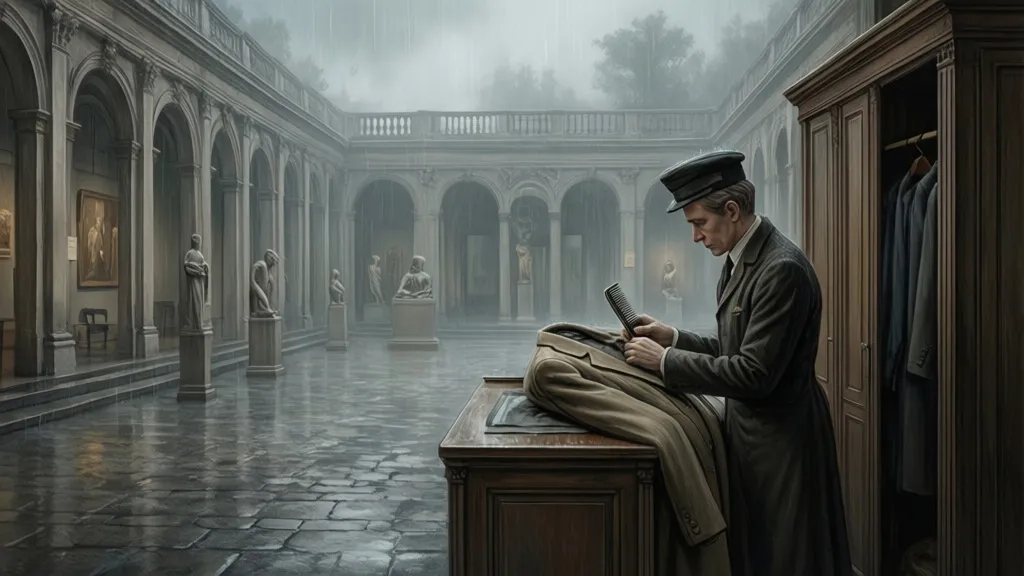
At nine-twenty on the first Sunday in June, Hara Natsumi found the comb because the coat was heavier than it ought to have been.
The rain had arrived without conviction, a fine cold mist that made the museum courtyard shine and persuaded visitors to hand over outerwear they would later insist they had never really needed. Natsumi stood behind the admissions desk with a ledger open to the cloakroom returns, her sleeves turned once, neatly. She was a conservator by department and a coat-check clerk by the logic of understaffing. On Sundays, the logic usually won.
The coat in question was a man's summer coat, beige, expensive, and damp along the shoulders. The claim ticket tied to its hanger read 47. Mrs. Mita, who had checked it in at ten past nine before hurrying upstairs to a lecture on Meiji textiles, accepted it from Natsumi with the absent gratitude of a person whose attention was elsewhere. Then she paused, frowned, and said it was not hers.
It was hers. The lining bore the initials S.M., embroidered with the self-conscious modesty of costly tailoring. What she meant, after a little offended rearrangement, was that the weight in the right pocket was not hers.
Natsumi put in two fingers and drew out a cracked ivory comb wrapped in the coat pocket's darkness like a secret. It was warm from the cloth. Rain and camphor rose from it together.
Mrs. Mita stared. She was in her late sixties, broad-browed, handsome in a way that had learned not to seek confirmation. Her gloves tightened around her handbag.
"That," she said, "has no business there."
Natsumi did not answer immediately. The comb was old, though not ancient. Fine teeth on one side, wider ones on the other. One end had split and been repaired with a minute metal staple darkened by time. Along the spine ran an incised pattern of overlapping plum petals. A maker's mark, small as a grain of rice, sat near the break.
Not museum property as such. Not obviously. But old objects had a way of drifting toward institutions and staying there.
"May I ask," Natsumi said, "whether you've seen it before?"
Mrs. Mita's face altered by a degree. Enough, in Natsumi's experience, to matter.
"Not for many years."
She took the comb between gloved fingers and then, as if remembering herself, put it back into Natsumi's palm. "No. Better not. It should not be with me."
This was not the sort of sentence ordinary visitors produced before ten in the morning, rain or no rain.
Across the hall, the assistant registrar, Okada Ren, emerged from the staff corridor carrying a stack of programmes and looking as though he had been born apologising for someone else. He saw the object in Natsumi's hand and stopped.
That was also enough, in her experience, to matter.
"Mrs. Mita," he said. "Is something wrong?"
"I was about to ask the museum that," she said.
Ren's smile arranged itself and failed. He was thirty, agreeable, and too well dressed for the salary. He had the polished caution of a man who knew exactly how often he was looked at and by whom. Behind him, in the corridor, someone laughed — one of the education staff, perhaps, or Kuroda from archives with his laugh like dropped spoons.
Natsumi held out the comb. "This was in pocket 47. Mrs. Mita says it isn't hers."
Ren took one quick breath through his nose. Camphor was not subtle at that distance.
"Ah," he said. "That may have been put there by mistake. If you'll give it to me, Hara-san, I'll see to it."
Mrs. Mita looked at him with cool dislike, which suggested familiarity. "You will do no such thing."
There was, Natsumi reflected, always one sentence in a morning after which the rest became inevitable.
She closed her fingers around the comb. "Perhaps, before anyone sees to anything, someone should tell me what it is."
Neither of them answered. The rain whispered at the glass doors. Upstairs, the lecture bell sounded once.
Mrs. Mita said, "If Mr. Okada would prefer this discussed somewhere less public, I intend to have tea at the Riverwalk at eleven-thirty. He may explain there why an object from the old Aizawa donation has found its way into my coat."
Ren stared at her. For a moment he looked absurdly young.
"I don't know what you mean," he said.
"Then perhaps by eleven-thirty you will have educated yourself."
She took her coat, declined the comb, and left it — tactically, Natsumi thought — in the conservator's custody. Then she went upstairs to listen to Meiji textiles with the posture of a woman who had just fired the first shot in a war she expected to win.
Ren watched her go.
"Hara-san," he said quietly, "may I ask you not to mention this to anyone yet?"
"You may ask."
That faint, involuntary smile touched his mouth. He knew her just well enough. "There are old collection disputes involved. It may be nothing."
"People usually say that when it isn't."
He looked at the comb again. "Could you keep it safe until lunch? I need to check something in records."
"And then?"
"Then perhaps I'll tell you the truth."
He said it lightly. Men said many things lightly when hoping that tone might stand in for honesty.
Natsumi placed the comb in a padded envelope from the desk drawer and wrote the time on the flap. 9:24. Her handwriting was narrow and patient.
"Lunch," she said.
He thanked her and went into the staff corridor more quickly than he had come out.
At eleven-fifty-eight, with the envelope in her bag and the tea she had been handed at eleven-forty already cold, Natsumi crossed the riverwalk to the tea room and found Mrs. Mita dead.
The Riverwalk Tea Room occupied the curve of an old warehouse wall and believed too strongly in lace. Its windows looked over the river, grey with rain, and its tables were set close enough together to make secrets sound theatrical. At noon on a Sunday it should have been half full. Instead, people stood.
Natsumi came in through a confusion of umbrellas and damp cardigans. A waitress with tears gathering industriously at the corners of her eyes kept saying, "No one touched anything, no one touched anything," as if repetition itself might create virtue. At the back, by the window, Mrs. Mita sat in her chair with her head tipped a little to one side, one hand still near her teacup. The cup had fallen onto its saucer and cracked it. Her eyes were open. Death had not been there long, but it was established.
A doctor from the next table had already been found. He stood back now, pale and competent.
"Heart failure, very likely," he said to nobody in particular. "But sudden. Very sudden. The police have been called."
Natsumi did not go nearer than she needed to. On the table lay the remains of a small lunch, scarcely touched, and a folded menu. No comb. No envelope. No note.
The waitress saw her museum badge and attached importance to it at once. People did.
"You know her?"
"Slightly. She was at the museum this morning. Was she alone?"
"She met a gentleman. Museum gentleman, I think. Pretty one. Blue tie. They argued very quietly. Then he left. Then another man came after, not five minutes. Tall, glasses. Archive sort." The waitress made this sound nearly criminal. "He didn't sit. Just bent to speak. She told him to go away. Not loudly. Then he left an envelope by the sugar bowl. White one. She picked it up after he went, looked inside, and put something from it into her handbag. The envelope itself she tucked into her portfolio, I think. Then she had tea, and then —"
The industrious tears overflowed.
Natsumi thanked her. A museum gentleman in a blue tie was Ren. A tall man with glasses from archives was almost certainly Kuroda Masayuki, senior archivist, fifty-six, yellowing fingers, humour of a surprisingly festive kind.
The room had become crowded with witnessfulness. Natsumi disliked crowds around a body. She disliked, also, being handed a fresh cup of tea by a waiter who had mistaken her stillness for need. It was too hot to hold sensibly. She held it anyway.
On the chair opposite Mrs. Mita lay a leather portfolio. Its clasp was open. Inside, visible above a sheaf of lecture notes, was a museum visitor map and a cream card from the cloakroom: 47. Tucked between the notes and the map was the corner of a white padded envelope.
Natsumi did not remove it. She only noted its presence. The pocket where the comb had been meant to travel was now empty.
A police car's siren sounded faintly from the street.
There would be statements, delays, and by half past one a staff meeting already scheduled for noon-thirty in the museum seminar room, because institutions honoured timetables more faithfully than they honoured grief. Before that meeting ended, if the tea room's witnesses were right, the museum would have acquired not merely a death but a scandal. Those matured quickly.
Natsumi set her untouched tea down and went back through the rain.
The meeting had been called to discuss the autumn decorative arts exhibition. By twelve-fifteen it contained instead the director, the assistant registrar, the senior archivist, the curator of Japanese material culture, two education officers, the receptionist, and Natsumi, all under the fluorescent pity of Seminar Room B.
Director Shibata had the mild face and severe hair of a man who had spent thirty years regretting committees and then becoming one. He had just finished saying that everyone must remain calm and make themselves available to the police when Natsumi asked, in the same tone one might use to request a pencil, where the Aizawa donation records were kept.
Silence observed her.
Ren went white with efficiency.
"Hara-san," he said, "this is not the moment."
"It may be the only one before the police ask less politely."
Shibata looked from one to the other. "What donation?"
Kuroda rubbed his glasses with a handkerchief. "A small prewar bequest. Hair ornaments, dressing objects, one screen fragment, some domestic material. Partly recatalogued in 2004. Nothing sensational."
"Mrs. Mita used the phrase old Aizawa donation this morning," Natsumi said. "Mr. Okada recognised the comb found in her coat. Mrs. Mita was then found dead after meeting Mr. Okada and later Mr. Kuroda. I would like to know what was worth meeting over."
This was direct. It was also, she thought, economical.
Kuroda let out a breath through his nose. "Ah. So the little ghost has returned."
"What little ghost?" said the receptionist, delighted.
Shibata closed his eyes briefly. "Kuroda-san."
"The ivory comb," Kuroda said. "Or what used to be one of a pair. The Aizawa donation came in 1938 from a widow with excellent manners and unreliable memory. Two ivory combs, catalogue numbers A-1938-44a and b. Matching plum pattern, one cracked and repaired. In the fifties, after flood damage and three changes of record system, one was still listed, the other was not. In 2004, when the database was cleaned, an old handwritten correction was taken as fact. The surviving card was amended. One comb became one comb. Such are the triumphs of administration."
"And the missing one?" said Shibata.
Kuroda made a small helpless gesture. "No one looked hard. It had been absent for decades on paper. Absence is very restful if entered in the correct field."
Ren said, too quickly, "That doesn't mean there was a theft."
"No," said Natsumi. "The label will tell us whether there was. Where is the provenance card?"
Kuroda looked annoyed at the word label, which suggested that archives consisted of useful things rather than his kingdom. "Locked drawer. Archive room two. I have the key. The spare is in the registrar's office key cabinet."
"Then let us open it."
Ren stood. "This is absurd. The police are coming. We should wait."
"If we wait," Natsumi said, "we will answer their questions without knowing the shape of them. That seems discourteous."
The education officers, who had no practical stake in any of this and were therefore enjoying themselves very much, murmured agreement.
Shibata rose with the air of a man discovering a cliff edge under office carpet. "Very well. All together."
Archive Room Two was down the staff corridor, past conservation and beside the old study room now used mostly for folded tables and guilt. The room smelled of paper, dust, and the species of despair encouraged by budget reductions. Steel cabinets lined one wall. Kuroda knelt at the lowest of them and fitted a key into drawer C.
The lock opened at once. The drawer moved three centimetres, then stopped.
Kuroda frowned and pulled harder. Something inside had jammed it.
"How theatrical," said one of the education officers.
No one thanked her.
Kuroda worked the drawer back and forth. A thin card had slipped upright within and lodged against the frame. With delicate irritation he eased it down using a ruler and drew the drawer fully open.
Inside lay a row of provenance cards in old manila sleeves. Near the front was an empty sleeve labelled in brown ink: Aizawa, personal adornment, ivory comb(s). In front of it, as if recently propped there and then displaced by the drawer's movement, was a newer white label card.
Natsumi picked it up.
It was a temporary exhibition label, the sort printed for internal use when objects moved between storage and gallery. On it, in neat machine font, was written:
A-1938-44a-b
Pair of ivory dressing combs, late Edo
Transferred from Aizawa Donation, 1951. Formerly in private custody pending claim by donor family. Return not executed.
Below, in blue pencil, someone had written years later: Entry corrected 2004 to single comb. See R.O.
"R.O.," Kuroda said softly. "Registrar's office."
Twenty years ago the registrar had been Okada Ryouhei, Ren's father.
The room became very still. Even the rain seemed to listen at the high windows.
Shibata said, with admirable calm, "Explain."
Ren's mouth opened once before sound emerged. "I didn't know about the transfer note. I knew there had been a discrepancy. My father mentioned an unresolved family claim, years ago. Mrs. Mita was related to the donor through marriage. She had been asking questions this spring. I thought —"
"You thought what?" Natsumi asked.
"That she had found the old accession list and wanted compensation, or to embarrass the museum. I found the comb in my father's things after he died. I thought it might be the missing one. I wanted to ask whether she recognised it before I told the director anything."
"So you put it in her pocket?"
He looked at her with exhausted contempt, mostly for himself. "No. I gave it to Ayako at the desk just after nine-fifteen, while Mrs. Mita's coat was still hanging on ticket 47. I told her to bring it up to me if Mrs. Mita came down before I returned. Then I was called to the printer. By the time I came back, the coat had already been returned."
This altered the path very little, but it repaired one piece of it.
"Ayako signed out at eleven," said the receptionist. "Her mother had a clinic appointment."
"Yes," Ren said. "But the coat was gone before half past nine. If anything went into it, it happened while it was still here."
Kuroda gave a dry little cough. "For what it is worth, Mrs. Mita asked me yesterday whether archive drawer C still held Aizawa provenance cards. I told her yes. She was very pleased with herself. It was unkindly charming."
"And you met her at the tea room to discuss that?" said Shibata.
"I met her to tell her she was about to make a fool of herself publicly. The donor family claim had not been ignored. It had been circumvented. She told me to go away. I obeyed, reluctantly."
Natsumi looked again at the empty sleeve, the white transfer label, the blue-pencilled note. Something small and practical pressed against the larger melodrama.
"Who opened this drawer last?"
Kuroda blinked. "Yesterday afternoon. For Mrs. Mita, in reading room supervision. I showed her the cards, then locked them away."
"Was the white label here then?"
He hesitated. "I don't think so. No. I would have noticed it because it shouldn't be. It belongs in old exhibition files."
"Then someone placed it after yesterday and before now." She looked at the jammed card's bent corner. "Not by magic. Who signed out the spare key?"
The receptionist, who knew these things because she knew all things worth knowing, said at once, "The key cabinet book is at reception. Anyone senior staff can take it if they sign."
Ren's expression changed first to indignation, then to caution. "You think someone opened the drawer this morning?"
"Someone with a key could. The card did not grow there in the dark. They opened it, inserted the label in front of the sleeve, shut it badly, and when we opened it just now the edge rode up and jammed."
Shibata said, very quietly, "Who had access?"
Kuroda looked offended again. "Staff. Myself. The registrar's office. Conservation, if they ask. Cleaning, under supervision. And whoever signed out the spare."
"Then the key log matters," Natsumi said. "As much as this card. Perhaps more."
From the corridor came the sound of shoes approaching fast. A young attendant put his head round the door and said the police were ten minutes away, and also that Ayako had telephoned reception from the bus station because she had left her cardigan.
"Tell her not to leave," said Shibata.
Natsumi was already moving.
Ayako was waiting under the museum's side awning with a paper bag, her cardigan folded over one arm and a face prepared for tears if useful. She was nineteen, a weekend desk assistant, and pretty in the unfinished way of very young women who suspect prettiness may itself be a profession.
Natsumi found her there with rain dripping off the eaves between them like a beaded curtain.
"I only did what he asked," Ayako said immediately.
This was promising. Innocent people often said they had done nothing. Useful people admitted sequence.
"Which he?"
She bit her lip. "Mr. Kuroda. No — not like that. Just work. He came to the desk around nine-fifteen with a little wrapped parcel and said if Mrs. Mita checked a coat, I was to put it in the pocket and tell no one because it was a surprise. An old lady thing, he said. I didn't like it. Then Mr. Okada came by and handed me another parcel — I didn't know there were two — and said nearly the same, only not surprise. He said private. Then the phone rang, and the lecturer wanted copies, and Mrs. Mita was already asking for her claim ticket, and I put one parcel in the programme drawer so I could sort it out. When I turned back, her coat was still on the rail. So I slipped the programme-drawer parcel into the pocket before Hara-san reached for the hanger. It was only a moment."
"Before nine-twenty?"
"Yes." She looked relieved to have a number. "Well before. Later — before eleven, I mean — Mr. Kuroda came back and asked whether I had done it. That was when I gave him the other parcel. I should have said that first."
That, Natsumi thought, was the trouble with very young witnesses. Their consciences arranged events by shame rather than time.
"Which parcel went into the coat?" Natsumi asked.
Ayako looked miserable. "The one from the programme drawer. I thought it was Mr. Okada's because he came later. But maybe I mixed them up. They were both envelope-sized. I didn't open them."
"What happened to the other one?"
"I gave it to Mr. Kuroda when he asked whether I had done it. He looked... strange. Then he laughed and said old objects made everyone silly. He took the envelope and went away."
There it was. Three hands before the coat: Kuroda to Ayako, Ayako to pocket, pocket to Mrs. Mita; Ren to Ayako, Ayako back to Kuroda. Crossed paths, if one liked neat diagrams. Life preferred knots.
"What time was that second part?"
"Ten-forty, maybe. Before I left."
"Did you touch the archive key cabinet this morning?"
Her surprise appeared genuine. "No. I don't have reason to."
"Did you see anyone at reception sign something out?"
She thought. "Mr. Kuroda, maybe? He was at the counter after ten. He asked for the reading room key once last week, so I didn't look. I was folding maps."
"And today?"
"I saw him writing