The Conservatory Key
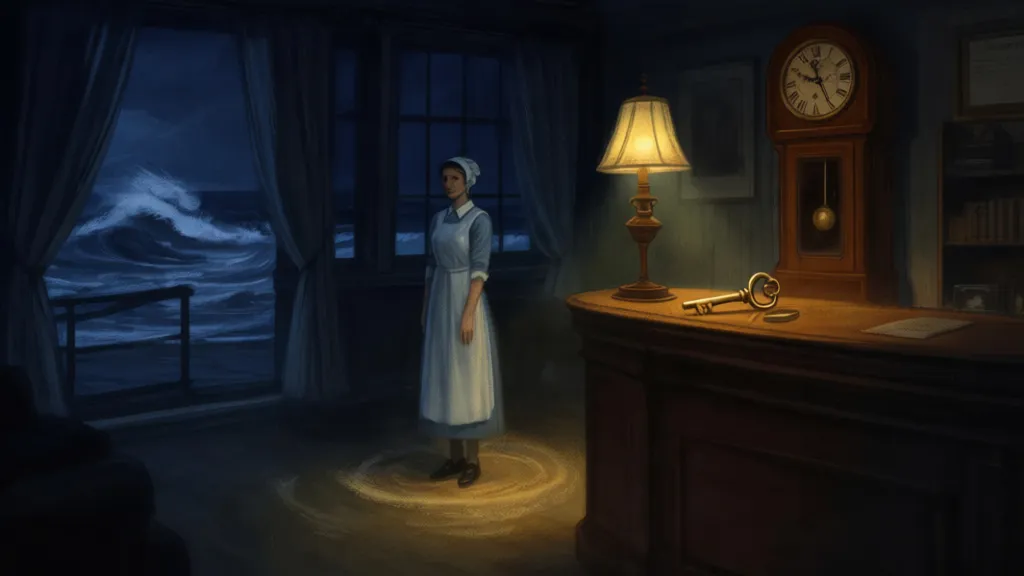
At twelve minutes past midnight, when the sea wind had begun to worry at the loose corner of the inn’s signboard, Housekeeper Senda Fumie came down the back stairs with a basket of towels and stopped in the lobby as if she had walked into a sentence with the wrong ending.
The clock above the reception desk had stopped at 11:17.
It was an old oak thing, broad-faced and self-important, bought by the proprietor’s grandfather because he had believed a good inn should tell the time to people who were trying not to think about it. It had not stopped in six years. Fumie knew this because when clocks stopped in inns, guests complained as if they had been personally insulted.
She set the towels down. The polished floor held a trail of wet footprints, dark as tea leaves on lacquer. They came from the entrance, crossed the lobby, and went directly toward the conservatory doors.
There the trail ended.
The conservatory itself was dark beyond the glass panes. Moonlight lay across the wicker chairs and the potted palms like dusted flour. The double doors were shut. So was the brass lock.
Fumie looked, with the practical contempt of a woman who had spent thirty years cleaning up after other people’s melodrama, at the key case mounted on the wall beside the doors. It was a narrow wooden box with a glass front and a little brass catch. Inside, hanging on its hook, was the conservatory key.
She stared at it. Then she stared at the wet footprints again.
The sea could be heard through the walls. Somewhere upstairs a man laughed in his sleep, or perhaps in someone else’s room. Fumie picked up the house phone and called the night clerk.
The clerk, Endo Kenta, arrived in slippers and a tie, which made him look like a boy being punished for ambition. He blinked at the floor, the clock, the locked doors, the key in its case.
“Did you make these?” he asked, because youth seeks impossible hopes before reasonable ones.
“Certainly,” said Fumie. “I put on a man’s shoes for variety.”
He bent over the footprints. “They’re too big for mine.”
“That narrows the field.”
He opened the front door. Rain had passed earlier; the stone step outside still shone. The path from the car park was damp. But on the mat there was only a general muddle of moisture, no distinct trace to show who had come in or when.
They checked the conservatory doors. Locked. They checked the windows that faced the veranda. Latched from inside. They checked, after some fumbling and one dropped ring of keys, the side service entrance. Bolted.
Endo looked at the key case again. “If the key’s there—”
“Yes,” Fumie said. “If the key’s there, then either your conservatory has learned to open itself, or something else has happened.”
He looked as if he would have preferred the first explanation.
By one o’clock the proprietor had been woken, muttered that nothing ever happened in February except burst pipes and adulteries, and instructed Endo to write down the matter in the incident book. The footprints remained, drying slowly at the edges. The clock still showed 11:17.
At six forty, before breakfast service had quite begun and while the sea outside the windows wore the colour of old pewter, another small thing happened.
The key was gone.
Fumie saw the empty hook first. The little brass catch on the key case hung open. The conservatory doors were still locked.
This time the proprietor did not mutter. He swore with the grave precision of a man who disliked waste. A guest was missing as well: a Mr. Kuroda, entered in the ledger the previous evening as a late arrival, Room 12, cash, no luggage beyond a leather holdall. Room 12 had been slept in, if one trusted the disorder of bedclothes. The holdall was gone. Mr. Kuroda himself was nowhere in the building.
By seven twenty the police had been informed, and by seven forty the inn had acquired, with no obvious effort of its own, a woman at a lobby table drinking tea that was much too hot and looking at the clock with interested dissatisfaction.
Her name was Akiyama Rei. She had come down from Room 8 because, as she told the proprietor, once police were expected no one sensible remained upstairs pretending not to listen. She taught archival studies at a university in Sendai and had been spending three quiet days on the coast with a former colleague, Dr. Nishimura Aya, who at present was still pinning up her hair while disclaiming all desire to be involved.
Rei set the cup down. It had scalded her tongue. It usually did.
“The clock really stopped at 11:17?” she asked.
“Unless someone stopped it later to be theatrical,” said the proprietor.
“That would depend on who your guests are.”
He looked at the breakfast room, where six respectable people and one playwright were trying to appear merely interested in toast. “Not impossible.”
The ledger lay on the desk. Rei drew it toward her. The page for the previous night showed three arrivals after ten: Mr. and Mrs. Hoshino to Room 4; Miss Tachibana, a ceramic artist, to Room 9; and Mr. Kuroda to Room 12 at 11:10, noted in Endo’s neat hand. Below that, another note: Room 12 changed from 14 by request. Sea noise.
Rei looked up. “Who changed him?”
Endo flushed. “I did. He said fourteen was too exposed to the road.”
“Did he sign?”
“No. It was late.”
“Did you see him go to twelve?”
“I gave him the key.”
“That was not my question.”
Endo swallowed. “No.”
The proprietor made a noise of irritation. “We all remember a late arrival,” he said. “The bell rang. Endo went out. There was a wet umbrella stand in the morning.”
“Whose umbrella?” Rei asked.
No one could say.
Dr. Nishimura had arrived by then and sat opposite Rei with the air of a woman who knew from experience that resistance was futile. “You are pleased,” she said softly.
“Not pleased,” Rei said. “Interested. There was a man, or there was not. An inn should know which.”
“The police will tell us.”
“The police,” said Rei, glancing at the stopped clock, the dry footprints, and Endo’s increasingly complicated expression, “will ask many large questions. I prefer smaller ones.”
There were three guests who insisted, independently and with a degree of satisfaction usually reserved for useful talents, that they had heard the same thing from the conservatory during the night: one clear tap of a spoon against porcelain.
Mrs. Hoshino said she heard it at about eleven twenty when she was removing cold cream. “Not stirring,” she said. “Just once. Tik. As if someone had found a flaw in their tea.”
Miss Tachibana, whose hair and earrings both made emphatic statements, said she heard it later, perhaps eleven thirty. “I notice sounds,” she said. “I work with firing. If a cup rings wrong, it dies.”
The playwright, Sugawara Minoru, said he heard it at exactly 11:17 because he had looked at his travel clock in irritation. “A single, delicate rebuke from crockery,” he said. “Then silence. If you put that in a play, people would call it too symbolic.”
“People say that to you often?” Rei asked.
“More often than they should.”
She asked where their rooms were. Mrs. Hoshino occupied 4, directly above the lobby stair. Miss Tachibana was in 9, overlooking the side garden. Sugawara was in 14.
Room 14.
Rei let that sit.
Then she asked to see Room 12.
It smelled faintly of damp wool and furniture polish. One pillow had a hollow. The bedcover had been folded back. On the washstand, the towel hung crookedly and was wet at one corner. In the wastebasket lay the torn strip from a matchbox and the waxed paper from a hotel soap.
“Mr. Kuroda washed his hands,” said Nishimura.
“Or someone wished us to think he did.” Rei bent over the wastebasket. The soap wrapper was from this inn, but the paper was dry and almost crisp. “When did you clean and prepare this room?”
Fumie, who had followed them, said, “At four yesterday. It stood empty after.”
Rei touched the basin. Dry.
“Can water not dry by morning?” Nishimura asked.
“It can. So can lies.”
On the bedside table lay the room key for 12.
“That is careless of him,” said the proprietor.
“No,” said Rei. “If he had truly slept here and left before dawn, it is ordinary enough. If he never entered, then someone put the key back.”
“Why?”
“To make twelve exist.”
They went next to Room 14. It faced the road and the sea beyond, less private than 12 but larger. The bed was untouched. Yet the ashtray by the window held a half-burnt match and the faint smell of a recently extinguished cigarette, though the room had been let to no one.
Endo stared at it. “I—I showed him fourteen first.”
“Yes,” said Rei. “Now tell me that part carefully.”
He did. A man had arrived near eleven in a dark raincoat and hat. He had spoken quietly, declined dinner, asked whether there was a room not overlooking the road. Endo had brought him to 14, then, after the complaint, to 12. The man had ordinary features, which is to say Endo remembered none. He had paid in cash from a damp wallet. He had no accent Endo could identify.
“Did he give a first name?”
“Kuroda Saburo.”
“A useful name,” said Rei.
“Useful?”
“It goes where it is put.”
She looked around 14 again. “And when you led him from 14 to 12, did you pass the conservatory?”
“Yes.”
“Was it open?”
“I don’t remember.”
“Did he carry the holdall himself?”
“Yes.”
“With which hand?”
Endo blinked. “Left, I think.”
“Did he remove his hat?”
“No.”
“Did you see his hair?”
“No.”
Nishimura folded her arms. “You are deciding he was not there.”
“Not yet. But if a man arrives in rain, sleeps in 12, walks wetly to the conservatory, somehow leaves with the doors still locked and the key in its case, then vanishes by morning, I prefer to ask whether we have one impossibility or three smaller deceptions.”
The conservatory was opened at last when the proprietor fetched the spare key from his office safe. It was a long, old-fashioned key with a bitten shaft and a brass bow polished by several generations of fingers. Inside, there was no missing man.
There were wicker chairs, a tiled floor, broad-leaved plants, and a tea table set for one. A cup and saucer stood there, washed clean but not put away. A silver spoon lay beside it.
Rei stood still.
“Here is your porcelain,” said Nishimura.
“Yes.”
The cup had a narrow brown line around the inside where tea had stood and been emptied. Beside the saucer was a smear no larger than a thumbnail, pale and gritty.
Miss Tachibana, peering over Rei’s shoulder despite all social conventions, said, “That’s clay.”
“It is salt,” said Fumie, who licked a finger with the calm authority of housekeeping. “Sea salt.”
On the tiled floor near the table were small crescent marks, as if a chair had been dragged and turned. On one chair-back hung, absurdly, a hotel laundry tag for Room 14.
The proprietor frowned. “How did that get there?”
Fumie said, “By moving.”
Rei looked toward the wall by the door. There, half hidden behind a palm pot, was the brass pendulum bob of the lobby clock.
Everyone stared at it.
The proprietor said, after a short and reverent silence, “Someone took my clock apart.”
“Only the pendulum,” said Rei. “Enough to stop it at 11:17.”
“Why hide it here?”
“Because one cannot hide an impossible sound in a room. One must give it a place to come from.”
Nishimura gave her a long look. “You know, then.”
“I know enough to ask for the ledger again.”
At the desk she turned pages back two days, then three. The late-arrival column showed room changes in Endo’s hand on four occasions in a fortnight. Two had been initialled by the proprietor. Two had not. On all four nights Sugawara the playwright had occupied a room with a view toward the lobby stair or conservatory side.
“That seems unlikely,” Nishimura murmured.
“It seems managed.”
Rei asked Endo, “Who taught you the room-change notation?”
“The old clerk. It saves rewriting.”
“Who suggested Mr. Kuroda might prefer 12?”
Endo opened his mouth, then shut it.
Sugawara, from his breakfast chair, said with careful lightness, “This is becoming accusatory. I object to drama before coffee.”
Rei turned to him. “Do you? Then let us keep it plain.
There was no missing man in the building.
“The wet footprints were made after midnight by someone wearing a man’s shoes and entering from the rain. They ended at the conservatory because they were meant to end there. The doors were already locked. The key in the case was visible through the glass because that also was meant to be seen.
“The room ledger records a late arrival named Kuroda and a shift from 14 to 12. Yet 14 bears the trace of actual use, while 12 bears only the sort of evidence one can plant from housekeeping supplies: a torn soap wrapper, a dampened towel, the bed turned down. The room key to 12 was returned because room 12 had to remain in the story.
“The spoon on porcelain was heard by three people because one person, in the conservatory or immediately beside it, made sure it was heard. Once is memorable. Stirring would not be. The stopped clock gave that sound a time and therefore authority.
“The key was removed from the case in the morning not to open the conservatory—there is a spare—but to complete the illusion that something had happened there after the footprints appeared. A progression: footprints, key, vanished man. It invites us to imagine movement where there was only arrangement.
“And the person who arranged it knew the inn well enough to hide the pendulum bob in the conservatory, to use an unlet room, and to exploit the clerk’s habit of recording room changes without signatures.”
She paused. Endo had gone very white. Sugawara had gone still.
“The question,” said the proprietor hoarsely, “is why.”
“It is in the ledger,” Rei said.
She laid a finger on the page. “If the police were called for a missing guest, they would compare records, ask staff to account for every movement, and discover these altered entries. Not only last night’s. Earlier ones too. Guests who officially changed rooms after hours, cash arrivals who were not properly registered, discrepancies in occupancy taxes.
“None of that was done to steal from the inn. The sums are too small. It was done so that one room might occasionally be made to exist on paper while remaining practically unused, or occupied by someone who preferred not to be seen entering it.”
The proprietor looked at Endo. Endo looked helplessly at Sugawara.
That was answer enough.
Mrs. Hoshino made a small sound of triumph and pity, the married woman’s ancient duet. Miss Tachibana looked merely interested. Nishimura sighed as if a theorem had gone where it always had to go.
Sugawara said, after a moment, “You might at least allow me the dignity of speaking for myself.”
“Certainly,” said Rei.
He stood. In daylight he seemed less theatrical than tired, though one could see how the first quality had been cultivated to defend the second. “I have been coming here for two years,” he said. “To write, allegedly. Endo and I became… close. In a provincial inn that would have interested the wrong people, among them one committee at my theatre and my wife’s brother, who believes morality improves by observation.
“So yes, when occupancy was low, Endo altered a room here and there. I entered by the side. I left early. We behaved like smugglers because that is what discretion makes of ordinary affection.”
Endo said quietly, “I told him we should stop.”
Sugawara gave the smallest nod. “He did. Last night I came to say good-bye, and to ask for one final night because farewells are greedy things. We quarrelled. He had already written Kuroda into the ledger—his idea, not mine, to conceal the extra room if anyone checked. Then he lost his nerve.”
“I crossed out nothing,” Endo said. “I should have, but I didn’t.”
“So our nonexistent guest remained.” Sugawara’s smile was brief and unpleasant to himself. “I thought if a scandal larger than bookkeeping appeared, the books would become confusion rather than evidence. A vanishing guest, a locked conservatory. It looked amusing at midnight.”
“And by morning?” Rei asked.
“By morning it looked exactly like what it was. Cowardice with props.”
“The footprints?”
“I wore an old pair of my brother-in-law’s shoes from the car. Too large for me, apparently not large enough to be interesting. I made the noise with the spoon in the conservatory while Endo watched the corridor. I stopped the lobby clock earlier, when no one was looking, and hid the pendulum after. Before dawn I removed the key from the case and intended to throw it into the sea, but that seemed melodramatic even by my standards. It’s in the umbrella stand.”
Fumie went at once and returned with the brass key wrapped in a hand towel.
The proprietor sat down heavily.
No one spoke for a little while. The sea kept on with its work beyond the windows.
Then the proprietor said to Endo, “You will leave at the end of the month.”
Endo bowed his head.
To Sugawara he said, “You will leave now.”
Sugawara inclined his own as if accepting notes after rehearsal. He looked once at Endo. It was not a dramatic look. That perhaps was why nobody else found somewhere else to look.
By ten the police had arrived, learned there was no corpse, no kidnapping, and only one species of disgrace available, and became brisk rather than inspired. Statements were taken. The ledger was surrendered. Breakfast congealed. Tea came to Rei after the matter was functionally over and had gone cold in protest.
She drank it anyway.
Nishimura joined her in the now-unlocked conservatory. The winter sun had reached the tiles and was trying, without much conviction, to make the room cheerful. The cup and spoon had been removed. The chair marks remained faintly visible on the floor.
“You enjoyed that more than was proper,” Nishimura said.
Rei considered. “Only the part where the facts consented.”
“And the people?”
“They did what people do. They arranged the furniture around desire and called it necessity.”
Nishimura smiled. “That sounds like something you would put in an article and pretend was about archives.”
Rei touched the empty hook in the key case, where the conservatory key had been rehung. “An archive is only a refined collection of lies that failed to disappear.”
From the lobby came the sound of Fumie instructing a constable on how not to tread on polished wood, and the proprietor answering questions as if each one cost money. Endo’s voice did not carry. Sugawara’s did once, then ceased.
Nishimura said, “Will you remember the trick with the spoon?”
“No,” Rei said. “I will remember the ledger. A false room is a more intimate thing than a false name.”
She sat in the wicker chair nearest the glass. The sea beyond the veranda was pale and restless. Somewhere up the coast, she recalled, stood the Suzuki Inn in the mountains’ opposite element, all cedar and steam and badly timed tea. Inns kept secrets according to their climate. Some swelled with them. Some rusted.
“The sad thing,” Nishimura said after a while, “is that their motive was almost reasonable.”
“Yes.”
That was the trouble with most motives. They began in a room one could enter without shame, and ended by making another room on paper because the first was not allowed to exist.
Rei lifted the cold tea, found it had become stronger while neglected, and drank. In the lobby the clock had been repaired and ticked again with an air of injured innocence.
Time, she thought, was often restored too easily.
The rest was not.