The Corridor Mirror
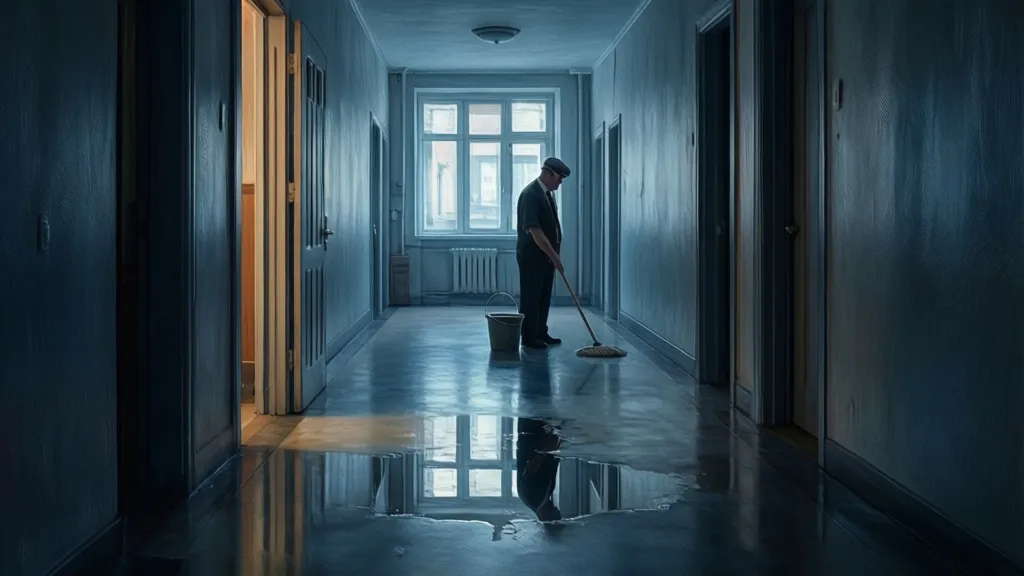
At six-ten, Superintendent Ishii found Apartment 4C open by three inches and stopped with the mop bucket tilted against his leg.
He had come up because of water. The tenant in 3C, a dentist with a gift for complaint, had rung the office at six and said there was a drip over his bathroom light. Ishii, who had been superintendent of the Hoshino Heights for eleven years and had therefore learned to distinguish a genuine emergency from loneliness, had decided this was probably both. Still, water had to be respected. It never improved by being left alone.
The fourth-floor corridor held the blue-grey light of early morning. At one end, opposite the lift, the long mirror fixed to the wall reflected the passage, the stairwell door, and anyone approaching the corner from the front entrance. It had been put there, Ishii had once been told, to make the corridor seem wider. In practice it made everyone check their face before knocking on a neighbour's door.
Apartment 4C belonged to Fujino Rika, age thirty-two, translator, always polite, always late with her recycling. Ishii knew these things because they were the kind of things a superintendent knew. Her door stood ajar. The security chain, improbably, was still hooked.
He stared at it for a moment before understanding what he was seeing.
The door had opened as far as the chain allowed. The chain was taut. The gap beyond it was narrow, but enough to show darkness, a strip of entryway tile, and no movement.
"Fujino-san?" he called.
No answer.
He knocked against the wood with the side of his fist. The chain rattled. Inside, something gave a small, domestic click as if settling. That was all.
He bent and looked through the gap.
The apartment was one of the wider one-bedroom units, with the kitchen-dining area visible from the entrance past a short hall. Morning light touched the edge of the table. It was set for two. Two bowls. Two chopstick rests. A plate with a half-peeled orange, the skin hanging from it in one bright strip. A glass with water in it. Another overturned on its side, dry from this distance, perhaps not dry at all.
On the floor, from the direction of the kitchen toward the bathroom, there was a single dark footprint.
Wet. Bare. Distinct enough that he saw the shape of the toes.
Ishii's hand tightened on the mop handle.
There were times, in apartment buildings, when one became intimate with people without ever speaking to them properly. One heard them arguing through pipes, sneezing through vents, crying in lifts with supermarket leeks under one arm. One knew, from the bins, whether they drank beer or red wine, whether they had started dating somebody new, whether they had given up trying to eat sensibly. One did not usually stand outside their half-open door at six in the morning looking at a footprint and think, with perfect clarity: I do not want to open this.
He went downstairs to use the office telephone and call the police.
By seven-fifteen, the building had acquired the alert, hungry stillness of an audience before curtains rose.
Residents who would never normally leave home before eight had business in the corridor. A woman from 2A came up to return, for no visible reason, an umbrella she had borrowed last week. The dentist from 3C appeared in socks and informed everyone that the dripping had stopped, which made him seem disappointed. An elderly man from 4A stood by the stairwell and pretended to stretch his calves while seeing everything.
Sergeant Takeda from the local station kept them back with patient firmness. He was broad, balding, and looked as if he had long ago stopped expecting mornings to be sensible. With him was a younger uniformed officer, and a civilian consultant in a navy coat who had arrived carrying a notebook, an apology for being early, and a paper cup of tea that had already gone cold.
Her name was Kanda Fumika.
She was not police. Ishii gathered this at once from the way Sergeant Takeda listened to her and then ignored her only after considering it. He had seen her once before, in another building, after a theft that had turned out not to be a theft and a widow who had turned out not to be one. She was, as he recalled, some sort of cataloguer at a university library. She looked exactly like a person who spent time with books: plain dark skirt, practical shoes, hair pinned with more competence than interest. Her expression was mild. Her tea was, from the way she held it, undrinkably cold.
Takeda showed his notebook to Ishii. "You found the door at six-ten. You didn't touch the chain. You didn't call out more than once."
"Twice," Ishii said. "Then I looked through the gap."
"And you saw the table."
"Yes. And the footprint."
"Only one?"
"Only one I could see."
Kanda had gone to the corridor mirror and was standing before it, not looking at herself. She shifted a little to the left, then right. In the reflection, Ishii saw the door of 4C, the stairwell, and part of 4B.
"Who lives opposite?" she asked without turning.
"4B? Morita Kenji. Music teacher. Or says he is."
Takeda sighed in a way that suggested the phrase had already been offered by two other residents.
"And next to 4C?"
"4D is empty. 4A is Kuroda, retired."
Kanda nodded. "The mirror shows anyone coming from the lift or the stairs to these apartments. But only on the approach. Once they turn the corner to go back, the angle changes."
Takeda said, "We're not solving geometry yet."
"No," she said. "Only furnishing it."
The locksmith arrived. The chain came off with the dull sound of privacy losing an argument.
Inside, the apartment was neat in the ordinary, unshowy way of a person who lived alone and did not want her things to look abandoned. There was no sign of struggle. The bed had not been slept in. The bathroom light was on.
The single wet footprint led to the open bathroom door and ended there.
The bathtub was dry.
The sink was dry except for a crescent of dampness near the edge, as if something wet had rested there and then been removed. A hand towel hung straight. There was no blood. No broken glass. No body.
Fujino Rika was simply not in her apartment.
Her shoulder bag was on a chair. Her purse was inside it. Her phone lay on the kitchen counter, charging. There was no television, no audio equipment, no record player anywhere in the main room or bedroom; the apartment held books, dishes, clothes, and very little else. On the table, set for two, the orange had begun to dry where the pith was exposed. Beside one bowl lay a pharmacy envelope containing sleeping tablets, prescribed three days earlier. The packet inside was unopened.
"Water leak?" Takeda asked, glancing toward the bathroom.
The younger officer checked under the sink. "No active leak. The downstairs complaint may have been from earlier."
Kanda set her tea down on the counter, looked at it, and with the resignation of a person familiar with disappointment, drank it anyway.
Then she crouched by the table.
"The second place setting is not casual," she said. "The bowls match. She expected someone, or someone was already here. The orange was being peeled by hand. Not prepared in advance. They were not dining properly. More likely talking."
"About what?" said Takeda.
"If we knew that, you would not have invited me."
He accepted this.
At eight-forty, the tenant's sister arrived carrying too much.
She had a leather satchel stuffed with papers, a canvas shopping bag in one hand, and in the other a flat folder clutched so hard the cardboard bent. She was older than Fujino by perhaps five years, but the family resemblance was undeniable in the brow and mouth. Where Rika, in the framed tenant registration photo in the office, had looked composed to the point of opacity, the sister looked as if life reached her without delay.
"I'm Fujino Mai," she said before anyone asked. "I came as soon as the superintendent called. I have her lease. I don't know why he said to bring it, but I brought it. I also brought these because they were at my place, and if there is some question about dates—"
She held up the canvas bag. It was full of pharmacy receipts, folded into a tight stack and kept with the desperation of someone trying to prove care after the fact.
Takeda led her gently into the vacant 4D so she would not see her sister's open apartment from the hall. Kanda followed with her tea, which had reached a new and abstract stage of temperature.
Mai spread papers over the bare table in 4D. The signed lease was current, ordinary, and useful chiefly because she had remembered to bring it. The receipts were more interesting. They were from three different pharmacies over six months: anti-nausea medication, painkillers not requiring a special prescription, skin cream, vitamins, sleeping aids purchased after consultation. Nothing dramatic. All for Mai, not Rika.
"I have chronic migraines," Mai said, seeing Kanda's eye move over dates. "My sister kept these because I don't keep anything. She kept everything. She said if I ever needed to argue with an insurer, I'd be glad. She liked proof."
"Did she ever keep receipts for anyone else?" Kanda asked.
"For people she worried about."
"Was she worried about someone?"
Mai hesitated. "There was a man. Not exactly a man. That sounds foolish."
"Most accurate descriptions do, at first," Kanda said.
Mai almost smiled. "He lived on this floor. Morita in 4B. He gave her music lessons once, though she didn't play anything. He gave lectures to anyone trapped near him. They became close. Then not close. Then whatever comes after that, where two people know where each other keeps the spare key and also avoid meeting on the stairs."
"Did they quarrel?"
"They had the kind of conversations that leave you tired and very precise. My sister said he wanted clarity. She said he used the word as if it were a moral quality."
"And was there anyone else?"
Mai folded and unfolded one receipt. "There was Dr. Shinohara from the clinic down on Matsuba Street. Woman. My sister translated some articles for her. They had dinner. More than once. Rika was not a person who explained her life to me in useful categories."
Neither, Kanda thought, were most people.
"When did you last see your sister?"
"Yesterday afternoon. I dropped those receipts off because she had been nagging me. We had tea. She said she was expecting someone that evening. I asked who. She said, 'An apology, probably.'"
Takeda looked up. "Whose apology?"
"She didn't say. I thought perhaps Morita's. He had been turning up at odd times. Once he left sheet music under her door like a schoolboy. Another time an orange."
Kanda's eyes moved, briefly, toward the kitchen next door.
"Did your sister seem frightened?" she asked.
"No. Irritated. Which, with Rika, was worse."
By noon the floor had yielded three statements and one performance.
Morita Kenji, from 4B, was thirty-eight, elegant in a tired way, and wore a silk dressing gown over trousers as if this arrangement had once been noticed and admired. He taught piano to children from better households than his own and had a voice trained to suggest intimacy even when discussing bins.
"I heard her at midnight," he said. "Alive, certainly. I was awake. I often work late. There was music through the wall. Schubert, the Serenade, though not well played. A recording, not live. And I heard her moving about."
"Did you hear a conversation?" Takeda asked.
"A murmur. One voice definitely hers. The other—" He spread one hand. "Too low. Impossible to tell."
"Male or female?"
"If I could tell, I would tell you. I am not being difficult."
This was untrue in spirit, though perhaps not in detail.
"You said you heard her alive," Kanda said. "That is a strong word."
Morita turned to her with practiced interest. "Because she laughed once. Briefly. People do not often do that while being dead."
"Do they often laugh while listening to Schubert through thin walls?"
"If the company is wrong, yes."
"Did you visit her apartment last night?"
A pause, polished before use. "No."
"Had you arranged to?"
"No."
"Yet her sister says you had recently tried to reconcile."
He smiled with visible effort. "Her sister says many things, I imagine, in distress."
"You can name the song," Kanda said. "But not the voice speaking with her."
Morita's smile thinned. "One attends to some sounds more naturally than others."
"Naturally," she said.
From 4A, retired Kuroda offered less polish and more confidence. He had gone to bed at ten-thirty, risen at one to use the toilet, and from his peephole had seen no one in the corridor. This was delivered with the satisfaction of a man who had at last found a civic use for insomnia.
The trouble was that from 4A one could not see the stretch by 4C clearly. The corridor bent. The mirror helped, but only if one opened one's door far enough and knew where to stand. Kuroda had done neither. He was offended by this fact and said so.
The dentist from 3C remembered only that the dripping above his bathroom had begun around midnight and stopped before dawn. He had put a bowl under it and gone back to bed. When asked whether the sound was steady, he said yes. When asked whether he still had the bowl, he produced it: a white ceramic ramen bowl with perhaps two spoonfuls of water at the bottom.
Kanda examined it and saw a faint greasy crescent on the surface.
"Kitchen water," she said.
"Or bathroom," said Takeda.
"No soap trace." She looked at the bowl again. "Or not much."
Then she asked to see the wall between 4B and 4C.
Morita objected to this, objected to his privacy being disturbed, objected to amateurism, objected to the state of his own sitting room, which was indeed a persuasive argument against witnesses. In the end he stood aside with the martyred expression of a man asked to host barbarians.
The wall to 4C held a piano, shelves of scores, and a low cabinet with a portable record player on top. Beside it lay several records, one of them Schubert.
"Did you play this last night?" Kanda asked.
"I often play music."
"Last night?"
"Perhaps. I don't catalogue my own listening for police use."
She bent and touched the machine's spindle. A powdery ring of dust remained where a record had not been sitting recently. On the cabinet there were two circles from glasses, one old, one fresher.
"Were you alone?" Takeda asked.
"Yes."
Kanda's gaze moved over the room without haste. There was a single teacup in the sink, lipstick on the rim, not Morita's shade if he had taken up that hobby. There was also an orange peel in the bin, coiled almost identically to the one on Rika's plate.
Morita noticed her noticing.
"If oranges are now suspicious," he said, "arrest the grocer."
"No one has arrested fruit yet," Kanda said.
He laughed, because he was the kind of man who laughed when uncertain whether sarcasm had injured him.
In the afternoon Dr. Shinohara came of her own accord.
She was a compact woman in her forties with excellent posture and the strained courtesy of someone who had postponed patients to be questioned by strangers. She ran the clinic on Matsuba Street. Yes, she knew Fujino Rika. Yes, they had dined together. No, she had not seen her the previous evening.
"I was on call until ten, then home," she said. "Ask my receptionist. Ask my neighbour, if you like. She hates me and notices everything."
There was affection buried in this. Kanda liked her at once.
"Were you close?" Takeda asked.
Shinohara considered. "In the way adults become close when they have both had enough of young people's definitions. We enjoyed one another. We did not report to a committee about it."
"Did Morita know?" Kanda asked.
"Of course. Buildings know. Men like him know first."
"Was he jealous?"
"He was proprietary. That is a less dignified feeling and therefore commoner."
She took a breath. "Rika had recently asked me a practical question. About sedatives. Not for herself. She said someone she knew was taking too many things not to sleep and then too many things to wake up enough to apologise. I told her to stop mothering him. She said she knew. She did not always follow sound medical advice where damaged musicians were concerned."
"Morita," said Takeda.
"Obviously Morita. Unless this floor has another decorative catastrophe."
After she left, Takeda rubbed his forehead. "Jealous neighbour, undefined relationship, possible invited guest, missing woman. This is becoming annoyingly human."
Kanda, who had acquired another paper cup of tea from somewhere and looked betrayed by it already, said, "Human things generally are."
She went back to 4C and stood in the kitchen until Ishii, hovering by the door, began to feel that he ought either to speak or evaporate.
"You're looking at the orange again," he said.
"Yes."
"I've been thinking," he offered, because people inevitably did once a mystery entered a building. "If she was taken away, why leave the table like that?"
"Because she did not know she was about to leave it," Kanda said.
"And the footprint?"
"That is what everyone sees because it is theatrical. The useful thing may be why there is only one."
She looked toward the bathroom, then up at the ceiling. "And why the downstairs leak was so small."
Ishii followed her eyes. In ordinary life, ceilings did not usually answer.
"Was there a rug in the bathroom?" she asked.
"No. At least, not now."
"But a tenant like Fujino would usually have one?"
"Yes," Ishii said after a moment. "Yes. She had a plain grey mat. I remember because she washed it and hung it on the balcony railing in summer."
Kanda nodded. "Removed, then. Something wet stood at the sink, then was moved. One footprint only, from kitchen to bathroom. No return print. Which means either the person dried their foot before stepping back—which people do not usually do once in the middle of panic—or the print was made by someone carried, supported, or leaving by another route."
Takeda said, "Window?"
"Fourth floor. No balcony from the bathroom. No marks. No." She turned toward the corridor. "I want everyone placed in this hall from eleven to one, and I want it with the mirror in mind."
They reconstructed the corridor at half past four with the cooperation of four unwilling residents and one delighted superintendent.
From the lift, a person approaching 4C appeared in the mirror almost at once. From the stairs, likewise. Anyone standing at 4A's door or halfway down the corridor could see arrivals reflected there. But once a person at 4C turned to go back toward lift or stairs, the angle of the bend and the placement of the mirror hid their departure after the first step. A watcher might see someone come to 4C and then, unless their eye remained on the actual corridor rather than the reflection, miss the moment when that person left. Worse, if another resident opened a door and drew attention, the reflected approach remained memorable while the unreflected departure vanished into assumption.
"So Kuroda could have seen someone arrive and later believed they were still there because he never saw them leave," Takeda said.
"Yes," Kanda said. "And he looked mostly at the mirror because people always do. It flatters their laziness."
Morita, leaning in his doorway in a fresh shirt, said, "This is all very interesting, but it hardly produces a missing woman."
"No," said Kanda. "You helped produce her."
He smiled thinly. "How direct. On what basis? My appreciation of Schubert?"
She faced him. Her voice remained mild enough to be mistaken, by the careless, for softness.
"You told us you heard Rika alive at midnight and identified the song through the wall. That was meant to fix her in her apartment with a living companion at that time. But she owned no record player at all. The sound had to come from your side, not hers. You supplied the song because you chose it. You could not describe the other voice because there was no conversation through the wall for you to hear, only what you wished us to imagine."
Morita's face changed by fractions. It was enough.
Takeda said, "You lied about midnight."
"I was mistaken," Morita said. "Thin walls confuse direction."
"Not that much," Kanda said. "Not to a music teacher."
She stepped into 4C and pointed toward the table.
"You came here in the evening. She was expecting an apology