The Frosted Window
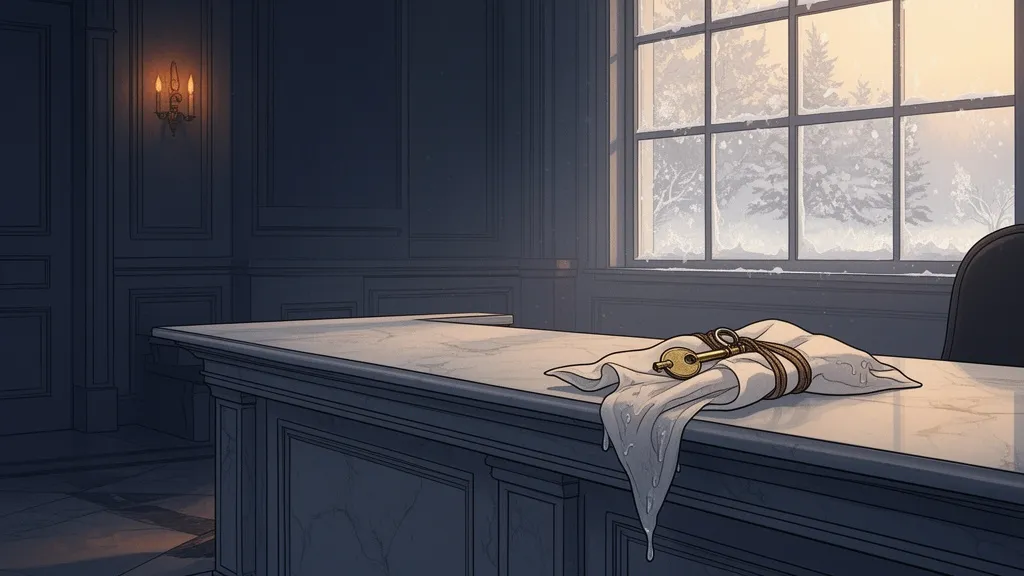
At 6:10 a.m., when the night porter came back from the side entrance with cold in his sleeves and a complaint prepared for the boiler, he found the room key on the marble desk.
It had not been there three minutes earlier. He was sure of that. The desk was old white marble veined with grey, and Keita Morimoto had polished it so often that any object left on it looked accusatory.
The key lay wrapped in a damp handkerchief. Beside it, the guest ledger was open to the previous night's page. One line had been scratched through so hard that the nib marks had cut the paper. The instrument, absurdly, was still there: a hotel teaspoon, its bowl bent a little from pressure.
Keita stopped with the draft still moving around his ankles.
On the sofa by the lobby window sat a pair of dark leather gloves, wet and shining. On the low table in front of them rested a chess clock. One side stood upright at eleven minutes. The other had run down. The mechanism still ticked in the quiet room with the persistence of a bad idea.
He put the back of his fingers to the handkerchief first. Wet. Meltwater, perhaps. No blood, thank God. He unfolded it carefully. Key tag: 214.
Keita looked up at the brass board behind him. The hook for 214 was empty.
The line in the ledger, though clawed at, could still be read. The guest had signed in under her own name. That, more than anything, made him uneasy.
17 October
Room 214 — Ms. Ayaka Noguchi — Tokyo
Someone had tried to erase certainty and had only underlined it.
He rang Room 214. The telephone sounded and sounded. No answer.
By 6:17 he had gone upstairs with the spare key and come down again because the deadbolt was thrown from inside.
By 6:24 the manager was in the lobby in a cardigan over his pyjamas, blinking at the key as if it had committed a discourtesy.
By 6:31, with the cook, the chambermaid, and Keita all present for reasons none of them could later explain, they opened Room 214 by force.
The room was empty.
The bed had been turned down but not slept in. The bathroom towel was dry. The deadbolt was still set. The window was shut, and coated on the inside with a thin skin of frost that turned the dawn into milk glass. On the dressing table stood a small travelling clock and a lipstick. Under the chair lay one heeled shoe. Its pair was missing.
The manager made a frightened little noise, halfway between annoyance and prayer.
Keita did not blame him. A closed room with nobody in it was not a thing a hotel wanted, especially not in October, with the mountain roads becoming unreliable and the regular guests beginning to prefer inns lower down. Small hotels lived on reputation. They also died of it.
At 7:05, because the local police box was understaffed and because the manager's wife had once gone to school with her, they sent for Natsumi Kuroda instead.
She arrived at 8:12 carrying a canvas satchel, gloves in one pocket and, in the other hand, a paper cup of tea which had become lukewarm somewhere on the hill. Natsumi was a part-time lecturer in classical literature, a full-time inconvenience to careless liars, and the manager's wife's preferred solution to any problem not visibly on fire.
She listened without interruption while Keita spoke. The only sign of impatience was that she drank the tea anyway.
When he had finished, she set the cup down too close to the ledger and moved it away again.
"Show me everything in the order you found it," she said.
Keita did. He was a methodical young man, narrow in the shoulders and broad in conscience. Natsumi liked him at once. Night porters were usually either incurious or melodramatic. Keita was simply offended by inconsistency.
She examined the desk first. The handkerchief was plain white linen, monogrammed A.N. in one corner. Damp still. The key dry except where the cloth had touched it.
The scratched-out ledger line interested her more than the key. She bent close.
"With this spoon?"
"It was here," Keita said. "I didn't touch it until Manager Sakamoto saw it."
The spoon had indeed done the damage. The pressure marks were broad and shallow in places, sharp in others where the edge had dug. An angry instrument, but an inadequate one.
"If someone wished to remove the name," Natsumi said, "why choose a spoon?"
The manager said, "Panic?"
"Perhaps. Or because the spoon was to hand. Which tells us where they stood. Near the tea tray." She glanced at the low table. "And near the chess clock. Whose is that?"
No one knew.
She pressed the lever. The right dial clicked over from eleven to ten and fifty-nine. Mechanical, old, well-kept. Not hotel property.
"When did you last see it?"
Keita frowned. "I don't remember seeing it before this morning. But around midnight there was a gentleman in the lobby reading by the fire. He might have had it in his bag. I didn't notice."
"What gentleman?"
The manager produced the register. A Mr. Ebisu, retired dentist, room 118. Also a Professor and Mrs. Hanai in 203, a honeymooning couple in 210, and Ms. Ayaka Noguchi in 214. No one else had checked in after ten.
Natsumi looked at the wet gloves. Women's, she thought at once, though that proved nothing except scale. Dark brown leather lined in cashmere, expensive enough to be cared for and too wet to have dried naturally in the warm lobby. Left recently, then.
"Did Ms. Noguchi arrive alone?"
Keita nodded. "At 5:40 p.m. She carried one overnight case. She was... composed. She asked whether the road to the old observatory was still open in winter. I said not reliably. She signed, took tea in the lounge, and went upstairs around six."
"Did anyone visit her?"
"No one asked for her."
Natsumi went up to 214.
The room had the respectable gloom of provincial hotels: dark wood, heavy curtains, a wall print of a lake pretending to be more distinguished than it was. The forced door had splintered near the lock. The deadbolt was a simple thumb-turn. Nothing special, which was almost more annoying.
She touched the bedspread. Smooth. Not slept in. She touched the teacup left on the bedside table. Cold. One lipstick print. The tea inside had never been drunk beyond a testing sip.
At the window she paused. Frost on the inner pane, thin and even except for one clear oval near the latch, as if a warm hand had rested there or warm breath had clouded and melted it before the room cooled again.
The latch itself was shut.
Below the window, outside, was the steep rear slope behind the hotel. Stones. Hard shrubs. No balcony, no drainpipe worth trusting.
"Who set the heating?" she asked.
The chambermaid, Chie, said, "No one. That room's radiator sticks. It stays low unless you kick it. Guests complain every year."
Natsumi crouched. The radiator was indeed cool.
On the luggage stand lay an overnight case, closed. In its leather handle, tucked there with absent-minded neatness, was a luggage label bearing the initials A.N. On the dressing table sat a small bottle of perfume, lipstick, comb, and no handbag. Under the chair, one shoe. In the bathroom, no toothbrush. So either Ms. Noguchi travelled strangely, or she had not intended to stay the night however carefully she had performed the arrival.
Natsumi straightened.
"Who saw her after six?"
Chie said she had delivered extra blankets to 203 at 8:20 and passed a woman on the second-floor landing. Camel coat, dark skirt. She assumed it was 214. The woman had no shoes in her hand, no luggage, and was going down the stairs.
The manager said there had been no dinner order for 214.
Keita said that around 10:50 p.m. he saw a woman in the lobby from behind, seated by the window with Mr. Ebisu. They appeared to be playing chess. He had assumed she was Ms. Noguchi because of the coat over the chair. He had not wished to stare. Mr. Ebisu was the kind of guest who could turn scrutiny into a speech.
"And after that?"
"At 11:30 Mr. Ebisu asked for hot water. He was alone."
Natsumi looked down at the frost again.
A room unused. A deadbolt thrown inside. A key returned downstairs. Wet gloves. A chess clock. A woman signed in under her own name, then apparently vanished without her coat or second shoe. It had all the busy look of impossibility. Busy things were often simple when one removed enough of them.
By 9:30 she had interviewed Mr. Ebisu, who was exactly as Keita had implied: silver-haired, freshly shaved, and faintly wounded by the existence of other people.
He admitted at once that the chess clock was his.
"I travel with it," he said. "Some people carry devotional objects. Mine is punctuality."
"And your opponent?"
"A woman introduced herself as Noguchi. She sat poorly, moved decisively, and had no patience for openings. We played three games in the lobby because she said her room felt cold. Quite true, as it happened. She wore one shoe and one stockinged foot tucked under her. I asked no questions. I am not a barbarian."
Natsumi looked up. "One shoe?"
"She said the other pinched. I considered that a design flaw, not a confession."
"Until what time did you play?"
"A little before midnight. Then she said she had an appointment and left by the front door. She forgot the gloves. I forgot to remind her. There are limits to civic virtue." He folded his hands. "You now look interested in me for the wrong reason."
"Only for the right ones. Did she take her coat?"
"No. But she borrowed my scarf for the dash to the annex and returned it five minutes later."
"The annex?"
The hotel had, behind the main building and joined by a covered passage, a small bath annex and laundry room. Keita had gone there at 6:07 to check a drafty service door.
Mr. Ebisu said, "She asked where one might speak privately without waking sleeping people. I said the annex corridor was empty at this hour. She laughed at that. Then she went out."
"Alone?"
"I assumed so. I was studying a blunder I had not made."
Natsumi thanked him and went to the annex.
The covered passage had one side open to the air behind decorative latticework. In the coldest hours, wind came through in a disciplined manner. The flagstones still held damp in the joints. Halfway down, near the laundry door, she saw a darker mark on the wood rail: not blood, merely melted frost or snow from a sleeve laid there. On the floor, pressed into the thin tracked moisture, was the faint outline of one woman's heeled shoe and, beside it, the flatter edge of a man's outdoor boot.
The marks went only one way. Out from the main building, then muddled near the service stair that descended to the rear path. No corresponding return.
Keita met her there, pale with effort. "I remembered something. At 5:55 this morning, before I found the key, the side bell rang once. I thought it was wind. When I checked the corridor, no one was there."
"Which side?"
"The annex entrance."
Natsumi nodded. That was useful.
By noon, Ms. Ayaka Noguchi arrived.
She came in by taxi from the lower road, carrying a handbag and wearing practical shoes, no coat despite the cold. She was thirty-five perhaps, handsome in a severe way that suggested effort spent on becoming legible to fools. When the manager hurried toward her with relief prepared, she said, before he had spoken five words, "I never slept here. I signed in, yes. I left before dinner. If there has been some misunderstanding, I will settle the room charge."
The lobby became still around her. Even the chess clock seemed to tick more distinctly.
Natsumi, seated by the hearth with fresh tea too hot to be safe, watched Ms. Noguchi take in the gloves, the ledger, the faces. Surprise came and went. Annoyance stayed.
"You left your overnight case," Keita said.
A pulse moved in her jaw. "Did I?"
"And one shoe."
That made her look at him properly.
Natsumi stood. "Perhaps we might speak in the writing room."
Ms. Noguchi said, "If this is about my private business, I would prefer not to entertain the hotel with it."
"Then let us be efficient," Natsumi said.
In the writing room, where chrysanthemums attempted gaiety and failed, Ms. Noguchi sat with the posture of a person declining to be helped.
"You signed under your own name," Natsumi said. "People who mean to disappear for a night generally do not. So whom were you protecting?"
Ms. Noguchi gave a brief smile. "That is a vulgar question phrased elegantly."
"Yes."
The smile almost deepened. Then it disappeared.
"I came to meet someone," she said. "A woman. We had arranged it clumsily. She was staying nearby with relatives and could not be seen with me in town. I took a room here so we might speak. That is all you need."
"Not if your room was dead-bolted from the inside after you left. Not if your key was wrapped in your handkerchief and put on the desk at dawn. Not if your name in the ledger was scratched out by someone in too much of a hurry."
For the first time, Ayaka Noguchi looked genuinely unsettled.
"I did not do that," she said.
"Did you leave before dinner?"
A pause. "No."
"Did you play chess with Mr. Ebisu?"
Her eyes closed, once. "Three games. He talks as he plays. Very fast."
"And after midnight?"
She turned her ring around her finger. "I met her in the annex corridor. We argued. Quietly, I thought. She told me she could not come away with me, which was sensible and a little late. Then her brother appeared. Not by accident, I suppose. He had followed her. He was angry beyond proportion, which is common in brothers. He said I had no right to involve the family. She cried. I dislike scenes. I left by the rear path and walked down to the road."
"Without your coat?"
"She had worn it down to the lobby earlier, because she felt the cold more than I did. After we argued, she said she could not go home in it. So she took it back upstairs before her brother went to fetch her things." Ayaka looked at the chrysanthemums as if they had personally offended her. "I also changed my shoes with her for ten minutes, because one of mine was hurting and she said her walking shoes would be easier on the path. Then in the argument we failed to exchange back. That part sounds stupid because it was stupid."
It sounded stupid because it was true.
"Her name?"
"No."
"Then her brother's?"
"No."
Natsumi let the silence lengthen.
At last she said, "The brother returned to the lobby before dawn. He wrapped your key in your handkerchief because it was icy from being outside. He scratched out your name because he wanted no record that you had met his sister. He also had to lock Room 214 from the inside without being in it. That is the only part requiring work."
Ayaka's head came up. Whatever she had expected, it was not this calm arrangement of her disgrace into practical pieces.
"Can he do that?"
"Probably. Men with protective tempers are often inventive in small ways. Tell me this: when you left your room for the lobby, how did you leave it?"
"I locked it. Of course."
"With the key?"
"Yes."
"And the deadbolt?"
"No. That only turns from inside."
Natsumi nodded.
So the room had been ordinary when Ayaka last used it. The impossible state was created later.
She went back to 214 alone and looked where she had not yet looked: the gap under the door, the strike plate, the splintered edge, the rug. On the floor near the threshold, almost under the torn wood from the forced entry, lay a smear of something waxy and pale.
Soap.
In the bathroom the wrapped guest soap had been opened. One corner was shaved away in a thin curl.
Natsumi stood very still.
Then she smiled, not happily.
Downstairs, she asked Keita for the dessert spoons. He brought them in a baffled cluster. One was missing from the breakfast tray inventory. The bent spoon from the ledger was a teaspoon. Irrelevant to the lock, but useful to nerves. People scratched at paper when they needed to be doing something while waiting for courage.
She asked to see the family register from the village association office, which the manager's wife kept because this mountain managed paperwork with a confidence out of all proportion to its population. The nearby households included one Matsuno family in the old postmaster's cottage below the observatory road: widowed mother, son Haruki, daughter Rina currently visiting from Nagano.
At 1:40 Haruki Matsuno was fetched.
He arrived with the face of a man who had been expecting this since dawn and resented only the delay. He was twenty-eight, broad-handed, wearing mountain boots still wet at the edges.
Natsumi put the gloves and single shoe on the table between them. Not dramatically. Merely in reach.
"Your sister borrowed these badly," she said.
He looked first at the shoe, then at Ayaka Noguchi, who had remained in the writing room despite having every reason to leave. Something exhausted moved over his expression.
"Rina is back at the cottage," he said. "She has a headache. Please leave her out of it."
"Gladly," Natsumi said. "If you explain the lock."
He did not ask how much they knew. Sensible men seldom did.
"I came to fetch her," he said. "She'd left after midnight. Mother was frightened. I found them in the annex passage arguing. I said things. She cried. Ms. Noguchi left down the rear path. Rina said she couldn't face walking through the lobby dressed like that, in another woman's shoe. So I took the key from her and said I'd collect her things from the room."
He swallowed.
"I used the side stairs to the second floor. The room was already locked, of course. I opened it with the key. I took only the shoe she had left there, because she was too upset to notice she had gone home mismatched. Then I thought of the register downstairs. If Mother ever heard..." He glanced away. "I am not proud of the rest."
"But you are capable of describing it," Natsumi said.
He nodded once.
"When I left the room, I pressed a sliver of soap into the deadbolt socket in the doorframe. Then I shut the door and locked it with the key. The latch held. The bolt itself could not extend because the strike was filled. I went downstairs, scratched at the ledger like an idiot, and took the key outside because I thought better there. In the annex corridor, I rang the side bell to see whether anyone was about. No one came at once. So I wrapped the key in the handkerchief because it was wet and left it on the desk.
"Then I went back up the service stairs. I had tied black thread to the deadbolt thumb-turn before leaving the room, passed it through the gap by the hinge side and under the door. Once outside, after the soap had begun to soften from the room's warmth and the pressure on the door, I pulled. The bolt slid into place. The soap gave way enough for it to enter the strike. Then I tugged the thread free. Most of it came away. I thought all of it had."
Natsumi thought of the waxy smear by the threshold and the clear oval on the frosted window. Waiting in the cold room, of course, to be sure the trick had worked. Warm breath near the glass. A hand by the latch. Not an attempted escape at all, merely a nervous man verifying his own mechanism.
"The frost formed because the window was shut in an unheated room after midnight," she said. "Nothing supernatural. Only weather."
Haruki gave a short, miserable laugh.
"I know. It looked theatrical anyway."
"Most foolish things do. Why leave the gloves and chess clock?"
"The gloves were Rina's. She forgot them in the lobby earlier. The chess clock wasn't mine. I didn't notice it."
Mr. Ebisu, informed later, said this proved his long-held opinion that society had become inattentive.
The manager's relief was so intense it became administrative at once. There would be no police report beyond a note about a domestic misunderstanding. The room charge would be settled. The broken door repaired. The ledger, alas, remained ugly.
Ayaka Noguchi asked to leave by the side entrance. Rina Matsuno did not come up from the cottage. Haruki offered no apology grand enough to satisfy