The Green Thermos
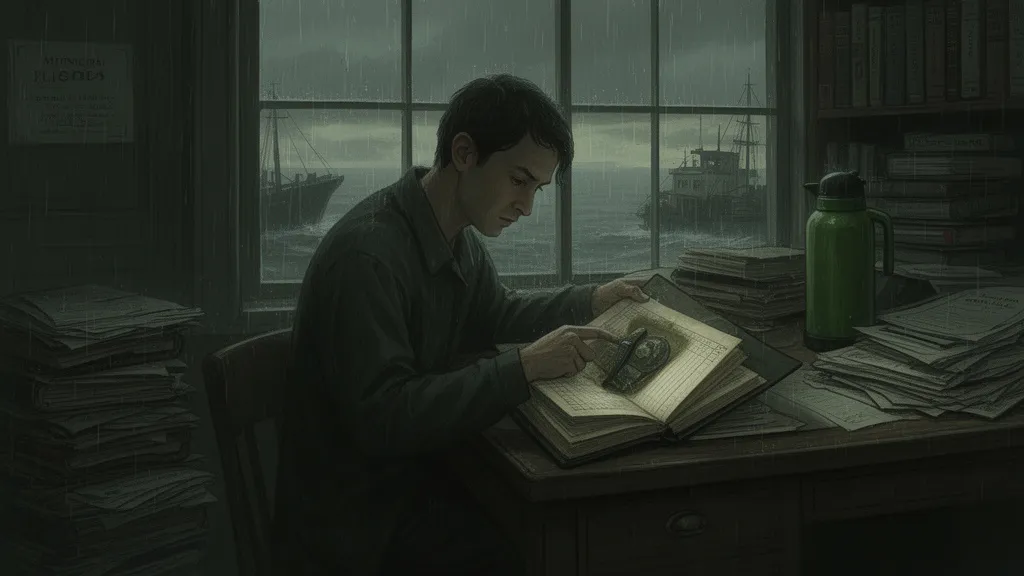
At three seventeen, with rain fretting at the archive windows like a patient creditor, Shiba Itsuki opened the harbor office ledger and felt paper where there should have been only paper.
He stopped with the book half spread beneath his hands. The returned volumes were always disagreeable in small, familiar ways. They came back swollen with damp, smelling of rope, fish scales, tobacco, old fingers. The harbor office treated municipal property as a category of weather. But this was different. Something sat inside the gutter of the ledger, not tucked loosely but pressed flat, as if hidden by someone who believed in exact placement.
Itsuki slid two fingers under it and drew out an envelope sealed with brown wax that had cracked into islands. Salt had softened the paper to a faintly granular texture. On the front, in block letters, was written only: For when somebody finally looks.
Below that was the date stamp.
He looked at it once, then again.
The municipal archive stamp read September 14. The night Kuroda Gen vanished from Pier Three.
Itsuki sat very still, one hand still on the warped ledger. Outside, rain ticked harder against the glass. In the reading room beyond the shelves, somebody pushed back a chair and coughed with theatrical perseverance. The archive continued around him in its ordinary, damp, mildly underfunded way. Only the date on the envelope was impossible.
Because on September 14 the ledger had not been returned.
He knew that with the intimate certainty of guilt. Three weeks ago, when the deputy mayor demanded complete harbor records for an audit that had not been scheduled and therefore had to be urgent, Itsuki had discovered the volume still missing from the harbor office. He had entered the return stamp himself rather than explain that a municipal office had failed to return a controlled record on time. He had meant to correct it quietly when the book came back. The archives survived on quiet corrections. So, occasionally, did archivists.
He turned the envelope over. No name. No seal but the ruined wax.
He could take it at once to Director Mamiya. He could also place it back where he found it, close the ledger, and spend ten minutes considering illness, transfer, and the possibility of becoming a fisherman.
Instead he opened it.
Inside was a folded square of paper and, beneath it, a single page torn from a tide schedule booklet.
The folded paper held a sketch done in carpenter’s pencil. A thermos, old-fashioned and squat, with a cup-lid unscrewed and lying beside it. The body of the flask was shaded dark except for one side, where someone had written green in small characters. Across the side of the thermos was a jagged line, the kind a child might use to mean a crack. But near the bottom, at the line of the base, there was a second mark—a tiny notch, drawn carefully, as if it mattered more.
The tide sheet had three times circled in blunt pencil.
8:10. 11:40. 1:05.
Nothing else.
Itsuki looked from one item to the other. He was a municipal archivist, which meant he spent most of his days with records, not mysteries. But records taught habits useful to both. Dates mattered. Hands mattered. The place where a page had been inserted mattered almost more than the page itself.
He glanced down at the ledger.
The spine label read: Harbor Office, Vehicle and Equipment Movements, Sept. 1–30. It had come back that morning in a sack with two rate books and a packet of invoices. Returned late, yes. Returned by clerk, according to the accompanying slip. Untidy but ordinary.
The envelope had been lodged between pages forty-eight and forty-nine.
Itsuki turned back to the entries around that place. Forklift use, fuel allotments, chain hoist maintenance, launch requests. The handwriting varied slightly by shift but not enough to matter. Then his eye reached page forty-nine and stopped.
The paper was paler.
He touched the corner. Thin. Too thin. Carbon paper copy, cut to size and pasted at the inner edge. Someone had replaced the original page.
A small, mean sensation moved down his back.
He turned the page with care. The carbon copy listed equipment checked out between 7 p.m. and midnight on September 14. Hand cart No. 2. Coil of mooring rope. Battery lantern. Thermos—crew room issue. Returned 11:20, damaged.
Thermos.
Green, perhaps. There was no colour noted. Of course there would not be. Municipal records were rarely poetic.
He read the names in the borrower column.
Hand cart: Minato, H. Mooring rope: Oda, T. Battery lantern: Kuroda, G. Thermos: Yoshino, E.
Kuroda Gen, dockworker, thirty-nine, missing. Presumed drowned, though no body had ever been found. The harbor had discussed him for a week with heartfelt certainty and contradictory detail, then less often, then only when weather or drink invited retrospective expertise.
Itsuki remembered the talk because he had been shelving maritime tax digests while two men from public works argued whether Kuroda had walked off in despair over debts or gone over while trying to secure a line in bad weather. Both theories had acquired supporters. Neither had acquired proof.
There had also been, he recalled, a woman from the harbor office crying in the corridor and saying to anyone who passed that Gen never drank tea from the common thermos because he said it tasted of metal.
He looked again at the carbon copy. Returned 11:20, damaged.
A damaged thermos entered a hidden envelope. A missing page acquired a substitute. His own false stamp now sat on the front of the whole business like a foolish hat.
“Shiba-san?”
He looked up sharply. Assistant clerk Nozue stood at the end of the shelf row with two bound maps against her chest. She was twenty-four, solemn, and perpetually surprised by dust.
“You’re still with the harbor returns?” she said. “Director Mamiya wants the inventory summary if you’ve finished cursing them.”
“I’m still cursing them.”
She accepted this. “There’s a man waiting, too. From the harbor. Very dry shoes for a day like this.”
“That is suspicious.”
“He appears to believe so.”
When she had gone, Itsuki slid the sketch and tide sheet back into the envelope but did not reseal it. He slipped it under the blotter on his desk and closed the ledger gently, as one might close the eyes of a witness.
The man from the harbor was Harbor Master Sakuma.
Sakuma was built like a wardrobe assembled by a conscientious carpenter. Rain glittered on the shoulders of his coat. He stood in the reading room beside the local gazette files, too broad for the space and faintly offended by all paper. His moustache was so exact that one suspected a ruler.
“Shiba-san,” he said. “I’m told our September equipment ledger was returned this morning.”
“It was.”
“I need to take it back.”
Itsuki felt his own face remain politely archival. “It has only just arrived.”
“Yes. Our clerk made an error.”
“An unusual event.”
Sakuma’s eyes rested on him. “If you prefer, I can call it an inconvenient one.”
That, from a harbor master, was nearly flirtation. Itsuki had known him for years in the way municipal employees knew one another: by signatures, corridor nods, and the occasional committee where everyone lied about storage capacity. Sakuma was generally thought to be stern. Itsuki thought he was merely a man who preferred that inanimate objects and human beings both remain where assigned.
“Director Mamiya isn’t here,” Itsuki said. “You know the procedure.”
“I know that a harbor office does not lose control of an equipment record during an audit week.”
Itsuki let a beat pass. “Then perhaps a harbor office should return its equipment records on time.”
Sakuma looked at him more sharply. Good, Itsuki thought. If one was already compromised, one might as well enjoy manners.
“I’ll wait,” Sakuma said.
He sat. The chair objected under him.
Itsuki carried the inventory summary to Director Mamiya’s office, found it empty, and stood for several seconds with the paper in hand, not moving. Report it now, and the stamp would be seen. Conceal it longer, and Sakuma’s presence downstairs would become impossible to ignore. The envelope under his blotter seemed to increase in weight by the moment.
On the director’s side table, tea waited in a pot gone lukewarm. On his own desk downstairs, his cup stood untouched and therefore certainly either too hot or already ruined by cooling. The archive was consistent in all the least useful ways.
He went back down.
Sakuma had not moved. He was studying the framed photograph of the archive staff from ten years earlier, perhaps trying to understand why institutions insisted on commemorating hairstyles.
“The director is out,” Itsuki said. “I’ll process the ledger after preliminary condition review.”
“I can assist.”
“With paper?”
Sakuma considered the insult and accepted it as within municipal range. “What condition issue?”
“Damp. Possible page substitution.”
That got him to his feet.
Itsuki did not enjoy secrecy, but he did enjoy choosing when it ended. He laid the ledger on the worktable between them and opened it to the replaced page. Sakuma bent over it, careful despite himself. He had square hands with a healed cut across one knuckle.
“This wasn’t here when I last saw the book,” Sakuma said.
“When was that?”
“September fifteenth.”
The day after Kuroda vanished. Sakuma did not seem to notice the significance of saying so immediately. Or he noticed and judged it harmless.
“You inspected the ledger after the disappearance?” Itsuki asked.
“Routine. We checked issue records for who had been on which pier and with what.”
“And found?”
“That Kuroda signed out a lantern and failed to sign it back in. It turned up later in storage.”
“Later when?”
Sakuma’s mouth tightened. “This is not a deposition.”
“No,” Itsuki said. “It’s an archive. We prefer dates.”
A small pause. Rain hammered the windows with renewed confidence.
“Two days later,” Sakuma said. “On a shelf in the chain locker.”
“Who found it?”
“Yoshino Ema.”
The name from the thermos line. Itsuki glanced down. “The same Yoshino who signed out the thermos.”
Sakuma saw the entry, and for the first time something in his expression changed. Not alarm. Recognition, perhaps, arriving late and unwillingly.
“Where did you get this page?” he said.
“Inside the ledger.”
“Don’t be evasive.”
Itsuki drew out the envelope and placed it on the table.
Sakuma did not touch it. That interested Itsuki more than if he had snatched it up.
“I haven’t shown this to anyone else,” Itsuki said. “Yet.”
“Open it.”
“It is open.”
Sakuma gave him a look one usually reserved for poorly stacked crates. Itsuki removed the contents and spread them. The sketch. The tide page. The harbor master looked at both without speaking.
“Do these mean anything to you?” Itsuki asked.
“No.”
It was too quick.
Itsuki had spent ten years listening to people explain missing deeds, inverted dates, vanished annex maps, and one regrettable incident involving a goat and a zoning record. Most lies were not about content. They were about tempo. Truth often arrived carrying furniture. Lies liked empty rooms.
“You recognised the thermos entry before you answered,” he said.
Sakuma’s gaze lifted. “That is not the same thing.”
“Perhaps not.”
“Yoshino Ema left the harbor office last week.”
That was at least an answer adjacent to usefulness. “Transferred?”
“She resigned.”
“Why?”
“She did not offer me the courtesy of a reason.”
Itsuki looked at the tide sheet. “Three times circled. Not tide heights, only times. Eleven forty and one oh five would bracket low turn after midnight tonight.”
“You read tide tables?”
“I shelve them. The knowledge leaks.”
Sakuma took the sketch at last. “That thermos belonged in the crew room for years,” he said. “Green enamel, chipped at the bottom. It did crack in September. There was some fuss because the tea leaked.”
“Who noticed?”
“Half the office. There was tea everywhere.”
“And Kuroda disliked tea from it.”
Sakuma looked at him again, more narrowly. “You hear things.”
“People talk in archives. They believe paper cannot listen.”
There were footsteps in the corridor. Nozue appeared with a tray and two cups. One slopped. The tea was certainly volcanic.
“For the harbor master,” she said, and then, seeing the worktable occupied by a compromised ledger, a hidden envelope, and two men leaning over them as if considering murder rates in another prefecture, added, “Ah.”
She put the tray down and departed at once, which was tactful but not subtle.
Sakuma ignored the tea. Itsuki waited, then took a cautious sip and burned the front half of his thoughts.
“Who knew this ledger was missing?” he asked when speech became possible again.
Sakuma answered at once. “My clerk. Myself. Possibly Yoshino, if she noticed. Kuroda’s disappearance put everyone into other concerns.”
“Who had physical access?”
“The harbor office was not a treasury, Shiba-san.”
“So many.”
Sakuma exhaled through his nose. “Many.”
Itsuki turned the carbon page over. Blank back. He held it to the light. At the inner margin, where it had been attached, a roughness of scraped glue. Whoever replaced it had not had practice. Or had been hurried.
“Did Kuroda and Yoshino know each other well?” he asked.
Sakuma’s expression did not change enough. It changed precisely where it had to.
“There was talk,” he said.
“Of what kind?”
“The ordinary kind. A small office manufactures intimacy from seating charts.”
“That is not an answer.”
“No,” Sakuma said, “it is a correction. The talk was inaccurate.”
Itsuki set down his cup. “How?”
Sakuma looked at the rain-flecked window, then back to the page with Yoshino’s name. “People assumed she was involved with Kuroda because they were often seen walking from the tram stop together. In fact she was involved with my deputy, Minato Haru.”
Itsuki said nothing.
Sakuma added, with the same flatness, “They were discreet only in the way highly conspicuous people imagine they are discreet. Kuroda knew. So did two clerks, a watchman, and, I suspect, everyone on Pier Two.”
“Did Kuroda care?”
“I believe Kuroda was fond of her. Whether romantically, platonically, or from the habit of rescuing younger people from paperwork, I cannot say. He and Minato disliked one another.”
The rain drummed harder, then shifted with wind. Somewhere in the stacks a gutter made its old threatening noise.
“Where is Minato now?” Itsuki asked.
“At the harbor.”
“And if I ask him about the thermos?”
“You may receive either an answer or a performance. He is gifted in both.”
By five o’clock the archive had emptied of patrons and nearly of staff. Director Mamiya had telephoned from the prefectural office to announce delays, committees, and a regrettable dinner. This suited Itsuki. He signed out the ledger for emergency preservation review, a phrase broad enough to shelter several sins, and left by the side door under an umbrella whose ribs had lost faith.
Sakuma walked beside him without asking whether he was invited.
The harbor in rain looked temporary, as if made each morning from timber, rope, and opinion. Lamps had begun to glow under eaves. Water stippled the black surface between pilings. The office itself was lit in three windows. Inside, a radio muttered baseball to no one attentive.
Minato Haru was younger than Itsuki had expected and more handsome than useful men had any obligation to be. He wore his harbor jacket open and his expression as if it had been selected for him by an admirer. When Sakuma asked for the September thermos damage report, his first reaction was not confusion but annoyance.
“That old thing?” he said. “It cracked. We threw it out.”
“When?” Itsuki asked.
“After Gen went missing. Next day, maybe.”
“Maybe?”
Minato’s smile was very near insolence. “I don’t preserve domestic tragedies by date.”
Sakuma said, “Answer properly.”
Minato’s eyes flicked to him, then away. There was history in that glance, and obedience in it too, though not willing obedience.
“On the fifteenth,” he said. “Afternoon.”
“Who threw it out?”
“Ema asked me to.”
“Why?”
“It was broken.”
Itsuki laid the sketch on the desk. “Broken where?”
Minato glanced down. “Like that.”
“Which means you’ve seen the break.”
“I just said I threw it out.”
“Yes. And the notch near the base?”
Minato looked up too quickly. “What notch?”
The sketch lay between them with its tiny pencilled mark as innocent as a grain of rice.
Itsuki said, “The one you noticed before asking that question.”
Minato leaned back. “Archivists are intolerable.”
“That is our charm.”
Sakuma’s voice came flat as a board laid down hard. “Where is Yoshino now?”
Minato folded his arms. “How should I know?”
“You were living with her until last week.”
That landed. Itsuki watched the quick change in his face—the instinct to deny, abandoned because denial would expose more than silence.
“So?” Minato said.
“So,” Sakuma replied, “if you intend to lie, choose a smaller lie.”
Minato laughed once, without mirth. “You say that as if anyone here has chosen small ones.”
Nobody spoke for a moment.
Then Itsuki said, “Kuroda signed out a lantern and Yoshino signed out the thermos on the night he vanished. The ledger page recording those issues was replaced. An envelope was hidden inside the book with a sketch of that thermos and three tide times. Whoever hid it expected the ledger to be found late, if at all.”
Minato’s expression had become watchful. Beneath that, something frayed.
“What happened on Pier Three at eleven forty?” Itsuki asked.
Minato did not answer.
“Or at one oh five,” Itsuki said.
“It rained,” Minato said. “It was dark. Everyone worked. Then Gen disappeared. That’s what happened.”
“Did he and Yoshino meet that night?”
“I don’t know.”
A lie, but a tired one.
Sakuma said, “The truth would help you.”
Minato looked at him with sudden, clean contempt. “Would it?”
Itsuki saw then that the affair Sakuma had described was not finished in the ordinary sense. Minato’s anger had too much shape. Not toward Yoshino. Toward Sakuma, certainly, but not as a subordinate toward a superior. More personal, more disappointed. Small communities did not make relationships simpler. They merely reduced the available furniture for hiding them.
Minato said, “Ema met Gen to give him something. Tea, maybe. He was soaked through from the rain. She took the thermos because she always fussed. Happy?”
“What did she give him?”
“I don’t know.”
This time Itsuki believed him.
“At eleven forty?”
“No. Earlier. Around eight.”
One of the circled times.
“Then why circle eleven forty and one oh five?”
Minato’s jaw worked. “I said I don’t know.”
On the shelf behind him, tied docket bundles sat in twine. A battery lantern, old and brass-handled, hung from a peg by the door. Itsuki crossed to it.
“Is this the lantern Kuroda signed out?”
Minato shrugged. “Probably.”
Itsuki took it down. The number scratched on the base matched the ledger notation. He opened the casing. Dry. Cleaned recently. But around the handle hinge, lodged in old grease, was a crescent of green enamel no larger than a fingernail clipping.
He held it under the desk lamp.
Sakuma came close. “From the thermos.”
“Likely.” Itsuki set the lantern down. “A cracked thermos does not usually strike a lantern hard enough to chip enamel into the hinge unless one object was swung against the other.”
Minato said nothing.
Itsuki looked at the tide sheet. “Eight ten: when Yoshino met Kuroda. Eleven forty: low-water turn. One oh five: enough rise to float a small skiff off mud at Pier Three.”
Sakuma’s head turned slightly. He was following now.
“Not drowning, then,” he said.
“No,” Itsuki said. “Transportation.”
Minato gave a short, exhausted laugh. “You make it sound elegant.”
“Only because the truth usually is not.”\