The Hallway at 1:17
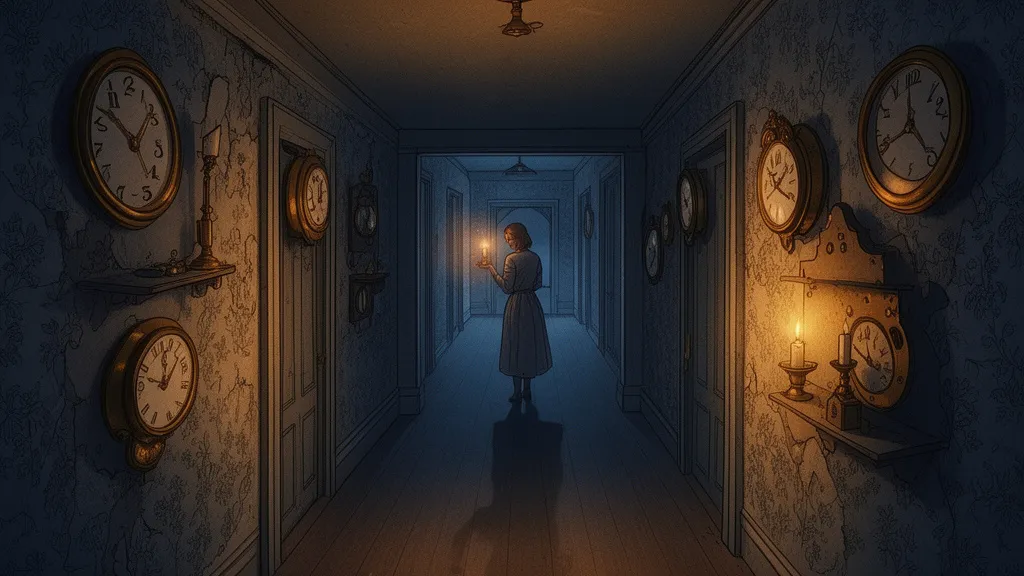
At two in the morning, Hirose Naoko stepped into the upstairs hall with a candle in one hand and saw that time had arranged itself badly.
There were six clocks in the boarding house corridor. The landlord, Senda Takuji, collected them in the hopeful manner of men who did not understand their own hobby. One brass carriage clock hung on a nail by its handle. Two cheap wall clocks, both with painted roses, kept no decent time even when encouraged. A black mantel clock sat on a narrow shelf that had no business holding it. There was a station clock with a cracked face and a walnut Vienna regulator that was both too good for the house and too large for the landing. At the far end, outside the top-floor corner room, stood a squat alarm clock on a little stand because, as Senda had once explained, the guest in that room liked to hear ticking.
All six had stopped.
All six showed seventeen minutes past one.
Naoko stood still. She was sixty-three, narrow-shouldered, and moved with the caution of a person who had spent forty years handling springs small enough to disappear into skin. The candle flame bent in the draught from the stairwell. Nothing else moved.
Then she heard the kitchen clock downstairs, ticking with obstinate energy.
That, more than the six halted clocks, sent her down.
The house was a converted villa near the sea, old enough to have settled into several opinions about level floors. In summer it took students, bird-watchers, and sentimental couples. In October it took whoever had missed the last train and discovered that the cheaper inns by the harbour smelled of diesel and despair. The sign outside called it Aonagi House. Inside, its wallpaper had browned politely.
Naoko reached the kitchen. The clock on the wall above the dresser was running backward. Not quickly; not theatrically. It ticked with the steady, small arrogance of a machine obeying its own injury. The minute hand crept from sixteen to fifteen.
Below it, on the table, a saucer of tea had spread into an amber ring. The cup lay on its side. A teaspoon rested in the spill like a man who had given up halfway across a river.
Naoko set down the candle, took the clock carefully from its hook, and listened. The escapement was catching in reverse. Not impossible, merely wrong. Someone had mishandled it, or dropped it, or forced the hands and shaken something loose. Her fingers smelled faintly of brass and tea.
Behind her, in the doorway, someone said, “Mrs Hirose?”
It was Kanda Mie from room three, wrapped in a green cardigan over a nightdress and holding herself with the rigid dignity of the newly startled. She taught singing at a girls’ school in Yokohama and had told everyone this by breakfast on the first day.
“You’re awake too,” Mie said. “I thought I heard something. Is Mr Senda up?”
“No.”
“What happened?”
Naoko looked at the overturned cup. “That,” she said, “is what I intend to ask.”
A floorboard creaked above them.
Both women looked up.
There was a quick tread, then a pause, then another tread, as if someone had remembered too late that running made a statement.
Senda Takuji came down in his shirt sleeves, with his belt unfastened and his hair bearing the marks of a pillow only on one side. He was a broad man in his fifties, gentle in manner when watched, evasive in the intervals. He blinked at the kitchen and said, after a useful delay, “What’s all this?”
Naoko raised the clock in one hand.
“Broken?” he said.
“And six upstairs stopped at 1:17.”
That brought a little too much expression to his face before he arranged concern over it. “Six?”
“The hallway clocks.”
Kanda Mie gave a soft, unhappy gasp, pleased to have a reason for it. “Is that important?”
“It depends,” Naoko said, “on whether one likes cause.”
Another door opened upstairs. Then another. Voices began to call along the corridor, asking what was wrong, and one voice did not answer.
The missing guest was in the top corner room, where the squat alarm clock stood outside. His name was Nakahara Jun, thirty-two, a translator according to the ledger, quiet according to everyone who had met him, and absent according to the room itself.
The door was locked from the inside.
Senda rattled the knob, called Nakahara’s name twice, then three times, and glanced at Naoko as if locked doors were an imposition she had arranged. The key was not in the outer keyhole. There was no answer from within.
The windows on that side of the house looked over a narrow strip of gravel and then the cliff path down to the beach. Three floors, if one was unromantic about attics.
“Perhaps he is asleep,” said one of the other guests, a university assistant named Fujishiro who wore round spectacles and pyjamas under a cardigan and seemed embarrassed by every noun he used.
Senda hit the door with his shoulder. It held.
“Stand back,” Naoko said.
This was not because she intended to force it. It was because she wished to kneel.
The keyhole was old-fashioned and rather talkative. She held the candle low and examined the scratches around the plate, the gap under the door, the thin line where old paint had sealed and resealed the frame. Someone behind her breathed loudly in suspense. It did not help.
“There is a key inside,” she said.
“How can you tell?” Mie asked.
“I cannot prove it from the draught,” Naoko said. “But the lock gives a different resistance when something is in the barrel, and the keyhole shows no light through it. We may as well ask it properly.”
Senda said, “Then we can’t—”
“We can,” Naoko said. “Bring me a newspaper. And something thin. A hairpin will do.”
Kanda Mie at once produced three hairpins from somewhere in her hair that suggested she had hidden architecture there all evening. The newspaper came from the stair landing.
Naoko slid the folded sheet under the door until it lay beyond the inner threshold, then inserted the pin into the keyhole. The mechanism was simple. The key within resisted, then moved. There was a tiny metallic complaint. Something dropped on to paper.
She drew out the newspaper. The key lay on it, harmless and complete.
One of the guests made a gratifying noise. Senda took the key, hesitated half a second, and opened the door.
The room contained no man.
It contained a bed slept in but not greatly disturbed, a washstand, an open wardrobe, a travel rug over the chair, a rain-dark wool coat hanging from the bedpost, one snapped spectacle arm on the floor near the radiator, and a window latched shut from within.
The sea could be heard below, although not seen. The curtains breathed in and out from a gap in the frame.
“Good God,” said Fujishiro softly, as if his education had not prepared him for disappearance.
Naoko entered. The others remained at the door, because even nonsense gains authority if introduced as a locked room.
The coat drew her first. It was damp from the shoulders to mid-sleeve but not at the hem. Not rain, then, unless its owner had stood in a very selective weather. Sea mist perhaps, or spray. The room itself was not damp enough to account for it.
She touched the cloth. Cool still.
On the floor by the radiator lay the broken arm of a pair of spectacles. Brown tortoiseshell, ordinary. The break was fresh, pale at the snap. A person might lose a spectacle arm in a fall, or in being stepped on, or in taking off spectacles one-handed while upset. The possibilities were numerous and therefore unhelpful, which was common enough at the start.
Something blue had caught in the radiator grille. A thread, wool or a wool blend, half an inch long.
Behind her, Senda said, “Perhaps he has gone out by another way.”
Naoko turned. “By which?”
He spread his hands. “The window? A rope?”
“There is no rope.”
“There was one?” Mie suggested, eager to contribute to disaster.
“No,” Naoko said. “There was not.”
She crossed to the window and examined the latch. Dust sat undisturbed along the lower edge except where the curtain brushed it. The inner sill had no scuff marks, no grit, no smear of salt-wet shoe. If a man had climbed out here, he had done it while hovering two inches above the wood.
She looked back at the door. The key now rested in Senda’s palm. A locked room was only a fact. People did the embroidery afterward.
“Has anyone seen Mr Nakahara since supper?” she asked.
There was the usual small confusion of memory. Supper at seven-thirty. Nakahara had eaten little. He had spoken with the woman in room five—Miss Okabe, a printmaker from Tokyo with cropped hair and a practical voice. They had sat in the lounge after dinner. Then she had gone to bed with a magazine. He had remained by the fire, reading. Senda had cleared glasses at half past ten and had seen him still there. At some point after eleven, presumably, Nakahara had gone upstairs. No one had remarked on him after that because people rarely did until absence converted them into witnesses.
Naoko asked Miss Okabe, “What did he speak to you about?”
Okabe leaned against the wall, arms folded, in yesterday’s shirt and a pair of loose men’s trousers that suited her indifference. “The lighthouse path. He asked whether it was safe at night. I told him only if he had a reason to break his neck.”
“Did he say why he wanted to know?”
“No.” She glanced toward the empty room. “He seemed low. Not dramatic. Simply occupied.”
Occupied was a fair word. It allowed grief, debt, love, and indigestion equal room.
Naoko said, “Did he wear spectacles?”
“Yes,” said three people at once.
Senda added, “Reading glasses. Thin fellow. Grey coat.”
“The coat is here,” Naoko said.
“And damp,” said Okabe, noticing at once what others had failed to.
Naoko gave her a brief look. “Yes.”
Senda moved to the washstand and lifted, for no reason she could see, the soap dish, then set it down again. “Shouldn’t we call the police?” he asked.
“In due course,” Naoko said. “Before that, we should avoid becoming inventive.”
He gave a short laugh that did not enjoy itself.
By half past two the house had settled into a kind of organised wakefulness. No one returned to bed. Tea was made and arrived, through no fault of Naoko’s, at exactly the wrong temperature: hot enough to punish and not hot enough to justify the punishment. She drank it anyway.
They gathered in the downstairs sitting room while Senda sent the maid’s boy to the village police box. The sea sounded close, though the tide was out. On the mantel, the clock there still worked because Senda had forgotten to place it in the hall and let it join the others in solidarity.
Naoko sat with her cup and asked for a plain account from each person.
They were seven in the house besides Senda and the kitchen maid, who slept in the annex and had heard nothing. Kanda Mie had gone to bed at ten-thirty and had woken at one, she thought, because someone walked along the hall in outdoor shoes. Fujishiro, the assistant, had been writing letters until nearly one and had heard the hall clock strike once, then not again. Miss Okabe had lain awake after midnight and had heard a cup break or fall downstairs. A commercial traveller in room two offered nothing except resentment at being included. An elderly couple from Chiba supplied matching inaccuracies.
Naoko listened for shape rather than certainty.
At one point Senda left the room to fetch more charcoal for the brazier. He was gone only a minute. When he returned, Naoko rose almost at once and said, “I should like to see the stairs again.”
She had no immediate need. She merely wished to interrupt him.
On the first landing she stopped.
By the umbrella stand, where there had been nothing before, stood a woman’s house slipper.
Red felt, worn at the heel.
Naoko looked at it, then called down, “Miss Kanda, have you mislaid a slipper?”
Mie climbed up, puzzled, and said, “No. Mine are green.”
The slipper was not hers, nor anyone’s among the guests. Senda, behind them on the stairs, said too quickly, “It must have been under the table all along.”
Naoko met his eyes.
He looked away first, which was useful.
“Mr Senda,” she said mildly, “if you continue introducing objects into the night, you will make it longer.”
“I don’t know what you mean.”
“I think you do. Please stop.”
Mie stared from one to the other with frank delight. The commercial traveller muttered that this was absurd. It was, but that did not lessen its importance.
Naoko bent and picked up the slipper. On its sole clung a crescent of fine grey ash.
Not from the hall. From the kitchen stove, perhaps, or from the back step where cinders were tipped. She turned it over, then handed it to Senda. “Put it back wherever you found it,” she said.
“I found it here.”
“Then your house is learning tricks.”
He coloured. The others watched him with the sudden attentiveness of people who had lacked a villain and were relieved to be offered a provisional one.
Under the stairs, while searching for nothing in particular and therefore something, Fujishiro called out. There was a suitcase there, pushed behind a bucket and a rolled mat.
It was Nakahara’s. The luggage label gave his name and a Tokyo address. The leather was good but old. The clasps were fastened. When Senda pulled it free, something heavy inside slid from one side to the other with a compact, dense thud.
No one liked that sound.
Mie whispered, “Surely not—”
“No,” Naoko said. “A human body would answer differently.”
That comforted no one except, perhaps, the body in question if he still existed.
She knelt by the suitcase. The dust beneath it had a clean gap where it had been moved recently. The handle was dry. On one corner there was a faint dark smear, not blood, not mud; tea, perhaps, or soot-water. She sniffed. Salt.
“Did you put this here?” she asked Senda.
“Of course not.”
“Did you see who did?”
“No.”
“Then someone carried a heavy suitcase through your hall after midnight, and you noticed nothing.”
“I was asleep.”
“Yes,” said Naoko. “Conveniently.”
Senda stiffened. “If you are accusing me—”
“I am observing you. It is less dramatic.”
She opened the suitcase.
Inside were clothes, neatly folded, books wrapped in paper, a shaving kit, a tin box of medicines, and at the bottom, beneath two sweaters, a bronze ship’s clock the size of a dinner plate.
It had come loose from its bracket and shifted when moved. That explained the weight and the sliding thud. It also explained something else.
Naoko lifted it carefully. The bezel was dented. There was a trace of white plaster along one edge and a fresh scrape on the winding arbor.
Senda made a sound through his nose, not quite a sigh.
“Nakahara brought this?” Okabe asked.
“Apparently.”
“A theft?”
“Possibly. Or a quarrel over property. Or a gift poorly timed.”
Naoko looked at Senda again. “Did you know he had this?”
“No.”
He answered too quickly once more. There was a pattern beginning, which was one of the more generous things a liar could offer.
At ten past three, before the village constable arrived, Naoko went back to the top room alone.
There were only a few facts she trusted. The hallway clocks had all stopped at 1:17. A kitchen clock had been damaged and reversed. A cup of tea had fallen downstairs. Nakahara’s coat was damp at the shoulders and sleeves but not the lower half. His spectacles had broken near the radiator. His suitcase had been hidden under the stairs. Senda had moved at least one object to alter suspicion. Therefore Senda feared what straightforward observation would produce.
But fear of scandal and fear of murder were not the same thing.
She stood by the bed and considered the coat again. Then she looked at the radiator. It was old, with a narrow gap between it and the wall. A thread of blue wool had caught on one rough point.
Blue.
Not from Nakahara’s grey coat.
She searched the room more slowly. On the bedcover near the pillow was a grain of white grit. On the washstand shelf, another. She rubbed one between finger and thumb. Plaster, perhaps. Near the skirting board, beside the wardrobe, a darker flake: paint, old cream paint.
The room shared a wall with the narrow service passage behind the house. At the back of the building there was also a disused linen cupboard reached from that passage. Naoko remembered this because on the first day she had opened the wrong door in search of the bath and found herself confronting stacked blankets and a resigned spider.
She crossed to the wardrobe and pulled it gently away from the wall.
A rectangle of newer paint showed where it had stood for years. At shoulder height, partly hidden by the hanging rail, there was a small panel in the wall the size of a ledger book. Its edges had been painted over repeatedly. Tonight the paint along one side had cracked.
Naoko touched it. It moved inward a fraction.
A service hatch.
Not a secret passage. Boarding houses rarely justified romance when bad maintenance would do. Once, perhaps, there had been a dumbwaiter shaft or a linen hatch between rooms and passage. It had been sealed, painted, forgotten, and lately reopened by force.
She did not open it yet. She returned the wardrobe as nearly as possible to its former place and went downstairs by the back passage instead.
At the rear, near the kitchen yard, hung pegs for coats. One peg was empty. On another hung a blue wool coat, damp to the elbows and crusted with sea salt at one cuff.
Miss Okabe, coming out of the scullery with a kettle, saw Naoko looking at it and said, “That’s Senda’s.”
Naoko touched the cuff. A thread was missing where the weave had snagged.
Blue.
“Have you been outside?” Naoko asked.
“Me? No.”
“Him.”
Okabe considered. “When we all came downstairs, his shoes were wet. He’d had no time to make them wet indoors.”
“Why did you not say so before?”
“You had enough already.”
That was sensible. Naoko approved of her increasingly.
“Did Nakahara mean anything to you?” she asked.
Okabe glanced at the kettle as if it were socially easier. “We met here last spring. We spent two days walking and not pretending it was courtship. He wrote once in summer. Then again last week asking whether I would be here now.” She looked up. “That probably sounds more organised than it was.”
“No,” Naoko said. “Only less categorised.”
A small smile touched Okabe’s mouth and went. “He wanted to ask me something. I thought perhaps whether I would come away with him. Or whether I would not. He had that sort of face this evening.”
A face carrying a question to which either answer would alter a life. People were not subtle when they believed they were.
“Did Senda know this?” Naoko asked.
“I doubt it. Unless he was eavesdropping for emotional content.”
“He was not. He is practical.”
“Then practical about what?”
Naoko looked toward the stairs. “Money, I think. And an object in a suitcase.”
The constable arrived at three-thirty with damp trouser hems, a notebook, and the calm of a man who preferred stolen bicycles to impossible rooms. He was called Mori. Naoko explained the locked door first, because policemen were entitled to be annoyed in the proper order.
Then she asked Senda to join them in the top room.
He did so unwillingly, which in itself was almost refreshing.
Naoko moved the wardrobe aside and showed the panel. Mori gave an interested grunt.
“This opens to the service passage?” he asked.
“Yes. The paint on the edges cracked recently. The plaster dust on the bed and floor came from forcing it.”
She pressed the panel. It swung inward into darkness with a dry scrape. Beyond lay the narrow passage between wall and outer structure, scarcely wider than a man’s shoulders. Cold air rose from below. There were fresh marks on the wood where something had brushed through in haste.
Mori bent with the candle. “A person could pass.”
“Just so.”
Senda said, “I had no idea that was there.”
Naoko did not answer him. She addressed Mori.
“At some point after one, Nakahara was in this room. Someone came to see him. There was a quarrel. His spectacles broke. The visitor wore a blue wool coat and caught a thread on the radiator while turning or reaching. Nakahara left not through the window or the door, but through this hatch into the service passage. Either willingly, to avoid being seen, or under pressure.”
Mori looked at Senda’s blue coat visible through the open door where Okabe now stood in the hall. “And the