The Harbor Locker
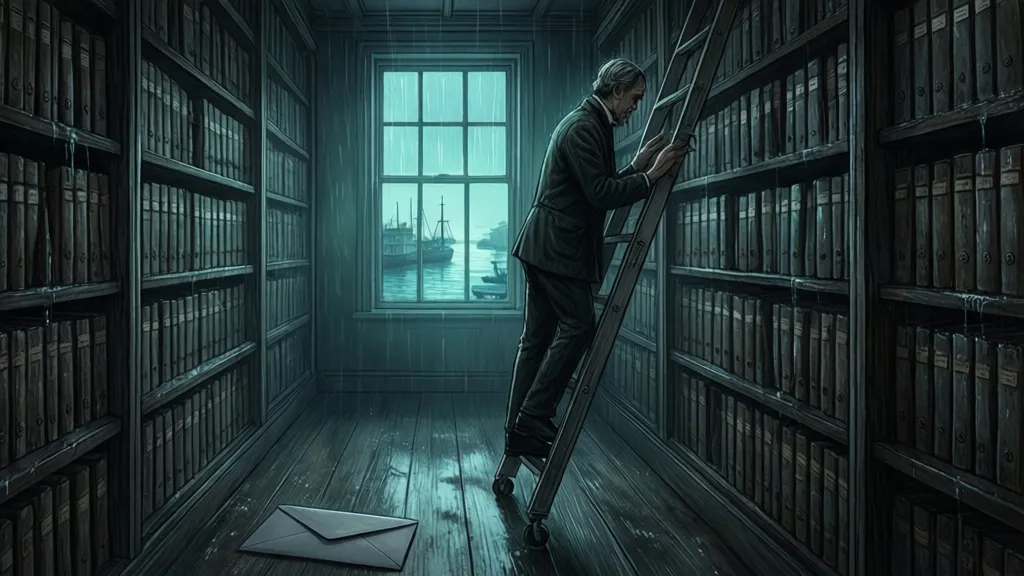
Fumika Seno found the envelope when she reached too far for a ledger nobody had requested in twelve years.
The municipal archive occupied the old tax office behind the harbor road, a building so damp in winter that paper acquired moods. At half past ten, with the rain gone and the tide turning, Fumika stood on the rolling library ladder in her cardigan and cotton gloves and pulled at a row of oversized accounting books labelled FISHERY COOPERATIVE, 1989–1993. One of them resisted. She frowned, shifted her grip, and drew the volume out by another inch.
Something folded and grey-white slid from behind it and struck the floor with a sound too soft for a ledger, too heavy for a letter.
She climbed down.
The envelope was wet through one corner and stiff with salt. Not sea-soaked exactly; it had dried once, then taken damp again. Her name was not on it. On the front, in dark blue ink gone feathery at the edges, were written four characters she knew well enough to stop moving.
To Ms. N. Tsukuda.
The hand was narrow, careful, with a tendency to make the last stroke of a character longer than propriety required. Mika Tsukuda wrote that way on requisition slips, meeting notes, labels for cardboard boxes. She had worked three desks over from Fumika for six years, and three weeks earlier she had gone out during lunch and failed to come back.
People had said vanished only after the first week. Before that they had said taking space, upset, with her sister probably, she does odd things when pressed. The police had asked routine questions. The station chief had become redder around the ears than usual. Mika’s apartment had contained nothing dramatic: two ferns, a stack of mystery paperbacks, a yellow raincoat, an unpaid gas bill, and a mug with a chip at the rim.
Fumika bent, picked up the envelope, and felt at once that there was more than paper inside.
The archive was quiet in the complete way only municipal buildings managed at night. A strip light hummed above the catalogue cabinet. Beyond the frosted windows lay the harbor road, then the black water. Fumika looked toward the door out of habit rather than fear. Nobody was there. The night watchman did not come to the records floor unless there was a leak, a smell, or a television crew.
She opened the envelope with the bone folder she kept in her pocket.
A single page came out first, torn raggedly from a larger form. The top line, still intact, read KASUMI MARU—PASSENGER MANIFEST, 17 SEPTEMBER. Below that, names in two neat columns. Twenty-three remained legible. One had been scratched out with such force that the paper had almost split.
The second item was a small brass key wrapped in a strip of pharmacy receipt paper, the kind printed on smooth, thin stock that curled when folded. Fumika opened it and read:
Minato Pharmacy
3 Sept
Cold tablets / adhesive bandage / saline wash
On the blank side, in the same narrow hand as the envelope, Mika had written: If found late, harbor office. Before high tide.
That was all.
Fumika sat down because standing had become ornamental. Her chair gave its familiar small complaint. On her desk was a mug of tea prepared forty minutes earlier and already cold in the way tea became when left in a municipal building, acquiring not merely a lower temperature but a kind of moral disappointment. She drank it anyway, because it was there.
Then she looked again at the torn manifest.
The scratched-out name could not be read whole, but the violence had not quite succeeded. The tail of one character remained at the left edge. At the right, a rounded stroke. Between them, furrows where the pen had gone over the line again and again.
Not a crossing-out made for correction, she thought. An act of temper, or fear.
The harbor office stood two streets away, attached to the ticket shed used by the small ferry in summer and by fishermen all year. It ought to have been locked. It also ought not to contain anything addressed to a municipal accounts clerk who had vanished.
The station chief would notice the missing envelope if he searched Mika’s desk tomorrow. If he remembered there was a desk to search. If he connected it with old ledgers in an archive he treated as a geological feature rather than a department.
Fumika folded the receipt paper back around the key and put both into her coat pocket. The torn manifest she slid inside her notebook. She switched off the desk lamp, left the strip lights on, and went downstairs.
The night watchman, Mr. Kido, was in the front office reading a horse-racing magazine upside down relative to the room. He was not asleep. He had merely developed a style of wakefulness that mimicked sleep closely enough to discourage conversation.
“You’re going out?” he said, without lifting his eyes.
“Harbor office,” Fumika said.
“At this hour?”
“Yes.”
He turned a page. “If you drown, leave a note. The forms are tiresome.”
“I’ll do my best.”
Outside, the air smelled of salt and engine oil. Rainwater still occupied the ruts in the road, reflecting the harbor lamps in broken yellow lines. The sea was in one of its secretive moods, dark and economical. Fumika walked quickly, one hand in her pocket around the key.
Three weeks earlier, on the last day anybody admitted seeing Mika clearly, Mika had stood by the copier with a file of subsidy applications and said, with unusual vagueness, “If someone asked whether I was on the ferry that Friday, what would you say?”
Fumika had looked up from a budget table. “I would ask why someone had become interested in your transport history.”
Mika had smiled, but not with her whole attention. “You always make things sound recorded.”
Then she had gone back to her desk, where, a little later, she had borrowed correction fluid she never returned.
At the time, the remark had seemed one of Mika’s sidewise jokes. After she disappeared, it had become one more sentence everybody tried to remember too late.
The harbor office door was ajar by less than an inch.
Fumika stopped under the eaves and listened. From the pier came the clink of rigging, the slap of water against pilings, a radio somewhere playing enka softly enough to suggest loneliness rather than taste. No voice came from the office.
She pushed the door open.
Inside, the single room smelled of wet rope, old forms, and the sweet medicinal sting of camphor rub. A desk lamp still burned, hooded downward over a stack of tide tables. Beside it stood a mug with fresh tea leaves stranded against the porcelain high up, as if hot water had been poured not long ago and drunk badly or in haste. The chair was pushed back. On the floor near the stove lay two damp crescents of sand.
Fumika closed the door gently behind her.
The key tags hung on a board by the wall. Most bore labels in thick marker: SHED, FUEL BOX, SIGNAL CUPBOARD, LOCKER A, LOCKER B. One hook was empty. Below the board stood a row of narrow metal lockers painted municipal grey and flaking at the corners. Four doors. Three padlocks. One brass lock already inserted.
Fumika touched it.
The metal was warm.
Not hot. Not warm from the room; the room was cool. Warm from a hand, recent enough that the heat had not yet left it.
She did not move for several seconds. The absurd, practical thought arrived first: someone had just been here and might still be on the pier, and she had not brought an umbrella.
Then she noticed the pier map tacked to the wall beside the tide tables. Someone had marked tomorrow morning’s high tide in red pencil. Not circled. Underlined twice. Beside it, in shorthand common among harbor staff, was written: NORTH END POSTS GONE BY 5:20.
By 5:20 the water would cover the outer section of the service pier, including the mud where anything dropped, dragged, or written might be erased.
Fumika took out the brass key.
It fit the lock at once.
She did not turn it.
Instead she looked at the desk. Then at the sand on the floor. Then at the receipt paper, now flattened in her palm. Cold tablets / adhesive bandage / saline wash. Not a dramatic purchase. Something for a cut, perhaps. Or for salt in the eyes.
In the drawer of the harbor desk she found the overnight logbook. The most recent entry, in broad handwriting she knew belonged to Sugawara from the evening shift, read:
20:10 — Checked service lockers. A and C occupied by maintenance gear. B empty. D jammed again.
No later note. The lamp had been switched on after that. The tea had been poured after that. The warm lock belonged after that.
A bicycle bell rang outside, then passed.
Fumika let out the breath she had been keeping and looked again at the lockers.
If she opened one now, she would be doing so before informing the police, before informing the station chief, and while holding an envelope that was not hers. If she waited, morning would bring questions, authority, and perhaps the loss of whatever the tide intended to remove.
She turned the key.
The lock opened with a small, indecently domestic click.
Inside the locker was no body, no money, no dramatic parcel. There were three things: a pair of women’s harbor boots with dry mud on the soles; a cloth satchel; and a rolled sheet of waxed paper tied with string.
The boots were Mika’s. Fumika knew because Mika had once complained for ten full minutes that the right one rubbed at the heel, then continued wearing them for two winters.
The satchel contained a ledger book from the harbor office, unofficial and older than the others on the shelf. Not ancient. Five years, perhaps. Names, dates, cash figures. Beside certain ferry crossings, in pencil later partly erased, were marks that did not belong to ticketing—small circles, triangles, and once a square. Against three dates were initials F.K.
The waxed paper held a stack of photographs. Not salacious, which would almost have been simpler. They showed deliveries at the municipal pier after hours: cartons moved from the ferry to a fisheries truck without entry in the shipping sheet; a man from the station office handing over envelopes; once, unmistakably, the station chief himself under a cap too informal to save his dignity. In the last photograph Mika had caught a face turned toward the lens.
Naoto Tsukuda, harbor assistant, age twenty-nine, brother to Mika Tsukuda, and widely considered the sort of handsome that exhausted women in stages.
Fumika sat back on her heels.
So that was why the envelope had been addressed to Ms. N. Tsukuda. Not Mika’s brother. Noriko Tsukuda, their aunt, lived above the stationery shop and had raised both of them after an accident on Route 7 took their parents. If Mika vanished, Noriko would be the person she trusted to decide what to do next. It was a family precaution, not a message to the dead.
Fumika returned to the manifest in her notebook.
The ferry date, 17 September, had been eight days before Mika disappeared. F.K. in the secret ledger. A scratched-out passenger name. She went to the desk and compared the broad figures in the harbor ledger to the torn page. On 17 September, there should have been twenty-four passengers. The official total in the day book said twenty-three.
One had been removed after the fact.
Not from a public record, she thought. From an internal one. Someone had meant not to erase a crossing entirely, only a person.
The initials F.K. belonged, almost certainly, to Fumio Kijima, deputy station chief and a man whose shirts always looked as if they had been ironed by threat. But the photograph was of the station chief himself, Mr. Arai, accepting an envelope at the pier. Petty smuggling? Off-book freight? Cash skimmed from late deliveries? Municipal corruption had a way of being less glamorous than advertised and more stupid.
Stupid enough to frighten someone, all the same.
She looked again at Naoto in the final photograph. His expression was not criminal. It was worse. He looked cornered.
There were footsteps outside.
Fumika switched off the desk lamp and stood very still. Through the window she saw a shape pass the glass and stop. A hand tested the door, found it shut. A pause. Then the footsteps moved away down the pier with care rather than speed.
Not Sugawara, she thought. Sugawara walked like furniture.
She waited a full minute before relighting the lamp.
Now consider this differently.
If Mika had discovered irregularities at the harbor and collected proof, she might have hidden it here. If she feared someone at the station office, she would not bring it home. If she expected to be questioned about the ferry manifest, she might ask Fumika in that sideways way what Fumika would say.
But if she intended the envelope for Aunt Noriko, why place it behind fishery ledgers in the municipal archive?
Because she had not placed it there.
Someone else had. Someone who knew enough of her habits, or of her friendship with Fumika, to know it would be found eventually in the one room Mika had worked in before transfers and reorganisations scattered their department. Someone who wanted the message found late.
If found late, harbor office. Before high tide.
Not a hiding place, then. A warning sent after she was already gone.
Fumika put the photographs back in order. One corner of the last print was creased and gritty. Sand had worked into the emulsion. Not harbor-office floor sand, which was pale and fine tonight, but darker mud-sand from the north end of the service pier where old timber posts stood in a row and the tide reached hardest. She knew it because archives required occasional site visits to certify municipal property no one had used in decades. Administration had many humiliations.
If something had happened to Mika, it had happened there, or evidence of it had been there. And by 5:20 the marks would be gone.
She wrapped the key, pocketed the photographs and the torn manifest, left the boots and ledger where they were, relocked the locker, and went out at once.
The north end of the service pier was a place for practical men and no one else. The boards changed underfoot from maintained planks to older timber patched in sections. At low tide the mud flats opened on one side like a dark tongue. Tonight the water had begun to creep back over them, patient as bookkeeping.
Her shoes picked their way by the harbor lamps. Halfway down she saw where someone had recently slipped or struggled: one handprint in wet grit on the edge board, then a drag mark toward the outer posts. There, where the mud showed between pilings, a pattern remained under the withdrawing water.
Not many marks. Enough.
One set of harbor-boot prints, smaller. One set of men’s shoes, turned outward slightly at the left foot. Naoto walked that way; she had noticed because his shoes wore unevenly and he blamed the roads. A second men’s pattern crossed them later, broad and hard at the heel. Between the smaller prints and the waterline were signs of someone kneeling. Near the end post lay a broken white plastic cap from a saline-wash bottle.
Fumika crouched, the tide wetting the edge of her coat. On the post itself, sheltered from the first reach of water, a strip of adhesive bandage had stuck and curled.
Mika had come here injured. She had washed something from her eyes or a cut. She had not left by ferry. She had met someone, at least one someone. And if the photographs had been in the locker since then, somebody had returned tonight to see whether they still were.
The broad-heeled prints pointed back toward shore.
When Fumika rose, she knew with the flat certainty of filing complete forms that she could no longer take this to the station chief.
She went instead to the only lit place still open at that hour besides the police box: Minato Pharmacy, where the owner slept in a room behind the counter and disapproved of everybody equally. Aunt Noriko was there.
This did not surprise Fumika once she saw her. Noriko Tsukuda was seated on a stool by the weighing scale, wearing a cardigan over her nightdress and holding herself with the exhausted dignity of a woman who had run out of panic and found something harder beneath it. The pharmacist, Mr. Endo, stood behind the counter in slippers, looking vindicated by the existence of trouble.
Noriko looked at Fumika’s face once and said, “You found what she left.”
So she had been waiting.
Fumika put the torn manifest and one photograph on the counter. “She addressed it to you.”
Noriko touched the edge of the paper but did not pick it up. “Naoto came tonight,” she said. “He asked whether Mika had left anything with me. He was gentle, which is how I knew to be afraid.”
Mr. Endo made a dry sound that might have been agreement or indigestion.
“Did he say where she is?” Fumika asked.
Noriko shook her head. “He said she had become dramatic. He said she was trying to make trouble for people who had helped him. Then he cried. He has always been ambitious in all directions.”
She looked at the photograph of her nephew on the pier and closed her eyes briefly, not in denial but recognition.
The police were called from the pharmacy phone. Not the local station office. The prefectural line directly, at Mr. Endo’s insistence and using language so particular about municipal conflict of interest that Fumika suspected he had practiced for years in the mirror.
By dawn the tide had covered the marks at the north pier, but not before two officers and a very unhappy detective from the next town had seen enough. They found, later that morning, Mika Tsukuda alive in an empty fisheries shed above the old boatyard, concussed, dehydrated, and furious at everybody for taking so long. She had been struck, not fatally, while trying to stop her brother from removing records from the locker. The station chief, who had been running cash and undeclared cargo through the harbor with a degree of confidence no one afterwards found flattering, had thought disappearance would look to his advantage if it looked voluntary. Naoto had thought many things, none of them steadily.
Mika had crawled, hidden, and failed to do any of her plans in the right order. This, Fumika thought later, was very like her.
The scratched-out name on the manifest proved to be Naoto’s. He had been recorded on a crossing he denied making because that trip connected him to an undeclared delivery and to the first evening Mika began to ask questions. Mika had torn off the page when she found the alteration in the office waste bag, then hidden it with the key and photographs. Someone discovered she had done so. Not soon enough.
That evening, after statements and clarifications and the station chief’s public collapse into the ordinary shape of a coward, Fumika sat in the archive with a fresh mug of tea. It had arrived from the day clerk out of kindness and was far too hot to touch properly. She held it anyway by the top edge and looked at the gap behind the fishery ledgers where the envelope had been.
Mika would return to work eventually, though perhaps not to the same desk. Naoto would not. Aunt Noriko, who had sat beside her nephew at the police station and asked for a blanket when he began to shake, would go on buying envelopes from the stationery shop and paying her bills on time. The harbor office would be audited. The town would say, for a month or two, that it had always suspected something.
It had suspected nothing useful.
On her desk lay the duplicate inventory slip Fumika had filled out for the recovered items. In the line for Condition, she had written: damp, incomplete, legible enough.
It seemed to her a description that applied rather widely.
She drank the tea too soon and burned her tongue.
Outside, beyond the archive windows, the harbor lamps came on one by one. Somewhere up in the mountains, tourists would be arriving late at the Suzuki Inn with damp suitcases and stories that improved in retelling. Here, in the municipal dark, the papers settled back into their boxes.
Something had been saved. Something had not.
Fumika sat with the heat in her mouth until it faded, and listened to the building keep its records.