The Impossible Date
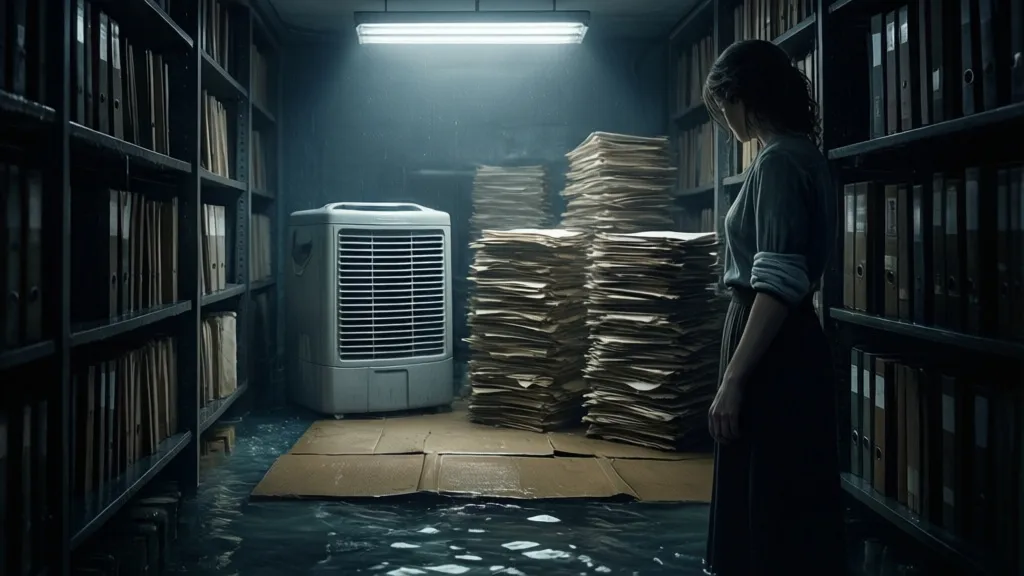
By seven in the evening, the basement smelled of wet cardboard, paste, and the particular sadness of public paper. Kisaragi Nao stood at the long sorting table with her sleeves turned back and a pencil tucked above one ear, moving permits from one stack to another while the dehumidifier rattled in the corner like an exhausted train.
The flood had been small, everyone said. A burst pipe in the records storeroom, ankle-deep water, no great disaster. The men from facilities had mopped and sighed. Section Chief Enomoto had declared that the damaged files must be checked against the register before the end of the week and had looked, with perfect innocence, in Nao’s direction.
Nao was a municipal records clerk, which meant that when misfortune happened to paper, it generally happened to her.
She turned over another permit. Application for interior alterations, denied for insufficient plans. Water tide marks ran across the lower half of the page like tea spilled by a nervous guest. Into the first stack. Next, occupancy registration, six years old, salvageable. Into the second.
On the third file she stopped.
The paper was dry.
Not merely less damaged. Dry, smooth, and faintly stiff, as if it had come from a ream that morning. The surrounding folder was swollen at the corners from floodwater. Its label had bled. Inside, every attached document showed foxing at the edges except for the permit on top, which lay there in calm, fresh cream.
Nao slid it out carefully.
Permit for tenancy alteration and water line separation. Property: 2-18 Minamimachi, second floor. Applicant: Tachibana Satoru. Official approval seal below, in red.
There was nothing obviously wrong with the text. It had been typed cleanly, with the slight unevenness of the old office typewriter that still sat upstairs because no one had had the authority to throw it away. The language was ordinary. The lot number matched the register tab on the folder.
Only the date was impossible.
Approved: 31 April, Year 8 of Reiwa.
Nao looked at it for a full five seconds, not because she doubted herself, but because absurdity deserved a moment’s respect.
April had thirty days.
She checked again. The numerals were clear. The month was typed, not handwritten. The red seal overlapped the date box by a finger’s width.
She set the paper flat on the table and looked at the seal impression. The city emblem sat in its usual circle, but the lower edge was nicked where the brass had been dented years ago after someone dropped it on tile. The dent made a tiny flattened bite in the border. Everyone in Records knew it.
Nao went at once to the cabinet by the far wall.
The official seals were kept in the top drawer, which was locked during office hours and very locked after them, at least in theory. The key was with the duty supervisor. Tonight the duty supervisor was home with gout and had left the key, rather rashly, in the care of Section Chief Enomoto. Enomoto, equally rashly, had gone to a retirement dinner and told Nao that if she needed anything urgent she could fetch the key from his desk.
His desk, upstairs, yielded the key in the second drawer beneath a packet of rice crackers and a romance novel with a bookmark exactly halfway through. Nao returned to the basement, unlocked the seal drawer, and found two seal pads, a ledger, a coil of string, and an empty velvet-lined space the size of a clenched fist.
The dented brass approval seal was missing.
She closed the drawer, then opened it again with the calm hope that reality might have improved in the last second. It had not.
The dehumidifier rattled on.
Nao went back to the table and read the fresh permit from the beginning. Property: 2-18 Minamimachi, second floor. A note clipped behind it referred to a request to divide one water supply into two metered lines for domestic and workshop use. She frowned. A workshop above that address. She knew the street. On the ground floor there was a kimono repair shop with a faded indigo noren and a woman in her sixties who rehemmed sleeves while listening to baseball with theological intensity.
Above it, the apartment had been shuttered for years.
That, too, was odd.
She checked the register book. The original permit entry existed: application received, site inspection pending, no approval date entered. In the margin, in older ink, one note: Applicant withdrew after notice of fire-code deficiency.
But in the folder, on fresh paper, the permit was approved.
She looked at the clock. Seven-twenty-three.
Nao disliked unnecessary drama. She preferred sequence. First, establish whether there was an innocent explanation. Second, determine when the seal had last been seen. Third, visit the address before whoever had borrowed the brass thing thought better of it.
The innocent explanations failed quickly. The register had no amendment. The archive transfer log had no record of retyping. The old typewriter ribbon upstairs was still damply black from recent use.
The last person to sign the seal ledger was Enomoto, three days earlier, for a batch of parking variances. Before him, Nao herself. The return column for Enomoto’s entry was blank.
That was possible. Enomoto could forget his own children in a quiet room. Yet the seal was not in his desk, nor in the tray beside the office typewriter, nor in the washroom where he had once left a stapler for reasons never explained.
Nao put on her coat, took the folder, and called up to the night guard that she was stepping out on municipal business. The guard, who was reading horse racing results with the concentration of a surgeon, lifted one hand without looking.
Outside, the rain had stopped but left the street shining. Minamimachi was ten minutes on foot, downhill past the shuttered stationery shop and the little bakery that sold out of cream buns before noon and mistrust before dusk. Nao walked quickly.
The kimono repair shop was dark. Above it, one second-floor window showed light behind the curtains.
The side entrance was a narrow door in a concrete alley. Someone had painted the frame years ago and then regretted beginning. Nao climbed the stairs and knocked.
There was a delay long enough to be composed.
Then the door opened by six inches. A man stood there in a white shirt with the sleeves rolled to the forearms. He wore rubber gloves, black with wetness to the wrist. Behind him, through the gap, Nao saw a kitchenette sink full of black liquid and several sheets hanging from clips over newspapers spread on the floor.
Ink, she thought at once. Not paint. Ink had a thinner, more patient sheen.
The man looked at her municipal badge, then at her face. He was perhaps thirty-five, neat-featured, with the sort of expression that wanted to seem weary and managed only guilty.
“Yes?” he said.
“Municipal Records Section. Kisaragi Nao. I’m checking a permit relating to this address.”
He did not move. “At this hour?”
“Yes.”
His gaze shifted to the folder in her hand. “There must be some mistake.”
“There may be. That’s why I’ve come.”
A pause. Then he opened the door a little wider, not enough to count as hospitality. “I’m only renting the place temporarily,” he said. “I don’t know anything about permits.”
“I see. Are you Mr. Tachibana Satoru?”
“No.” The answer came fast, then slowed into shape. “No, I’m not.”
“Your name?”
“Okuda.”
“Given name?”
He hesitated. “Jun.”
Nao nodded as if this had satisfied a form. “Mr. Okuda, may I ask why you are washing ink?”
He looked down at his gloves, apparently surprised to find them on his own hands. “I do calligraphy practice.”
The sheets clipped over the newspapers were not calligraphy paper. They were thicker, office stock cut to size. On one, near the corner, she could see the shadow of a typed date box.
“I won’t take much of your time,” Nao said. “I need only confirm whether you have seen this document.”
She drew out the fresh permit and held it where both could read. He looked at it exactly once, and in that glance she watched recognition arrive, retreat, and leave its shoes by the door.
“I’ve never seen it,” he said.
The sink behind him gave off a faint metallic smell. Ink, yes, and something else: brass warmed by skin and rinsed badly.
Nao said, “May I come in?”
“No.” Too prompt again. He corrected himself with a smile so thin it seemed economical. “I’m sorry. It’s a mess.”
“Mess rarely deters government.”
That almost made him laugh. Almost.
From the stairs below came a voice, female, carrying upward with effortless irritation. “If that is another salesman, tell him I repair silk, not souls.”
Footsteps followed. A woman appeared at the turn of the landing carrying a paper parcel. She was exactly as Nao remembered the kimono repairer: compact, straight-backed, with silver hair pinned so firmly it seemed structural. She looked from Nao to the gloved man and took in the door gap, the sink, the tension, all in one glance.
“Ah,” she said. “Office trouble.”
“Good evening, Ms. Hoshikawa,” Nao said.
The woman brightened. “City Hall. Of course. I have your tax letters. They are very stern.” She shifted the parcel to one arm. “Are you arresting my tenant?”
“No.”
“Pity. It would improve the street.”
“Madam,” the man said sharply.
Ms. Hoshikawa ignored him with the ease of long practice. “He is not my tenant, strictly speaking,” she said to Nao. “The apartment was let years ago to Mr. Tachibana, who made puppet heads and paid irregularly. Then there was the business with the fire inspection and he vanished. This one arrived a month ago with a letter.”
“A letter?” Nao asked.
“From Mr. Tachibana, apparently, saying his cousin would use the rooms. Family arrangements. Such a phrase always conceals vulgarity.”
The man’s jaw tightened.
“May I see the letter?” Nao said.
Ms. Hoshikawa considered. “Yes. Unless he has boiled it.”
“It’s downstairs,” the man said.
“In my account book,” she replied. “I do not leave paper where men can improve it.”
Nao looked once more at the black sink. The man shifted, blocking the view by an inch. It was enough.
“Ms. Hoshikawa,” she said, “would you be kind enough to show me the letter?”
“With pleasure.” The older woman started down the stairs, then turned back. “If he runs, he must pass me. I am smaller than I was, but not decorative.”
Nao followed her down.
The shop smelled of starch, cedar, and old rain. Kimono sleeves in pale repair silks hung along one wall like quiet flags. Ms. Hoshikawa set her parcel on the counter and unlocked a drawer with a key produced from somewhere in her sleeve, which Nao respected.
“The cousin,” the woman said, handing over a folded letter. “Typed. Men who lie by typewriter think the machine will take responsibility.”
Nao unfolded it.
It was typed on ordinary paper, signed Tachibana Satoru in a careful hand. The date was ten days ago. The writer requested that his cousin, Okuda Jun, be allowed to occupy the upstairs rooms temporarily while sorting stored materials. He apologized for past inconveniences. The apology, Nao thought, had the polished vagueness of forgery.
“Did you know Tachibana well?” she asked.
“Well enough to know he had no cousin,” Ms. Hoshikawa said. “He had admirers, creditors, and one dentist in Sendai to whom he wrote tragic postcards. Family, no.”
“You’re certain?”
“I hem in silence. People tell me everything.”
Nao smiled despite herself. “Did Mr. Tachibana ever resolve his permit issue?”
“No. He wanted a separate water line because he was washing dyes upstairs. Illegal, probably. Also foolish. The inspection man said the corridor was too narrow and the rear window painted shut. Tachibana shouted that regulations were enemies of art. Then he disappeared.”
“Did he take his belongings?”
“Most of them. Not all. The present one has been carrying boxes in and out for weeks. At odd hours.”
“Did you see what was in them?”
“Paper. Flat bundles.”
Nao looked at the typed letter again. The alignment of the characters was faintly familiar. The lower-case e sat a little high; the numeral 8 printed with a slight weakness in its top loop. The same as the fresh permit.
The old office typewriter.
Ms. Hoshikawa watched her face. “So,” she said. “What has he done?”
“Not enough, yet, for me to say neatly.”
That was honest. She had a forged permit, a missing seal, and a man upstairs bathing papers in ink. She did not yet have the shape of the thing.
Then she did.
Not all of it. Enough.
She asked, “Has there been work done upstairs? Plumbing?”
“Two men came last week with tools. They were there half a day. I asked whether they had notice from the city. One told me yes. He had the face of someone accustomed to borrowing certainty.”
“And water usage?”
Ms. Hoshikawa snorted. “He runs it constantly at night. As if laundering crows.”
Ink. Washing. Fresh permit for water line separation. But why retype the permit and place it inside a flood-damaged file? Because a forged permit was only useful if discovered in the records after the work had been done. If questioned, one could say the office had approved it years ago and then mishandled the file in the flood.
The impossible date—31 April—was not a joke. It was haste. Someone had copied a month and numbered line wrongly while trying to create an official past.
And the seal, still warm when she noticed its absence, had been taken recently because the forgery itself was recent.
Nao folded the letter. “Please stay here,” she said. “If he leaves, call the guard booth at City Hall. Ask for Nakamura; tell him Records says to wake up.”
Ms. Hoshikawa gave a crisp nod that made obedience sound like an insult.
Nao went back upstairs.
The door was no longer merely six inches open. It stood wide, either from panic or calculation. The apartment beyond was a workshop in temporary disguise. On the table lay cut sheets, carbon paper, and a municipal file jacket left open beside the typewriter ribbon box. In the sink, black ink clouded water around several submerged pages and, at the bottom, something brass catching the light.
The man stood by the window, gloved hands hanging at his sides.
“I was about to bring the seal back,” he said.
Nao entered and closed the door behind her. “Eventually?”
He gave a bleak little shrug. “Probably.”
She set the folder on the table and looked around. There were not many personal effects. A kettle, untouched. Two cups, one chipped. A futon rolled against the wall. On a chair back hung a man’s jacket; on the windowsill stood a vase with three stems of dried bellflower. Not decorative. Remembered.
“This wasn’t about tenancy,” she said.
“No.”
“You’re not Okuda Jun.”
“No.”
“Tachibana Satoru?”
After a moment he nodded.
It altered him less than she expected. The false name had sat on him badly.
“Why come back at all?” Nao asked.
He pulled off one glove finger by finger, as if unpeeling a second thought. “Because the shop downstairs still receives deliveries addressed to me. Because some of my blocks were left in the storeroom. Because I was a fool the first time and needed the water line if I wanted to work here again. Choose any of those. All are true.”
“And the cousin’s letter?”
“I thought she wouldn’t allow me back under my own name.”
“She wouldn’t.”
A corner of his mouth moved. “No.”
Nao looked at the papers clipped to dry. Several were permit drafts. One, half washed, showed the date box with 31 April ghosting into illegibility.
“You made more than one attempt,” she said.
“The first seal blurred.”
“You stole the brass stamp from City Hall.”
“I borrowed it.”
“Words are so devoted to us,” Nao said.
He sat down then, rather suddenly, on the edge of the futon. The gesture was not theatrical. Simply tired.
“I used to come to the office with applications,” he said. “The old clerk at the counter—Matsuda—liked my puppet heads. He let me wait while forms were fetched. Once he showed me the records room because he thought the old maps would interest me. Years later I remembered the layout. Last week, when the flood happened, everyone was carrying boxes and arguing. The side corridor was open. I saw the chance.”
“Chance to remove your file and replace the permit.”
He nodded. “And the seal. I thought I could return it before anyone noticed. But the papers smeared, and then you came.”
Nao considered the sequence. During the flood confusion, he had entered, found his old file, taken the seal from the unlocked cabinet or desk, then retyped the approval on fresh paper using the municipal typewriter at some earlier or later moment. The forged document would support the plumbing alterations already done. If challenged, he could produce an official-looking permit from the file itself.
It was clumsy, in places. It was also close to succeeding.
“Why not file a new application properly?” she asked.
He looked at her with genuine surprise. “Because it would be denied again.”
“Then why do the work?”
At that he was silent long enough that she heard water ticking from the sink tap into blackness.
Finally he said, “There are things I wash here that cannot be washed where I live now.”
“Dyes?”
“No.” He looked away, to the dried bellflowers. “Paper.”
On the low shelf beside the futon sat several bundles wrapped in cloth. Nao unknotted the top one without asking. Inside were old manuscript sheets, many watermarked by age, covered in brush writing and revisions.
“Tachibana’s work?” she said.
“My partner’s,” he replied.
Not wife. Not husband. Not with any label offered to improve the matter.
“He restored prints,” Tachibana said. “He used soot inks, recipes no one bothers with now. He died two years ago. After that I left. I thought I had finished with this place. Then his papers began to mildew in storage. The rental room I have now is too dry for silk and too damp for paper; the pipes spit rust. Here there is light in the morning and room for trays. I needed a separate line because the washing must be controlled, and because I cannot explain to landlords why I use so much water to save work that no one has promised to publish.”
He looked at his bare hands. The fingers were stained black in the creases despite the gloves.
“I know what this sounds like,” he said.
“It sounds like forgery,” Nao said. “Also grief. The first is my department.”
That made him laugh once, sharply. Then he put his face in his hands for a moment and said, muffled, “Yes.”
The explanation, when Enomoto arrived in a borrowed raincoat and visible moral distress, was dull in the way truth often was. Nao gave it step by step at Ms. Hoshikawa’s counter while the older woman mended a torn lining and listened with the appetite of a well-fed cat.
Tachibana had once applied for legal alteration to the apartment’s water supply and been refused for fire-code reasons. He later abandoned the rooms. After his partner’s death, he returned under a false name to salvage and wash the partner’s manuscripts. He arranged unauthorized plumbing work. To protect himself, he entered City Hall during the basement confusion, removed his old file, retyped an approval permit on fresh paper, and stamped it using the dented brass seal taken from the cabinet. He inserted the forgery into the flood-damaged folder, hoping the disorder would hide the substitution. The date was wrong because he typed in haste and did not notice that April has only thirty days. When the seal impression blurred on his first attempt, he made another, leaving draft pages which he tried to destroy in ink when Nao arrived.
“Absurd,” Enomoto said weakly.
“Yes,” Nao said.
“Criminal.”
“Yes.”
Ms. Hoshikawa threaded a needle. “Also badly organised. If one must deceive the municipality, one should at least consult a calendar.”
No one disputed this.
The police matter was left to be handled. Tachibana surrendered the seal from the sink, where it emerged blackened and still faintly warm in the core of the brass. The warmth did not matter legally. It mattered to Nao, who liked facts that arrived with body.
By the time she returned to City Hall, it was after ten. The guard had made tea in her absence and left it on her desk under a saucer. It was cold.
Of course it was.
She drank it anyway while writing the incident report. The dehumidifier still thudded below. On her desk lay the forged permit in a clear sleeve, its impossible date now merely evidence, no longer threatening to become history.
When she finished,