The Letter in Brass
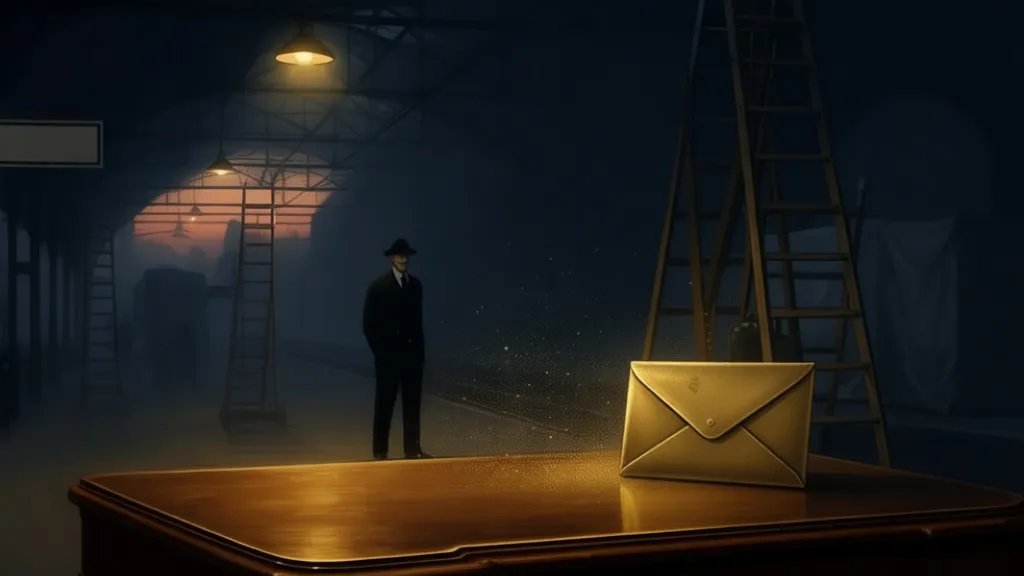
By the time Shinji Arai noticed the envelope, he had already mopped the booking hall twice and locked three doors that no one was likely to open again that evening.
The station had been closed for repairs for six days. Closed, however, did not mean empty. Men came and went with ladders and paint tins. The foreman shouted at everyone. Dust settled on fresh surfaces with a sort of professional contempt. And because the line still handled freight, and because railways disliked irregularity the way priests disliked noise, one customs clerk had been assigned to remain on site until the last goods transfer cleared.
That clerk was Shinji, who found abandoned objects for a living. Or rather, he found the paperwork that abandoned objects became.
He was dragging the mop bucket past the old freestanding timetable board when the front leg caught on a raised tile. The brass stand wobbled. Its circular base gave a small, hollow sound.
Shinji stopped.
Most things in stations were either solid or pretending hard to be. Hollow brass invited inspection. He set the mop aside, crouched, and touched the underside of the base. His fingers met a strip of loosened felt, damp and curling away from the metal. Behind it was a cavity. Inside the cavity was an envelope.
It came out wet, but not newly wet. The paper had drunk water and dried once, then taken in a little more. It had the softened edges of an object that had spent time where it should not have been.
It was addressed in blue-black ink.
Ms. Reiko Fujimura c/o Kitanobe Station Waiting Room
Shinji looked at it for a moment longer than was necessary.
Three years ago, before the line began losing money in a more official way, Reiko Fujimura had worked in the station café. She had died in winter. Slipped, people said, on the mountain road above the river. Found the next morning under clean snow. She had been thirty-four, brisk, handsome, and unusually patient with tourists.
He knew this because everyone in Kitanobe Station had known Reiko, and because the station was the kind of place where one woman’s death remained in the woodwork.
The envelope was unsealed.
Shinji straightened, letter in hand, and listened automatically for footsteps, as if someone might object. There were only the familiar repair noises from somewhere behind the shuttered souvenir shop, and the slow ticking of the station clock over the concourse doors.
He drew out the contents.
The letter was a single sheet.
I received your last letter.
You were right about the sound in the wall.
Come when the clock says 9:17.
Nothing else. No signature.
Folded behind it was a hand-drawn map of the station, old enough to show the second waiting room that had since become storage. A brown coffee stain spread over one corner like a continent. Its darkest ring sat exactly on the concourse clock.
At that moment the clock began to strike the quarter. Shinji looked up. The minute hand stood at fourteen past nine.
He did not believe, in any serious sense, that dead women answered letters from inside railway buildings. Even so, there was something unhelpful about holding a damp envelope addressed to one of them while the station clock approached the hour named in the letter.
He folded the paper again with care. Then, because there was no one sensible available, he went to find the least unsuitable person still in the building.
Professor Chisato Minegishi was sitting on an upturned crate in the former kiosk, making notes on a clipboard and drinking tea that must have been cold by now. She had come that afternoon to catalogue old station records before the repairs displaced them. She taught local history at the small women’s college two towns over, and had the librarian’s habit of appearing unsurprised by anything that had already happened.
Shinji found her pencilling dates in a hand of narrow severity. A paper cup stood by her knee.
“Professor,” he said. “Do you know whether jokes can be posthumous?”
She looked up. Her eyes moved first to his face, then to the envelope.
“They can,” she said. “They are usually less successful. What have you got?”
He handed her the letter.
She read it once, then again. “Where did this come from?”
“The base of the timetable stand.”
“And wet.”
“Yes.”
“Not from today.”
“No.”
She turned the map toward the light. The stain had blurred some pencil marks but not all. “Coffee,” she said. “Or a coffee substitute. The station café made both, depending on budgets and optimism.”
Shinji leaned against the kiosk shutter. “It’s addressed to Reiko Fujimura.”
“I can read,” said Professor Minegishi mildly. “You opened it because she has been dead for three years.”
“I opened it because it was hidden in station furniture.”
“That too.”
She set the paper on her knee. “Who is left in the building?”
“Foreman Sato and two electricians. One of the electricians left at nine. The ticket office is empty. Freight office locked. Cleaner left early because her sister’s son had a recital involving taiko drums and she said family must be endured while one still had them. Stationmaster Hori went down to the depot at eight and won’t return. The contractor’s men are in and out.”
“And every person old enough to remember Reiko properly?”
“Gone home,” Shinji said. “Or out of town. Her cousin moved to Sendai. The old café owner is in hospital. The retired porter is visiting his daughter. We seem to have arranged this incompetently.”
Professor Minegishi gave a small sound that might have been agreement. “When was this timetable stand moved?”
“This morning. They pulled up tiles under it.”
“So the letter could have sat there for years.”
“Yes.”
“But someone wanted it found now, or happened to leave it where repairs would reveal it.”
“Also yes.”
She held the map closer. “The stain marks the clock. That is the obvious thing. Therefore it may not be the relevant thing. Still, we should not ignore the obvious merely because it is showing off.”
The concourse lights flickered once, then steadied.
Professor Minegishi looked up at the ceiling, then at the cup beside her. “Would you like tea?”
“No.”
“Wise. It is dreadful.” She rose, joints objecting quietly, and handed him the cup instead. “Carry this, if you please. I distrust being startled while holding liquids.”
He took the tea. It was, impressively, both too cold to comfort and still hot enough to be unpleasant.
Together they crossed the concourse under the clock.
Kitanobe Station had been built in the late Taisho period and repaired in every decade since with a determined lack of consistency. The result was a building of handsome beams, patched plaster, and additions that seemed to have happened in moments of administrative weakness. The main hall opened to two platforms, one now dark. Along the rear wall ran the shuttered café, the former waiting rooms, a luggage office used for storage, and a narrow service corridor that ended at the old women’s washroom, closed years ago when the plumbing gave up.
Professor Minegishi paused beneath the clock. “9:17 is specific enough to be a mechanism, a memory, or a timetable. What happened here at 9:17?”
“Last local to Moriyama used to depart at 9:17 before they cut the schedule.”
“Used to. How long ago?”
“Four years.”
“Before Reiko died.”
“Yes.”
She nodded. “Then the instruction may mean: come after everyone has gone.”
Shinji glanced toward the platform. “That would fit.”
On the map, a faint pencil line branched from the clock toward the wall behind the old café. At first glance it looked like careless shading. At second glance, it stopped too neatly.
Professor Minegishi touched it with one finger. “There. The sound in the wall.”
They went to the former café. Its shutter was half raised because the electricians had been at work inside. Tables were stacked against one wall. The counter remained, minus charm. The smell was dust, stale wood, and the ghost of frying oil.
Shinji set the tea down, then immediately forgot it.
The wall behind the old service shelf was panelled in dark wood. He tapped once. Solid. Again, lower. Solid. A third time, near the join where a decorative trim strip had loosened from the plaster, gave a less certain note.
Professor Minegishi listened, head bent. “Again.”
He did.
“There is a cavity,” she said.
“Stations have many cavities.”
“Yes, but this one has been discussed in correspondence.”
He found a screwdriver among the electricians’ abandoned tools and worked the trim free. Behind it, the panel had warped slightly around a square section no larger than a ledger. It was not a proper door. It had simply been made to come out.
Shinji wedged the screwdriver in and prised.
The panel lifted. Behind it was a shallow recess between studs. Inside lay a stack of envelopes tied with cotton tape, a café saucer, and an empty tin that had once held imported biscuits.
No one spoke for a moment.
Then Professor Minegishi said, “Well. The dead woman was not replying from beyond the grave. She was receiving mail in a wall, which is more practical.”
The envelopes were dry. Most were addressed to Reiko at the station café or the waiting room. Several had been opened carefully along the top edge. Two remained sealed. The saucer bore a brown ring.
“Coffee,” Shinji said.
“Obviously. Be careful.”
He untied the bundle and sorted them on an empty table. Dates ranged from five years ago to a little over three. The handwriting on the addresses varied only in mood. The sender’s name appeared on some backs and not others: A. Natsume, no town given.
One envelope, older than the rest, was postmarked from Toyama. Another from Nagano. Then Sendai. Then nothing at all: the last four had no stamps, as if hand-delivered.
Professor Minegishi took up the top letter and read with professional shamelessness. “These are love letters,” she said.
Shinji looked away out of politeness, which did not prevent him hearing.
I shall stop writing if you truly wish it, but your last note did not say stop. It said wait.
Another:
I sat in the second waiting room until the 9:17 left and still thought you might come back through the ticket gate.
Another:
You were right that everyone sees what they expect in a station. They see departures and arrivals. They do not see what remains in place.
Professor Minegishi set that one down with care. “Not A. Natsume’s first heartbreak, I think, but perhaps the most organised.”
Shinji picked up the two unopened letters. One was brittle with age. The other was the damp envelope he had found.
“Why would Reiko hide them here?” he asked.
“Because she wished to keep them and not be seen keeping them. Because the station was the one place she could control. Because she had a correspondent who could not safely write to her home. Because she enjoyed melodrama. People are seldom stingy and singular at once.”
He glanced toward the platform again. The lamps beyond the glass had begun to flicker in sequence, each a brief failure, as if some invisible hand were testing them.
“The letter says she received the last letter,” he said. “But if this one was hidden, she never did.”
“Unless someone else wrote it.”
“Why?”
Professor Minegishi considered. “To summon someone here at 9:17. To frighten someone. To tell someone where the letters were after Reiko died. Or to answer a question she could no longer answer.”
Shinji looked at the line of envelopes. “Who was A. Natsume?”
“I was just thinking of that.”
He had seen the old station employment files that afternoon, labels curling in their boxes. He remembered a surname because custom forms made names memorable by repetition.
“Natsume,” he said slowly. “Atsuko Natsume worked here part-time at the café one summer. Student. Four years ago, maybe five. She was from the college.”
Professor Minegishi’s eyebrows rose. “My college?”
“I think so.”
“Then I know who to ask, if only she had not apparently left town before our dramatic evening.” She turned another envelope over. “Atsuko transferred after a term. Quiet. Excellent at maps. There was gossip, because colleges are monasteries with better cardigans. Reiko used to meet someone after closing. The porter thought it was a man because she wore lipstick on those nights, which proves only that the porter was a porter.”
Shinji said nothing.
Professor Minegishi gave him a brief glance. “You may laugh internally.”
“I am occupied externally.”
He had found one more object at the back of the recess: a timetable card, folded in half. On the front was an obsolete departure grid. On the back, in pencil, someone had written a single line.
If anything happens, listen after the last train.
The handwriting was not the same as the blue-black ink on the wet envelope. It was sharper, pressed harder into the paper.
Professor Minegishi took it. “That sounds less romantic.”
“More practical.”
“Which is often how fear writes.”
From outside came the rumble of a freight engine shifting somewhere down the line. Then silence rolled back in around it.
Shinji looked once more at the wall, the shelf, the floor.
“What sound?” he said.
Professor Minegishi followed his gaze. “In the wall? Water, perhaps. Pipes.”
“No. Something a person would write about. Something you could be right about.”
He crouched by the skirting board. The café floor had been partly lifted for repairs. Near the service shelf, one plank was newer than the others by only a year or two, not enough to be obvious unless one had spent several evenings noticing replacements out of boredom.
He knocked. Hollow.
Professor Minegishi set down the letters. “How irritating,” she said softly. “Another cavity.”
Together they lifted the loose plank. Beneath it ran an access channel for old heating pipes, long disused. In the channel, wrapped in oilcloth, was a ledger book.
Shinji opened it on the table.
It was the station café account book for the final year under the old owner. Tucked into the back cover were receipts and a page of copied figures. Several sums had been altered. Stock paid for, not delivered. Deliveries signed on days the café had been closed by snow. The kind of theft too small to interest distant management and too large to be accidental.
On the copied page, one note had been added in the same hard pencil as the timetable card.
Hori knows. Ask him why receipts vanish after 9:17.
The stationmaster.
Professor Minegishi exhaled through her nose. “There we are. Reiko had discovered someone stealing from the café accounts. She tells her correspondent about a sound in the wall, perhaps water running where documents were hidden, perhaps work being done after closing. She arranges to meet after the last train. Then she dies before she can say more.”
Shinji said, “Or she is made to die.”
Professor Minegishi looked at him. “Do you think so?”
He thought of the winter road above the river, of old snow and one pair of footprints being enough until thaw. “I think if she confronted Hori with this, and if Hori feared exposure, then a meeting on the mountain road would not improve anyone’s safety.”
A key turned in the outer office door.
Both of them went still.
Footsteps crossed the concourse: measured, unhurried, familiar with the building. Shinji extinguished the café light by instinct. Through the half-raised shutter he saw Stationmaster Hori’s shape move under the clock.
He should have been at the depot.
Hori paused beneath the timepiece, exactly where the coffee ring lay on the map. It was 9:17.
Then he turned toward the café.
Professor Minegishi said, very quietly, “The joke, it seems, was addressed to him.”
Hori lifted the shutter and stepped in. He was a compact man in his sixties with polished shoes and the expression of one who had been interrupted in being right for many years. That expression altered when he saw the table.
Not much. Enough.
“I thought I heard someone,” he said.
“You expected to,” said Professor Minegishi.
His eyes moved to the wet envelope, the open recess, the ledger. He did not ask what they were doing. Innocent people often did. Guilty people preferred arithmetic.
“Where did you find those?” he said.
“In your building,” Shinji said.
Hori’s mouth compressed. “Miss Fujimura had a theatrical streak.”
“Did she?” said Professor Minegishi. “Or did she have accounts?”
There was a brief silence in which the platform lamps flickered again.
At last Hori sat down. It was the action of a man who had realised that standing would look childish. “The old café owner skimmed for years,” he said. “Everyone knew. Then he became ill, and suddenly the figures mattered. Reiko found copies. I told her to leave them. It would ruin him. It would close the café sooner. It would cost staff their positions over amounts no one could recover.”
Professor Minegishi said, “And did she?”
“No.” He looked at the ledger. “She said she would send the records to head office if I did not. Then she said perhaps she wouldn’t, if I helped her with another matter.”
Shinji waited.
Hori gave a dry little laugh that contained no amusement. “The girl from the college. Atsuko. She had gone. Reiko wanted to know where. She thought I had seen letters, because all stationmasters see letters if they choose. She asked me to keep any that arrived. I did. Then I regretted it. Then she died before I had to decide what to do with them.”
The room seemed to contract around the ordinary pettiness of that. Not money exactly. Not love exactly. The handling of both.
“You hid the letters,” Shinji said.
“Yes.”
“In the wall.”
“Yes.”
“And tonight?”
Hori looked, not at him, but at the damp envelope. “I received a note this afternoon. No signature. It said: She has answered. 9:17. I thought—” He stopped.
“You thought someone had found out,” said Professor Minegishi.
“Yes.”
“Who wrote the note?”
Hori spread his hands. “How should I know?”
Professor Minegishi’s gaze went to the map, then to the saucer with its old brown ring. “Atsuko Natsume is back in town,” she said. “Only someone who knew about the letters and the station café would mark the map with coffee and choose 9:17. She wanted you here, under the clock, to feel what waiting had cost. And she wanted someone else to find the rest first.”
Hori looked suddenly older. “She came by in spring,” he said. “Asked whether Reiko had left anything. I said no.”
“Of course you did.”
He gave Professor Minegishi a brief, almost respectful look. “It was too late.”
“For what?” she asked.
He did not answer.
There was no confession to murder, no neat piece clicking into place with satisfying force. Reiko had died on a winter road. Hori had concealed letters and accounts. He had reason to fear her, and perhaps she had reason to fear him. But reason was not proof, and mountains were hospitable to accidents.
Shinji knew this. He also knew that some truths remained stubbornly in the form nearest to them. A hidden ledger was one thing. A dead woman in snow was another.
The last freight transfer passed through at 9:41, all thunder and iron breath, and then the station settled around its own bones.
Hori gave up the ledger and the letters with little dignity and less resistance. There would be reports. There would be questions from head office. The old thefts would be untangled badly. Atsuko Natsume would have to be found, though not, Shinji thought, with any urgency that would flatter the system.
After Hori left under supervision of the foreman, who had been delighted to acquire a scandal before going home, Professor Minegishi remained in the café, retying the letters in their tape.
“Will they keep these?” Shinji asked.
“Officially, perhaps for a while. Unofficially, I intend to become difficult.” She looked up. “You may cite me if needed. I am very good on paper.”
He believed her.
The tea still sat where he had left it. He picked it up, forgot its condition, and drank. It had become entirely cold, which was somehow an improvement.
Professor Minegishi watched him over the rim of her spectacles. “You persist,” she said.
“It seems weak to stop now.”
Outside, the platform lamps had steadied. The clock over the concourse showed 9:58. Its hands moved with the indifferent accuracy that had drawn all this out of hiding: a dead woman’s name, a student’s patience, an old man’s cowardice, sums copied in pencil, and a time that had once meant a train and then meant waiting after it.
Professor Minegishi placed the bundle of letters into a document box. “Whatever else happened,” she said, “