The Master Key
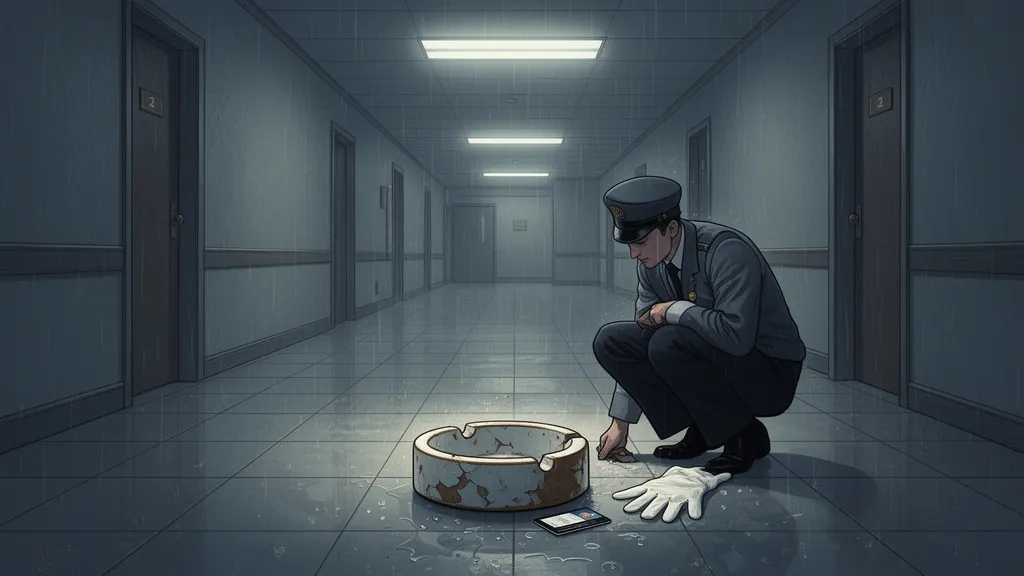
At 2:10 a.m., when the rain had thinned to a mist and the night staff had begun to look as though they had always belonged to the hour, bellhop Ren Mizushima crouched in the service corridor outside the linen store and found Room 418 taped under a chipped ceramic ashtray.
He had come for clean bathrobes. Instead he found the keycard fixed to the underside with a strip of yellowing tape, as neatly placed as a label in a file.
Beside the ashtray lay a pair of wet white gloves.
They were the thin cotton kind used by housekeeping when polishing glass. He picked one up by the cuff. It was cold and damp. There was a faint smell on it, sharp and artificial.
Pool chlorine.
Ren straightened with the keycard in one hand and the glove in the other. The corridor was empty. The service lift doors were shut. Somewhere beyond the walls a machine hummed with expensive patience.
He looked again at the card sleeve.
A minute later he was at the front desk, where Assistant Manager Fujita took one look at his face and stopped counting the till.
“What is it?”
Ren laid down the card, then the gloves.
Fujita’s brows moved first at the number, then at the smell. “Where?”
“Staff corridor by linen. Under the ashtray.”
“Who is in 418?”
Ren checked the register automatically. “Professor Saeki. Checked in at 7:22. Single occupancy, two nights.”
Fujita glanced toward the old brass clock above the lobby arch, as though it might have an opinion. The clock had none. The lobby, lined with black lacquer columns and potted palms, was polished into a state close to moral pressure. At this hour it held only one sleeping businessman in an armchair and a young couple pretending not to quarrel by the vending machines.
Fujita lowered his voice. “Ask him whether he has misplaced his key. Casually.”
“And the gloves?”
“Bring them. No, wait.” He reconsidered with managerial pain. “No. Leave them here. If this is staff business, I would rather not wave the evidence at a guest.”
The hotel used keycards for the rooms, though several of the older executives still spoke of keys as though the cards had merely changed shape. The system recorded entries. It was proud of doing so. Each floor had polished brass room numbers, thick carpets, and enough mirrors to multiply inconvenience.
Room 418 was at the end of the east corridor, near the stairs that led down to the pool level. Ren knocked.
There was a pause, then the bolt drew back.
Professor Saeki wore a robe over striped pajamas and had the expression of a man interrupted in the middle of distrusting the world. He was in his fifties, narrow-shouldered, with silvering hair tied back. His room was orderly behind him. A book lay open on the desk beneath the lamp. An untouched cup of tea sat by it, almost certainly cold.
“Yes?”
“Forgive me, sir,” Ren said. “We are checking room cards after a system alert. Has your card been with you since check-in?”
Saeki frowned. “Of course. I put it in the tray there.” He gestured to a lacquer tray by the television, then stopped. The tray was empty.
He turned back. “It was there.”
“When did you last look?”
“I don’t catalogue my keycard every quarter-hour.”
“Has anyone entered your room tonight?”
“No.” The answer came cleanly, too quickly to be considered. “Nobody.”
“Did you leave the room?”
“Once. Dinner downstairs. I returned before nine.”
“After that?”
“After that, no.” He looked at Ren more sharply. “What sort of system alert?”
Ren smiled the hotel smile, which suggested both competence and the absence of information. “We are verifying a discrepancy. Thank you, Professor.”
When he returned to the desk, Fujita had already accessed the lock log.
“There were three openings after check-in,” he said.
Ren set his hands on the counter. “Three?”
“7:24, guest card. 9:11, master. 11:48, master. 1:36, master.”
“The master key?”
“The one kept in my office.”
He did not need to say the rest. At 6:00 a.m. the morning audit would print access reports along with the night ledger. If the master key had been used three times on an occupied room, someone would have to explain it. If no one could, then everyone who could have touched it would be explained instead.
This was not a large hotel, but it was the kind that produced small feuds in abundance and forgave very little when put in writing.
Fujita rubbed his temple. “Wake no one yet. We find out what we can before the audit.”
“Who had the office key?”
“I did. Housekeeping supervisor borrowed it at 8:40 for the minibar ledger and returned it before nine. Banquet captain used the copier at ten. Night cashier went in for coin rolls. Then me again.”
“A crowded innocence,” Ren said.
Fujita gave him a look which acknowledged the remark only by suffering from it. “Go through the night. Quietly.”
Ren nodded.
He glanced at the gloves on the desk. Their dampness had begun to darken the polished wood beneath them.
Pool chlorine, Room 418, and the master key. The shape of the problem was visible. Its purpose was not.
He began with what was nearest to fact.
The elevators kept timestamps because the engineering chief distrusted both guests and gravity. The panel printout in the back office was a strip of narrow paper, each line a carriage movement and door cycle. Ren stood under the fluorescent light and read.
At 9:08 p.m., the service lift went from pool level to the fourth floor. At 9:12, back down.
At 11:44, the guest elevator went from lobby to four. At 11:50, four to lobby.
At 1:31, the service lift went from basement laundry to four. At 1:38, four to basement.
He copied the times into a pad.
Then he checked the pool records. The pool closed at ten, but towels were counted twice, once at closing and once after midnight when the janitor checked the humidity vents. The receipt book for issued locker towels lay in a drawer beneath the spa desk, with the patient misery of all records nobody admired until they became useful.
At 8:55 p.m. a guest from 418 had signed for one extra towel.
The signature was K. Saeki.
Ren stood still a moment.
Professor Saeki had said he returned before nine and did not leave after that. The towel was issued at 8:55, which did not prove a lie by itself. He might have stopped by the pool on his way back. But the wet gloves by the staff corridor were from housekeeping stock, not from the pool, and the service lift had risen from pool level to the fourth floor at 9:08. The times sat beside one another too neatly to be ignored.
He went to the pool.
At night the pool level always seemed like an afterthought of luxury. The water lay black-blue under the dimmed ceiling lights. Deck chairs stood in folded lines. The smell of chlorine was stronger here, enough to make the gloves in memory sharpen.
He checked the lost-property cupboard, the towel bins, the utility closet.
In the utility closet there should have been a full box of white polishing gloves. There were eleven pairs left in a carton meant to hold twenty. Housekeeping had used some earlier, certainly. But a damp place made all arithmetic suspicious.
On the metal shelf below the carton stood a glass vase wrapped in hotel stationery paper. Ren peeled back one corner. It was cracked through the neck.
A note in looping handwriting was clipped to it.
To be replaced before breakfast. From Orchid Lounge.
The Orchid Lounge stood off the lobby. At midnight the flower arrangement there had still been complete: white lilies, eucalyptus, and one extravagant branch of blue hydrangea, all in a broad ceramic vase painted with cranes. Ren remembered because one of the petals had fallen onto the piano and no one had dared move it.
He looked more closely at the wrapped vase.
Not ceramic. Glass.
A replacement from storage, then. Which meant the original lounge vase had broken sometime tonight.
He left the pool level and climbed back to the lobby.
The Orchid Lounge was empty except for the piano, the flowers, and a woman in an emerald silk blouse asleep with impossible dignity on the sofa. She was one of the guests from the literary conference occupying the hotel this week. Ren knew this because literary conferences produced sleeping elegantly in public with unusual frequency.
The flowers stood in their vase on the low table by the window. Ceramic, pale blue, painted with cranes. Near the base, on the side turned discreetly toward the wall, was a fresh chip.
Large enough to match an ashtray? No. But large enough to have happened tonight.
He crouched. On the carpet beside the table, almost hidden in the dark pattern, was a single grain of white grit. Ceramic.
Not from the vase alone, he thought. Something had been dropped, broken, replaced, or half concealed. The ashtray in the staff corridor had been chipped as well.
The woman on the sofa opened one eye.
“You are either stealing the flowers,” she said, “or admiring them professionally.”
“Only the arrangement, ma’am.”
“Then tell your florist she places hydrangea too low. It makes the lilies vain.”
She closed her eye again.
People in hotels were often too much of something. It helped them travel.
The manager’s office smelled of paper clips and caution. The master keycard was kept in a drawer within a cash box because trust, here, had layers.
Fujita unlocked both and stared.
The master card was present.
“Then whoever used it returned it each time,” Ren said.
“Thank you. This has greatly improved my mood.”
“Who could take it without being seen?”
“Anyone with office access, if they chose a moment. Or anyone borrowing the office key for a reason less foolish than the truth.”
Ren checked the sign-out sheet for the office key. Several names. Several harmless reasons. On paper, everyone was tidy.
He turned to the lobby security mirror.
It was not a camera, merely an old convex mirror mounted high by the back corridor, a relic from the years when the hotel preferred reflection to electronics. It showed the reception desk, part of the lounge entrance, and the passage toward the offices in a warped silver curve. One corner had a hairline crack, fine as a thread, splitting the lower right segment.
At most hours it was decorative. At a bad hour, it was evidence.
Ren stood where the office door would reflect and studied what the crack erased.
A person coming out of the office carrying something low in the right hand would have that hand distorted or hidden depending on angle. The face would show. The object might not.
“Did you notice anyone lingering?” he asked Fujita.
Fujita considered. “At eleven-thirty, Ms. Natori from housekeeping brought up forms. At one-fifteen, Sudo from maintenance argued with the vending machine contractor on the phone. At one-thirty, Ms. Kamei from the Orchid Lounge came for aspirin. She cut her hand, she said, on broken glass.”
“Broken glass.”
“The lounge vase. Or so she said.”
Ren looked up at the mirror again.
Kamei was the lounge pianist on weekends and hostess on weekdays, which gave her a practical authority over flowers, drunks, and lonely men with expensive watches. She was in her thirties, handsome in the severe way that made other people sit straighter. Her relationship with the banquet chef had occupied staff gossip for six months and resisted every available label. They had once arrived separately at a New Year’s party and left with the chef’s mother, which had not clarified matters.
If she had cut her hand on the vase, there should be a record of it. If she had not, there should be a reason to say so.
He found her in the pantry behind the lounge, wrapping the cut with fresh gauze.
“It looked worse under the light,” she said, before he asked. “Now it looks theatrical.”
“Did the lounge vase break?”
“It chipped. I nearly dropped it. We changed to the spare while I cleaned up.”
“With whose help?”
“Mine. I am very gifted.”
“And the broken glass?”
She gave him a quick, cool look. “There wasn’t any. I said glass because if I said vase, Fujita would begin forms.”
“That is unlike him.”
“Cruelty does not become you, Ren.”
“Did you go near the manager’s office at one-thirty?”
“For aspirin, yes.”
“Did you enter?”
“No.” She tied the gauze one-handed and neat. “The office door was open. Fujita was inside. He gave me aspirin and a lecture on carrying ceramics while distracted.”
“Distracted by what?”
Her mouth moved very slightly. “By Professor Saeki. He had been in the lounge after dinner being intelligent at me. It is an exhausting form of courtship.”
“Courtship?”
“Toward himself, certainly.”
Ren let that rest. “Did he leave anything there?”
“A room card.”
She looked at him, saw the significance arrive, and lifted one shoulder.
“He put it on the table beside his drink. I noticed because men who wish to seem unconcerned about being recognised often place their room number in plain view.”
“What time?”
“Near nine. Before I chipped the vase.”
“And then?”
“He went to the pool stairs with someone.”
“With whom?”
“I didn’t know her name.”
Kamei’s tone stayed flat. It was flatter than indifference. Ren waited.
“She works mornings in housekeeping,” Kamei said. “Thin, pretty, anxious. The kind of woman to whom apologising has happened too often. They were arguing politely. Which is still arguing.”
“Ms. Natori?”
“No. Younger. Emi.”
Emi Arai. Room attendant. New since April.
“Did they come back together?”
“I saw Professor Saeki return alone through the lobby at about nine-ten. Wet at the sleeves. Without the card.”
“And Emi?”
“No.”
The service lift from pool level to four at 9:08. The master entry at 9:11.
The line between them had begun to show.
Emi was in the laundry office folding inventory sheets into exact halves, as though paper could be persuaded not to accuse her if treated gently.
She looked up when Ren entered, and he saw at once what Kamei had meant. Not beauty, exactly. The sharper thing beside it: the readiness to say sorry before anyone had spoken.
“Did I miss a room?” she asked.
“No. I need to ask about tonight.”
Her hands stopped.
“Did you go to the pool level around nine with Professor Saeki?”
Colour left her face in small, deliberate stages. “Who said that?”
“He signed for a towel. The lift log places someone from pool to four at 9:08.”
“I didn’t go to his room.”
“I didn’t say you did.”
She closed her eyes for a moment, not from guilt but from the labour of choosing a lie and discarding it.
“He asked to speak privately,” she said. “In the corridor by the pool. He recognised me.”
“From where?”
“From my university.”
That altered the shape again. “You know him?”
“He was my adviser for one semester. Years ago.”
“Why did he want privacy?”
Her folded paper had creased under her thumb. “Because he wrote letters to me then. Not obscene ones. Worse, in a way. Earnest. Helpless. He is married. He was married then. I never answered. When I left school, that was the end.”
Ren said nothing.
“He saw me at check-in and panicked. After dinner he asked me not to tell his wife if she ever learned he had stayed here. She won’t. I don’t know her. But he wanted promises. He had been drinking enough to become sincere, which is dangerous in a professor.”
“And the keycard?”
“He left it on the lounge table. I noticed. I thought if I gave it back at the desk, there would be a question. So I took it to return quietly and then—” She stopped.
“And then?”
“He kissed me.”
Her voice did not change. That was the clearest part of it.
“I pushed him away. He grabbed my wrist. Not hard. Hard enough. The towel rack fell. We heard someone in the stairwell. He told me to go. I took the service lift up because I didn’t want to cross the lobby with him. I meant to leave the card at his door and knock, but when I got there I realised I had no right explanation for having it.”
“So you used the master key.”
She looked at him.
No denial. Only fear, precise and exhausted.
“How?” he asked.
“I borrowed the office key earlier for minibar sheets. I saw where Fujita kept the master card. Later, when everyone was busy with a conference group arriving from dinner, I took it, opened 418, put his card on the tray inside, and left. I returned the master card at once.”
“9:11.”
She nodded.
“That accounts for one opening,” Ren said. “There were two more. At 11:48 and 1:36.”
Her face changed. Confusion arrived, and with it relief so thin it hurt to see. “I didn’t do those.”
Ren believed her before he had decided to. The useful thing was that belief now required proof.
“Why was the guest card taped under the ashtray?” he asked.
“I don’t know.”
“The gloves?”
“I don’t know.”
She swallowed. “Will they dismiss me?”
“That depends,” Ren said, “on whether someone else has made your mistake into a habit.”
He went back to Room 418 and knocked again.
Professor Saeki opened faster this time, as if vigilance had kept him near the door.
Ren held up the card. “Was this in your tray when you checked just now?”
Saeki stared. “No.”
“It should have been, if no one had entered since check-in.”
The professor’s composure shifted. Not much. Enough.
“I may have overlooked it.”
“Did you go to the pool with a member of staff?”
“That is not your concern.”
“Tonight it is exactly my concern.”
Saeki’s hand tightened on the door edge. “A private conversation took place. Nothing improper.”
“Then why did you tell me nobody entered your room?”
“I told you nobody entered after I returned.”
“You told me nobody entered. Also, your room card was not here. It was in the lounge, then under an ashtray in the staff corridor.”
He said nothing.
“You had visitors,” Ren said. “Or you think you did.”
That landed.
Professor Saeki looked past him into the corridor, then stepped back. “Come in.”
The room had the stale neatness of a man who had straightened everything he could not control. On the desk, beside the cold tea, was a folded receipt from the bar.
“One brandy at 11:35,” Ren read.
Saeki sat on the chair by the window. “I had trouble sleeping. I went downstairs for a drink.”
“And returned at 11:48. The second master-key entry.”
“I suppose.”
“You suppose?”
He lifted his head. He looked suddenly older, less vain, more merely human. “I did not use a master key. I found my room open.”
Ren waited.
“The latch was not on. The lights were off. I thought perhaps I had failed to shut it properly. When I entered, a woman was in the room.”
“A guest?”
“I don’t know.”
“Describe her.”
“Tall. Dark dress. Hair pinned up. She turned away at once and said she was from housekeeping. She apologised, said there had been a report of a leaking pipe from 518 and she had the wrong room. Then she left.”
“Kamei,” Ren said quietly.
Saeki blinked. “The pianist?”
“Hostess.”
“She resembled her, perhaps. I had only a moment.”
“And at 1:36?”
Saeki looked genuinely bewildered. “I was asleep.”
Ren’s eyes went to the desk tray.
There, quite openly, lay the 418 card.
So someone had entered at 1:36 and removed it again. Later it had been found taped under the ashtray with wet gloves smelling of chlorine.
Not theft, then. Nor intrusion for its own sake. Someone was moving the card after the fact, trying to alter the story of the room.
He picked up the bar receipt. The reverse side showed a faint transfer of lipstick where it had lain against another paper. Deep rose.
Not useful by itself. Except that Kamei wore no lipstick at work, only tinted balm, because she said cups should not