The Name on the Board
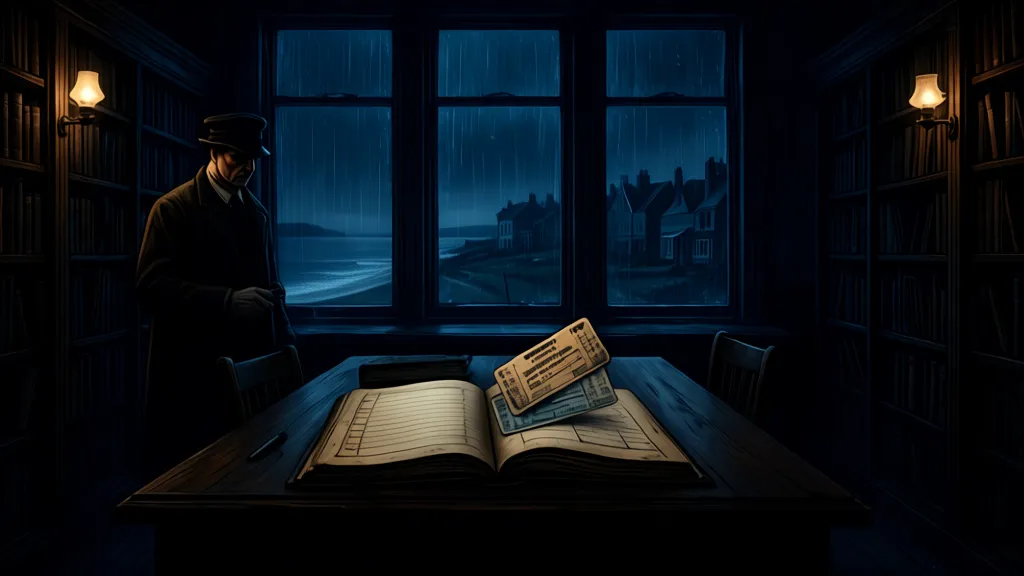
At eleven twenty-three, Natsume Fumi slid the last ledger from the returns trolley and found the train ticket lying inside it as if the book had grown a tongue.
She stopped with both hands on the cracked cloth cover. The reading room of the Shiosaki Town Archive was never truly quiet. Rain tapped the high windows. The sea, two streets downhill, worked steadily at the harbour wall. Somewhere in the building a pipe gave a patient knock, as if requesting admission to its own interior. Still, the ticket altered the room at once.
The ledger should have been empty.
It was a port customs register for the winter of 1964, newly brought down from the attic stack to be cleaned and wrapped. Fumi had checked it herself at ten-fifty. A child could have hidden in the dust between those pages, but not a ticket. Now a narrow rectangle of thick cream paper lay tucked at page 213, halfway out, in the manner of a bookmark left by someone who expected to return.
She lifted it carefully.
The paper was warm on one side, warm enough that she looked at the green-shaded lamp near her elbow before she looked at the printing. The warmth could have come from that. It could have. She did not enjoy finding herself in company with the word could at this hour.
The ticket had been issued forty-one years ago.
Shiosaki to Higure Junction. Second class. Adult. 17 October.
The serial stamp was blurred, but the name on the back, written in ink by a clerk’s small dutiful hand, was still clear.
Kurata Shin’ei.
Fumi knew the name because all small towns trained memory badly. One did not learn what one wanted and discard the rest. One learned everything and carried it around forever. Kurata Shin’ei had drowned in the autumn storm of 1989, not in a dramatic way and not, the town had said, in a particularly careful one either. His body had been found caught under the old fish market pier with his shoes still on. He had been a schoolteacher. He had once been engaged to a woman who later married a dentist from Numazu. He had a younger sister in Kobe who sent chrysanthemums every year for exactly six years and then stopped.
He had also, Fumi remembered after a moment, been the son of the station’s ticket clerk.
She turned the ticket over again. The fibres at one corner had gone soft, as old paper did in damp air, but the warmth remained.
On the table beside her sat a cup of tea that had arrived twenty minutes earlier by way of her own bad judgment. She had made it too early, then forgotten it while searching the attic index. Now it had achieved the faintly tragic temperature of old bathwater. She drank some anyway, because there was no reason to punish the tea for being itself, and because routine occasionally bullied nerves into behaving.
The tea did not help.
She looked at the ledger. Nothing else had been inserted. No note, no scrap, no mark in the margin. Only this ticket, page 213, customs declarations for lamp oil and machine parts and preserved pears.
The obvious explanation was that someone had used the ticket as a bookmark before the ledger entered the archive. The obvious explanation was thin. The ledger had spent years tied shut with cotton tape. Fumi had untied it. Dust had lain across the fore-edge in an unbroken skin. And there was the warmth.
She stood, ticket in hand, and crossed the reading room to the office door.
The station archive occupied the disused west wing of Shiosaki Station, where records went to become old enough to seem respectable. The station itself still functioned, though only six trains a day now bothered with the place, and on storm nights fewer than that if the coast line flooded. Upstairs, in what had once been staff quarters, retired ticket clerk Murota Gen lived in two rooms under a leaking eave. He had stayed after retirement in the way cats stayed in shops: no one had planned it, but removing him would have seemed theatrical.
He alone still knew where certain old station records had gone, and why. He alone still insisted on calling Fumi young Natsume, though she was thirty-four.
She locked the reading room behind her and walked along the dim corridor toward the main hall, the ticket between two fingers.
The station smelled of wet wool and extinguished electricity. The last southbound train had passed at ten-forty. The shutters over the kiosk were down. Timetables slept in their glass cases. At the far end of the hall, beneath the old mechanical board that had not worked in years but had been kept as decoration and local pride, rain blew in under the doors and made the tiles shine.
Fumi slowed.
Something pale marked the board.
She moved closer and saw at once what was wrong. One of the little black slats in the Arrivals section had been scratched so roughly that the white underlayer showed through. The painted time had been half obliterated. Across it, in pencil, someone had written a single word.
Natsume.
Her surname. Not Fumi. Not Miss Natsume. Merely the family name, as if the board itself had become familiar, or official.
Above it, the destination read Higure Junction. Below it, the time that should have stood there—11:52, if memory served—had been crudely worried away.
She put the ticket beside the slat. The paper and the board belonged to one another with an intimacy she did not like.
No one in town had much reason to play games with old rail paraphernalia. People had reasons for many things in Shiosaki, but they were usually practical, sexual, or inherited. This looked like a message, which was more tiring.
She turned toward the staircase to the clerk’s rooms.
Murota Gen’s door was at the top landing, beyond a landing window that rattled in the wind. Light showed under the door. Fumi knocked once, then again, harder.
No answer.
“Mr Murota.”
Rain dragged at the building. From inside came nothing. She tried the knob. Locked.
That in itself proved very little; Murota locked his door against weather, drafts, salesmen, nieces, health advice, and on one memorable occasion a municipal poet. She bent and looked through the keyhole out of habit, saw darkness and the edge of what might have been a cabinet, and straightened.
There was another sound now, nearly lost under the rain. A faint, regular drip.
It came from outside, from the platform side.
Fumi stood still for a moment, the ticket in one hand, her cold tea settling in her stomach with all the comfort of regret. By dawn, the sea road would be under water. The station sat on a spit beyond the old channel; at spring tide, rain and darkness could cut it off from town until morning light and common sense returned together. If she called the police now, they might come, or they might suggest she remain indoors, touch nothing, and wait. If she woke Murota by force and this proved to be one of his antique manias arranged theatrically, she would have to endure his pleasure in it for months. If she ignored both and stepped onto the platform, she might at least learn why seawater seemed to be entering her evening in instalments.
She chose the platform because archivists, contrary to public image, did not spend their lives avoiding damp. They merely resented it.
The drip came from a suitcase standing upright under the eaves near the far end of Platform Two.
Fumi saw it as soon as she pushed open the side door. Rain swept across the tracks in silver threads. Beyond the platform lamps, the sea was only motion and paler dark. The suitcase was old, brown, leather once but now a soft and defeated thing with straps around its middle. Water ran steadily from one corner, gathered at the platform edge, and fell to the ballast below.
No one stood near it.
She crossed the platform, her sensible shoes immediately proving less sensible than advertised. The station clock over the central canopy read eleven thirty-six.
The suitcase had no tag. The handle was wrapped in black twine, perhaps for comfort, perhaps to keep it from failing. Seawater had left a white skin on the buckles. One side bore a chalk mark she could not read in the rain.
She crouched. The drip was from the bottom seam. Not all over: one seam only. As if the case were wet inside.
Fumi did not open it at once. Instead she looked along the track, then down toward the service lane, then back toward the hall doors. The platform was empty in the emphatic way some places managed when they would have preferred not to be. A bench, a vending machine gone dead for the night, a poster for a summer shell festival three months out of date, and nothing human except herself.
Then she saw the chalk mark properly. Not chalk. Pencil on a luggage label tucked half under the strap.
For Natsume.
This was becoming vulgar.
She stood and went back to the side door. Inside, by the timetable notices, hung the station’s emergency telephone connecting directly to the town police box and, in storms, to whoever regretted being on duty there. She lifted the receiver.
No line. Only the soft inland hiss of weather in the cable.
She replaced it and was considering whether to try the public pay phone in the main hall when she heard movement above her: a heavy tread, then another. Someone descending the stairs slowly, as if each step had been lent to him and might be recalled.
Murota Gen emerged carrying a lantern though the corridor lights were on.
He wore a cardigan the colour of old plums, buttoned wrong, and held his jaw in the determined way of a man who had recently discovered his own sleeping position was an insult. His white hair stood up over one ear.
“You make noise,” he said. “Young people have no respect for midnight.”
“You were awake.”
“I was not. I had simply not committed to sleep.” His eyes moved to the ticket in her hand. Their tiredness altered. “Where did you get that?”
“In ledger C-64-17. And someone has written my name on the arrivals board.”
“Yes,” he said.
Fumi stared at him. “That is not an explanation.”
“No.” He shifted the lantern. “Did you open the suitcase?”
“No.”
“Good. Come into the hall. Not there.”
This was exactly the kind of sentence likely to improve nothing. Still, she followed him into the main hall, where the light was steadier. Rain touched the doors with many small fingers.
Murota set the lantern on the ticket counter though it was not needed. Habit, perhaps. Or ceremony.
“That ticket belonged to my son,” he said. “The one who died.”
“I know.”
“I wrote your name on the board this evening.”
That, at least, had the virtue of being a fact.
“Why?”
He looked up at the slat. “To tell you that the arrival did not mean a train.”
She thought about this, found no useful arrangement for it, and said, “You might have written a note.”
“I did. I put it in the suitcase. Then I decided if anyone else found it first, there would be trouble in the wrong direction.”
“You arranged all this for me to open a suitcase?”
“I arranged all this because if I simply told you, you might begin with sympathy, and sympathy is inaccurate.”
People frequently said things to archivists that suggested records were the only straight objects left in the world. Fumi found this flattering on behalf of paper and unfair to cabinets.
“What is in the suitcase?” she asked.
Murota sat down on the bench beneath the dead timetable board with the care of a man whose body had become an argument among several separate interests. “A ledger from the station office. Missing since 1989. Also some stones. The stones are there so nobody carries it off lightly.”
She did not sit. “Why soak it in seawater?”
“I did not soak it. Someone else hid it under the old signal shed by the harbour wall. The tide got to it.”
“Tonight?”
“No. Recently.” He rubbed his forehead. “You should open it before the paper worsens. But before that, I want to know whether you have enough already to ask the right question.”
This was also theatrical, but it was at least old-fashioned theatre.
Fumi looked at him, at the board, at the ticket still in her hand.
“A train ticket for your dead son,” she said slowly. “A missing station ledger hidden by the sea. My name on the board instead of an arrival time. You wanted an archivist, not the police, because this is about records. And you locked your door, or let me think you had, to delay me until I found the suitcase.”
“I lock my door every night.”
“But you heard me.”
“Yes.”
“You did not answer because you wanted me to choose the platform.”
He inclined his head. “A person’s first choice is instructive.”
“She says, after finding a dead man’s ticket in a tied ledger, that this town is always slightly too fond of itself.”
The corner of his mouth twitched. “Now the question.”
Fumi looked again at the board. The scratched-out time had bothered her from the moment she saw it. If the arrival did not mean a train, then the missing time mattered because it had once pointed to one.
“Was your son supposed to arrive on the 11:52 from Higure Junction the night he died?”
Murota’s face became very still. “No. That is what people believed. He was supposed to leave on it.”
Rain struck the windows harder.
There it was: not an answer, but a hinge.
They opened the suitcase on the station office floor, because Murota refused to expose damp paper to a draft and Fumi, who had stronger knees, refused to argue while holding twenty kilos of mystery and seawater.
Inside, beneath two rounded beach stones wrapped in newspaper from last month, lay a station ledger swollen with wet. The leather cover had blackened. The pages had fused at the edges and smelled of salt, mould, and the stubborn second life of things people had hidden badly.
There was also an envelope, oilskin wrapped, addressed in a shaky hand.
For Archivist Natsume Fumi, because she reads all the way through.
“That,” said Fumi, “is manipulative.”
“Yes,” said Murota. “Open it.”
She did.
Inside was a single sheet.
Miss Natsume,
If this reaches you, it means I have failed to decide neatly. In the station ledger for October 1989 there is an alteration I made. My son Shin’ei did not drown by mischance. He left his case in the left-luggage room at 11:40 p.m. and bought a ticket not to travel but to give the appearance of travel. At 11:52 the train from Higure arrived. During that confusion another man used my son’s ticket stub and left by the side gate. I changed the register so no one would see there had been a deposit in the left-luggage room after the final collection. I did this because I believed the other man had reason enough, and because my son, even dead, still wished to protect him.
I have carried this for sixteen years and become tedious with it.
G.M.
Fumi read it twice. There was no signature beyond the initials. There did not need to be.
She set down the page and looked at Murota. “You altered the station record to conceal evidence in a death inquiry.”
“Yes.”
“Because you believed your son was protecting a man.”
“Yes.”
“Which man?”
Murota reached for the wet ledger. “That is the part I was wrong about.”
The station office had a long table under a portrait of some railway official from the period when moustaches were apparently a branch of government. Fumi spread blotting paper over one end and began easing the damp ledger open with a bone folder and more patience than comfort. Several pages gave way reluctantly. Salt had clouded the ink. Yet station clerks of Murota’s generation wrote like accountants preparing evidence for God.
October 17, 1989. Left luggage deposits. Collections. Notes on delayed freight. At 11:40 p.m., a suitcase deposited: brown leather, no tag. Depositor: K. A.
The entry had been scratched through, but not well enough.
“K. A.,” Fumi said. “Who?”
Murota leaned on the table. “At the time, I thought Kaji Akemi.”
Fumi knew that name too. Until three years ago, Kaji Akemi had run the flower shop beside the post office and had the kind of beauty that towns discussed in practical terms, like weather damage. In 1989 she had been twenty-eight, married, and, according to anyone with windows, not faithfully so. She now lived in Atami with a piano teacher and sent New Year cards to no one in Shiosaki except the woman who had once done her hair.
“She and your son?”
He shrugged one shoulder. “Not exactly. They were affectionate. They were imprudent. They were not in love in the useful way. People assumed many things.”
“And you concealed this for her?”
“I believed he had met her that night. I believed there had been a quarrel. There was one witness who remembered seeing a woman’s scarf near the harbour lane.”
“Near the harbour lane,” Fumi repeated. “Not at the pier.”
“No.”
She looked back at the page. K. A. The ticket in her pocket seemed to grow sharper.
“Kaji Akemi would not have used initials at your counter,” she said. “Everyone knew her.”
“Yes.”
“And if the deposit was made at 11:40, after final collection, the suitcase stayed overnight unless someone with a key removed it.”
“Yes.”
“Yet your note says another man used your son’s ticket stub and left by the side gate when the 11:52 arrived. So the ticket mattered, and the suitcase mattered, but not in the way you thought.”
Murota watched her without expression. Good witnesses and retired clerks shared one talent: they could remain motionless until another person did the labour.
“Who had access to left luggage after hours?” she asked.
“Station staff. My assistant clerk. And, if they borrowed the key and failed to confess it, the night porter.”
“Who was the assistant clerk?”
Murota did not answer at once. Outside, something loose on the platform clanged in the wind.
Then he said, “Kanzaki Aoi.”
Fumi looked up.
The current mayor of Shiosaki, Kanzaki Aoi, had in 1989 been a station assistant with excellent penmanship and a face people still described as earnest when they meant handsome. He was a widower now. He organised volunteer sea-wall repairs in rolled sleeves. He also visited Murota every second Thursday with oranges and the manner of a dutiful nephew no one had requested.
“K. A.,” Fumi said.
“Yes.”
“Your son was protecting Kanzaki.”
“I thought so. For years.”
“Were they—” She stopped, because precision mattered. “Were they close?”
Murota adjusted a page edge with one finger. “Close enough to be spoken of inaccurately in either direction. They walked together. They quarrelled about books. My son mended the hem of Kanzaki’s winter coat once, very badly. Kanzaki brought him eels when his school term ended. You may classify that as you like. Shiosaki did.”
Fumi, who had spent her life among notes in margins and categories pretending to be useful, did not classify it.
Instead she said, “And now you think you were wrong.”
“Yes.”
“Why?”
Murota took a breath that sounded almost annoyed. “Because two weeks ago Kanzaki came to tell me he was standing for re-election and hoped my support would not be damaged by old gossip. A very elegant sentence. During it he mentioned, without thinking, that Shin’ei had once borrowed his fountain pen at the station counter and never returned it.”
He opened a drawer of the station desk and brought out a pen wrapped in cloth. The barrel was dark blue. The cap band was engraved: A. Kanzaki.
“I found this inside the suitcase when I recovered it from the harbour shed,” Murota said. “The suitcase I had never seen opened. The suitcase I altered records to obscure. If the pen was in there, Kanzaki had packed it, or Shin’ei had after meeting him. Either way, Kanzaki lied to me recently. Which means he feared the suitcase now, not then.”
Fumi considered the sequence. “Someone hid the suitcase by the harbour recently because the old station ledger had become dangerous. You found it, but instead of going to the police, you staged this performance for me.”
“Because if I gave it directly to the police, they would ask where I had been concealing a tampered railway ledger for sixteen years. Tiresome.”
“It would certainly spoil the oranges.”
This time he smiled properly.
She bent over the damp pages again. There were other marks. At 11:48, in the notes column, a line partly erased: Key borrowed— and then only a stroke. On the opposite page, in Murota’s own hand from the next morning: Left-luggage room checked 6:10. Empty.
Not impossible. Merely administrative, which often came to the same thing.
A suitcase deposited at 11:40 under initials K. A. The final train from Higure arrived at 11:52, creating momentary movement. Someone used Shin’ei’s ticket stub to suggest he had boarded or alighted in the confusion. A key had been borrowed. By 6:10 the room was empty.