The Orange Grain
1
At two-thirteen in the morning, Kanda Fumika found the envelope because she had been looking for a teacup ring.
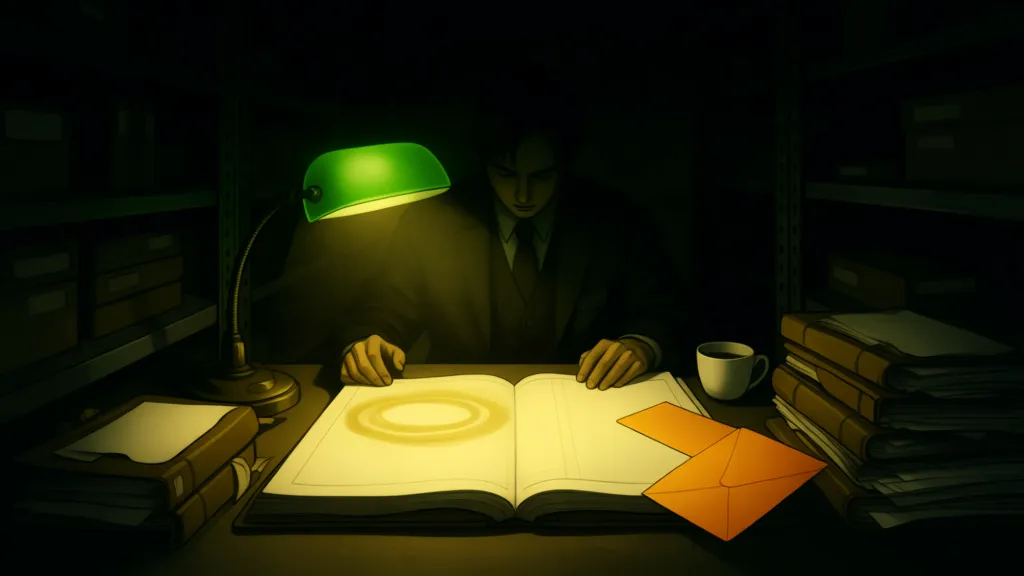
The ring had appeared on the accession ledger for Temporary Judicial Deposits, volume eleven, a pale brown crescent on the lower margin of page 247. Fumika disliked stains in records with the calm intensity other people reserved for moral questions. She stood at the long steel table in Basement Two, ledger open beneath the green-shaded lamp, and traced the ring with one finger without touching it. The page had dried stiff. Someone on evening duty had set down a cup, then blotted at it, making matters worse in a very human way.
She turned to check whether the corresponding box had also been inconvenienced, and saw that envelope 11-247-C sat very slightly askew.
Not enough to alarm anyone normal. A thumb's width out of line, perhaps less. The municipal records office stored temporary evidence from closed or suspended cases in grey acid-free cartons, each compartment labelled by year and division. Everything in Basement Two leaned toward obedient geometry. One envelope out of true looked, to Fumika, as obvious as a man standing on a table.
She took it out.
The envelope was thick, cream, sealed with two strips of clear tape over the flap. The tape had been cut once and laid down again with care. A bubble no larger than a sesame seed showed where the second hand had not matched the first exactly. In the adhesive, held as if under glass, was a single grain of orange paint.
Fumika lifted the envelope closer to the lamp. The paint was bright, construction-site bright, not the dull bureaucratic orange of old file labels. The kind used on barriers, road markings, municipal railings. Fresh enough, she thought, that it had not yet gone chalky.
The envelope should never have been opened at all.
She looked at the call slip tucked in the front of the carton. No retrieval signed in the last six months. No authorization mark from Legal Affairs. No notation from the incoming transfer clerk. The file was attached to a suspended witness intimidation case from four years before. The contents line read, in an even hand: one cassette tape, one handwritten statement, one photograph, miscellaneous correspondence.
Fumika did not open it. She set it on the table, fetched the movement ledger, checked the shelf camera log out of habit, remembered with annoyance that the basement camera had been dead since April because procurement required three quotations for every small misery, and wrote down the envelope number instead.
Then she heard movement beyond the compact shelving.
Not rats. The archive had rats in the abstract, because every old building did, but this was a human sound: the slight scrape of a shoe turned on concrete, followed by stillness so deliberate that it became another sound in itself.
Fumika straightened.
"Who's there?"
The shelves returned paper silence.
She considered, as she often did at night, that municipal service attracted eccentrics because it promised regularity and then failed to supply it. The day staff were merely talkative. The night shift, reduced to essential personnel and those who preferred not to be observed, had developed pockets of private oddness. There was Nishio from tax appeals, who labelled his lunch containers by emotional state. There was Wakabayashi in maps, who said the building settled differently according to moon phase. There was Fumika herself, who came downstairs at two in the morning to investigate tea stains.
She took the lamp from the table and stepped between the shelves.
At the far end, where the old civil engineering plans were kept flat in shallow drawers, someone had left a folded blanket on top of Cabinet E-4. Grey, clean, carefully rolled at the edges. Beside it sat a paperback novel, face-down; a thermos; and, tucked behind the cabinet where only a person already looking would see it, a pair of slippers.
Fumika stopped.
The basement was not empty after all.
2
At two-thirty-two she woke Assistant Section Chief Hori by office phone. He answered on the fifth ring in a voice that had clearly been asleep and intended to remain so.
"If this is about labels," he said, "use the blue cabinet."
"There appears to be a person living in Basement Two," Fumika said. "Also, evidence envelope 11-247-C has been opened and resealed. I have not disturbed it further."
Hori's silence sharpened.
"Living," he repeated.
"With a blanket. Possibly a thermos. The slippers suggest duration."
He said a word that did not belong in records management. Then, because he was at heart a diligent man when cornered, he asked the correct next question. "Is the person there now?"
"I heard someone. I have not pursued them alone."
"Don't. Lock Basement Two and wait by the stairwell. I'm coming in." A pause. "And don't tell security yet."
That was mildly interesting.
"Because?"
"Because external audit arrives at eight. Because if someone has been sleeping in our basement for months, security will spend six hours discovering its own vocabulary. Because if this concerns a judicial deposit, I would like one fact before we invite twenty opinions."
This, too, was reasonable.
Fumika locked the fire door from the stair side and stood with the envelope in a document tray, her cardigan buttoned to the throat against the basement chill. At two-forty she acquired tea from the vending machine on the third floor. It came down like molten regret. She carried it anyway.
Hori arrived at three-oh-eight in a raincoat over his pyjamas, though he had put on proper shoes. He was a narrow, conscientious man whose hair always looked as if he had just removed a helmet.
He took one look at the tray and said, "You brought the evidence. Good."
"I also brought tea," Fumika said.
"That was your first mistake."
They went down together.
The blanket, paperback, thermos and slippers remained. A toothbrush in a paper cup had been tucked into the gap behind Cabinet E-4. There was also, lower down, a cloth shopping bag containing two shirts, a packet of crackers, and a municipal renovation leaflet folded into quarters.
Hori held the leaflet under the lamp.
"Bridge repainting and facade repair, Ward Three Historic Streetscape Project," he read. "Orange barriers. Three blocks away from here."
The grain of paint in the tape gleamed faintly.
"Whoever opened the envelope had paint on their hand," Fumika said.
"Or on a sleeve. Or on a bag."
She nodded. "And whoever has been sleeping here reads translated crime novels and buys unsalted crackers."
Hori glanced at the paperback. Appointment with Death.
"A severe temperament," he said.
They searched the basement more carefully. The old boiler room annex, long decommissioned, connected to a records corridor by a half-hidden service door whose latch had not caught properly for years. Beyond it was a narrow chamber with a sink, a chair, and, on the chair, a folded municipal cleaner's smock. There was no person.
There was, however, a crate turned upside down beneath the small window. The window looked into the area well behind the building. It could be opened from within. Outside, on the sill, fresh mud marked one edge.
"Gone recently," Hori said.
"When I called out, perhaps."
He looked around the improvised room with an expression that mixed dismay and professional envy. The arrangement was efficient. One had to respect method, even in trespass.
On the sink sat a bar of soap, a cheap razor, and a municipal visitor pass on a lanyard.
The pass bore the name MORI JUNKO, temporary conservation consultant.
The photograph showed a woman in her forties with straight hair tucked behind one ear and a face whose most notable feature was the determination not to be notable.
Hori said, "Do we employ a temporary conservation consultant?"
"No. If we did, she would complain about humidity with more authority."
He turned the pass over. The issue date was eight months old. The signature authorizing it belonged to a deputy director who had since retired and would, Fumika thought, sign almost anything if approached while holding a pastry.
Hori took off his glasses and pinched the bridge of his nose. "All right. We will proceed in this order. First, identify whether Mori Junko exists. Second, determine what was inside that envelope and whether anything is missing. Third, discover why our unknown guest chose that envelope tonight. Fourth, survive audit."
"You say that as if one of these were more difficult than the others."
He gave her a flat look. They returned to the table.
Fumika slit the tape along its most recent seam.
Inside lay a cassette tape in a paper sleeve, a three-page witness statement, a colour photograph of a narrow alley behind a bar district, and several letters clipped together. Nothing at first glance looked absent. That was unhelpful. Most losses, she had found, did not obligingly leave holes shaped like themselves.
She read the file cover first. Case 44-19B: assault resulting in grievous injury, probable intimidation of witness, prosecution suspended after witness disappeared before supplementary hearing. Witness name: Mori Junko.
Hori lowered his hand from his face.
"Well," he said. "That is irritatingly neat."
3
By three-fifty, they had learned three more things.
The first was that Mori Junko had once existed in tidy bureaucratic form. Her resident registration had not been cancelled. Her national insurance entries stopped six months after the case. Her lease on a small apartment had ended four years ago. Thereafter the paper trail thinned in the ordinary way of people who preferred not to be found.
The second was that nobody in night security had noticed an extra person in the building because night security, between one and four, consisted of Mr. Doi, who spent most of his patrols composing haiku about draft conditions. Hori read the patrol book in silence for several seconds, then read aloud:
Vent by loading bay / expresses civic sorrow / in a north-east gust.
"He has a gift," Fumika said.
"For unemployment, perhaps."
The third thing was hidden in the witness statement itself.
Mori's statement described seeing two men force a third into the alley behind a hostess bar near Hanazono Street. One man, she wrote, had orange paint on the cuff of his work jacket. He called the other by surname once: Tsuyama. She had been in the alley because she had gone out to smoke despite not being a smoker, which Fumika considered an admirably exact kind of lie. The injured man survived. Two suspects were questioned and released pending identification. Before Mori could make a formal supplementary identification, she vanished.
Attached correspondence showed why the case had later gone stale. There had been confusion over whether Mori had gone voluntarily to avoid involvement or under pressure from the suspects' associates. A detective had argued for continued protection. Funding and staffing had done what they usually did to conviction.
The photograph from the envelope showed the alley mouth, a service door, stacked beer crates, and, at the far right edge, a painted handrail in a shade very close to the grain in the tape.
Fumika set the photo aside. "If she has been living here under her own witness-pass alias, she opened the envelope to check whether the file still existed."
"Or to remove something from it."
"Then why leave everything?"
"Because she was interrupted."
At that moment, as if punctuality had decided to become ironic, a cleaner came in through the side entrance with a trolley, saw Hori in pyjamas beneath a raincoat and Fumika with judicial evidence spread on a table, and backed out without comment. This was tact of a high order.
Fumika read the letters. Most were internal memoranda. One, however, had been misfiled among them: a folded note on municipal memo paper, written in blue ballpoint.
Storehouse too damp. Basement better. Night access still works if latch not fixed. Wait until Tsuyama is transferred. Then decide.
No signature.
Hori looked at it. "That was not listed on the contents line."
"No. Which means it was added later, or it belonged elsewhere and was pushed in by accident."
"By whom?"
Fumika turned the note over. On the back was a faint imprint from another sheet. She angled it beneath the lamp. A phone number emerged in parts, then the tail of a name: ...zaki.
"Not enough," Hori said.
"Perhaps enough if one already suspects vanity. People who think they are helping often use memo paper because they enjoy the administrative flavour of secrecy."
She took the renovation leaflet from the sleeping area and smoothed it flat. On the back, in pencil, someone had marked a timetable: tea room 1:10 / boiler door 1:25 / shelf / back out 1:40.
The handwriting was not Mori's. It was larger, more emphatic, with the inflated loops of a person who liked to be thanked.
"She had help tonight," Fumika said.
Hori nodded once. "Which member of staff has orange paint on them at this season?"
Fumika thought of day shift, of Facilities, of the audit preparation frenzy that had occupied the building for a week. Then she thought of one particular figure in fluorescent workwear who had spent the previous afternoon leaning in the records office doorway, charming two clerks and shedding bits of fresh paint from his sleeves like pollen.
"Matsuda from the renovation crew," she said. "But he is not staff."
"No. But he has a temporary access badge because Facilities keeps lending them out like prayer slips."
"And he was talking to Senior Clerk Igarashi about the old district offices."
Hori looked at her. "Igarashi from legal transfers?"
"He knows every suspended case by gossip value. He also brings people into the tea room after hours because he dislikes going home before an audience has formed."
There was another fact, small and mildly ugly. Igarashi had been the transfers clerk who logged 11-247-C into basement storage four years ago.
"We should ask him," Hori said.
"At four in the morning?"
"Yes. Before he has time to become strategic."
4
Igarashi arrived at four-thirty wearing a scarf arranged with more drama than the hour deserved. He was fifty-six, silver-haired by intention, and had the weary elegance of a man who had long mistaken performance for dignity. He took in Hori, Fumika, the opened envelope, and the blanket on the cabinet with one swift look.
Then he smiled.
Not because he was pleased. Because he had recognised the shape of the room and chosen his face.
"This seems busy," he said.
Hori invited him to sit. He did not.
Fumika watched his scarf. There, near one end, was a dusting of bright orange no one had noticed at midnight because no one expected legal transfers to resemble street furniture.
"Did you know Mori Junko was in the building?" Hori asked.
Igarashi's pause was a fraction too level. "Should I?"
"Yes," Fumika said. "Since you wrote her the note about the damp storehouse and the broken latch."
He turned to her. Vanity always preferred its sharpest audience.
"That is an allegation."
"No," she said. "An allegation would involve motive before handwriting. Your lowercase t hooks leftward. So does the note's. You also press hard on downstrokes when you are trying to feel responsible. It has come through from the previous sheet."
Igarashi looked offended by the accuracy rather than the content. It was, Fumika thought, the look of a man caught in a mirror arranged by an enemy.
Hori said, "Start with the truth. It will save time."
The smile thinned.
"The police asked us to hold documents, not souls," Igarashi said. "She came here years ago. Thin as a bookmark, furious with everyone, convinced that if the men who had threatened her knew where she was she would be finished. She had had enough of official protection by then, and who could blame her. She said she only needed somewhere for a week. The old supplies room was empty. Then it was winter. Then spring. The case drifted. She became useful." He gestured vaguely toward the shelves. "She mended folders. Re-sorted misboxed material. Wrote labels more legibly than half the department."
"You let a missing witness live in the archive for months," Hori said.
"Intermittently."
"There was a toothbrush."
"Fine. Consistently."
It was difficult not to admire the correction.
"And Matsuda?" Fumika asked.
Igarashi's mouth sharpened. "A fool. But a practical one. He met her when the facade works began. She used the rear yard window to get air. He passed food; she passed him opinions. They developed an attachment impossible to categorise and therefore irresistible to both of them. He thought he was helping tonight."
That, too, seemed plausible. Matsuda was thirty at most, broad-shouldered, eager, the kind of man who treated secrecy as proof of romance. Mori, in her photograph, had looked exactly like someone who would be amused by that and sorry later.
"Helping with what?" Hori said.
Igarashi looked at the envelope. For the first time, his performance slipped. Beneath it was simple fear.
"The audit," he said.
Hori stared. "The external audit is not interested in judicial deposit content. Only storage compliance."
"Not directly. But Box Eleven is flagged because half its intake chain predates the new standards. If they sample 11-247-C and compare the contents line with the old transfer memo from district prosecution—"
He stopped.
"There was another item," Fumika said.
"Yes."
"Not listed here now."
"No."
"What was it?"
Igarashi gave a small, defeated laugh. "A second witness note. Not from Mori. From the injured man, after the assault and before he changed his mind. He named Tsuyama's employer. Councilman Sodeyama's younger brother. The file should have gone upward. Instead, there were calls. Delays. Then that page vanished from the prosecution copy. I had the deposit packet in transfer for one afternoon. I made a decision to keep a copy in the envelope, separate from the official inventory. It seemed prudent. Also, if I am honest, melodramatic."
"And now?" Hori asked quietly.
"Now it is gone. Mori knew it had once been there because I was fool enough to tell her. She wanted to know whether it was still there before the auditors touched anything. If it was missing, then it had been removed long ago and quietly by someone inside. If it was present, then she meant to force the matter into daylight before anyone could regularise the box and pretend the discrepancy had never existed. She did not know which frightened her more."
That at least was clear. Mori had come tonight to check, not to erase. Her fear had been of silence with paperwork around it.
"You arranged this," Fumika said.
"I told her not to. She never listened when advice arrived too late."
That had the texture of affection, old and inconvenient.
"Where is she now?" Hori said.
Igarashi looked at the service window. "Gone, I expect. She said if the copy was missing she would stop waiting for institutions to recover their memory and would go to the one reporter she still half-trusted. She had an address. She had been preparing for days."
Fumika considered the timetable on the leaflet, the rolled blanket, the packed shirts. Yes. Tonight had not been improvisation but departure.
"Who removed the copy first?" she asked.
Igarashi spread his hands. "Not tonight's people. Mori had never seen this envelope opened before tonight. Matsuda only got her to the shelf and back. The copy was already gone when she looked. If you want when, then sometime after I hid it and before now. If you want who, I have only my suspicions, and they improve in elegance as they lose contact with proof."
5
The answer lay, irritatingly, in the thing Fumika had first come to correct.
She went back to the ledger with the teacup ring and turned again to page 247. The stain covered part of a notation in the margin, one she had dismissed as water damage. Under the lamp, however, the ink showed through the brown crescent in broken strokes. Not a spill after all, but a spill over writing.
Hori leaned beside her.
"Can you read it?"
"Not all of it." She tilted the page. "'Moved to dry review'... and below that... initials. K.H."
"Kitahara Hiroshi," Igarashi said at once. "Deputy director then. He liked side channels if they felt benevolent."
Fumika nodded. "If you told him the envelope held an unofficial extra copy and worried about damp, he may have moved it upstairs for safekeeping without entering a formal retrieval. Later it came back to the box without the copy. That explains how the copy vanished years ago without any sign on the contents line."
"By Kitahara?" Hori said.
"Or by someone who handled his desk, his annex shelves, or the return." She looked again at the stain. "But the tea ring matters because someone saw this old margin note recently and tried to blur it before audit prep. That someone is current."
Hori's eyes narrowed. "Nakano."
"Evening duty clerk Nakano Keiko," Fumika said. "Her initials are N.K