The Pawn in Glass
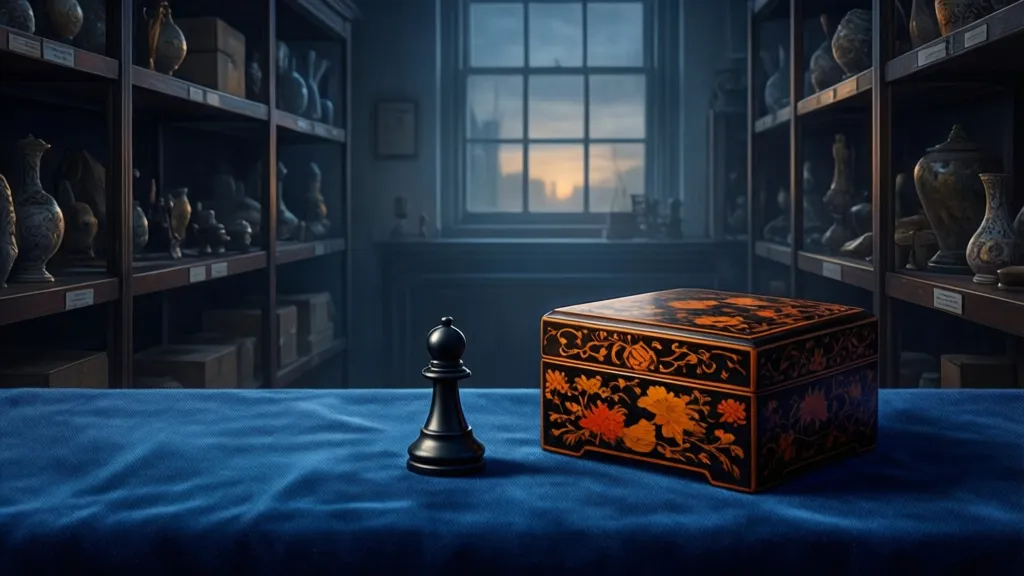
At nine six the next morning, the black pawn was standing on the blue velvet beside a lacquered incense box from the late Edo period, as if it had always belonged there.
Matsuda Aya stopped with her key still in the archive room door. The pawn was no larger than the first joint of her thumb. It had a shallow nick near the base, where the restorer had noted an old chip in the ebony. She knew it at once. She had spent most of the previous Thursday writing three labels for the Takemori bequest because the donor's family disliked the word miscellaneous.
The chess set should have been in Case Twelve, Gallery B, arranged exactly as the conservator had left it: black king tilted half a degree because the board was not quite level, white bishop with a hairline crack in the miter, one black pawn at the far right of the second rank.
This one was in Case Four, Gallery A.
Aya crossed the gallery, unlocked Case Four, and lifted the little piece with gloved fingers. On the velvet there remained a pale crescent of dust, the clean mark where the base had sat overnight.
She looked at the lock first. No scratch. No drag. Then at the brass corners of the case. Then at the floorboards beneath, where the cleaner's mop had left its broad dry arcs and, between them, nothing useful at all.
"Again?"
She turned. Sano Jun was halfway through the side door with a tray and a face arranged into concern. He was the museum's education coordinator, a man whose scarves suggested a sincere belief in European winters. The tea on his tray was steaming with menace.
Aya said, "Yes."
"I had hoped," Jun said, setting the tray on a plinth intended for a Buddhist fragment not yet returned from loan, "that yesterday had exhausted the pawn's social ambitions."
She looked at him.
He raised both hands. "You prefer facts. Yesterday at nine twelve, same pawn, same case. I remember because you said, very quietly, No. It was expressive."
Aya had indeed said No. Yesterday she had also carried the pawn back to Case Twelve, checked the accession sheet, checked the cleaner's log, checked with the morning guard, and received from all three the blank resistance of innocent paperwork. She had then spent the day being polite to the donor's daughter, who disliked labels even more than miscellaneous.
Now she set the pawn into a padded tray and said, "Who opened first?"
"Oshima-san at eight forty-five. I came in behind him. He says all cases were shut."
"And Case Four?"
"Locked."
That meant someone with a key had opened it, placed the pawn inside, and locked it again before opening.
Jun poured tea for her without asking. It was too hot. She drank it anyway.
By ten thirty the curator knew. By ten forty-five the deputy director knew, which was worse, because the deputy director had the moral atmosphere of a sealed corridor. At eleven five, in the office where the air smelled of dry cardboard and administrative suspicion, he folded his hands over a file and said, "Matsuda-san, I trust you understand the position. The Takemori collection has not yet been formally accepted by the board. If there is irregularity in handling—"
"There is irregularity in access," Aya said.
"Precisely. And access falls under collections management."
It always did, once blame became available.
Across from him, Curator Nishibe winced with her eyes and said nothing. She was retiring in three months and had acquired the prudence of a person crossing a road with loose gravel.
The deputy director continued, "Tonight the climate room must be checked in full. Every object, every tag. The board meets at eight tomorrow. I would prefer to tell them this was a minor misunderstanding and not a pattern of negligence."
Aya said, "There is also the climate room lock."
That finally stirred him. "What about it?"
"Yesterday evening it was secured at six eighteen. This morning it was still locked, but the indicator wafer had shifted. It was opened once during the night."
"By whom?"
"That is what I am trying to discover."
He gave her a look people gave cabinets when the drawer would not slide properly. "Do so quickly."
By the end of the meeting, she had acquired no help and a pressure behind her eyes.
The climate room sat beyond the paper archive, behind a steel door with a mortise lock old enough to be honest. The wafer inside the keyway turned a different color when the bolt was fully thrown. The conservator used it to see, at a glance, whether a hurried hand had only pretended to lock up. This morning the color line had been fractionally off. Someone had opened the room and locked it again.
The only keys were held by Aya, Curator Nishibe, conservator Fujimori, and the night guard's desk in a sealed envelope for fire or leak. In theory, only in theory, any use of the emergency key required a note in the log.
There was no note.
Aya spent the afternoon with lists. She always preferred facts in rows. At one fourteen she checked the accession photographs. At one forty she checked the restoration report from Hasegawa Studio. At two five she checked the old household inventory provided by the Takemori family. At two thirty-two she found the first thing that was not merely annoying.
The restored chess set consisted of thirty-one pieces.
In the restoration report, one line read: black pawn, replacement felt added to base; inventory tag detached during cleaning and retained separately.
Aya went very still. The little paper tags had been tied to the set decades ago with silk thread gone brittle from dust and pride. During restoration most had been removed, numbered, photographed, and rehung. One had detached.
Which meant one black pawn had once had its own identifying tag.
And now that pawn was the one travelling.
She asked Fujimori, who arrived smelling faintly of shellac and having forgotten both his pen and one sleeve button. "Did you reattach the loose tag?"
He frowned upward in the manner of a man consulting a ceiling for memory. "No. It was too fragile. I placed it in a small polyethylene sleeve with the object's subnumber. Gave the packet to Collections."
"When?"
"Last Tuesday. Or Wednesday if Tuesday was the day of the leaking pipe." He brightened. "There was tea in the corridor."
There often was. It was never helpful.
Collections was a metal cabinet in Aya's room because Collections in this museum meant Aya, one clerk shared with Education, and a set of forms whose main purpose was to suggest order. She unlocked the cabinet, checked the drawer for detached tags, and found the sleeve.
Empty.
At three nineteen she wrote that down.
At four ten she asked the cleaner whether anyone had been in Gallery A after hours. The cleaner said only Mr. Takagi the night guard, and once Miss Takemori, the donor's daughter, who had returned for a scarf two evenings earlier before locking time. At four twenty-five she asked Oshima the morning guard whether Miss Takemori had come in yesterday. He said no. At four thirty-one she looked at the visitor book and found Miss Takemori's name written in a brisk hand on Tuesday and not thereafter.
At five exactly, as the last visitors shuffled out through the rain, Aya stood in Gallery B before Case Twelve and looked at the chess set.
The pieces had the faintly affronted air of objects required to endure people.
She counted them again. Thirty-one. The pawn had been returned at noon. It stood now in its proper line.
She looked at the base felt beneath it, the shade slightly newer than the others. Then at the accession card, where each piece had been listed under the collective bequest and one note in old brush ink had been copied from the family inventory:
One black soldier piece chipped by the south veranda, ninth month of Taisho 11.
A family would not remember which pawn had once bounced off a veranda unless the incident had attached itself to something else.
Aya closed the case, switched off the gallery lights, and remained.
At six forty-seven the museum was quiet in the layered way large old buildings became quiet: roof settling, pipes thinking, rain arranging itself against windows.
Aya had told no one she intended to stay. It was easier to observe people when they thought they had finished with her.
She waited in the paper archive with the lights off, the climate room key in her pocket, and drank a cup of tea Jun had left on her desk in an act of loyalty so imprudent it had gone cold before she touched it.
At seven thirteen, footsteps crossed the corridor outside. Not the cleaner's soft practical pace. Slower. Measured. A person walking carefully because the building should already have been empty.
Aya opened the archive door enough to see.
The donor's daughter, Takemori Reina, moved past the reading room in a dark raincoat with the hood down. She was in her middle thirties, faultlessly dressed even now, and had the kind of face on which displeasure looked hereditary. She did not glance around. She went directly to Gallery B.
Aya followed at a distance.
Reina unlocked Case Twelve with a key.
Not one of the case keys issued by the museum, Aya saw at once, but an older narrow key. Reina must have had it from before the donation, when the family's display cabinet had stood in the western room of the Takemori house. The museum's contractor had reused the old locks in the exhibit cases because the donor liked continuity and the budget liked obedience.
Reina lifted the travelling pawn from the board and stood with it in her bare hand, not looking at the set but at the far wall, where a screen painting of geese had gone slightly dark under varnish.
Aya stepped into the light and said, "If you move it to Case Four again, it will only save a few hours."
Reina shut her fingers around the pawn. She did not start visibly; she simply became harder to look at. "You should not be here after closing."
"Nor should you."
"My family's property is in this room."
"No. Your family's gift is in this room. At present, with paperwork unfinished. By tomorrow morning, if a piece is judged missing, it may also be my professional failure. So I would be grateful if you explained why this pawn has been touring the museum."
Reina looked at the object in her hand as if deciding whether to throw it. "You would not understand."
"That is possible," Aya said. "It is not an argument."
For a moment Reina seemed on the edge of saying something frank and useful. Then she put the pawn back into Case Twelve with exact care and locked the case.
"I never entered this building after hours," she said.
Aya said, "You are in it now."
"Then you may report me."
She walked past, the scent of rain and expensive soap following her. Aya watched her go, noticing not the statement but the shape of it. I never entered this building after hours. A sentence so polished it had been prepared in advance. Which meant she expected the question.
Aya checked the case. The pawn was in place. Nothing else was disturbed.
Then she heard a sound from the service corridor behind the climate room. Not loud. A chair leg scraping, then a muffled thud.
She ran.
The night guard, Takagi, sat upright in the wooden chair outside the climate room as if posed for a school lecture. His chin had sunk to his chest. His cap lay on the floor. One sleeve cuff was dark with rainwater; then Aya saw both cuffs were wet to mid-forearm. In his right fist he held a torn paper strip.
She took it gently free.
It was the bottom half of an inventory tag. On the front: ...mori Collection. On the back, the subnumber in Aya's own hand: 17-b.
The black pawn.
Takagi woke badly. He jerked, saw Aya, and then the corridor beyond her, where no one stood now. His face lost what little color it had begun with.
"Matsuda-san," he said thickly. "I wasn't—"
"Sleeping?"
He looked at the chair, considered the evidence, and said, "Not intentionally."
She crouched to his level. "Why are your cuffs wet?"
He glanced down as if they had been attached by a stranger. "I don't know."
It was not a performance. It was the sincere confusion of a man whose evening had left gaps in him.
"Who was here?"
"Miss Takemori. I think. No—" He swallowed. "She asked whether the old family cabinet key still worked. Earlier. Before rounds. Then there was a smell. Sweet. I thought maybe lacquer? I sat down only for a moment." He looked toward the climate room door and flinched. "Did I open that?"
Aya put a hand on the knob. Locked.
"Do you have the emergency key?"
He patted his jacket, then the desk pouch at his belt, and produced the sealed envelope. The seal had been broken and folded closed again.
There were very few uglier things in a museum than an emergency protocol quietly used and then tidied.
Aya opened the envelope. The key was damp.
Takagi said, almost pleadingly, "I would not. Not without logging it."
"I know," Aya said, because she did. Takagi was vain about his punctuality, defensive about his knees, and pathologically respectful of procedures. A man like that might conceal a cigarette. He would not improvise paperwork.
She unlocked the climate room.
Cold dry air came out carrying old textile and cedar. Shelving lined three walls. Trays. Boxes. Wrapped ceramics. The Takemori reserve pieces occupied the middle bay: a writing box, two Noh masks, three scroll tubes, a family photograph album, and one long shallow tray where detached labels and non-display components had been kept pending cataloguing.
The tray had been opened.
Inside lay a coil of faded silk thread, several small paper sleeves, and a rectangular absence in the dust where one item had been removed. Not recently enough to disturb the entire layer; recently enough to leave a fresh-edged outline.
Aya lifted the nearest sleeve.
It contained the top half of an old inventory tag.
The missing lower half was in her hand.
She fitted them together. The break matched. The full line, written in old ink gone brown, read:
Black soldier piece chipped by south veranda, used to carry note on the night of the storm.
Aya closed her eyes once. Then opened them and looked again at the empty space in the tray.
A folded paper packet was missing. Small. The size of a note preserved beside a tag.
Behind her, Takagi said, "Am I dismissed?"
It had the flatness of a man looking over a cliff and inventorying the fall.
"Not yet," Aya said. "First tell me what happened, exactly."
He did, in fragments. Miss Takemori had come just after seven, saying she had forgotten a handkerchief during the afternoon visit. She had been sharp with him when he said galleries were closed. Then apologetic. She had offered him a wrapped sweet from a confectioner's near the station because, she said, her father always brought that brand on rainy days. He had eaten it. They had spoken about old locks. She had asked whether the museum still kept the family tags. He remembered that. He remembered standing up to show her the service corridor. After that, only the smell—almond, perhaps, though he was not sure—and then waking in the chair.
Aya listened and thought of all the absurd methods by which grown people chose to ruin themselves. The sweet need not have been dramatic. A sleeping powder, enough to cloud him. The wet cuffs were stranger.
She examined the floor. Beside the chair, faint on the worn boards, a dotted line of water led from Takagi's left side toward the rear service door. Not shoeprints. Drips, as if something wet had been carried close to the body.
She opened the rear service door. Outside, a narrow stone passage ran between the museum wall and the old garden reservoir. Rain had slowed to a mist. At the edge of the threshold, protected by the eave, was another small fact: mud on the sill and one dark smear where a sleeve had brushed.
Wet cuffs. A key damp from more than a hand. A lock opened from the inside.
Not from the corridor, then. From the passage.
The climate room had a second door.
Aya knew that, of course; everyone in collections did. It was a narrow internal hatch at the back, built decades ago when the room served as a coal-accounting office and later sealed by shelving on the museum side. The exterior door in the passage was still there but bolted from within and supposedly unused. If someone had reached in from outside after opening it, their sleeves would be wet. If Takagi had been half-conscious, he might have been made to stand and give up the emergency key while someone used the main door, or simply had the envelope taken from him while he could not later sort the sequence. What mattered was simpler: the outer passage door had been opened first, in the rain, by someone who knew it was there; the climate room had then been entered from the corridor with the damp emergency key; inside, the rear bolt had been worked back to make the passage door usable from within while the search was made. Afterward the room had been relocked from the corridor and the outer door bolted again behind the shifted shelving. It would look, later, as if the room had only been opened conventionally.
Unless one noticed sleeves and damp metal.
She went back in and checked the rear wall behind the shelving. The lowest shelf had been shifted half an inch. Enough to access the old bolt.
Takagi, watching, said, "I did not know that door still moved."
"You weren't meant to," Aya said.
Reina was still in the building. She had to be. The front guard would have seen her leave by the main entrance, and she would avoid that now. Aya sent Takagi, shakily recovered, to call Oshima and lock the public exits. Then she crossed to the former family gallery on the west side, where the Takemori pieces had stood before formal transfer. It was the room Reina preferred during donor visits because it still smelled faintly of cedar and old authority.
She found Reina there, sitting on a bench beneath the portrait of her grandmother, with her gloves in her lap and a folded paper packet beside her.
"Thank you," Aya said, looking at the packet. "That saves time."
Reina said, "You are very calm for a woman about to accuse a donor."
"A donor's daughter. Distinction matters in boardrooms." Aya remained standing. "You moved the pawn each morning because you suspected that particular piece mattered, and because you needed to know whether the museum had preserved whatever had once been tied to it. Not because you had found the note already. Because you had not."
Reina's mouth changed, not quite a smile. "You assume a great deal."
"Only from what you left in plain sight. The family inventory singled out one pawn for a trivial childhood chip. The restoration report said that same pawn's tag had detached and been retained separately. You knew, or guessed, that something had once travelled with it. So you moved it where it would be noticed. If the museum ignored it, then the tag was probably gone and the matter ended. If the museum identified it, checked its paperwork, and started looking for the detached tag, then whatever belonged to the pawn might still be somewhere in Collections." Aya looked at the packet. "Yesterday, when I examined the accession records and the restoration report, you saw enough to understand I had followed that trail. That is when certainty became urgent."
Reina's fingers tightened once over her gloves.
Aya continued, "So tonight you came yourself. You drugged Takagi, took or persuaded out of him the emergency climate key, and used the old passage door because you knew the room had once connected to the exterior service walk. The outer door was opened first, which is why the sleeves and key were wet. Then you unlocked the climate room from the corridor, searched the tray, and worked the old rear bolt behind the shifted shelf so the passage route could be used and concealed again. The torn tag remained in Takagi's fist because he half-woke while you were separating it from the sleeve and you needed him to look guilty, or careless."
Reina looked down at the paper packet. "Not guilty. Only incompetent. That would have been enough."
Aya said, "Yes."
That was the simple ugly part of institutions: they preferred a fault they already paid for.
Reina lifted the packet and turned it between her fingers. "It was my mother's handwriting. I knew it before I opened it."
Aya sat at the far end of the bench, not close. The room had gone very still around the rain.
"Then open it again," she said.
Reina gave a short laugh with no amusement in it. "You think I have not memorised every fold?"
"I think you wanted the object more than the words. That is not the same thing."
For the first time, Reina's certainty faltered. She handed over the packet.
Inside was a note on thin paper, brittle at the creases, written in a hurried hand:
If Father sends me away tomorrow, meet me by the south veranda after the storm. I will carry the pawn so you know I came myself.
Akiko
No surname. No date. But enough.
Aya thought of the copied line in the family inventory, absurdly domestic in tone. Chipped by south veranda, used to carry note on the night of the storm. Someone in the household had known. Not enough to preserve the whole scandal in formal language, only enough to preserve the object attached to it.
"Who was it for?" Aya asked.
Reina said, after a moment, "For my aunt. My mother's elder sister. They were both expected to marry usefully. One did. One did not. There was a servant