The Red Boot Key
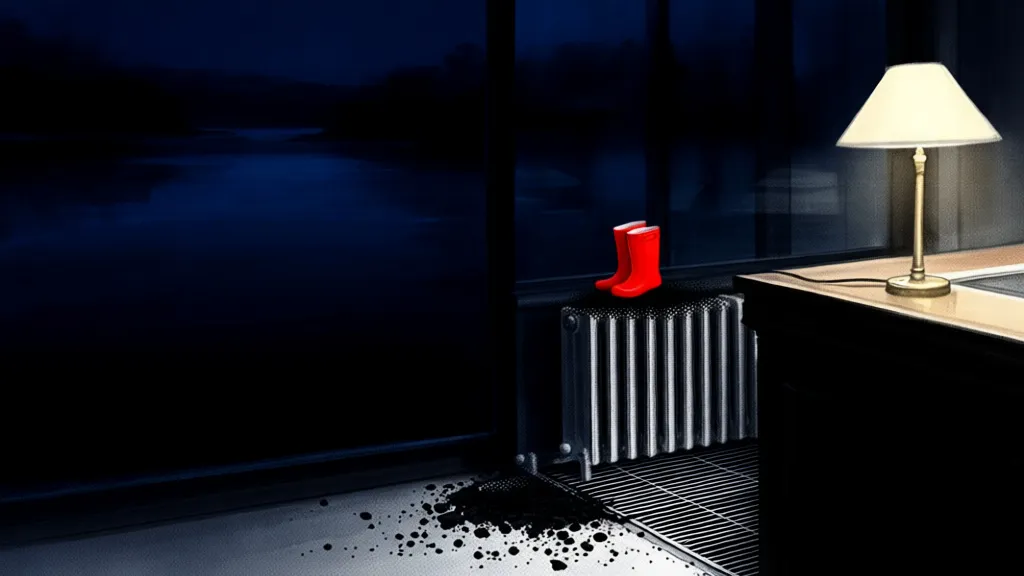
At two-thirteen in the morning, Hara Emi reached behind the front desk to rescue the electric kettle before it boiled itself dry and found, instead, a child’s red rain boot standing on the radiator like a reprimand.
It was the left one. Small, glossy, and still damp. A dark crescent of lake water had spread under it on the painted metal grill. When Emi lifted it, black sand clung to the rim and to the tread in a neat wet half-moon.
She held it in one hand and looked at the night ledger with the other.
There were thirty-two occupied rooms at Lake Shirasagi Hotel. In theory.
In practice, there were thirty-one. The fourth floor west corridor had been closed for repainting since Tuesday, and room 417 in particular had been kept out of service because the window latch stuck. The manager had complained about the latch, the paint smell, the overtime, and the decline of standards in roughly that order.
Emi set the kettle properly, switched it off, and examined the boot under the desk lamp. Cheap rubber. A cartoon frog on the side. The sort of thing a parent bought because it was there and the child needed boots by afternoon. Inside, beneath the damp insole, something pale was wedged against the toe.
She tipped the boot carefully.
A white key card slid out, struck the desk, and landed against the register with a click much louder than the hour deserved.
On the paper sleeve, in the receptionist’s rounded handwriting, was written 417.
Emi looked at it for a moment. Then she looked back at the boot, as if it might now explain itself.
It did not.
Outside the lobby windows, the lake was a black pane with one blurred string of lights from the boathouse. Rain had ended shortly after midnight. The storm had left the carpets smelling faintly of wool and umbrellas. Somewhere in the corridor, an ice machine hummed like a person thinking too hard.
Emi was not, by title, a detective. She audited accounts, handled late arrivals, wrote down complaints about pillows, and prevented the breakfast yogurt from being stolen by conference guests with unusual energy. But the night shift had a way of making every object a witness. People put things where they ought not to be when they believed everyone sensible was asleep.
She placed the boot on a towel. The black sand interested her more than the card.
Lake Shirasagi had a narrow public beach behind the old boathouse. The ordinary sand there was pale brown. Black sand came from the maintenance strip below the west retaining wall, where volcanic gravel had been spread in winter for traction and washed down in spring storms. Guests were not meant to use that path. It led, by a side stair and a service door, toward the closed fourth-floor west wing.
Emi wrote the time in the incident book.
At two-twenty-one she called housekeeping. No answer. At two-twenty-three she considered calling the manager and did not. Mr. Takeda believed all problems improved by being postponed to business hours, except those involving his own slippers.
She took the master corridor chart from the drawer and unlocked the back office cabinet. The fourth-floor west keys hung undisturbed on their hooks. The service door key was missing.
That was less good.
Emi put on her cardigan, tucked the boot and key card into a canvas lost-property bag, and took the staff staircase up.
The fourth floor smelled of paint, dust sheets, and a citrus cleaner so aggressive it seemed moral. The east corridor was lit. The west corridor beyond the fire door was dark except for a night light at the far end. Brown paper covered the carpets in strips. Plastic sheets veiled two armchairs and a decorative vase, making them look temporarily haunted.
Room 417 stood three doors from the corner. The paper seal Mr. Takeda had taped over the latch on Tuesday had been sliced cleanly through.
Emi slid the card.
The lock blinked green.
Inside, the room was neat at first glance and wrong at second. One bed had been slept in. The coverlet was folded back with care too deliberate to be housekeeping. A bath towel hung over the chair to dry. On the windowsill sat three shells from the gift shop, still with their price sticker on one. The wastebasket contained a child’s juice box, flattened. On the dresser lay a brochure for the swan cruise, ringed with a teacup stain.
The tea, in fact, was still there. A hotel porcelain cup on the bedside table, full to the halfway mark, stone cold.
Emi looked at it without affection.
She opened the wardrobe. Empty. The bathroom held a toothbrush in a paper sleeve, one adult raincoat, and no person.
The raincoat was green and expensive, and in the pocket was nothing except a packet of ginger candies.
By two-forty-eight she had a short list of facts and no shape to fit them. Someone had used 417 after it was closed. Someone had come in from the lakeside service path. Someone had had a child with them, or wished her to think so. Someone had left in a hurry, but not a panicked one.
The most annoying possibility was the likeliest: a guest had been shifted unofficially into the room because of overbooking, leakage, marital dispute, celebrity nerves, or some management improvisation that would become, by dawn, the night auditor’s paperwork.
Emi locked the room again and went downstairs with the boot.
At six-fifty, the first light over the lake was thin and practical. By seven-ten, the breakfast staff had begun moving through the lobby with trays and opinions. At seven-thirty-two, Mr. Takeda arrived in a tie patterned with very small pheasants and listened to Emi’s report with the expression of a man being asked to admire a crack in the ceiling.
“417 was not occupied,” he said.
“Yes,” Emi said.
“Then no one occupied it.”
Emi placed the boot on the desk between them. Black grains marked the towel.
Mr. Takeda looked at the boot, then at the lobby, as if hoping the object belonged to some other establishment. “Before breakfast service,” he said quietly, “we do not create alarm. Close the floor fully. Tell housekeeping not to go in until I say so.”
“I would like to identify the guest first.”
“We do not know there was a guest.”
Emi touched the key sleeve with one finger. “No. Merely tea.”
He disliked irony because it sounded, in other mouths, too much like accuracy. “Take statements if you insist. Discreetly.”
He said if you insist in the tone of a man granting a decorative vice.
By eight-fifteen there were, conveniently, three parties in the breakfast room who had children young enough for a red rain boot.
The first was Professor Mamiya from Sendai, attending the local folklore conference and travelling with his eight-year-old daughter, Rika, who wore yellow sneakers and a magnified expression of disinterest. The professor examined the boot over his miso soup.
“Not ours,” he said. “Rika’s boots are blue. With rabbits.”
Rika, without looking up from her illustrated puzzle book, said, “They are foxes.”
Her father adjusted his glasses. “Quite.”
The second was Ms. Kuroda and Ms. Ishii from Tokyo, sharing room 305 with Ishii’s nephew Haru, age six, because Haru’s mother had been hospitalised briefly and family arrangements had become, as Ms. Kuroda put it, operatic. Haru glanced at the boot and said at once, “That’s not mine. Mine got a dinosaur mouth.”
“It has a dinosaur mouth,” Ms. Ishii murmured.
“No,” Haru said patiently. “A better one.”
The women exchanged the tired look of co-commanders. Neither corrected the other’s cup placement, but each did it after the other looked away. Emi noticed this because she noticed things left slightly askew.
The third was a widow named Saegusa, travelling with twin grandchildren who were five and had the disconcerting habit of answering in chorus only when not asked. She peered at the boot and declared it common. The twins declared it lonely. Saegusa said neither of them owned anything red because red encouraged running.
None of this helped, except that all three adults insisted, with a touch too much readiness, that the boot belonged to someone else.
That interested Emi.
People denied ownership of an object in different ways. The innocent usually did it by adding detail. The guilty often did it by adding distance.
Professor Mamiya had supplied unnecessary zoology. Ms. Kuroda and Ms. Ishii had produced a child prepared to critique monster design. Mrs. Saegusa had converted the matter into a philosophy of colour. Each answer was plausible. What was common to them was not fear but caution. They did not wish, for reasons of their own, to be connected to the closed floor.
At eight-forty, Emi asked the breakfast captain whether any tray had been sent to 417.
“No room service after ten,” he said. “But at six, one of the kettles was missing from the pantry.”
“The old copper one?”
“The new electric one. Returned wet.”
“Where?”
“Service lift landing, fourth floor west.”
That was useful. So was the fact that he answered first and only then wondered whether he ought.
Emi went to see the housekeeping supervisor, a narrow woman named Chiba who folded fitted sheets with the concentration of a surgeon and regarded management as an atmospheric problem.
“You said not to clean 417,” Chiba said. “So naturally one of the girls tried to.”
“What did she touch?”
“Nothing important. She saw the towel on the chair and the shells and came to tell me because shells are how guests mark territory.”
That was not a universal principle, but it had enough examples behind it to deserve respect.
“Did you notice anything else?” Emi asked.
Chiba considered. “The little paper slippers in 417 were missing. One child size from linen stock as well. And someone took an extra blanket from the west closet yesterday evening, before my shift ended.”
“Who signed for it?”
“No one. We are not a prison.” She paused. “Though some days we lack only walls.”
Emi asked for the linen tally anyway. At seventeen-forty yesterday, one child’s blanket and one child’s slipper set had been marked out by hand, initials unreadable under a smear.
Not a child, then, brought by a guest. A child expected.
She returned to the front desk and spread the registration cards. Thirty-two rooms occupied. One no-show from Osaka had been charged at eight p.m. Room 214, single. A last-minute walk-in couple had taken 118. A note in Mr. Takeda’s hand transferred room 402 to 407 due to a bath leak.
Then she saw a narrower note clipped beneath the stack: If Dr. Aso arrives after midnight, hold key. Do not assign west side because of paint smell.
No room number. No signature. The handwriting was the assistant manager’s, round and apologetic.
Dr. Aso had not checked in at the desk. Emi had been on duty from eleven and would have remembered; doctors arriving after midnight did not often carry cello cases.
She checked the luggage room. There was, in fact, a cello case with an old station label from Matsumoto. Attached to the handle was a tag: Aso, N.
The case had arrived by taxi at 10:40 p.m., according to the porter’s chalk note. Left in storage because the guest had telephoned that she would be delayed.
A delayed guest. A closed room occupied. A child’s blanket missing before evening shift ended.
Emi stood very still. Then she called the taxi stand.
The second driver she asked remembered the fare because of the rain. “Woman in green coat,” he said. “From the station to the hotel side entrance, around one-thirty. Not alone. Had a little girl asleep on her shoulder. And another woman? No, not woman. Young man maybe. Hard to say. Slim one. Stayed in the car while she carried the child in under the awning. Then I took him back toward the town clinic.”
“The woman in the green coat,” Emi said. “Was she carrying a cello?”
“No luggage. Only the child. She was in a hurry, but polite.”
The town clinic sat a fifteen-minute walk uphill. Its visiting physician this week was, according to the conference leaflet by the phone, Dr. Aso Nao, lecturing on sleep disorders and local legends. Which was an absurd pairing and therefore probably academic.
Emi asked the day receptionist to cover the desk, accepted a cup of tea she had no wish for, found it too hot to swallow and too late to refuse, and went out toward the lake path instead. The black sand there, below the west retaining wall, had been muddied by night rain. Adult shoeprints had blurred, but one smaller print remained clear where the wall sheltered it: the tread of a child’s rain boot, frog-eyed at the sole.
Beside it was the narrow mark of a wheeled case.
Not a stroller. Too slim. A cello case, dragged for a few steps before being lifted.
The side service door, hidden by clipped hydrangeas, opened onto the stair landing where the kettle had been found. Someone familiar with the hotel had used it. Not a random guest.
When Emi returned, Dr. Aso was in the lobby.
She was thirty or so, elegant in the exhausted way of people who had slept in trains and then denied it, and she wore the green raincoat from 417. Beside her sat the cello case. She was speaking to Mr. Takeda, who had adopted his expression for difficult invoices.
Emi approached with the boot in its towel.
Dr. Aso saw it and closed her eyes briefly. It was not the face of a liar deciding; it was the face of a tired person realising the lie had already chosen for her.
“That is inconvenient,” she said.
Mr. Takeda turned. “You know this object?”
“A little girl knows it better,” Dr. Aso said. “I had hoped she would have both by now.”
“Please,” Emi said, “tell us from the beginning.”
Dr. Aso glanced at the guests in the lounge, the pianist polishing dead keys, the bellboy pretending not to hear. “Somewhere less theatrical?”
They used the small reading room off the lobby, where the hotel kept regional histories nobody borrowed and a print of the Suzuki Inn in winter because hoteliers were sentimental about one another’s snow.
Dr. Aso sat with the cello case at her knees like a shield.
“The child is my daughter,” she said. “Legally, my niece, on paper old enough to please certain relatives. In practice, my daughter.”
Mr. Takeda made a small sound suggesting scandal had presented itself without proper appointment.
“I was to arrive yesterday before dinner,” Dr. Aso went on. “My sister was bringing Mei from the clinic after her fever came down. My sister did not bring her. She sent her husband instead.”
“The slim man in the taxi,” Emi said.
“Yes. My brother-in-law. He and Mei adore one another and lie badly for each other. He said my sister had changed her mind, that Mei should not stay with me while I was lecturing, that they would take her home in the morning. Then he arrived at one-thirty in the rain with a sleeping child and asked if I could hide them for a few hours because my sister was following in her car and wished to make a scene in public.”
Mr. Takeda said, “Madam—”
“Yes,” Dr. Aso said. “I also thought this was a poor plan. But there was a child with a fever in the rain.”
Emi said, “So you used the side entrance.”
“I have stayed here before for conferences. I knew the service door from smoking academics with bad boundaries. The front desk was lit. I did not want my sister meeting me in the lobby first.”
“Why room 417?”
At this, Dr. Aso hesitated. “Because the assistant manager gave me the card last month and told me, if I ever needed an hour of peace from conference organisers, the closed rooms were quieter.”
Mr. Takeda went pale in a managerial fashion.
“That was not official policy,” he said.
“No,” Emi said. “It seldom is.”
Dr. Aso continued. “I had the old card sleeve in my wallet. I thought the room would remain unused. I put Mei to bed there, boiled water with the kettle, and waited for my sister not to arrive. She did not. Instead she telephoned at three and cried. Then shouted. Then cried again. We have a family talent for alternating.”
“Why leave before morning?” Emi asked.
“Because my sister finally admitted the truth. Mei’s fever had frightened her. She and her husband had quarrelled. She said things about my raising a child in borrowed corners of my life, which was not entirely unfair. Then she asked me to bring Mei to the clinic at dawn and let her pretend she had never sent the child away.”
Mr. Takeda rubbed his forehead. “And the boot?”
Dr. Aso gave a small, defeated smile. “Mei woke half-asleep. I carried her out wrapped in the blanket. One boot came off on the stair. I went back for it, heard someone at the service door, and hid behind the desk while the night kettle screamed. I set the boot on the radiator, took Mei out the lakeside path, and forgot it because she was coughing.”
“That someone,” Emi said, “was me.”
“Yes. I am sorry.”
The remaining question was the easiest and therefore the one left for last.
“Why,” Emi asked, “did three different guests insist the boot belonged to someone else?”
Dr. Aso blinked.
Emi had already seen the answer in the breakfast room, in the little exchanges of eyes and hands. “Because each of them saw some part of it,” she said. “Professor Mamiya was on the west veranda after midnight smoking where he should not. He saw a woman carrying a child upstairs and does not wish the conference chair told. Ms. Kuroda and Ms. Ishii took Haru down to the lobby when he had a nightmare and saw the boot on the radiator, but they are used to not inviting institutional attention to unusual family arrangements. Mrs. Saegusa heard a child coughing in the closed wing because she was awake with her own pain tablets and concluded some hotel scandal was under way. None wished to be involved. So each stepped one pace backward and called it someone else’s.”
No one contradicted her, chiefly because no one present had been any of those people.
Mr. Takeda said, after a silence, “This cannot become known.”
“Very little becomes known,” Emi said. “Most things merely become tidied.”
She handed him the incident book. “The practical issue is whether you intend to close the floor before housekeeping records the kettle, the blanket, the slippers, and the room use properly. If you do, the discrepancies will remain. They are less discreet in writing than in memory.”
He looked at her, then at the neat list she had made during the night. A manager could dislike facts and still prefer them arranged.
At last he said, “Room 417 was used unofficially due to a delayed arrival and a family medical emergency. Charge no lodging fee. Replace linen. Repair the service door lock today.”
A concession, in him, sounded much like defeat.
Dr. Aso bowed her head. “Thank you.”
“To the hotel,” Mr. Takeda said sharply, because gratitude, too, required management.
By noon the fourth floor west was formally sealed. Housekeeping had washed the teacup, stripped the bed, and removed the last black grains of sand from the corridor paper. The red boot had been claimed at eleven-forty by a child named Mei who wore only one sock, accepted the recovered boot with grave satisfaction, and then asked whether the hotel kept frogs in the lake.
“We keep swans,” Emi said.
“Frogs are better,” Mei replied.
Her mother—or aunt, on paper—smiled without correcting her.
They left for the clinic with the cello case and the blanket folded over Dr. Aso’s arm. From the lobby window Emi watched them cross the wet drive: the woman walking too straight from fatigue, the child skipping on recovered feet, each attached to the other by something sturdier than explanation.
The breakfast rush ended. The conference delegates dispersed into weather. Somewhere above, a vacuum cleaner growled over a stain with personal feeling.
Emi sat at the side desk with the final report, and the tea the day receptionist had brought her at last became drinkable by passing all the way through hot into cold. She drank it anyway.
What had nearly been lost was not, she thought, the room or the manager’s composure or even the hotel’s fiction of order. Those were replaceable. Hotels existed to make disorder sleep under numbered blankets.
The rarer thing was smaller and more troublesome: the hour in which a frightened mother had believed she might place her child somewhere quiet, just for the rest of the night. That had been borrowed, clumsy, faintly ridiculous, and true.
Emi closed the incident book.
Beyond the glass, the lake had turned silver. The black sand by the west wall would dry and look ordinary by afternoon.