The Retyped Drawer
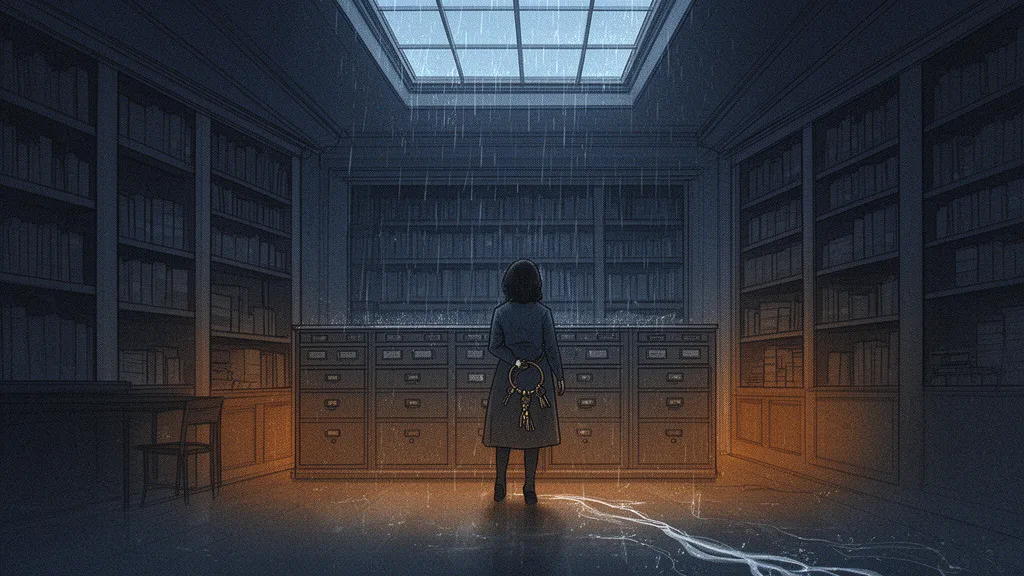
By half past eleven the rain had found the skylight.
It did not fall heavily. It tapped, paused, then tapped again with a patience that suggested it had all night. Beneath it, in the municipal library's archive room, Hoshino Aya stood with a ring of keys in one hand and looked at the line of old catalogue cabinets as if one of them had spoken.
Water had come under the baseboard by the north wall. Not much. A thin, dark thread had escaped the storm drain outside and was feeling its way along the lino toward the leg of a map case. Aya had seen worse. The building was old in the civic manner: square, worthy, and always one season behind its maintenance.
She set down her cold tea on top of the periodicals trolley, regretted it at once, and crossed to fetch the absorbent cloths from the cleaning cupboard. On the way back she noticed that drawer 4-C was open by less than a finger's width.
It should not have been.
The local history catalogue had been sealed during renovation nine months before. The public terminals covered the same material now, imperfectly but with great confidence, and 4-C belonged to the set of drawers tied shut with cotton tape and marked To Be Recatalogued. Aya had tied some of them herself. She remembered because the tape was too soft and made unsatisfactory knots.
This tape had been cut.
She crouched, set the cloths against the creeping rainwater, and pulled the drawer out.
The cards were dry. They had been retyped.
For a moment she thought she meant only some of them, the first handful perhaps. Then she drew one card, then another, then twelve in a packet, and saw that every original entry had been removed and replaced by a new card of similar stock, cut a little less cleanly. Each bore the same date.
17 October 1998.
Each bore the same address.
4-17 Midorikawa Heights, Saginomiya-cho.
Nothing else. No title. No accession number. No subject headings. The typeface was from a machine older than the library's electric typewriters, its letters striking slightly high on the line. The capital R bit deeper into the card than the others, as if impatient.
Aya held one card up toward the fluorescent light. Different hand, the brief had said to no one, and it was true even of typing. The spacing was disciplined. The address sat exactly one thumb-width from the left edge every time. Whoever had done it had not been careless. They had been repetitive on purpose.
She pushed the drawer fully out and found, at the back, one original card that had slipped sideways and remained trapped behind the false front. It was for a pamphlet on postwar housing surveys. On its reverse, in pencil, someone had written only: service corridor, 4:35.
Aya sat back on her heels.
The archive room smelled of paste, damp cardboard and old cloth. Above that was the library itself, dark now except for the security bulbs in the stairwell. Aya worked the night shift twice a week because the department was short-staffed and because she preferred the building when no one felt obliged to explain things to her. Usually the excitement consisted of a leaking pipe or a misplaced donors' register.
Not this.
She looked at the clock over the sink. 11:37.
The address was twenty minutes away on foot in good weather, fifteen if one cut through the shopping arcade, ten by bicycle if one trusted municipal brakes. Aya trusted almost nothing, but she did trust curiosity.
She took the card with the pencilled note, one retyped card, her coat, and then came back for the tea and drank it in three punishing swallows because there was no kind way to leave tea to die.
Midorikawa Heights had been modern in 1998 and had not improved with age. The building was a slab of concrete with a tiled entrance that held the cold. Rain shone on the handrail. The fourth floor smelled faintly of frying oil and laundry starch.
4-17 stood at the end of the corridor beside a wired-glass door marked Service. The flat's nameplate was blank.
Aya pressed the bell.
No answer came. She pressed it again and heard, within, not movement but the delicate knock of something settling as a room cools. She tried the handle.
Unlocked.
The entry gave directly onto a narrow dining-kitchen. The light above the sink was on. A table had been laid for two with practical care: two bowls, two pairs of chopsticks on rests, soy sauce decanted into a small white pourer, pickles in a covered dish. One chair stood slightly back, as if vacated a moment before. On the stove a kettle retained heat enough to mist the lid when she touched it. Beside it sat a teapot wrapped in a faded knitted cosy, blue once, now almost grey.
Aya did not step farther in. There was no obvious sign of struggle because this was not that sort of room. It was too tidy for drama, and too inhabited for abandonment.
A voice behind her said, with considerable annoyance, “If the management company has finally sent someone, they have chosen a theatrical hour.”
Aya turned.
The speaker was a woman in a green raincoat carrying an umbrella and a net bag of daikon, leeks, and what looked like a single melon. She was perhaps fifty, perhaps sixty. Some faces made a point of not assisting.
“I’m from the municipal library,” Aya said.
This had the useful effect of making the woman even more suspicious.
“You look like it,” she said. “And why is the municipal library in my sister’s corridor?”
“Your sister lives here?”
“Lived nowhere for months,” the woman said. “If you ask me. Which I notice no one does, officially.” She shifted the melon in the bag and peered past Aya into the flat. “The kettle is warm.”
“Yes.”
“That is inconvenient.”
Her name, she said after some negotiation, was Senda Fumiko. The tenant of 4-17 was Senda Maki, her younger sister, who had disappeared in February. Not vanished theatrically. She had simply failed to attend work at the florist's shop, failed to answer her phone, and failed thereafter to present herself in any place where people who loved her had expected her to be. The police had taken a report and, in Fumiko's tone, had then gone on to become the police elsewhere.
Maki's rent had been paid automatically through April. The flat had been searched once, briefly. Since then Fumiko had visited when she could bear it and not when she could not. The management company, irritated by grief but respectful of contracts, had left the place locked.
“And tonight?” Aya asked.
“Tonight I came because someone telephoned me at eight and breathed,” Fumiko said. “I do not recommend that method of communication.”
Aya looked again at the table.
“For two,” she said.
“For my sister and someone she would not describe properly,” Fumiko said. “Which left me to do the describing. Sometimes a woman from the city office. Sometimes a man from the old theatre. Sometimes no one at all, just that look people have when they are pleased with themselves and expect you to be impressed.”
Aya let that rest. On the draining board lay two cups, one dry, one with a crescent of fresh moisture in its base. The gas beneath the kettle was off. On the refrigerator door a magnet held up an unpaid water bill from March and a receipt from a stationery shop dated yesterday: index cards, carbon ribbon, adhesive labels.
“Did the police leave this?” Aya asked.
Fumiko looked at the receipt and her mouth hardened.
“No,” she said. “Maki had dreadful handwriting. She bought cards when she wanted to be neat. She was usually sorry afterwards.”
Aya asked to see the rest of the flat. Fumiko consented with the air of a woman making a poor investment out of boredom.
The bedroom was bare except for clothes in the wardrobe and a paperback face down on the floor. The bath was dry. The balcony door was latched from within. Nothing was missing in the dramatic sense. That, Aya thought, was often the trouble. If a life were clearly interrupted, one could point to the break. Here, life had been edited.
She came back to the kitchen and looked again at the service door in the corridor. The paint around the frame had been rubbed recently where a key entered the lock.
“What is through there?”
“Maintenance access,” Fumiko said. “A narrow passage along the back of the building. It links the plumbing shafts and ends at the fire stairs. The management man told me it remains locked because residents leave bicycles in impossible places if given ideas.”
Aya showed her the pencilled note from the card: service corridor, 4:35.
Fumiko read it, then looked up with a face that had become very still.
“Four thirty-five in the morning?” she said.
“So it seems.”
“The garbage collection entrance is opened at five,” Fumiko said slowly. “Earlier than that, the caretaker does rounds. He unlocks service for the boiler check. My sister mentioned once that if you stood by this door before dawn you could hear every honest thing in the building, because no one had put on their daytime face yet.”
Aya took this seriously. Maki sounded like the kind of woman who noticed the correct part of people and suffered for it.
They found the caretaker in the basement office half-asleep over a racing form. He was indignant first, then cautious, then helpful in the order common to men surprised by two women after midnight. Yes, he opened the service corridor each morning at 4:30 or a little after. Yes, he locked it again once the boiler inspection was done, usually by 4:45. No, residents were not permitted there. No, there had been complaints this spring about someone moving quietly on the back stairs before dawn, but complaints in apartment buildings were a species of weather.
“Who has keys?” Aya asked.
“The manager, me, city maintenance when they pretend to schedule properly.” He scratched his cheek. “And one was missing in March. Turned up again in the key box in April. People are idiots.”
“Did anyone use the address here for post?”
The caretaker glanced at Fumiko, reconsidered a joke, and said, “The city office woman came twice. Brown suit, navy coat. She asked if Miss Senda had left forwarding instructions. I said no.”
“What office?”
“I don't memorise bureaucrats. She had a face like an apology.”
Fumiko gave a brief, dry laugh. “That includes all of them.”
Aya thought of the retyped cards, the identical address, the receipt for index cards. Someone had been using the library to point toward this flat. Not to conceal the address, because concealment did not repeat itself six hundred times. To ensure that someone patient, some night, would notice.
Whoever it was had lacked a safer way to say: look here, and look at dawn.
At 4:18 they were back in the archive room.
The rain had worsened in the hours between. Water now threaded openly under the baseboard and had begun to reach the wheels of the periodicals trolley. Aya had laid more cloths, then failed to improve matters. The local history cabinets stood in a line like elderly witnesses refusing strain.
Fumiko, having accepted this library emergency as one accepts weather on a trip one regrets taking, sat on a stool and watched Aya lift drawer after drawer.
The same date. The same address. Drawer 4-C, 4-D, 5-A. Not the entire catalogue, only cards relating to municipal housing records, tenant associations, welfare surveys, residents' newsletters, and three years of city council minutes. Enough, Aya realised, to create a path.
If one followed the cards as a researcher would, one was guided from housing development plans to occupancy disputes, from occupancy disputes to redevelopment hearings, from those hearings to council minutes in October 1998. And every route ended in 4-17 Midorikawa Heights.
One original card remained by accident in 5-A. It referred to a residents' petition regarding “temporary accommodation allocations after the riverbank clearance.” On the back, in the same pencil as before, was written: she said she never lived there.
Aya straightened.
“Not your sister,” she said. “Someone before her.”
Fumiko was already on her feet. “The date,” she said. “October 1998. Midorikawa Heights was used then for temporary housing, wasn’t it? For the people moved out before the embankment work.”
Aya nodded. She remembered the file from training because bureaucratic euphemism had offended even the instructor. Clearance had meant evictions with pamphlets.
If a woman connected to that relocation had disappeared, and if the official record had later denied she had ever occupied 4-17, then the library cards formed not a message from Maki but a map to an older omission. Maki, florist, neat only by effort, must have found something. Perhaps in these same drawers before renovation sealed them. Perhaps she had lacked a copy. Perhaps she had done the laborious thing because laborious things remain.
“And the city office woman?” Fumiko said.
Aya did not answer at once. She was looking at the stationery receipt again in her mind. Yesterday. Index cards, ribbon, labels. If Maki had been gone since February, someone had continued her work recently. Someone who knew the library well enough to enter the archive room and understood exactly which drawer a night archivist would notice once water or chance brought her there.
Not an intruder. A key-holder, or someone trusted by one.
Aya thought of the assistant director of community records, Kuroda Emiko, who wore brown suits, navy coats, and an expression permanently arranged one apology in advance of events. Kuroda had supervised the digitisation transfer and had insisted, with gentle tenacity, that the obsolete cards could wait. Kuroda had also come in at odd hours for “inventory reconciliation,” always carrying her own pencils.
Fumiko said, “You have remembered somebody.”
“I have remembered a manner,” Aya said.
At 4:31 they stood in the fourth-floor corridor of Midorikawa Heights with the caretaker, who had become cooperative in direct proportion to the hour's impropriety. He unlocked the service door. The passage beyond was narrow enough that shoulders noticed each other. Bare bulbs ran along the ceiling. Pipes sweated in the damp. At the far end a second door opened onto the fire stairs.
The floor carried marks: not many, but enough. Scuffed arcs where something had once been dragged and, more recently, the regular half-moons of heeled shoes turning in place by the fourth-floor access panel.
Aya crouched. Beside the skirting lay a small thing caught in dust: a typed capital R, punched clean through a ribbon when the machine had struck too hard, fallen perhaps while carbon was changed. A sliver of black-red typewriter film clung to it.
Fumiko exhaled through her nose. “Your apologetic woman,” she said.
A sound came from the stairs. Not loud. The service corridor made little sounds large.
Aya rose.
Kuroda Emiko stood at the far end holding a leather document case in both hands. Her navy coat was buttoned wrong by one hole. Even now she looked as if she had arrived to explain a funding delay.
“I thought,” Kuroda said, after a pause whose civility was almost admirable, “that if the cards were noticed, it would be by someone slower.”
The caretaker, delighted to encounter villainy before breakfast, said, “This area is not for residents.”
“No,” Kuroda said. “Nor for records officers, strictly speaking.”
Aya said, “You retyped the cards.”
Kuroda looked tired rather than trapped. “Maki Senda did the first drawers. She came to the city archive annex in January to ask for relocation rosters from 1998. She had found a mention of a woman named Tachibana Yuriko in an old tenants' newsletter. Yuriko appeared in the petition, in one welfare ledger, and nowhere else. Not in the official occupancy list for Midorikawa Heights. But correspondence referred to room 4-17.”
The service corridor held the words without kindness.
Kuroda went on. “Maki believed Yuriko had been removed from the record because a complaint she filed would have embarrassed men who have long since retired comfortably. I believed she was probably right. Maki wanted to go to the police. I told her that if she did so with fragments, they would mislay her respectfully.”
Fumiko said, very levelly, “And then my sister disappeared.”
Kuroda shut her eyes once. “She did not disappear because of this. At least, I do not think so. She met someone in February, someone she trusted unwisely. After that, I lost contact. I looked for her. Then I found that the occupancy file for 4-17 had been signed out from storage under my division code by someone imitating my seal badly.”
“Who?” Aya asked.
Kuroda gave a small movement of one shoulder. “A councillor's secretary in 1999. Now deputy mayor.”
It was almost comic, how municipal corruption persisted in rising no higher than the level of soft chairs and commemorative speeches. Aya would have enjoyed that later.
“For months,” Aya said, “you used the library.”
“Yes. Because the cards could not be erased remotely, and because paper in public is harder to murder than paper in an office. Maki understood that first. I only continued.” She lifted the document case slightly. “The original relocation ledger is here, along with the sign-out slips. I was going to leave it in 4-17 and call a newspaper from a pay phone. This is not a profession that rewards elegance.”
Fumiko asked the necessary question. “Where is my sister?”
Kuroda's face altered then, and Aya believed her before she spoke.
“I don't know,” she said. “I found one postcard in my office pigeonhole in March. No stamp. Just a mountain sketch and three words: Stop looking kindly. I took it as advice and insult both.”
The caretaker said, “Should I call the police?”
“Yes,” Aya said.
Then she looked at the case, at the damp corridor, at the barely open access panel beside 4-17 where pipes and darkness made an indifferent wall. Records hidden. Records restored. A service passage unlocked for eleven minutes before dawn, enough time to move paper from one version of the world to another.
Kuroda followed her gaze. “If this goes through official channels first,” she said quietly, “the ledger may fail to remain itself.”
This was, Aya thought, the true pressure point. Not law against crime. Paper against custody.
She held out her hand. “Give it to me.”
Kuroda hesitated, then passed over the document case.
Aya gave it at once to Fumiko.
“Take this downstairs,” she said. “Sit on it if necessary. When the police arrive, tell them the library discovered a materials theft connected to a missing-person inquiry and that copies have already been prepared.”
“I have not prepared copies,” Kuroda said.
“You retyped six hundred cards,” Aya said. “You own carbon paper. You disappoint me if you stopped there.”
For the first time, Kuroda almost smiled.
At seven ten, after statements, phone calls, and the first grey astonishment of morning, Aya returned to the archive room.
Maintenance had finally come for the leak. The baseboard was damp, the cloths sodden, and drawer 4-C stood open on the worktable beneath a sheet of blotting paper. The retyped cards waited in their severe rows. Outside, rain gave up and became mist.
Aya sat. Someone had left her tea on the trolley again. It was now too hot to drink without resentment. She drank it anyway.
On the table beside the false cards lay the original card for the housing pamphlet with the pencilled note: service corridor, 4:35. A practical message, hidden in a tool built for retrieval. She thought of Maki Senda setting a table for two, perhaps hoping the person opposite would tell the truth before the water boiled. She thought of Yuriko Tachibana, who had once occupied a room and then, in the official manner, not occupied it at all. Whole lives could be pushed from one drawer to another until they ceased to index.
Not entirely, it seemed. Someone always typed too hard. Someone saved a receipt. Someone laid a trail so obvious that only neglect made it invisible.
The library above her would open at nine. Schoolchildren would come for exam guides, pensioners for newspapers, two habitual men for the same argument about local baseball history. The archive room would smell of damp paper all day. A proper inventory would begin. Calls would be made. Copies would be compared. The deputy mayor would have, Aya hoped, a notably worse week than planned.
It was not the same thing as finding Maki.
That was what remained when the puzzle had been made to behave. The missing did not return because the reasoning was sound.
Aya put the surviving original card back into its place. Then she began, one drawer at a time, to separate the false cards from the true positions they had so patiently occupied. Somewhere upstairs a door opened, and the building took its first breath of day.