The Seventh-Floor Doors
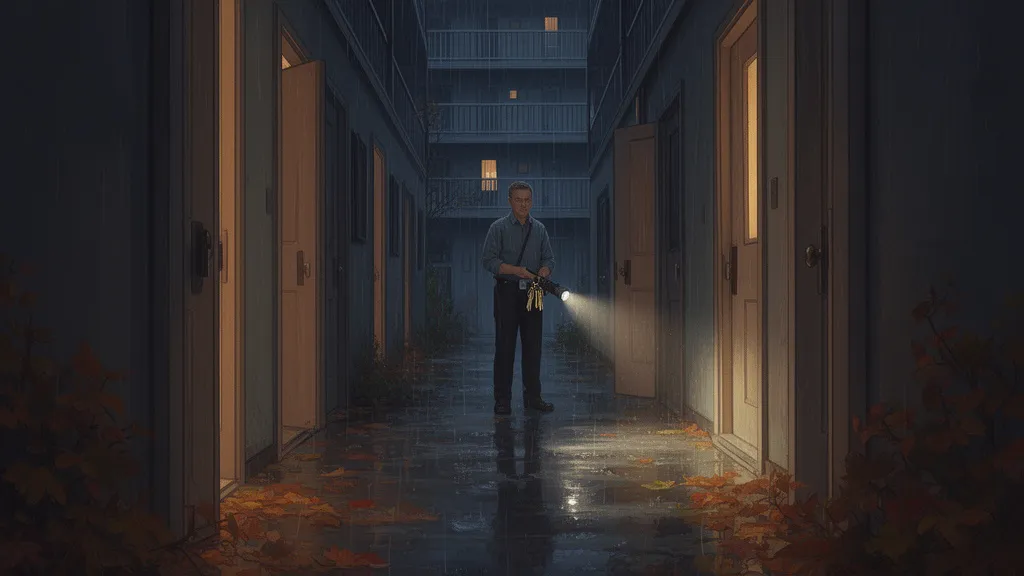
By the time Sato Fumie reached the seventh floor, the rain had found the seams of the building.
It had begun at dusk as a respectable autumn shower. By midnight it was slanting hard across the windows of Midori Heights, making the glass rattle in their frames and the entry mats smell of old wool. Fumie, who had spent twenty-two years as superintendent of the building and had therefore seen every kind of domestic emergency except perhaps a tiger, came out of the service stair with a ring of passkeys, a flashlight, and a cup of tea gone cold in the crook of her hand.
Mrs. Aizawa in 703 had called down to say there was a light flickering across the hall and someone had left the corridor window ajar. Mrs. Aizawa called down for many things. Three weeks earlier it had been "a suspicious onion." The onion had belonged to 702 and was only rolling with the slope of the floor.
Still, the window would need shutting. In weather like this, the hall collected damp and complaints at the same rate.
The seventh-floor corridor was long and narrow, with six apartments facing each other in pairs. At this hour it should have been dark except for the emergency lamp over the lift. Instead, a weak pulse flashed under the frosted glass panel of 706, on, off, on again, as if the kitchen itself were thinking whether to remain alive.
Fumie stopped beside 701, reached to pull the corridor window closed, and then noticed the knob.
The door of 701 stood not open, exactly, but unlatched. A finger's width showed blackness inside.
She set down the tea on the sill and tried the handle. It gave at once.
Her brows went up. Mrs. Kagawa in 701 locked her door even to carry rubbish to the chute. Fumie knew because she had once locked herself out during this operation and blamed the architecture.
Fumie crossed to 702. Unlatched. 703. The same. One by one she tested every door on the floor. Each had been unlocked from the inside.
That was the shape of it, and the shape was wrong.
People forgot many things in apartment buildings: umbrellas, anniversaries, fish in freezers. Six separate tenants did not all forget to turn a lock on the same wet night. Nor did burglars ordinarily break in merely to improve fire safety.
The blinking light in 706 went on, then off.
Fumie stood a moment in the middle of the corridor, listening. Rain at the windows. The faint hum of the lift cables. From behind 703, a radio murmuring so softly that the singer seemed to be apologising. No movement. No voice.
She picked up her flashlight and knocked on 706.
"Mizuno-san?"
Nothing.
She knocked again, harder. The light blinked once more under the glass.
"Mizuno-san, it's Sato from downstairs."
Silence. Then, somewhere deep in the apartment, a small mechanical click.
Fumie put her hand on the knob. The door was unlocked.
Inside, the air smelled of wet cloth and cooked rice.
The apartment was a one-bedroom unit, compact and tidy in the way of people who had once had too little space and never forgot it. The genkan tiles were damp. A pair of women's loafers sat neatly to one side. Beside them, a man's cheap vinyl slippers from the convenience store, the sort sold for guests who would never stay long enough to justify better.
The kitchen light over the sink was failing, which explained the pulse. It buzzed weakly, brightened, dimmed, brightened again.
On the counter stood a bowl of rice with chopsticks resting across the top. Steam no longer rose from it, but when Fumie touched the side of the bowl with the back of her finger, it was still faintly warm. Water had been tracked from the genkan over the floorboards and into the kitchen: a line of wet shoe prints, clear at first, then thinning. They led to the sink.
And stopped.
There was no corresponding trail away from it. The floor beyond the sink was dry. No shoes were under the table. No one crouched in the bath or on the balcony. Fumie checked because she was practical, not because she expected a full-grown adult to fold himself into the cutlery drawer.
The bedroom was empty. The wardrobe doors stood open. A raincoat was missing from the hooks by the entrance. Mizuno Haruka's handbag was gone as well. Her mobile charger remained plugged in near the bed, with no phone attached.
The sink held a single glass, rinsed and left upside down on the rack. Beside the drainer lay a torn strip of grocery receipt, soaked enough to curl at the edges. Fumie peeled it from the steel with two fingers. Most of the ink had blurred, but three lines remained: rice 5kg, scallion, and part of a time stamp, 21:1—.
The answering machine in the living room blinked a red light of its own. One unheard message.
Fumie pressed play.
A young man's voice, too close to the receiver and speaking over street noise, said, "Haruka, it's me. I'm downstairs. Forgot my key again, can you buzz me in?"
Then the machine clicked off.
Fumie looked at the time display. 10:48 p.m.
She stood very still.
Midori Heights had no entry buzzer. The outer door was locked after ten, but residents opened it with keys. Visitors used the intercom panel in the vestibule, and the call rang to the apartment telephone, not the answering machine. If someone stood in the rain outside and pressed 706, Haruka's telephone would ring in the apartment; if she did not answer, the line simply went dead. No one who actually came to the building said he was downstairs and asked to be buzzed in, because there was nothing to buzz, and no such message could have been left through the intercom in any case. To leave that message, someone had to dial 706 directly from elsewhere and pretend to be at the door.
She replayed the message once. The voice was ordinary in exactly the wrong way.
Then she went back into the corridor and called the police.
By two in the morning there were three uniformed officers, one patient detective, six annoyed tenants in varying states of decency, and a great deal more damp than when the matter began.
Detective Imamura was a man with a soft face and a talent for letting silence do his work. He listened while Fumie explained what she had found. Then he listened again while each seventh-floor resident denied opening his or her own door and looked, with varying frankness, at the others.
"Perhaps a prank," said Mr. Noda of 704, who taught economics and wore knitted vests as if resisting the twentieth century. "Children."
"What children are you imagining," said Mrs. Kagawa of 701, "at midnight, in a secured apartment block, systematically unlocking doors from the inside? Polite children?"
She was sixty-eight and had the figure of a rolled umbrella.
"You left yours open," Mr. Noda said.
"I did not."
"None of you did," said Imamura mildly. "That is the difficulty."
Mizuno Haruka, tenant of 706, was twenty-nine, worked at a stationery wholesaler, lived alone, paid rent on time, and had no known reason to vanish between supper and bedtime. The neighbors supplied these facts with the eagerness people reserve for situations where they may be useful without yet being implicated.
There was also, according to 703, "a man sometimes," though this proved to mean only that a man had been seen entering 706 on at least four occasions over six months. Mrs. Aizawa added, with admirable fairness, that on one of those occasions Haruka had looked furious, and on another she had looked "as if she had forgotten everyone else in the building had eyes." This was perhaps the same expression.
Imamura took notes without visible opinion.
The seventh-floor doors interested him almost as much as the disappearance.
Midori Heights was old enough to have a particular kind of lock: a knob lock on the outside, and inside, a thumb-turn that engaged with a soft metallic click. If the thumb-turn was left horizontal, the door could be pulled shut and remain unlocked. If vertical, it latched locked. Residents sometimes set the turn before opening the door for the night, then pulled it closed behind them. But all six tenants insisted that when they retired that evening their locks had been set to vertical.
"Someone could open from inside and leave it unlocked," said one of the uniforms.
"All six?" Imamura said.
"Master key?"
Fumie shook her head. "The master opens the knob. It doesn't change the thumb-turn."
He looked at her with more interest.
"You know the hardware well."
"I know what breaks at three in the morning."
That amused him, briefly.
He had already sent one officer downstairs to check the entrance logbook. Midori Heights had no electronic security worth naming. It had, however, Mr. Kondo at the desk until ten o'clock, and after him a register in which delivery men occasionally wrote lies. Elevator usage was recorded only by a maintenance counter that noted when the lift stopped on each floor, useful for repairs and little else. Still, Imamura collected what old buildings offered.
The initial theory was simple enough: someone had entered 706, willingly or not; Mizuno Haruka had left with that person or been taken; the unlocked doors on the floor were either a diversion or unrelated confusion.
The second theory was simpler, and therefore more offensive. Haruka had gone somewhere of her own accord, perhaps with a lover, and the rest was a story assembled by bored neighbors and an over-alert superintendent.
This theory gained force at 6:15 a.m., when Haruka's answering machine recorded another message.
The machine had been left plugged in as found. Imamura and Fumie, who by then had both acquired fresh cups of tea and both regretted them, were in the apartment when the red light began to blink.
Fumie took a swallow of hers and burned her tongue. The detective pretended not to notice, with the tact of a man experienced around human weakness.
He pressed play.
This time there was no voice. Only three seconds of room sound: the click of the machine engaging, a low hum, and then, distinct and near, the same dying buzz of the kitchen light.
The call had been made at 6:15 from Haruka's own line.
The uniform beside the phone stared. "From inside?"
"So it appears," Imamura said.
The local officers became, after this, energetic in several unhelpful directions. One examined the balcony as if kidnappers preferred third-floor acrobatics and simply extended the habit upward. Another suggested Haruka had staged her own disappearance and hidden a timer on the phone line, though he could not explain the mechanism and seemed offended when asked to.
Fumie listened, looked, and went back into the hall.
She had not liked the unlocked doors from the start because they were too broad. Broad gestures in mysteries belonged to frightened liars and people cleaning up after smaller mistakes. The real thing, in her experience, was usually local. A wet cuff on a dry day. A key where there should have been none. A complaint made ten minutes too early.
The seventh-floor corridor by morning smelled of drying umbrellas. The police had dusted knobs and found a democratic muddle of prints. Neighbors hovered in doorways under instructions not to gossip, which they obeyed only in the grammatical sense.
Fumie stood by 705 and looked down the hall again.
The floor was a dull vinyl tile, brown marbled with beige. Wet marks showed on it beautifully. Last night she had seen the prints into 706, but there had been other traces too, half-obscured by later traffic and police shoes. She had not thought them important then.
Now she crouched, knees protesting, and studied the strip between 705 and 706.
There were the broad damp ovals from officers' shoes. There were the pointed prints of Mrs. Aizawa's slippers, despite her claims to have remained indoors. There, almost gone now, were smaller marks with a cross-hatched sole pattern. Men's rain shoes, probably. They approached 706 from the lift and returned the same way.
And between them, at regular intervals near each apartment threshold, were tiny crescents of water no larger than fingernails.
Fumie touched one. Dry now, but edged with corridor dust.
Drops from an umbrella, she thought first. Then no. They were too evenly placed, each near the frame, each on the latch side of a door.
She straightened and looked at the locks.
The thumb-turns inside could not be reached through the outside, not with fingers. But the old doors each had a mail slot, chest height, covered inside by a hinged brass flap. Residents almost never used them; bills went in downstairs boxes. The slots remained because removing them would have cost money no owner volunteered.
She stared at 705, then at 706, and imagined a hand posted through a slot, holding something thin.
It would not reach the knob. It would not need to.
She went into the service closet, found a roll of floral wire left by the New Year wreath contractor, and returned. With 704's occupant watching as if she were performing surgery on his future, she inserted the wire through his mail slot while he stood inside. It took her three attempts and one muttered insult at brass fittings, but she hooked the inner chain latch where it hung loose against the door, lifted it, and let it tap.
Mr. Noda blinked. "What use is that?"
"Not the chain," she said. "Watch the knob."
She tried again, this time fishing lower. The wire scraped, caught, and tugged the inside thumb-turn from vertical to horizontal with a neat metallic click.
Mr. Noda made a small sound of indignation, as if his privacy had been defeated on principle.
Fumie let herself in.
"Only if the door is already open a little," she said. "Otherwise the angle is wrong."
"Then how was it done?" Imamura asked.
Fumie looked down the corridor. "With noise, and with manners."
She asked the residents, one by one, what they had heard before eleven. The answers came as most useful answers did, reluctantly and with embroidery. Mrs. Aizawa had heard a man and woman quarrelling somewhere down the hall, though she had first called it television. Mr. Noda had heard knocking at more than one door, and once someone saying, rather distinctly through the rain, terribly sorry. Mrs. Kagawa admitted that she had opened her door on the chain because she thought someone was asking whether the corridor window should be shut in the storm. 702 had done the same because there had been a knock and then, "Excuse me, is Miss Mizuno all right?" 705 had opened because he heard raised voices and assumed, incorrectly, that he might be useful.
That was enough. In an apartment corridor, one disturbed conversation was the skeleton key to the rest.
"He didn't need each door open for long," Fumie said. "Only enough to speak through the gap. If the chain was on, he could still put the wire through the slot while pretending to be concerned, asking whether they had seen anything, whether they heard the argument, whether Miss Mizuno was unwell. People in hallways are generous with attention. They watch the face, not the hand. Once the thumb-turn was horizontal, he waited for them to shut the door. It closed unlocked."
She glanced at the tiny water crescents by the frames. "Those are where he stood."
Imamura, who had followed her silently down the hall, said, "Every door on this floor."
"Yes. Deliberately. So one unlocked apartment would mean nothing."
He considered the mail slots. "Who knew they were useful?"
"Anyone old enough to have lived with them," said Fumie. "Or anyone who had tried." She held up the floral wire. "And anyone carrying something like this."
"A burglar opening possibilities ahead of time?"
"No. A man who needed this floor to look disorderly."
She told him then about the answering-machine message. Not that it was false—that he knew—but how it was false in time. The call at 10:48, from a man claiming to be downstairs, could not have come through the building entrance system at all. It had to be a direct telephone call placed from somewhere else after Haruka was already gone, by someone who wanted it to seem he had arrived too late to matter. A street call, performed for the tape.
"So he called from outside first," Imamura said.
"Yes. After she had left the building. Perhaps from a pay phone by the station, perhaps from a shop. Somewhere with traffic behind him, so the lie would have weather. It puts him downstairs without placing him on the seventh floor. It also suggests she was still inside to hear him, which she was not."
She nodded toward the kitchen. "Then later he saw the blinking light after the first message and panicked. Or he had never noticed the machine before and noticed it only when he returned. So he made the blank call from the apartment line, thinking the machine would overwrite. People who do not use old machines think many flattering things about them."
This was true. The tape had simply advanced.
Imamura's face had gone still in the way that meant his mind was moving.
"The elevator logs," he said.
The lift had stopped at seven at 9:23 p.m., 9:41, 10:11, and 10:52. Then not again until police arrived after midnight. Residents accounted for the first three stops: Mr. Noda had returned from campus at 9:23. Mrs. Aizawa's niece had left at 9:41. A food delivery for 705 had come at 10:11, provoking a marital dispute over noodles that all parties had unfortunately heard.
The 10:52 stop remained unattributed.
The torn grocery receipt in 706, timestamped around 9:10, suggested Haruka had come home shortly before 9:23. The rice on the counter suggested she had just begun to eat when interrupted. The wet footprints to the sink suggested someone else had entered from the rain and asked, naturally enough, for water.
Or had gone to rinse something. A glass.
There had been one glass drying by the sink.
One guest slipper at the entrance.
A man sometimes.
Imamura asked for Haruka's telephone records and for the building's tenant list with emergency contacts. By noon they had the first useful name.
Kanzaki Tetsuo, age thirty-four, employed intermittently by a printing company, had been listed on Haruka's old lease application as a person to contact in emergency. Former fiancé, said the paperwork, later amended by hand to ignore this if possible in Haruka's square script. He lived two train stops away in a narrow building whose landlord described him as "pleasant until romance was involved," which saved time.
He was brought in by four o'clock.
He denied everything with the careful patience of a man insulted by facts.
Yes, he had seen Haruka from time to time. No, they were not exactly together. Yes, he had gone by Midori Heights the previous evening because the rain had reminded him she disliked thunder. No, he had not gone up. No, he did not know anything about unlocked doors, answering machines, or vanishing women. Yes, he was aware she had another friend now, if friend was the proper word. No, this had not troubled him.
Fumie, sitting at the side of the management office while Imamura questioned him there as a courtesy to everyone, found this last answer the least persuasive. It was not the content. People often endured arrangements harder to classify than the vocabulary allowed. It was the texture. Kanzaki said friend as if laying down a card he hoped no one else would name.
Imamura asked, "What did you use to open the doors?"
Kanzaki looked honestly puzzled for half a second. Then he said, "I told you, I didn't go up."
That half-second was enough.
What broke him, in the end, was not the mail-slot trick. It was the hall detail Fumie had trusted from the start.
Midori Heights put a narrow woven mat outside each apartment every rainy season, cheap brown things intended to save the floors. Five mats on the seventh floor were uniformly dark with moisture. The mat outside 706 had a pale dry stripe across one end, narrow as a belt.
Fumie had noticed it when dawn came and the corridor brightened. Something long and dry had rested there while rain dripped from everything around it.
A folded umbrella? No. Residents brought those inside. A parcel? Possible, but no one on the floor had received one.
Or a length of wire coiled in paper, set down while a man composed his face before knocking.
The paper from such a packet had been found later in Kanzaki's pocket: florist's wrapping, damp and torn. He had bought white lilies that night from a shop near Haruka's station. The florist, a cheerful man with opinions about everyone, remembered because Kanzaki had also asked to borrow some binding wire to reinforce the stems against the rain.
He had gone to Haruka intending reconciliation. He found her in the company of another person—not a lover in the melodramatic sense, but Akase Jun, a woman from her office who often ate late suppers with her after inventory nights, and sometimes stayed until the trains thinned. Haruka had not hidden this friendship because she did not think she owed Kanzaki the courtesy of concealment. Kanzaki, seeing Jun's shoes in the genkan and hearing voices inside, had knocked anyway.
Haruka opened the door only a little. There had been an argument, low and urgent. Jun, not wishing to be drawn into former-fiancé theatrics, had slipped out while Haruka was still in the kitchen, taking the service stairs to avoid notice. Her later silence came from a motive almost too understandable to condemn: she