The Third-Floor Key
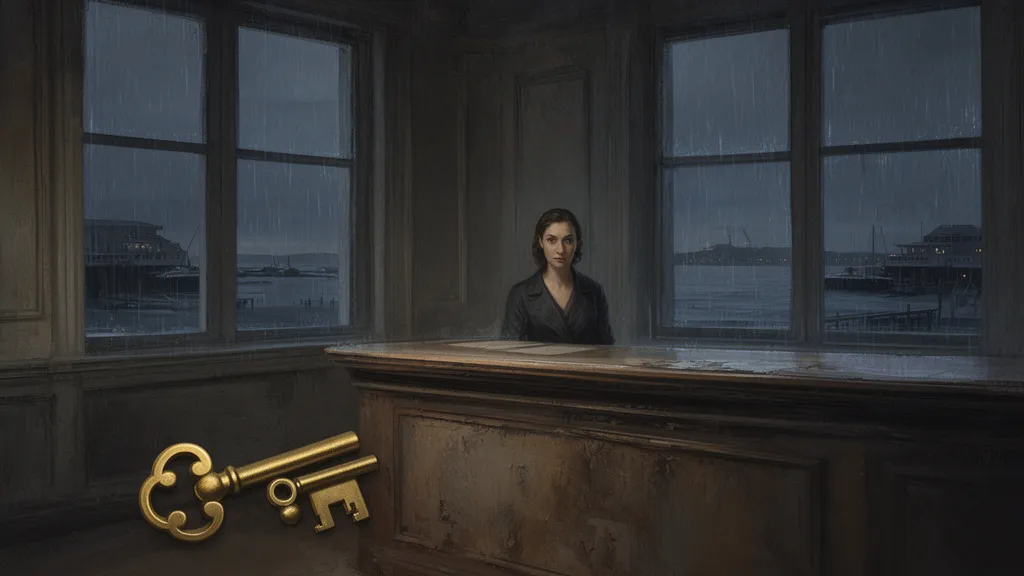
At half past eleven, when the rain had thinned to a mist and the tide had begun to draw the dark away from the seawall, Aki Shinozaki found that there was one key too many and one room too few.
She was standing behind the night desk of the Kaigan Hotel, a narrow old place facing the harbour road, with a brass bell nobody used and pigeonholes for keys that had outlasted three owners and all sensible systems. The evening clerk had gone home after leaving the books in the usual state of cheerful injury. Aki, who taught cataloguing at the town library on weekdays and audited the hotel’s nights twice a month for money she preferred not to describe as necessary, set the checked-in keys in a line and began putting them back where they belonged.
The third-floor keys were grouped by a strip of faded green paint across their tags. Room 301, 302, 303, 305, 306. She paused.
There should have been 304.
It was in the tray with the returned keys, not the pigeonhole. The brass was still warm.
Aki lifted it by the ring. There was a smear of green on the edge of the tag, fresh enough to mark her thumb. The paint strip on the third-floor row had cracked with age into small islands. This green was bright, wet-looking, almost cheerful.
She looked at the ledger.
Room 304 had been let two nights before to Mizuno Rei. Two bags, no breakfast, cash in advance. In the column for return there was a short slanting tick in the evening clerk’s hand, beside tonight’s date and time: 11:05.
She turned to the index cards in the drawer below. The Kaigan Hotel still kept a card for each current guest because Mrs. Kuroda, the owner, trusted drawers more than books and books more than memory, though not by much. Third floor: 301 occupied, 302 vacant, 303 occupied, 305 occupied, 306 occupied.
No 304 card.
Aki checked again, because people could vanish from hotels in many ways and most of them were ordinary. A card might be misfiled under M. It was not under M. It was not under vacant rooms. It was not under unpaid accounts, special requests, or the paper clip that meant trouble. The room existed in the ledger and on the wall board, and nowhere else.
The kettle on the side table clicked. Someone had left tea steeping too long. Aki poured it anyway, found it both too hot and too bitter, and drank without surprise.
Then she took the third-floor pass key and went upstairs.
The corridor smelt faintly of damp tatami and furniture polish. The sea put a steady breath against the windows at the end. Room 304 stood between 303 and 305, exactly where arithmetic insisted it should. There was no sign on the door. The keyhole was old brass, the kind that accepted disagreement reluctantly.
Aki knocked.
No answer.
She listened. The hotel had thin walls in the way of old hotels, but some doors held silence more decisively than others. This one offered nothing at all. She fitted the pass key, turned it, and felt the lock catch and release.
The room was empty.
Not theatrically empty. Merely used and then left behind in a hurry subtle enough to pass at a glance. The bed had been remade, though badly; one lower corner of the sheet was tucked under the mattress while the other hung loose. The wastebasket held the silver wrapper from a cough lozenge, twisted hard. The window was latched. The wardrobe stood open and bare. In the washroom, the towel rail held one towel, folded, dry at the ends and damp in the middle.
A bucket sat near the far wall under a brown ceiling stain shaped, with unhelpful precision, like a spread hand.
A drop fell into it while she watched.
Aki stood still. The stain was old around the edges and newly dark at the centre. There had been no bucket in the room that afternoon; she was sure of it, because at three she had come up to look for a volume of local history a guest had left behind in 306 and had noticed a housemaid carrying fresh towels past 304’s open door.
She crossed to the desk. No note paper had been used. The drawer contained a sewing kit, two postcards of the harbour in finer weather, and a Gideon Bible with a paper bookmark advertising the Suzuki Inn, a mountain ryokan a hundred kilometres inland, where the pine trees looked offended by all human arrangements. Someone had underlined nothing.
The bucket contained perhaps half an inch of water. On its rim was another small smear of the same bright green paint.
She locked the room again from outside and went back downstairs.
Mrs. Kuroda lived in two rooms behind the kitchen and came to the desk in slippers, wearing a cardigan buttoned wrong and the face of a woman who had agreed to sleep only in principle.
“What is it?” she asked.
“Who checked out of 304 at eleven-oh-five?” Aki asked.
Mrs. Kuroda blinked. “No one, surely. 304 is closed.”
“It is not closed in the ledger.”
“It should be. The ceiling leaks when it rains.”
Aki slid the book toward her and placed the warm key beside the entry.
Mrs. Kuroda looked at the name. “Mizuno Rei,” she read, and frowned with offended concentration. “I don’t know any Mizuno Rei.”
“But this is your clerk’s hand.”
“That is true. He writes as if pursued.”
“When did 304 close?”
“Last month. We moved the wardrobe because of the damp patch, then moved it back because I dislike rooms looking apologetic. We have not let it since.” She touched the key tag. “Who painted this?”
“That is what I hoped you might tell me.”
Mrs. Kuroda was silent for a moment. Then she said, “Wake Morita.”
Morita was the evening clerk, twenty-three, earnest, and capable of lying with such visible strain that one wanted to offer him water. He arrived in a raincoat over his pyjamas, hair flattened on one side, and began denying things before he had been asked anything precise.
“I did not let anyone into a closed room,” he said.
“Excellent,” Aki said. “Who is Mizuno Rei?”
He looked at the ledger. “I wrote that?”
“You did.”
“That can’t be right.”
“It is, however, written.”
Mrs. Kuroda folded her hands. “Morita.”
He swallowed. “A woman came in around eight. She said she had reserved a room by letter. She was carrying a small suitcase. I said we had no such reservation. She said there must be some mistake and asked me to check again. I checked the book. The line was there already. Room 304, Mizuno Rei, paid.”
“Already?” said Aki.
“Yes.”
“In your handwriting?”
He reddened. “I thought perhaps I had entered it earlier from a note. Sometimes I do things quickly and remember them later. She said she was expected. She seemed very certain.”
“Did you take her upstairs?”
“No. I gave her the key.”
“The key now warm from being returned at eleven-oh-five.”
He gave her a miserable glance. “A man returned it.”
Mrs. Kuroda said, “A man?”
Morita nodded too quickly. “He said Miss Mizuno had left already because of the leak. He put the key on the desk and asked for no receipt.”
Aki waited.
“He wore a cap,” Morita added, because the pause required tribute.
“What sort of cap?”
“A dark one.”
“Helpful.”
“I didn’t look properly.”
“Why not?”
Morita’s ears turned pink. “Because at the same time Mrs. Senzaki was asking whether the dining room haddock was local in spirit if not in fact.”
That, Aki thought, was plausible. The hotel’s long-term guest Mrs. Senzaki considered dinner a moral inquiry.
“Did you see the woman leave?” Aki asked.
“No.”
“Did anyone else?”
At that point there was a cough from the hall. A woman in a whale-gray coat stood there with one hand on the brass umbrella stand, as if she had been placed among the objects and was deciding whether to remain.
“I heard them,” she said.
Mrs. Kuroda closed her eyes briefly. “Mrs. Teraoka. You should be in bed.”
“At my age,” the woman said, “bed is a rumour. If this is about the closed room on the third floor, I heard them.”
She had the narrow wrists and composed mouth of someone who had spent a life making small exact motions in public. Aki knew her by sight. Retired pianist. Winter visitor every year. Demanding about silence, forgiving about bills.
“You heard whom?” Aki asked.
“The woman and someone with her. Or after her. It is tedious to be exact before one has a shape for the thing.” Mrs. Teraoka walked to a chair and sat. “At a quarter to ten I passed 304 on my way back from the lounge. A woman’s voice was speaking behind the door. Low, quick. Then a man answered. Not loudly. They sounded close to the door, and close to each other, though not friendly. I thought they were quarrelling with restraint, which is often worse. Later, around ten-thirty, I passed again because the pianola downstairs was playing a fox-trot with homicidal insistence and I wished to discover who to resent. I heard a woman’s voice once more. The same room. No man then.”
“The door was locked?” asked Aki.
“I tried it,” Mrs. Teraoka said with no shame at all. “I dislike scandal only when badly executed.”
“And it was locked.”
“Yes.”
“Did you see anyone leave?”
“No. Though I did see Miss Hanai carrying paint.”
Mrs. Kuroda sat up. “Paint?”
“The young art teacher in 303. A jar of green paint and two brushes. She said the sea made her desperate for colour.”
Mrs. Kuroda looked as if the sea had been slandering her personally.
Aki made a note on the back of an envelope. The hotel had three people on the third floor that night besides the nonexistent guest: Miss Hanai in 303, Professor and Mrs. Nomura in 305, and Mr. Ebata, a salesman of funeral textiles who snored in 306 with commercial sincerity.
“Thank you,” Aki said to Mrs. Teraoka.
The older woman inclined her head. “One more thing. The two voices were not separated by the room. They were both just by the door, as if speaking into the wood. It was odd.”
“Odd how?”
Mrs. Teraoka smiled slightly. “Like hearing a duet performed on one piano.”
By one in the morning, Aki had spoken to everyone who would admit to wakefulness.
Miss Hanai in 303 opened her door wearing a man’s shirt over striped pyjamas, green paint indeed on her fingers and one cheek. She taught drawing at the local middle school and behaved like someone who expected disapproval and intended to charge for it.
“Yes, I had green paint,” she said. “Poster paint. For a sign. The rain cancelled the students’ exhibition, so I made a notice for the hall. Look.”
The sign on her desk read POSTPONED, NOT DEAD in a forceful hand.
“Did you lend any paint to a guest in 304?” Aki asked.
“There is no guest in 304.”
“So you know.”
“The housemaids know everything first. No.” She folded her arms. “I did hear someone next door. A woman, certainly. Perhaps a man. Or perhaps one woman discovering several emotions at once. It happens.”
“Between nine and ten-thirty?”
“Yes. There was movement overhead too, but that would be impossible unless the roof had taken lodgers.”
Aki looked up. The room above 304 would be part of the attic passage where old linens were stored.
Professor and Mrs. Nomura in 305 were a different sort of duet. He was a marine biologist of the kind who spoke to everyone as if presenting a footnote; she was small, handsome, and had perfected the expression of a woman who had expected one life and received another of equal value but different style. They denied hearing anything unusual, though each denied it after glancing first at the other.
“Nothing at all?” Aki asked.
Mrs. Nomura said, “Only the storm.”
Professor Nomura said, “And a bucket being moved.”
His wife turned her head slowly.
He coughed. “Well. Since we are speaking scientifically. A scraping sound against the floorboards. Around nine-thirty. Brief.”
“From 304?”
“Presumably.”
Mrs. Nomura said, “You did not mention that.”
“I did not imagine it relevant.”
That was married life in one sentence.
Mr. Ebata in 306 answered in an undershirt and immediately volunteered too much. He had been downstairs from eight until almost eleven playing shogi with a harbour pilot. He had not gone near 304. He had never met any woman named Mizuno Rei. He had once known a woman named Rei in Wakayama but she had sold umbrellas, which surely could not matter.
“It probably does not,” Aki said.
He seemed disappointed.
At two, she returned to 304 with Mrs. Kuroda and a lamp. The room yielded no more by force than it had by politeness. There was no luggage, no hairpins, no ash. The leak continued in patient intervals. The bucket stood exactly under the darkest finger of the stain.
Aki crouched beside it.
The floorboards showed a faint crescent of water marks around the bucket’s current place. Beside that, nearer the bed, was a second ring, half dried.
“The bucket was moved,” she said.
Mrs. Kuroda frowned. “To catch the leak better?”
“Perhaps. But if the leak was already known, why let the room?”
“We did not let the room.”
Aki looked up at the ceiling stain. A hand, unmistakably. Palm near the wall, fingers spreading toward the window. The shape had a lurid quality, the kind accidental patterns acquire when they resemble intention.
Then she stood on a chair and touched the plaster just beyond it.
Her fingers came away gritty. On the top of the wardrobe, just below the ceiling line, lay a scrap of peeling green paint no larger than a fingernail.
She got down and looked at the wardrobe doors. The piece missing from the upper edge would have matched, but not the bright green on the key and bucket. This was older, duller, painted long ago over a repair.
“Your back stairs,” she said. “Where do they go from this floor?”
“To the service landing, then down to the yard,” Mrs. Kuroda said. “But the lower door sticks in damp weather.”
“Show me.”
The back stairs smelt of salt and rust. They were narrow, boxed in, and badly lit by a single bulb caged against breakage. Halfway down, on the wall, someone had once painted directional arrows in green. Time had erased most of them, but not all.
At the foot of the stairs a door opened outward onto the rear yard. Beyond it, in darkness, lay the retaining wall and a drop to the strip of shore that appeared only at low tide. The door was bolted now. Its inner bar had a fan of rust around the brackets, except where one section had been scraped recently clean.
Aki touched it. The metal felt damp and cold.
“No one remembers opening it?” she asked.
Mrs. Kuroda said, “We do not use it. The old gate at the bottom is seized.”
“Has anyone looked at it this week?”
Mrs. Kuroda considered and gave the only honest answer possible. “Why would we?”
Morning clarified nothing except the sea.
At low tide the rocks below the hotel showed themselves like old grudges. The rear stair descended from the yard by six stone steps to a rusted iron gate set in the outer wall. Its latch was red with corrosion except at the tip, where bright metal had been rubbed through recently. One hinge wore a clot of green paint.
Aki stood with Morita and Mrs. Kuroda in the salt wind while gulls commented cheaply from the quay.
“There,” Morita said, too eagerly. “Green.”
Aki did not praise him. On the stone below the gate lay a flake of fresh paint, bright as the smear on the key. The tide had not yet reached it.
On the far side of the gate, a narrow path led along the base of the wall toward the harbour steps. Anyone using it at low tide could have left the hotel unseen from the front.
“Who painted this gate?” asked Aki.
“No one,” said Mrs. Kuroda. “At least not recently. It was green years ago.”
Aki thought of the arrows on the back stairs, the scrape on the bolt, the paint on the key, the bucket, the gate hinge. Noise around a clue. Or clues around a habit.
Inside, she asked for the old room records. Mrs. Kuroda produced boxes of invoices, maintenance notes, and reservation slips tied with string and resentment. Aki sat in the breakfast room with a pot of tea cooling toward disappointment and read.
By ten she found the first useful absence.
Room 304 had indeed been closed last month after leakage from the roof passage. The note was signed by the handyman, Okabe: Moved pail. Shifted wardrobe to inspect wall. Temporary patch. Do not let until dry. The word pail was underlined twice, as if he feared abstraction.
Attached to the note was an old duplicate key register. Third-floor keys had been repainted green three years earlier when a summer boy mixed the tags after cleaning. One spare key for 304 was marked missing, not replaced. Next to this, in Mrs. Kuroda’s hand, probably with old service set.
Aki took the paper to the owner.
“Who had the old service set?”
Mrs. Kuroda frowned. “For years, whoever supervised housekeeping.”
“And now?”
“Now there is no full supervisor. The maids share duties.”
“Who had it last?”
Mrs. Kuroda’s frown changed shape. “Yoshida.”
“Yoshida?”
“Our former head housemaid. She left in spring.”
“Why?”
Mrs. Kuroda adjusted the corner of a placemat which needed no help. “Because she was unhappy.”
This was not false, which made it less useful.
“Unhappy with the work?”
“With many things.”
Miss Hanai, passing the breakfast room with a roll of cartridge paper under her arm, said, “Yoshida was in love with Mrs. Nomura, if that assists your filing system.”
Mrs. Kuroda shut her eyes again, not for prayer.
Aki looked up. “Was she.”
Miss Hanai leaned on the doorframe. “So everyone said. I arrived late to the hotel and early to the gossip. They had been close for years. Then the Nomuras came less often after Yoshida left.”
Mrs. Kuroda said, “People exaggerate.”
“They do,” said Miss Hanai. “That does not mean they invent.”
Aki thanked her. Miss Hanai wandered off, leaving a faint smell of turpentine and satisfaction.
Mrs. Nomura received the next question without surprise. That itself was a form of answer.
“Yes,” she said. “Yoshida and I were close.”
Her husband was out examining tide pools with professional zeal and, Aki suspected, domestic tact.
“In what sense?” Aki asked.
Mrs. Nomura smiled without amusement. “In the sense that other people always want specified for them. We wrote. We walked. She was kinder than many. I was younger than I am now.”
“Did she leave because of you?”
“In part. My husband was offered a chair in Sendai. We no longer came every season. Yoshida wished for promises. I had none that could survive daylight.”
“That is exact.”
“It was, at the time, crueler than lying. Now it is merely true.”
“Has she been here recently?”
Mrs. Nomura looked toward the window. “I received a note last month. She said she would be in town. I did not answer.”
“Did you meet her anyway?”
“No.”
The word came too quickly and with too little air behind it.
Aki said, “Mrs. Teraoka heard two voices in 304.”
“I am not Yoshida.”
“That was not my question.”
Mrs. Nomura’s hand tightened on the arm of her chair. “I went to the door at ten. Only for a moment. I thought—I thought if she was there, I should make an end of it. She spoke through the door. She said there was no need. She would leave before morning.”
“Did you hear anyone else?”
“No.”
“Did you go in?”
“No.”
“Did you touch the key?”
“No.”
This time Aki believed her.
Now consider the voices.
Aki asked Mrs. Teraoka to repeat exactly what she had heard. The pianist did so with the