The Third Seal
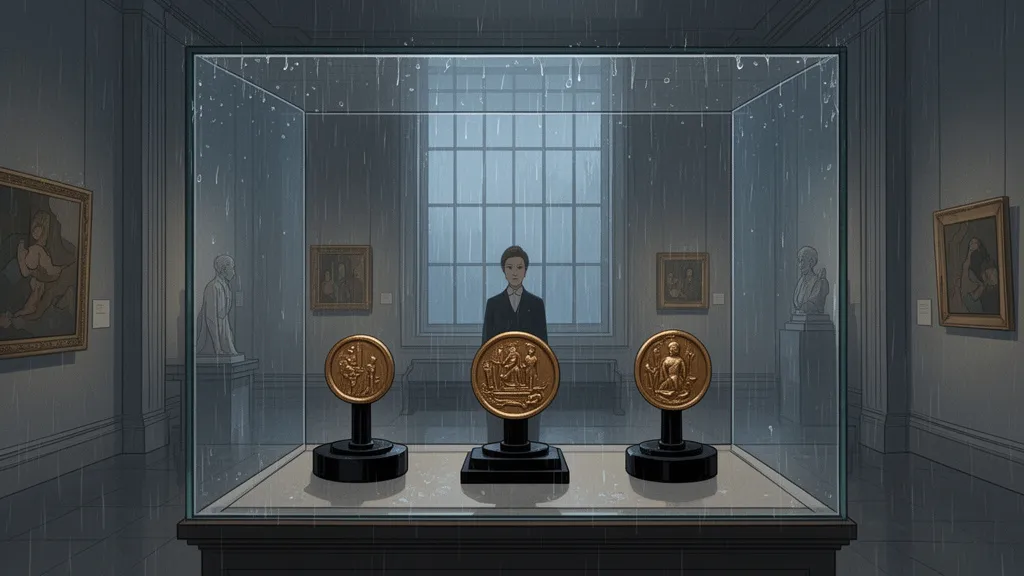
At seven-forty on a wet Thursday morning, Arai Fumika unlocked the East Asian Decorative Arts room and saw at once that one of the bronze seals had become too obedient.
The three stood in a row beneath the glass case, each on its black mount, each the size of a clenched plum, each bearing on its square base a maze of archaic characters no visitor could read without help. The left seal leaned slightly forward, as it always had. The right one sat a little crooked because the felt beneath it had worn thin on one corner. The middle one was upright, polished by the light, exact in a way the others were not. It looked like a child in borrowed manners.
Fumika set down her satchel and looked again.
Rain made a soft, persistent tapping against the high windows. The museum, before opening, had the severe smell of wax, damp wool, and old paper. A cleaner's cart squeaked somewhere beyond the lacquer screens. She took out the case key, opened the brass lock, and did not touch the seals. She bent until her fringe nearly brushed the glass shelf.
The middle seal's patina was wrong. Not dramatically; whoever had done it had known enough to be careful. But the green in the recesses sat on the bronze like cosmetics. And there was a minute burr at the inside edge of the knob where a casting seam had been filed and not quite persuaded to disappear.
A forgery, then. Near-perfect, certainly enough for donors and trustees and men who liked to say remarkable without seeing anything. But not enough for the person who had written the tray labels three years ago and corrected two catalogue entries by hand because the former curator had confused seal script with ornament.
She straightened and looked at the night log attached to the stand beside the case.
The page for yesterday was in order: eighteen-thirty, gallery closed by Senda; twenty-one-ten, rounds by Mori; six-fifty, exterior doors checked by Ogawa. No unusual entry. Tucked beneath the clip was the transparent acetate sheet they kept over the case map for marks and notes. On it, in blue grease pencil, someone had circled the centre panel and written print?
There was indeed a fingerprint on the inside of the front glass. A single damp mark, already drying to a blurred whorl, low and slightly to the left of the middle seal.
Inside.
Fumika closed the case, not fully, and went at once to the conservation room.
The old conservator, Kitajima, was standing over a tray of ivory netsuke with both hands planted on the table as if the table might move away from him. He had taken off his raincoat but not yet his scarf. His hair, white and obstinate, stood out in damp feathers over his ears.
"Kitajima-san," she said. "Please come to the Decorative Arts room. Now."
He glanced up. He had the mild, resentful expression of a man interrupted by the world for forty years and still astonished by its persistence. Then he saw her face and became attentive.
They returned together. Fumika opened the case and stepped aside.
He did not lean in immediately. That, more than anything, made her watch him closely. Kitajima loved objects with a proprietary tenderness usually reserved for frail, difficult relatives. He bent over damaged lacquer with the absorbed look of a man hearing distant music. But now he remained upright for one beat, two. Then he put on his spectacles.
"The middle one," he said.
"Yes."
He examined it without touching. The blood drained from his face so quickly that the skin beneath his eyes showed yellow.
"Who opened the case after closing?" he asked.
"That is what I am going to find out."
He took off his spectacles and polished them on his handkerchief though they were not wet. "No. You are going to find out quickly. Takeda is due at noon."
The donor.
Professor Takeda Shun'ei, retired epigrapher, collector, benefactor, and owner—until three years before—of the set of three Han-style scholar's seals bequeathed to the museum under terms so particular that the trustees spoke of them as one spoke of weather or stomach ailments. The seals were to be kept together, displayed together, and identified in the catalogue by provenance to the Takeda family collection. Takeda liked to visit them. He liked, more specifically, to be seen visiting them.
"Do you recognise it?" Fumika asked.
Kitajima folded the handkerchief once, twice. "Recognise what?"
"The forgery. You look as if you do."
His mouth thinned. He was not a good liar. This did not stop him.
"I look as if I am eighty-one and have found a false object in my gallery before breakfast."
"Conservation is not your gallery."
He almost smiled. It vanished at once. "Please do not be clever, Arai-san. Not this morning."
There it was: not fear of the theft itself, but fear of its naming.
She closed the case fully. "Who had keys?"
"I do. You do. Senda for the opening rounds. Security has the master set sealed in the downstairs office."
"And last night?"
"I locked the Decorative Arts room myself at six-fifteen."
"Were the seals in order then?"
He hesitated. Only a breath. Fair-play, she told herself out of old habit; if someone hesitates, note where. "I did not inspect them individually. But nothing struck me as wrong."
That was not the same answer.
"Who knew Takeda was coming at noon?"
"Half the museum. He telephones before every visit as if announcing an eclipse."
Fumika nodded. "Please stay available. And don't tell anyone yet."
"You say that as though I tell everyone things."
"You tell no one things," she said. "It produces administrative difficulties."
This time he did smile, unwillingly. It altered his face for a second, then left it older than before.
She went first to the security office, where Mori, broad-shouldered and damp from the service entrance, was making tea in a kettle that had boiled itself into rage. He greeted her, poured her a cup out of politeness, and gave it to her at a temperature suitable for metalwork. She accepted it because refusal delayed people.
"Master key seal intact?" she asked.
He showed her the cabinet. The wax tab over the lock had not been broken.
"Any incident overnight?"
"Leak in Corridor C. Nothing else." He looked at her over the steam. "You have that face."
"What face?"
"The one that means paperwork for me."
"Probably. Who was on rounds at twenty-one-ten?"
"I was. I signed the log."
"Anyone in Decorative Arts after close?"
"No one authorised. The education volunteers left at six. Curators drifted out. As usual, no one drifts with permission." He considered. "There was one envelope in the internal post tray for archives, dropped off late. Rain on it. I moved it before it soaked through."
"Who brought it?"
"Messenger from town. Young man in a blue cap."
"Where is it now?"
"Archives, I assume. Unless archives has ceased to believe in paper entirely."
She carried the tea away, burned her fingers, set the cup on a windowsill, and forgot it.
In the archives room, the post tray held circulars, two invoices, and a cream envelope mottled with dried rain. It had no stamp, only the museum address and her department written in a careful hand she did not know. Inside was a folded note and a tram ticket.
The note said only:
If the third seal is moved before noon, look at Lot 118 in last month's Asamori Relief Sale catalogue. Ask who paid cash.
No signature.
The tram ticket was for yesterday evening, punched at 18:42 on the hill line from Minato Crossing to Museum West.
Fumika sat down slowly. The archives room was narrow and overfull, ledger shelves rising to the ceiling, document boxes labelled in three generations of handwriting. The windows fogged at their corners. A dehumidifier hummed with the melancholy diligence of a second-rate monk.
Someone had known a substitution would be attempted before noon. Or expected one. The wording was exact: if the third seal is moved. Not stolen, not changed. Moved. As if the writer thought the object itself would pass briefly through human hands.
She took out the Asamori Relief Sale catalogue from the donations shelf. The charity auction had been held the previous month after the landslide in the northern district. Most lots were books, ceramics, old restaurant vouchers contributed by local businesses who preferred generosity to taxes. Lot 118 was listed on page thirty-two.
Set of three bronze study seals, family property of donor, 19th-century copies after Han models.
Donor: withheld.
Estimate: modest.
The accompanying photograph was poor, shot from above, but enough could be seen. Three seals, almost identical in shape.
Fumika looked back toward the gallery in her mind and saw at once what had unsettled Kitajima. The Takeda seals were not unique. Or rather, they were unique in one particular way only a careful owner would notice: on the true set, the left seal had a tiny bruise under the knob where it had once been dropped. The auction photograph showed that bruise on the middle seal.
Two sets, then, or one set misdescribed and moved years ago. Either possibility was poisonous.
She checked the result sheet tucked into the back of the catalogue. Lot 118 had sold for an amount absurdly high for copies and quite low for a family scandal. Buyer: private. Payment received in cash.
No name.
But a pencilled tick in the margin gave the clerk's initials: N.H.
Nishimura Hana, from Development, kept donor records like state secrets and left lipstick marks on teacups as though signing treaties. Fumika found her in the fundraising office arranging chrysanthemums by height on the windowsill, an operation she pursued with the concentration of a military engineer.
"Hana-san," Fumika said, "who paid cash for Lot 118 at the Asamori sale?"
Hana did not turn at once. "Good morning to archives too."
"Good morning. Who?"
"One likes to feel wanted for oneself."
Fumika waited.
Hana pivoted, took in her expression, and set down a yellow chrysanthemum. "That bad?"
"Perhaps."
Hana lowered her voice. "I can't disclose buyer identities from charity events without cause."
"There is cause."
"Administrative cause, moral cause, or police cause?"
"Choose the one that makes you least troublesome."
Hana, who liked troublesome as a profession, folded her arms. "The bidder's proxy used no name. A gentleman from Takeda's office settled in cash the next morning and asked for collection to be delayed. I remember because no one sane pays in notes for heavy bronze objects."
"Which gentleman?"
"His secretary before last. Not the severe woman, the soft one. Sugimoto. He resigned in winter."
"Collected by whom?"
"Not sure. Wait."
She opened a drawer, produced a duplicate receipt book, and licked her thumb before Fumika could stop her. "Here. Released two days later to 'K. Kitajima' on presentation of authorisation."
Fumika looked up.
Hana's eyebrows rose. "Should I begin to enjoy myself?"
"No," said Fumika. "Not yet."
Kitajima was back in conservation, cleaning his spectacles again. He had either done this twelve times in the last hour or not at all.
She laid the catalogue open on the bench beside him, then the receipt copy.
"You collected Lot 118."
He looked at the papers, and the effort of not immediately answering was visible in the line of his jaw. "Yes."
"For Takeda?"
"No."
"For whom, then?"
He sat down with care. "For myself."
The rain sounded louder, though perhaps the room had simply gone still around it.
"You bought three bronze seals from the relief auction," she said. "Why?"
"Because I recognised them from the catalogue photograph. Or thought I did."
"Recognised them as what?"
"As a second set commissioned by Takeda's father. Decades ago. Replacements."
That, she thought, was the sort of family vanity that flourished best in scholarship.
Kitajima went on, each sentence extracted as if with fine tools. "I knew the elder Takeda slightly. He believed the family seals should remain perfect. One was damaged in the war. He had copies made by a caster in Ueno. Very good copies, for the time. He never publicly admitted it. Later, after his death, the son—Professor Takeda—published an article on the set as untouched inheritable objects. Untouched," he said, with sudden bitterness. "Objects are always touched. That is why they become history."
"And you bought the copies because—"
"Because the sale catalogue called them 19th-century copies, which was wrong but close enough to tempt no one except me. I intended to compare them quietly and, if necessary, persuade Takeda to amend the catalogue record before he gave the originals here."
"Three years ago?"
"No. Last month. I only saw the sale listing then."
"And did you compare them?"
He looked away. There was a flush now under the earlier pallor. Shame restored colour better than health.
"Yes."
"What did you find?"
He was silent.
She understood then not the whole shape, but enough of it to see where the floor dropped. "You found that one on display was already a copy."
He nodded once.
"Which one?"
"The middle."
The exact one now replaced by a newer forgery.
So this morning's substitution was layered on an older one. Someone had removed, not the original seal from the family set, but the older replacement that had been standing in its place for years. Unless they knew where the original was now. Unless Kitajima did.
"Why did you say nothing?" she asked.
He looked older than eighty-one at last, not in years but in accumulation. "Because by then Takeda had donated the set publicly. Because if I exposed it, he would deny knowledge and accuse my department of mishandling, or his father's memory would be dragged through committees and papers, or both. Because museums," he said, almost gently, "run on objects, money, and the vanities that attach themselves to both. Remove one, and the other two grow teeth."
"Where is the original middle seal?"
He closed his eyes.
That was answer enough.
"With you," she said.
"In my custody. Safe."
"Your custody is not a category recognised by policy."
"Policy was not invited."
She could almost hear Hana saying she had missed her true calling in diplomacy. "Did anyone know?"
A pause. "One person suspected."
"Who?"
"Mizuki."
Mizuki Aya, assistant curator, age thirty-two, excellent with school groups, terrible with hierarchy, and possessed of the kind of composure that usually covered either innocence or a plan. She and Kitajima had spent the past year in a pattern of companionship and quarrel no one had managed to classify. He corrected her labels in red pencil; she brought him pickled plums from her mother's shop and ignored him for days when annoyed. The museum had decided this was mentorship because institutions preferred nouns.
"Why would she suspect?"
"Because she notices where I look." He said it without self-consciousness, which made the thing between them more precise, not less. "And because she found the old wrapping paper in my locker and asked one question too many."
"Did she have a key to the case?"
"No."
"Did you tell her where you kept the original?"
"No."
This time she believed him.
The tram ticket sat on her desk while the morning narrowed.
18:42 from Minato Crossing to Museum West. Someone had come up the hill after hours and wanted her to know it. The ticket was yesterday's, not old enough to be accidental. Minato Crossing was where the commercial arcades began, and also where Takeda kept his office above a stationery wholesaler. Sugimoto, the former secretary, might have boarded there. So might half the city.
Fumika looked again at the rain-spotted envelope. The paper was museum stock, borrowed from somewhere in-house. The handwriting on the address was careful, neutral, the hand of a person trying not to be recognised and not quite succeeding. She went downstairs to compare it with internal forms.
At ten-fifteen she found the match in the volunteer desk register. The numerals were too upright; the tail of the 7 crossed back through itself. Mizuki Aya.
Mizuki was in Gallery 2 crouched in front of a display of export porcelain, repairing a label with a glue stick and unnecessary force.
"Did you send me an anonymous note?" Fumika asked.
Mizuki looked up. Her expression was direct, then resigned. "Yes."
"Why anonymous?"
"Because you are very reliable, Arai-san. Reliable people sometimes require propulsion."
"And why not simply tell me?"
"Because I did not know whether what I knew would harm Kitajima-san, Takeda-sensei, or only my continued employment. I was hoping for a version with options."
"There are fewer options at eleven in the rain."
Mizuki sat back on her heels. She was handsome in the severe way of old portrait heroines, made less intimidating by a smear of glue on one thumb. "The envelope itself I wrote. But I did not send it from inside. I gave it to Endo-san and asked him to post it in town after he left."
"Takeda's secretary?"
"Yes. He had come looking for Kitajima-san and found me instead. He was frightened enough to be useful. He said only that if anyone sensible still worked here, Professor Takeda must not be allowed to make a scene at noon. Then he asked whether Professor Takeda's seals were still on display. Not the seals. Professor Takeda's."
"Why would he help you?"
"Because he is leaving next week," Mizuki said. "And because I think he has spent six months carrying messages between two vain old men and no longer wished to carry the last one. He did not know what was in my envelope. He only agreed it ought to reach you without passing across a museum desk with my name on it."
That settled one matter neatly enough. A reluctant secretary could be induced to act against his employer's preference; a frightened one, more so.
"What did he say exactly?" Fumika asked.
Mizuki frowned, recalling. "That Takeda-sensei had discovered 'a certain confusion' about the seals, and that Kitajima-san had made it worse by becoming principled in old age. Those were his words. Then he said Takeda would come today expecting the confusion to be corrected before noon."
The glue stick stilled in her hand.
"I had the unpleasant sense," she said, "that two old men were discussing a duel by means of stationery."
There it was, finally. Not theft from outside, but pressure from ownership that had never become simple by entering a museum.
"Why mention Lot 118?"
"Because I knew Kitajima-san bought it. I found the receipt stub weeks ago. He told me enough not to leave me in peace and not enough to let me help." Her mouth tightened. "An old male method."
Fumika let that stand. "Did you go into Decorative Arts after closing?"
"No. I don't have a key."
"Could Kitajima have let you in?"
Mizuki's eyes flicked to hers, amused despite everything. "That is a very administrative way to phrase gossip. No."
"Did anyone else know about the original seal?"
"Only if they listened at doors. Endo might have guessed more than I thought. Last week Takeda telephoned while I was in conservation. He was asking whether noon today still suited. Kitajima-san said yes, and then Takeda said, 'Bring the correct one this time.'"
Now the line was visible. Takeda had learned that Kitajima possessed the original middle seal. Noon was to be a private restoration: the genuine seal returned to the case before the donor's visit, the embarrassing old family copy removed, the museum left with three apparently proper objects and no proof of the old deception except in Kitajima's conscience.
A clumsy plan, but not a pointless one. The modern forgery did not serve as a permanent cover. It served only as a stopgap, something to occupy the mount for a few hours until the original could be put back. If Kitajima obeyed, the new fake would vanish before anyone but a specialist saw it. If he did not, someone had acted without waiting for his consent.
"When did you last see Endo?" Fumika asked.
"Yesterday evening. At the side entrance. He was very dressed and very wet. He handed me the museum stationery from the office packet by mistake, apologised, took it back, and then left with the envelope after I wrote it. He kept wiping his hands on his handkerchief."
Wet hands. Museum stationery. A man moving between messenger and accomplice because he lacked the nerve to be either cleanly.
"Thank