The Varnish Jar
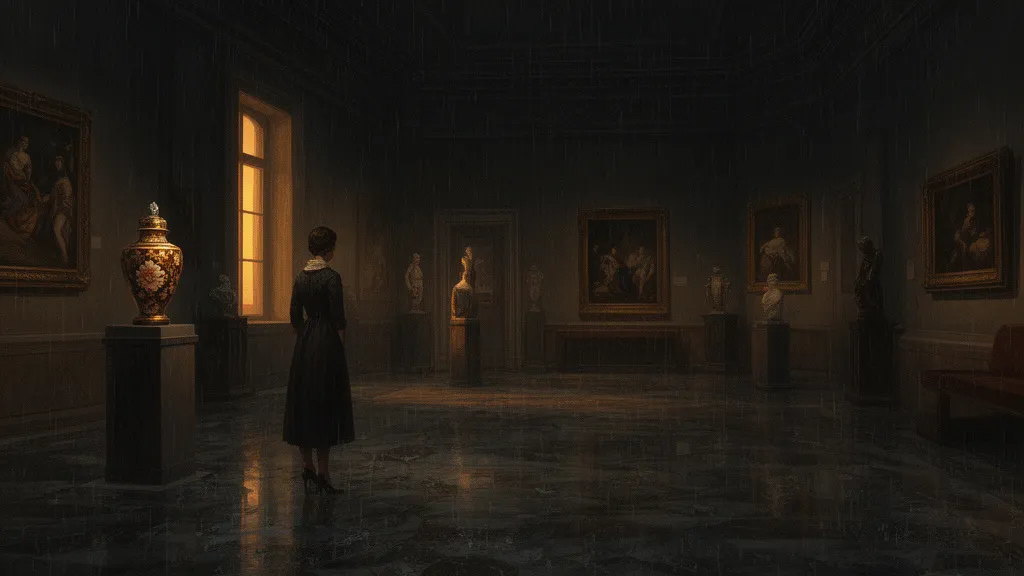
By eight ten, Kuroda Mei had already unlocked the side entrance, signed the damp security book, and regretted agreeing to come in early.
Rain had followed her up the museum steps in a fine persistent mist. It darkened the cuffs of her trousers and left the marble vestibule smelling faintly of wool, umbrellas, and old stone. She crossed the western decorative arts gallery with her portfolio case under one arm and her tea in the other, too hot to drink and too badly timed to put down. At the threshold of the temporary exhibition room, she stopped so abruptly that a little tea leaped over the lid and burned her thumb.
There was a footprint on the white tile.
Not a print in dust. A wet one, rain-dark, clean-edged, a left foot pointed slightly outward. It stood alone beneath the central display case as though someone had stepped there and then vanished upward.
The case itself housed Lady Aster in Blue, a loaned miniature portrait from the Takamori collection, scarcely larger than a hand mirror and vastly more troublesome than a mural. The vitrine was glass on all sides, mounted on a pale plinth, sealed the previous afternoon in the presence of Mei, the registrar, and the donor’s representative, who had worn pearl earrings the size of moral judgments.
Now the night guard was standing three paces away from it with his right hand stuck to a jar.
He looked at Mei with patient misery.
“I did not touch anything,” he said.
The statement was, she thought, unnecessarily broad.
Guard Sugiyama was sixty-two, tidy, and so respectful of procedures that he bowed to labels. The jar in question sat on the low condition-report table. It was squat, made of thick glass, and half-filled with citrus varnish used the day before on a frame from another room. Sugiyama’s palm was flattened against the side as if he had tried to catch it from falling. His fingers had spread and hardened there.
“How long?” Mei asked.
“Since seven forty-five.”
“You have been attached to it for twenty-five minutes.”
“Yes.”
“Why?”
“I believed it better than dropping it.”
This had the sound of truth, or at least of Sugiyama.
Mei set her tea carefully on the windowsill, where it would become undrinkably cold at the precise moment she needed it. Then she moved into the room, not toward the guard first but toward the footprint. The tile floor had been cleaned last night and dried to a hard white sheen. The print was a clear mark of water and city grime, no more than two minutes old when first made, now already paling at the edges.
One left foot. No right. No return.
She crouched and looked at the sole pattern. Smooth leather, narrow waist, modest heel. Formal, perhaps women’s, perhaps merely neat. Around the footprint the room remained immaculate.
The display case was worse.
At first glance the seals remained intact. White paper tabs signed across in black marker by three witnesses, one on each concealed access point. No obvious tears. No shifted alignment. Yet the miniature inside was hanging slightly wrong. Mei felt it before she could explain it. A tiny angle. The portrait had sat level yesterday within its velvet mount. This morning the left edge was lower by perhaps three millimetres.
And on the inner glass, at the side nearest the footprint, a crescent of condensation was slowly drying.
She straightened.
“Sugiyama-san,” she said, “did anyone come in after six?”
“Only Director Senda at six fifteen, to fetch a folder from his office. He did not enter this room. At seven ten, Miyasaka from cleaning passed the corridor. At seven thirty-five, Assistant Curator Nonomiya arrived and went upstairs to East Asian painting. She signed in. Then I heard a small sound from here.”
“What kind of sound?”
He considered. “Like a glass placed down by someone trying not to make a sound.”
“And then?”
“I came in. The varnish jar was rolling off the table. I caught it. My hand remained.”
Mei looked at the condition-report table. It stood near the wall, far enough from the central case that a rolling jar reaching the edge and falling would have made more than a small sound. On the tabletop lay cotton gloves, a bone folder, two pencils, and yesterday’s frame screws in a labelled envelope. Everything else was orderly.
“Sugiyama-san, who left the varnish here?”
“Conservation did. Yesterday.”
“We do not leave open adhesive-coated materials in an exhibition room.”
“It was closed,” he said, wounded on behalf of regulations. “I checked. Only the outside is sticky.”
Mei walked to him, bent, and inspected the jar. The lid was secure. A smear of amber varnish had dried over one side where someone had handled it with bad luck or worse timing. Sugiyama’s hand was fixed to that patch.
“Did you touch the display case?”
“No.”
“Did you try to?”
“No.”
He hesitated, then added, “I did consider asking the case to open itself.”
“That would have been efficient.”
Despite himself, he almost smiled.
Mei took a solvent pad from her bag, freed him in three minutes, and sent him to wash while she telephoned Registrar Hoshino.
By the time Hoshino arrived, breathless and sleek in a raincoat too expensive to trust to hooks, Mei had confirmed the one thing she would have preferred not to confirm. The vitrine was locked from outside as before. But one concealed maintenance panel at the rear, near the plinth base, had been unlatched and relatched from within.
From within.
Hoshino said this twice, each time more like a complaint to architecture.
“It cannot be,” she said.
“It can,” Mei said. “It simply should not.”
They checked the seals with magnification. The signed tabs over the obvious access doors had not been broken. The hidden rear panel was not paper-sealed because it was not meant to be used except when the case was disassembled, which required space impossible to obtain while the case stood in place. Unless, she thought, one were already inside it.
Hoshino pressed fingers to her forehead. “The donor’s representative returns at noon. If the miniature is missing—”
“It is still there,” Mei said.
“Is it?”
Mei looked again through the glass. The blue oval portrait remained in its velvet mount, woman in powdered hair, one shoulder turned. But the silk backing behind it had a slight bulge. Miniatures were light. A substitution was not impossible.
Hoshino inhaled sharply. “You are not helping.”
“I am conserving accuracy.”
They did not open the case. Not yet. If there had been tampering, they needed to understand it before disturbing anything.
Mei took out her notebook.
“Tell me everyone with access yesterday,” she said.
By eight forty-five she had a list, a cold tea, and three people already lying to her in different textures.
Director Senda lied with indignation: he had entered only his office and had not gone near the exhibition room, though his umbrella stand drip marked the corridor outside it. Assistant Curator Nonomiya lied with elegance: she had not seen the miniature after installation, though she described at once the donor representative’s pearl earrings. And frame technician Arima lied with cheerful incompetence: he had left all screws where they belonged, though one was now half a centimetre short in its envelope and another had acquired fresh brass dust.
The smaller clue appeared first in Hoshino’s palm.
They were examining the mount records at the condition table when Hoshino frowned and picked at her sleeve.
“What is this?”
On her fingertip lay a bit of dark green thread no longer than a grain of rice, tightly twisted, wool or felt, too short to belong usefully anywhere.
“It was in my pocket seam,” she said.
Mei took it. “Have you been in storage?”
“No.”
The thread went into an evidence fold. Ten minutes later Mei unscrewed the brass plate from the vitrine plinth to inspect the locking mechanism, and another identical thread was caught behind the lower frame screw of the plate. At nine twenty, Sugiyama, newly detached and fragrant with hand soap, discovered a third caught at the cuff seam of his uniform jacket, where he must have brushed the accessory case when he hurried in to catch the falling jar.
“Perhaps the museum is unraveling,” he said.
“It would choose a more dramatic colour,” Mei said.
Still, she looked up. Dark green. Not from the miniature, which was mounted on cream silk and blue velvet. Not from the guard’s uniform, grey. Not from Hoshino’s raincoat, taupe with ambitions.
She stood in the center of the room and let her eyes move, not quickly, across corners, labels, vents, plinth edges, the wheeled ladder left in the adjacent gallery, the windows furred with rain. The room had six paintings on the walls and three free-standing cases. The central one held the miniature. To its left, a case of lacquer writing boxes. To its right, a small display of gentleman’s accessories: gloves, calling card case, opera glasses, and, on a velvet rise at the back, a folded dark green felt-lined travel cloak hood from the late nineteenth century. Borrowed from costume storage, selected by Nonomiya for “atmospheric conversation” between objects.
The hood’s felt lining was dark green.
Mei went to the right-hand case and looked closely. One inner seam along the edge of the hood had a tiny rawness where fibres had caught and pulled free.
Hoshino, watching her, said, “You think someone brushed against it.”
“Not brushed. Hid behind it? Used it?”
“In a locked case?”
“In a museum,” Mei said. “Nothing is more accessible than an object everyone agrees not to touch.”
She asked for the keys to the accessory case, opened it, and examined the hood. In the seam of the felt was a recent tear, very small. Enough to shed fibres if snagged on metal. Enough to leave one behind a screw, one in a pocket, one on a jacket cuff.
Nonomiya arrived at nine thirty with a face composed for difficulty. She was thirty, elegant, and had arranged her severe black hair to imply both discipline and unavailability, while in practice she offered selective quantities of each. She and Hoshino had once lived together, which in museum administration had counted for less gossip than the fact that they had ceased doing so without ceasing to share lunch.
When Mei asked why a costume hood had been placed in a decorative arts show about intimate portraiture, Nonomiya said, “Because not every conversation has to be literal.”
“Did you move it this morning?”
“No.”
“Yesterday after installation?”
“No.”
“You signed in at seven thirty-five.”
“Yes.”
“Where did you go?”
“Upstairs.”
“With wet shoes?”
“I was carrying them,” Nonomiya said.
This was so improbable that even Hoshino blinked.
Nonomiya sighed. “I changed at the stair landing. The soles were soaked. I left the wet pair in my office.”
“What pair?”
“Low black pumps.”
“Show me.”
They went upstairs. The pumps were indeed under Nonomiya’s desk, damp, narrow, left sole turned slightly outward with wear. Mei compared the pattern to a sketch she had made of the footprint. It matched closely.
Nonomiya folded her arms.
“You may arrest my shoes,” she said.
“I would first like your reason for entering the exhibition room before going upstairs.”
“I did not enter.”
Mei looked at her. People lied in many ways; Nonomiya did it by making the truth seem aesthetically displeasing.
“What happened yesterday?” Mei asked.
“Installation happened yesterday.”
“With whom?”
“With all of us.”
“With whom after the representative left?”
Nonomiya’s mouth altered by less than a millimetre. “Arima came back to adjust the wall labels. Director Senda came in to discuss the donor remarks. Hoshino and I argued about a caption. Sugiyama hovered in moral support of rules. Mei-san, you were in and out preparing the humidity packets.”
“And later?”
“Later I returned alone for my notebook.”
“What time?”
“Six twenty. Perhaps six twenty-five.”
“Did you open any case?”
“No.”
“Did anyone else?”
“No.”
Another lie, or part of one.
At ten, Mei asked for the previous day’s packing crate to be brought from temporary storage. The miniature had arrived in a fitted traveling box inside a larger wooden crate with foam compartments and an absurd quantity of tissue. She wanted to see whether anything in the packing arrangement suggested an easy substitute.
The crate came up on a trolley pushed by Arima, who was broad-shouldered, apologetic, and always one conversation behind his own face. He set it down and, while explaining that he had certainly not misplaced any screws worth mentioning, dropped a small screwdriver from his breast pocket. Mei picked it up before he could.
Dark green fibres clung to the shaft near the handle.
Arima saw her see them.
“That,” he said, “could be from anything.”
“It could,” Mei said. “Which thing?”
He scratched his cheek. “Felt table cover? Coat lining? Christmas?”
Mei did not answer. She opened the packing box. The custom inner support for the miniature had two retaining straps of cream ribbon and a shallow recess the size of the portrait mount. Empty, of course. Yet in one corner of the recess lay a tiny chip of dried amber.
Varnish.
Not from conservation work on the miniature. The portrait itself had not been treated. Someone with varnish on their hand or clothing had touched the interior of the packing box after unpacking.
Hoshino leaned in. “Sugiyama?”
“Sugiyama did not unpack loans,” Mei said.
Arima said, too quickly, “Neither did I.”
“But you carried the crate.”
“Yes.”
“With varnish on your hand?”
“No.”
Mei set down the lid. “Who used the citrus varnish yesterday?”
Arima looked helplessly toward the door, where Director Senda had just appeared, thin as a bookmark and equally eager to be inserted into significance.
“Senda-sensei approved the frame touch-up,” Arima said.
Director Senda adjusted his spectacles. “A minute amount, for a rubbed corner. Entirely routine.”
“On which object?” Mei asked.
“On the travel hood case plinth edge,” he said.
“That is not a frame.”
He drew himself up. “A surface, then. The distinction seemed unhelpful at the time.”
“Who handled the jar?”
Senda hesitated. “Arima opened it. I may have moved it after.”
“Where?”
“From the accessory case, once Hoshino had unlocked it for object placement, to the table.”
“Why?”
“I disliked its being visible.”
This, Mei believed. Senda disliked many things for visual reasons. But if he had moved the jar with a tacky side, he might have transferred varnish elsewhere. She looked at his hands: clean, well-kept, no residue. Too late for that to matter.
The question that did matter had been waiting since eight ten. If the case had been opened from inside, who had been inside it, and when?
Not this morning; there was nowhere for a person to emerge without leaving more than one footprint. Not overnight; Sugiyama’s rounds would have heard or seen something. Yesterday during installation, perhaps, hidden while others assumed the room empty. But the case containing the miniature was too small for any adult.
Unless nobody entered that case.
Mei went back to the room and stood where the single footprint had stood before it evaporated. From there, the angle to the central vitrine aligned with the accessory case to the right. Glass reflected glass. The dark green hood, on its velvet rise, made a curtained shape in the rear corner.
A person small enough to crouch behind that case’s internal plinth for a minute or two could not stay long, but long enough was all a museum usually offered.
She asked Sugiyama to repeat exactly what he had seen at seven forty-five.
“The jar rolled,” he said. “I caught it. Then I looked at the central case. The portrait seemed crooked.”
“Did you look at the accessory case?”
“No.”
“Did you hear a door?”
“No.”
“A panel?”
“No.”
“Breathing?”
He considered this with painful seriousness. “This is a museum. There is always breathing.”
Mei nodded. Fair enough.
Then she bent behind the central plinth once more. The concealed maintenance panel was reachable only through a low service cavity. Too small for a person, but large enough for an arm. If one were in the neighbouring case and had some improvised extension—something slender, hooked, and padded against noise—one might manipulate it through the narrow gap between the cases’ rear skirts.
The dropped screwdriver. The fibres on its shaft. The slight sound of glass placed down quietly.
Not a person inside the central case. A hand inside the accessory case, using the removed hood as concealment while working in the cramped space behind the plinths.
To do what?
Open the maintenance panel from the rear cavity, reach into the central case base, lift the velvet mount from below, and take the miniature out through the lower support void.
But the portrait was still visible.
Substitute.
Mei turned to Hoshino. “We open it now.”
Hoshino swallowed. “Without the donor representative?”
“With you and Senda as witnesses. Better our scandal than theirs.”
They cut the seals. Hoshino made a small sound at each snip, as though etiquette itself were fraying.
Inside, the portrait looked correct from three feet away and wrong from six inches. The painted oval sat in its mount, yes. But the ivory support was fractionally thicker than before, and the backboard beneath had been packed with folded paper.
Mei lifted it out.
The paper was exhibition brochure stock, cut to size. The image was not the miniature at all but a very fine colour photograph mounted on card.
Hoshino sat down on the nearest bench without permission from herself.
Director Senda said, “Oh dear,” with the tone of a man receiving weather about another district.
Arima went pale enough to become useful.
Mei examined the inside base. The mount support had indeed been accessed from below. Tiny fresh scratches marked the retaining clips. One clip held a green fibre.
“Who photographed the miniature after unpacking?” she asked.
Nonomiya said nothing.
Senda said, “For publicity, naturally.”
“Who printed this?”
Arima said, “I only cut the board.”
Everyone looked at him.
His face rearranged itself too late. He sat down heavily on the crate trolley.
“It was not my idea,” he said.
“Whose?” Hoshino asked, very quietly.
Arima looked at Nonomiya. Nonomiya did not look back.
Of all the lies in the room, that silence was the cleanest.
The explanation, once it began, required no genius. Only time, sequence, and the sad reliability of people who think a delicate deception remains delicate after involving three colleagues and a screwdriver.
Nonomiya had arranged the accessory case specifically so the dark green hood stood near the rear panel line between the two vitrines. During installation, when Hoshino unlocked the accessory case for placement and condition checks, Arima opened it again under that same authority, loosened the hood from its mount, and discovered the felt could hide his forearm from the room if he crouched behind the case and reached into the rear gap. The maintenance panel on the portrait case, though not meant for use in situ, could be flicked from behind with a hooked screwdriver wrapped in cloth.
After the representative left, Nonomiya returned “for her notebook.” In fact she returned with a colour print made from the publicity photograph and a folded brochure backing. Arima met her there. Director Senda, who had come back to polish his opening remarks and saw more than was good for him, did not stop them. He had his own motive for silence: the museum’s accounts were poor, the donor exacting, and the promised insurance valuation on the loan could ease a deficit if a loss were declared under certain humiliating but survivable circumstances.
He had not devised the theft. He had merely recognised it as useful.
Arima, varnish still tacky on his fingers from touching up the plinth edge under Senda’s direction, handled the packing crate and left amber traces there. He crouched at the rear of the accessory case, hidden by the hood, and used the screwdriver to release the central panel from behind. Nonomiya, small-handed and steadier, reached through the service cavity from the opened panel, lifted the original miniature free, inserted the photograph and paper packing, and relatched the panel.
The green fibres shed where the hood seam snagged on screw heads and tool shaft. One caught behind the brass plate screw when Arima replaced it. One lodged in Nonomiya’s pocket seam when she concealed the stolen miniature there. One caught on Sugiyama’s cuff when he hurried past the accessory case to catch the rolling jar. Sugiyama heard the small sound when Nonomiya set the hood support back in place too carefully.
Then the varnish jar rolled.
“Why the jar?” Mei had asked, and that had taken one more minute.
Nonomiya gave it in the end herself.
She stood