The Violin Case Key
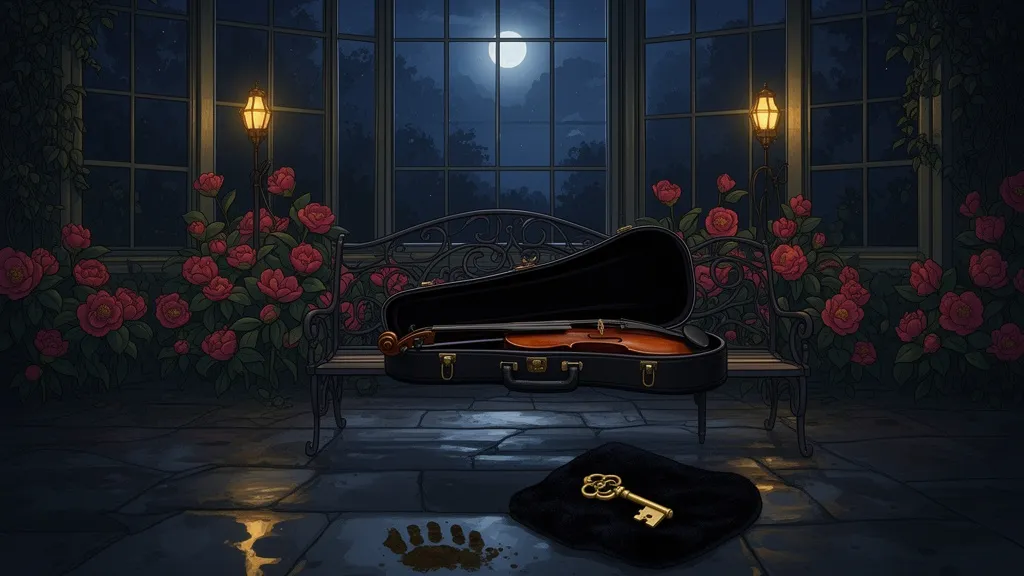
At ten past two, Maki Shinohara turned the corner into the conservatory and stopped so quickly that the tea in her paper cup struck the lid and burned her thumb.
The violin case lay open on the iron bench beneath the camellias. Black velvet inside, silver hinges bright under the night lamps, and in the exact centre a brass key. Beside it, on the velvet, there was a smear of wet mud the shape of a thumb pressed down and lifted away.
Maki set the tea on the flagstones. It was still too hot. It would be cold when she remembered it again.
The conservatory belonged to the Hoshino Museum of Decorative Arts, which occupied an old villa and several newer wings designed by people who disliked straight lines. At night the building quieted into little sounds: a humidifier clicking on, water moving in hidden pipes, leaves touching the glass roof. The violin case made no sound at all. That was one reason it looked so theatrical.
The other was that no concert had been held that evening, and no violin case had any business being there.
Maki was not a detective. She was a night guard with a degree in musicology, an excellent memory for labels, and a tendency to notice where objects sat in relation to one another. The museum paid her to notice doors, windows, and hands where hands should not be. Her degree had turned out to be useful mainly when donors said things about lacquered instruments that were nonsense.
She crouched beside the bench without touching the case. Mud on the velvet, still wet. A brass key of old-fashioned shape but recent polish. No instrument. No tag. No note.
Above her, the red light on the conservatory camera was dark.
That was wrong.
Maki straightened and looked up properly. The camera sat in its smoked plastic dome above the doorway to the west corridor. It should have shown a red standby point. It showed nothing.
She pressed her earpiece. “Control?”
A yawn answered first, then Okuda’s voice. “Mm?”
“Camera C-4 is out.”
“Again?”
“Was it out before?”
A pause. Paper moved. “No. Wait. The monitor flickered once around one fifty. Came back. You’ve found something?”
Maki looked at the open case. “Yes.”
“Human?” Okuda asked, with hopeful dread.
“No. But irritating.”
That made him laugh, which was unfair to the circumstances. “I’m coming.”
She stayed where she was. Procedure required the scene to remain untouched until another staff member confirmed it. Procedure, she had noticed over the years, was written by people who expected events to arrange themselves politely inside forms.
The conservatory smelled of damp soil and orange blossom. One of the volunteer gardeners had insisted on citrus trees in tubs despite the altitude, and the museum had indulged her because she was eighty-two, rich, and terrifying. Through the glass, the mountain beyond the town was only a blacker shape against black sky. Somewhere down that slope, beyond the road and the shuttered souvenir shops, stood the Suzuki Inn. Maki had once spent a wet weekend there for a staff retreat. The tea had arrived during a fire drill and had been cold by the time she drank it.
Okuda arrived wheezing lightly, though he was only carrying a torch and his own suspicion. He was broad, cheerful, and believed all mysteries should either become accidents or belong to someone else.
“Ah,” he said, seeing the bench. “Very irritating.”
They observed together. The case was expensive but not museum inventory. The brass lock on it had no scratches. The mud was dark garden mud, not the pale grit from the front drive. The key lay flat, one tooth nicked, oval bow plain.
“Could be a prank,” Okuda said.
“At two in the morning?”
“That’s when people do their worst thinking.” He bent, squinting. “What kind of key?”
“Desk, drawer, cabinet. Not a padlock.”
“You can tell that from looking?”
“I can tell it wants to feel useful indoors.”
Okuda looked at her and accepted this in the same spirit with which he accepted modern sculpture.
They checked the nearest doors. No sign of forced entry. The west corridor windows were latched. The staff entrance log showed no movement since one thirty-two, when the cleaning crew left. The environmental alarms were quiet. In the control room, the footage from C-4 froze at 2:09:14 on an empty doorway, skipped, and resumed at 2:10:14 with the violin case already on the bench and nobody in sight.
“One minute exactly,” Maki said.
“System glitch.”
“Maybe.”
“Could someone wipe one minute?”
“Not elegantly. Not from inside the conservatory.”
Okuda drank vending-machine coffee and made a face of ethical objection. “You think one of ours?”
“I think someone knew where the blind spot would matter.”
That was not the same thing, though he looked unhappy because it was close enough.
The museum director, called from bed, ordered the case and key sealed until morning. The donor whose office adjoined the East Gallery could not be reached. This was fortunate. Maki completed an incident report while the tea beside the camellias cooled through every stage of disappointment.
By eight-thirty, the museum was no longer quiet. Conservators whispered with appetite. Administrative staff moved as if there were royalty in the building, which in a museum often meant money, which in this museum meant Mr. Shunichi Saegusa.
Saegusa had donated the east wing, the lecture hall, and enough ceramics to oblige the museum to praise him in two languages. He was sixty-three, handsome in the polished way of expensive men, and wore grief as if it had been tailored. His late wife had been a violinist. After her death, he had funded a small annual music programme the museum did not need but had learned to appreciate.
His office on the second floor had once been a curator’s room. He used it when he visited, which was often enough to suggest boredom and not often enough to become useful. The office contained shelves, a broad desk, two abstract paintings, and a Japanese chest with brass pulls that everyone called the donor’s filing cabinet because nobody wished to say tansu incorrectly in front of him.
By nine, Maki stood in the office with the director, Okuda, Saegusa, and Reika Nonomura from the board. Reika was a former soprano with pearl earrings and an expression suggesting that if incompetence had a smell she could detect it at once.
The brass key from the violin case lay in an evidence envelope on the desk.
“It fits this drawer,” the director said unnecessarily.
The bottom right drawer of the desk stood locked. Or should have. Saegusa had said, with cool impatience, that the drawer was always kept empty and always kept locked. He had then added, rather too quickly, that nobody but he had the key.
“And it has not been opened,” Saegusa said.
He stood with one hand resting lightly on the desk edge, as if addressing an inferior witness in court. Maki had met this type before. Wealth gave some people the habit of speaking in verdicts.
The director looked at her. “Miss Shinohara discovered the key. Since she is the reporting officer, I thought—”
“She may hand it over,” Saegusa said.
He was already holding his phone in his left hand. His right remained free. His cuff was immaculate. On the outer edge of the right thumbnail there was a crescent of pale brown under the lacquered buff. Dried mud, or something very like it.
Maki noticed it and looked away at once. Looking too directly at a clue could make people feel accused before there was anything to accuse them of. It was a discourtesy and often impractical.
“The camera failed for one minute,” Reika said. “The board will want to know how often this happens.”
“Rarely,” said the director.
“Never at a useful time,” said Okuda under his breath.
Maki, who should by all rights have been silent, said, “Before I hand over the key, I’d like to ask Mr. Saegusa a few questions.”
The room became still in the brisk administrative way of people deciding whether this is admissible.
Saegusa smiled without warmth. “Are you police?”
“No.”
“Then kindly do your job and allow the museum to do its own.”
“She is doing her job,” the director said, unexpectedly firm. “A mysterious key in a closed building is a security matter.”
Reika’s eyebrows rose. She enjoyed firmness in others the way some people enjoyed chamber music: best at a short distance.
Saegusa placed the phone face down. “Very well. Briefly.”
Maki said, “When were you last in this office?”
“Yesterday afternoon. Around five.”
“Alone?”
“Yes.”
“Did anyone know you would be here this morning?”
“Several people. There was a board call at nine-thirty.”
“Why keep an empty drawer locked?”
“Because I prefer order.”
That was possible. It was also the sort of answer people gave when the exact truth was small, private, and therefore awkward.
“Do you own a violin case like the one in the conservatory?” she asked.
“No.”
This came fast enough to be prepared.
“Did your wife?”
His face changed very little. That made the small change visible. “She owned several.”
“Is one missing?”
“How should I know?”
“From your home,” Maki said.
Reika moved, interested now. The director looked pained. Okuda looked delighted in the careful way of a man who knew delight had no place here.
Saegusa said, “My wife has been dead three years. Her things were catalogued. Some were lent. Some were stored.”
“Stored where?”
“At Kiyose House.”
The old Saegusa residence stood on the edge of town. It had a gate, a caretaker, and enough rooms for grief to breed in.
Maki nodded. “Who has access?”
“Myself. The caretaker. My niece, occasionally.”
“Your niece is Emi Saegusa, the museum’s development assistant?”
“Yes.”
Now the exact flavour of the room changed. Development offices and donors were already entangled by nature. Add family, and the knot grew decorative.
Maki had met Emi often. She was thirty, efficient, and laughed as if daring people to disapprove. She and Reika Nonomura were close in a way nobody had defined aloud, which in museums was simply good manners.
Maki asked, “Did you speak with your niece last night?”
“No.”
Another prepared answer. Not necessarily false. Prepared was only prepared.
She looked at the locked drawer. “May I examine the desk first?”
Saegusa spread his hand with a host’s patience. “Examine the furniture as much as you please.”
She began with what could be seen. The desk was walnut, old enough to have acquired minor dignity. The locked drawer sat below a shallower stationery drawer. Dust along the rails had been recently disturbed. Not surprising if anyone had tried the lock; more interesting was the faint crescent mark on the desk edge above the keyhole, as if a thumbnail had pressed there while the drawer was being shut.
The floor beneath the desk was clean except for one dried speck of dark mud near the right front leg. Garden mud again, not hall dust.
“Who cleans this room?” Maki asked.
“A contractor,” said the director.
“Last night?”
“Early evening.”
The mud therefore came after cleaning. That narrowed little, but it narrowed.
She crossed to the window. Closed and latched. Outside, a narrow stone balcony overlooked the courtyard and, beyond, the conservatory roof. The balcony door key hung on a labelled peg inside a small cabinet by the bookcase. It was present.
“Do you use the balcony?”
“Not in winter,” Saegusa said.
“It is May.”
“I stand corrected by the guard.”
Dry, resentful. He was recovering himself.
Maki opened the cabinet, checked the peg, and saw beside the balcony key an empty hook labelled Store Rm. E-2. The director noticed her glance.
“That one is with Facilities,” he said.
“Since when?”
He frowned, thinking. “Last week? No, earlier.”
Okuda said, “The conservatory prop room?”
“Adjacent,” Maki said.
Saegusa had shifted his weight, very slightly, at the mention of the label.
There was no leap in that. Only movement.
She asked if she might speak to Emi before the drawer was opened. Reika objected that this was absurd. Saegusa said he would not be subjected to theatre. The director, perhaps because everyone else disliked the delay, granted it at once.
Emi arrived in six minutes with a folder under her arm and annoyance made elegant by lipstick. She took in the room, the envelope, her uncle, Reika, and Maki, and sighed.
“This is about the conservatory, I assume.”
“You heard already?” Maki said.
“The building is humming. Half the curators think a Stradivarius vanished.” She looked at the empty office. “Did one?”
“No,” said Saegusa.
“Then a cheaper melodrama.”
Reika’s mouth tightened at the word melodrama, because former sopranos dislike casual use.
Maki asked, “Were you at Kiyose House yesterday?”
“Yes. At about seven. I dropped off papers for my uncle to sign.”
“You spoke just now of the conservatory as if you expected this.”
Emi gave her a direct look. “I expected something.”
Saegusa said sharply, “Emi.”
She ignored him with the ease of long practice. “Uncle, if this is still about that drawer, the thing has become ridiculous.”
Reika looked from one to the other. “What drawer?”
“No one’s,” said Saegusa.
“Your locked empty one, apparently,” Emi said. “Which ceased to be empty when you put Mother’s letters in it.”
Silence followed. Not because the fact was devastating. Because it was intimate, and intimate facts in public rooms always land harder than criminal ones.
Saegusa said, “Those letters are private.”
“They were my mother’s letters,” Emi said. “To your wife. For twenty years. You took them from Kiyose House without asking. You told me they would be safer with you, which was interesting, since they had survived perfectly well in storage.”
The room acquired a different centre of gravity.
Maki said, quietly, “Why would the letters need to be safer?”
Emi laughed once, with no mirth in it. “Because the board is preparing the memorial exhibition and half the town now remembers my mother and Aunt Chisato were inseparable. People are very creative when a dead violinist becomes respectable.”
Reika looked at her carefully. Whatever category had been quietly avoided between Emi’s mother and Chisato Saegusa, it now stood in the room without labels and refused them.
Saegusa said, “There is no relevance here.”
“There is if you moved those letters last night,” Maki said. “Did you?”
“No.”
Emi said, “Then where are they?”
He turned to her. “You are behaving disgracefully.”
“Families often say that when asked for inventory.”
It was such a Maki-like sentence that Okuda glanced at her in mild admiration, though Emi had said it first.
Maki looked at Emi’s hands. No mud beneath the nails. Smart shoes, city soles, clean. She smelled faintly of rain though the morning was dry; perhaps from the taxi rank, perhaps not. Her expression held anger, but not surprise. She had expected conflict, not discovery.
“Who knew about the letters?” Maki asked.
“Me. My uncle. Probably Aunt Chisato when alive, if she had eyes.” Emi folded her arms. “And Reika, because I tell Reika things.”
Reika did not flinch. “Only because you insist on having secrets in unventilated places.”
A relationship quietly undefined, Maki thought, and set it aside as human structure rather than clue.
“What are in the letters?” asked the director, who had the expression of a man wishing to resign into forestry.
“Affection,” Emi said. “Dependence. Resentment. Twenty years of one woman asking another not to leave her. If the museum wants a summary, I can prepare one on letterhead.”
Saegusa’s face had gone very pale and very composed, which was another kind of alarm.
Maki said, “Mr. Saegusa, if those letters are in the locked drawer, and if you insist it was never opened, then someone placed this key in the conservatory to make us open it in front of witnesses.”
“Yes,” he said. “Precisely.”
“And yet the key was left in a violin case associated, very likely, with your wife. In the conservatory. On the route of the failed camera. That suggests not exposure for its own sake, but a message aimed at you.”
He said nothing.
“Did you go into the conservatory last night?”
“No.”
“But you did come to the museum.”
This time the silence was longer. It was broken, inevitably, by his phone vibrating against the desk.
He switched it off. “How?”
“The mud on your thumbnail,” Maki said. “The same dark soil as the conservatory tubs. The disturbed dust on the drawer rails. The mark above the keyhole where someone pressed while shutting it. And one thing more. If the drawer had truly not been opened, you would have handed us the key yourself, to prove it empty. Instead, you wanted the key in your possession before anyone looked inside.”
Reika exhaled very softly. Okuda, who loved honesty when it happened to other people, became very still.
Saegusa said, “I came after dinner. I used my own key to enter. I intended to remove the letters before the exhibition team began rummaging through every corner under pretext of efficiency.”
“Why last night?”
“Because Emi had begun making threats.”
“I told you to return them,” Emi said.
“I opened the drawer,” Saegusa went on, as if she had not spoken, “and found it empty.”
That altered the room once again.
Maki felt the pieces change shape. “Empty?”
“Yes. Empty.” His control frayed at last, only at the edge. “Then I heard a sound in the corridor. I thought someone had seen me. I closed the drawer, locked it, and left by the east stairs. When I reached the conservatory, I found the violin case on the bench.”
“Already there?”
“Yes.”
“Open?”
“Yes.”
“And the key inside?”
He hesitated. “No. The case was empty.”
That was the first answer all morning that felt raw enough to be true.
“You put the key there,” Maki said.
He looked at her with actual surprise. “Of course I did. What else was I to do? Carry the drawer key in my hand after I had just discovered the drawer had been opened? If I kept it, I became the man with the key to the private drawer. If it was found publicly, then at least the discovery would not depend on my account.”
He glanced at the evidence envelope. “That is my key. The only one I had made for the drawer.”
Emi stared at him. “You left your own key in a violin case?”
“I was not, at that hour, consulting a panel of experts.”
Okuda made a small sound of admiration for the bluntness.
“So the missing minute,” Maki said, “was when you placed your key in the case.”
“The camera was working when I entered the conservatory. Then the light went dark.”
“Because someone had already disabled it,” she said.
The culprit, once that was clear, became almost embarrassingly near.
She turned to the small cabinet by the bookcase and the empty hook labelled Store Rm. E-2.
“The prop room key,” she said. “Who had it yesterday?”
The director blinked. “Facilities, I told you.”
“Who collected display cloths from the prop room for the memorial planning meeting?”
He thought. Reika answered first.
“Harada. The exhibition assistant.”
Harada was twenty-six, earnest, and openly devoted to Chisato Saegusa’s legacy in the manner of people who fell in love with the dead because the dead cannot interrupt. Maki had seen him in the conservatory more than once, carrying music stands for events that made no acoustic sense.
“Why Harada?” Okuda asked.
“Because he had access to the adjacent room key,” Maki said. “Because he could disable the conservatory camera’s local connection panel from the maintenance cupboard there, but likely only briefly and clumsily, which gives us one missing minute, not a polished erasure. Because he knew enough about the exhibition to know letters existed and enough sentiment to choose a violin case as his method.”
She looked at Emi. “And because someone told him.”
Emi’s eyes widened, then closed once. “I told him only that my uncle had taken the letters. He asked where they were kept. I said, perhaps, the office drawer. I thought he was being sympathetic.”
Reika said, dry