The Warm Button
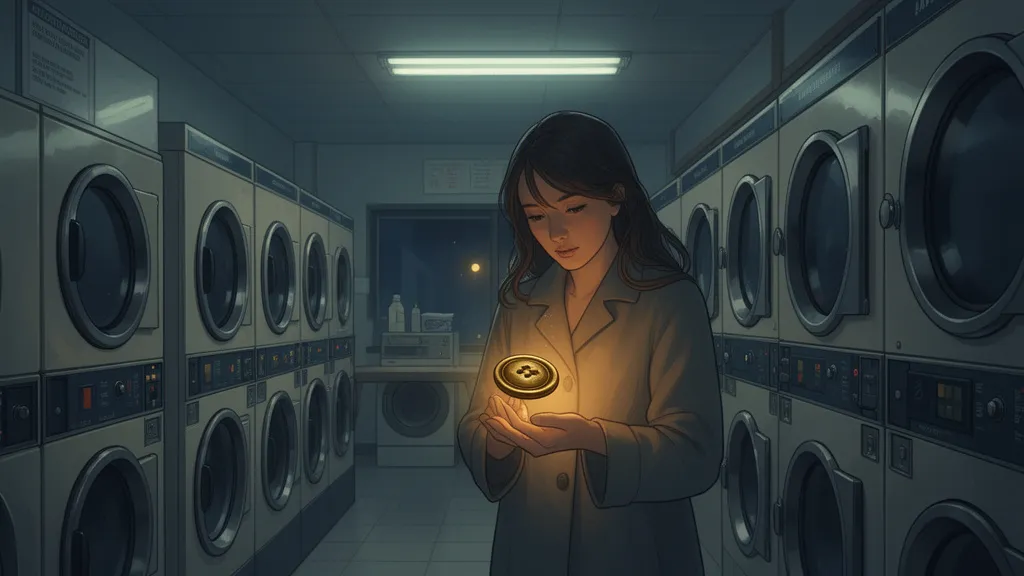
By the time Rieko Suda burned her fingers on the brass button, she had already decided the evening was badly organised.
The washing machine at the end of the row had finished six minutes earlier. The dryer beside it had stopped and begun its polite electronic chirping, which nobody in the room seemed prepared to answer. A college boy in a fencing jacket was asleep over a paperback. A woman in a cream cardigan was folding hand towels with the concentration of a surgeon. Two children were making a fort from empty detergent baskets. And the tea Rieko had bought from the vending machine outside had proved, against all reason, both too hot to hold and too weak to justify it.
She set the paper cup on the narrow folding shelf, opened the waiting machine, and began transferring damp laundry into a basket that was not hers.
This was not theft. In a neighborhood coin laundry, there came a point at which unattended washing became a public nuisance and therefore public property for exactly thirty seconds. She had reached that point three minutes ago.
The load was ordinary enough at first: bath towels, two shirts, a child's socks with cartoon bears, a navy skirt. Then her hand found the cuff of a small school blazer. She drew it out by one sleeve, preparing to shake it straight before laying it on top.
Something hard pressed into the turned-up cuff.
She touched it, frowned, and pinched the fabric. A single brass button had been sewn inside the cuff hem, not where any sensible tailor would put it, but hidden in the fold as neatly as a coin in a magician's palm. It was round, smooth, and unexpectedly warm.
Rieko let it drop into her palm. It sat there with a body's heat.
She looked at the blazer again. Navy wool, white piping, the crest of Hoshino Academy at the breast pocket. Primary division, if she remembered the uniforms properly. There should have been three brass buttons down the front. This jacket had only two. The top one was missing.
"Oh," said the woman in the cream cardigan, looking up from her towels. "Have you found something strange?"
Rieko held up the button.
The woman came over, hands still folded around a tea towel. She was trim and neat, with the kind of face that made apologies before they were needed. "That is strange," she said. "Was it in the machine?"
"In the cuff. Sewn into it. And warm."
The woman's eyebrows moved. "Warm?"
"As if it had just come off someone's coat."
The college boy woke enough to say, without opening his eyes, "Dryer, probably," and went back to sleep.
It would have been a satisfactory answer if the blazer had come from a dryer. It had come from a washing machine.
Rieko looked around the laundromat with a little more interest than before. The room had twelve machines, six washers opposite six dryers, with a central folding table and a corkboard crowded with piano lessons, pet-sitting offers, and a notice for the summer festival. The glass door at the front looked onto the narrow shopping street. Near the back, under a sign reminding customers to clean the lint trap after use, stood the larger dryer whose door was presently not quite shut.
Ajar by a hand's breadth.
Rieko had noticed it earlier only because the strip of interior light made a pale wedge on the floor.
She put the blazer over one arm and picked up the button again, this time with less confidence.
"Whose machine was this?" she asked.
No one answered.
The children, who had exhausted the architectural possibilities of detergent baskets, now approached to inspect the jacket. One of them, a solemn girl with two stiff braids, pointed at the crest.
"That school is where Emi goes," she said.
"Which Emi?" asked Rieko.
"Emi from the stationery shop. Her mother says she loses things because she is too full of weather." The child considered this. "I don't know what it means."
Her brother did. "It means she forgets her hat," he said.
The woman in the cream cardigan smiled. "That would be Mrs. Nonomiya's daughter. The shop is two doors down from mine. I can fetch her mother, if you like."
"Please," said Rieko.
The cardigan woman nodded, put down her folded towels, and went out onto the street. Rieko laid the blazer on the table. It was damp from washing, but not freshly so. The wool had that exhausted softness clothes got after they had been soaked and spun. The missing top button had left two pale threads on the placket. Someone had cut them cleanly.
That was less ordinary.
She slipped the hidden button into the little dish by the sink where people left forgotten coins and hairpins. Then she checked the machine again. Nothing else. No second button. No note in a pocket. No name tag except the stitched surname Nonomiya.
A minute later the cardigan woman returned with Mrs. Nonomiya, who arrived in an apron printed with cherries and looked as if she had run through three separate worries on the way.
"I'm so sorry," she said before she had reached the table. "I left a load here and then a customer came in with ledger paper and I forgot the time. Is it all right?"
Rieko indicated the blazer.
Mrs. Nonomiya stopped. The blood seemed to leave her face in stages. "Where did you get that?"
"From your wash."
"That can't be from my wash."
"It has your daughter's name inside." Rieko turned the label toward her.
Mrs. Nonomiya stared at it as if someone else had stitched the letters there in malice. Then she said, very carefully, "Emi did not wear that home."
The room became attentive.
Even the fencing student lifted his head.
Mrs. Nonomiya put both hands on the table. "This morning she left in her summer blouse. When the rain came at noon, my sister took her cardigan to school. The blazer has been missing since the spring ceremony. I thought it was in the storage cupboard at home."
Rieko said, "Then how did it get into your wash?"
"I don't know."
The answer was true in the broad shape of it. In the finer grain, there was something wrong. Mrs. Nonomiya was looking at the jacket, not with surprise alone, but with the flat, fixed attention people gave to the return of an item they had privately ceased hoping to recover.
The cardigan woman touched the hidden button in the dish. "And this was sewn into the cuff?"
"Yes."
Mrs. Nonomiya looked at that too, and her mouth moved before any sound came. "That one was loose," she said. "Months ago. I meant to resew it."
"Instead someone cut it off and hid it in the cuff," said Rieko.
Mrs. Nonomiya shut her eyes briefly. "I suppose so."
The fencing student stood up now, interested at last. He was long-limbed and pale, with the alertness of a person who liked to know the rules of a room. "If the jacket was missing for months," he said, "someone must have brought it here today."
"Obviously," said Rieko.
He accepted the rebuke with grace. "Then we ask who used the machines."
That was sensible. Rieko disliked him slightly less.
The laundromat had become, by neighborhood standards, crowded with witnesses. Besides herself, the cardigan woman, Mrs. Nonomiya, and the student, there was an old man waiting for horse-racing forms to finish drying in machine three, the two children, and the owner of the corner fish shop, who had entered unnoticed carrying a basket of aprons and was now listening with the serene greed of a man receiving free entertainment.
"One thing first," said Rieko. She crossed to the large dryer at the back and opened its door fully.
Warm air moved over her hand. The drum was empty.
Inside the rim, the metal still held heat. On the floor below lay a little comma of navy thread.
"Who used this dryer?" she asked.
No one knew. The old man said it had been ajar when he arrived. The fishmonger said it had chirped earlier, or perhaps another machine had. The children could contribute only that one of them had wanted to climb into it and been prevented.
Rieko crouched to inspect the lint trap. Someone had cleaned it recently but not well. Around the silver mesh clung a gray film, caught with several short white fibers and one longer strand of navy wool. She lifted the wool between two fingernails.
Hoshino Academy blazers were navy wool.
The student had come to stand beside her. "You're very calm about this."
"It's a button, not a corpse."
"That is reassuring."
She ignored him. "Mrs. Nonomiya, when did you bring your washing?"
"About forty minutes ago. Perhaps a little more. I put one load into washer five and went back to the shop."
Machine five was the one Rieko had emptied. Its cycle display now showed END in cheerful green.
"Did you load it yourself?"
"Yes."
"Alone?"
Mrs. Nonomiya hesitated for one fraction too long. "My niece was with me for a moment," she said. "No, not my niece. My sister's assistant. Aya. She carried the basket. Then she went to buy postage stamps."
Again true in outline, and rough at the edges.
"And the blazer wasn't in the basket?"
"No."
The cardigan woman said, "Would you swear to that?"
Mrs. Nonomiya gave her a grateful, pained look, as if grateful that someone had made the question indecent enough for her to resist. "I sorted the clothes at home. It wasn't there."
Rieko considered the machines. The hidden button had been warm. It could have been warmed in the dryer and then transferred into the wet cuff before the jacket went into the washer—but that was clumsy, and the jacket itself had not been warm. More likely the button had only recently been removed from somewhere heated by a hand or pocket. Yet Mrs. Nonomiya identified it as her daughter's missing front button. If so, the person who loaded the wash had both jacket and button, but did not put them into the machine in the same straightforward way. Why hide the button in the cuff at all?
Because one wanted it found, but not immediately. Or because one wanted to return the jacket without appearing to possess it.
"Who emptied the lint trap?" she asked.
This produced only blank looks, until the solemn braided child said, "The pretty lady did."
Everyone turned.
"What pretty lady?" asked the fishmonger.
The child frowned at him for being difficult. "The one who smells expensive."
Her brother clarified. "The piano teacher."
That narrowed the possibilities to one person on the street.
Mrs. Nonomiya straightened. "Yuri Takase? She was here?"
"With a paper bag," said the child. "She opened the back dryer and said, 'Honestly,' in a tired voice. Then she took fluff out and threw it away."
"When?" said Rieko.
The little girl held up seven fingers.
"Seven minutes ago?"
"No. Because I am seven."
Her brother sighed with the dignity of the elder by perhaps twelve months. "Before the man with fish came in," he said. "And after the old man sneezed."
The old man said, "I sneeze often."
Then, after a moment, he added, "Though there was another girl before that. Short hair, red canvas shoes. She came in from outside, looked into the big dryer when it stopped chirping, then went out again. I remember because she nearly walked into me and said sorry without meaning it."
Mrs. Nonomiya's hands tightened on the edge of the table.
"Aya," said the cardigan woman softly.
Rieko pinched the bridge of her nose. Her tea had cooled to a depressing temperature. She drank it anyway.
"Cardigan," she said, because she had somehow failed to ask the woman her name, "would you mind fetching Ms. Takase as well?"
"Miyu Kawai," said the woman mildly. "And no, I don't mind. I would rather like to hear this." She went out again.
While she was gone, Rieko did what should perhaps have been done first. She asked the owner.
Mr. Hara lived above the laundromat and came down in slippers, carrying the key to the service panel and an expression of resigned civic duty. He was shown the jacket, the button, and the lint trap. He listened, scratched his ear, and said, "The back dryer had a sticky hinge this week. If it's not pushed hard, it stays ajar about this much." He demonstrated a gap of two inches. "It doesn't start unless shut properly."
"And if it has just stopped?"
"Door can bounce a little when someone opens it and lets it go. Seven minutes, ten minutes, who knows. Why?"
"How long does the inside stay warm with the door ajar?"
He considered. "Not long in this weather. Five minutes quite warm. Ten, only a little. Seven, perhaps exactly inconvenient."
Rieko looked at him. He shrugged. "You asked."
The service panel yielded the only useful modernity in the room: not surveillance, merely cycle logs for the card reader. Washer five had been started at 5:18. The back dryer, number eleven, had run from 4:42 to 5:12.
Mrs. Nonomiya had loaded her wash six minutes after dryer eleven stopped.
A jacket could have sat in that dryer after the cycle ended. Someone could have opened the door at 5:19 or 5:20, found it, taken out the lint, handled the jacket, and then decided what to do.
That made the warmth less theatrical and more precise.
When Miyu Kawai returned, she had with her a woman in a pale green dress and sensible sandals, carrying herself with the exhausted elegance of a person too often thanked by other people's children. Yuri Takase taught piano above the florist. She was in her early thirties, beautiful in a way that seemed accidental and therefore irritating to some.
She took in the assembly, the jacket, and Mrs. Nonomiya all at once. Something quick and private crossed her face.
"I see," she said.
"Do you?" said Rieko.
Yuri looked at her. "Not yet. But I see the direction."
The fishmonger settled in against a machine with every sign of a man cancelling his evening.
Rieko said, "Were you here around twenty past five?"
"Yes. I brought a load of piano-cover cloths. Dryer two." She pointed without looking. "And I cleaned the lint trap on the large dryer because it was full."
"Why that one?"
"Because I disapprove of fire."
This also was true, and delivered with some style.
"Did you open dryer eleven?"
"Yes. The door was ajar. I shut it out of habit, then opened it to check whether anything had been left inside. There was a child's blazer."
Mrs. Nonomiya made a small sound.
Yuri's eyes shifted to her, then away. "I recognised the school crest. I also recognised the name tag."
"Because?" asked Rieko.
"Because I have seen Emi in it. Obviously."
"At the spring ceremony, perhaps?"
Yuri's mouth altered by less than a smile. "Among other times."
There it was: enough history in six words to furnish several evenings of gossip. Rieko did not need the gossip. She needed sequence.
"What did you do with the blazer?"
"I left it there for a moment, cleaned the lint trap, then saw Mrs. Nonomiya's wash turning in washer five." Yuri paused. "I put the blazer into that machine."
Everyone was still.
Mrs. Nonomiya said, very low, "Why?"
"Because it was yours," said Yuri. "Or Emi's. I thought returning it quietly would be kinder than carrying it to the stationery shop like evidence."
"And the button?" asked Rieko.
Yuri looked at the brass disk in the dish. "That was in my pocket."
No one spoke. It was a good answer in the way a cleanly dropped plate was a good sound: complete, and impossible to undo.
Rieko said, "Explain from the beginning."
Yuri rested one hand on the back of a plastic chair. "The blazer was at my apartment. It has been there since April. Emi left it after a lesson on the day of the spring ceremony. She ran home in a hurry because she had promised to help at the shop, and I forgot to send it after her. Then—" She stopped.
Miyu Kawai, who understood the mechanics of disgrace as other people understood weather, said gently, "Then sending it became difficult."
Yuri inclined her head.
Mrs. Nonomiya had gone very still. Only her fingers moved, smoothing the cherry-print apron flat against her thighs. "Because if my husband had seen it there," she said, "he would have asked why you had not simply returned it at once."
No one was obliged to look surprised, so no one did.
The relationship, whatever shape it had taken or refused to take, had already been understood by most of the room. Small streets were efficient that way.
Yuri said, "Yes."
The fishmonger examined a ceiling panel with tact so pointed it became almost comic.
Rieko said, "That explains the missing jacket. Not the hidden button."
Yuri nodded. "The top button came off in my hall cupboard last month when I moved some coats. I found it in the umbrella tray and put it in my pocket, meaning to sew it back on before returning the blazer. Today I brought the jacket in a paper bag. I intended to put it through the wash with Mrs. Nonomiya's things while she was out, so it would seem merely misplaced rather than kept."
"You knew she would be here?"
"I saw her come in from the music-room window. We keep inconveniently similar hours."
That, too, sounded true.
"Then why was the jacket in the dryer first?" asked the student.
Yuri looked almost pleased to be asked something practical. "Because Aya Mizuno met me outside. She had been sent for stamps, as Mrs. Nonomiya said. She saw the paper bag, guessed at once what was in it, and told me not to be absurd. She said she would handle it. She took the bag, came in here, and put the blazer into the empty back dryer to hide it while Mrs. Nonomiya was loading the washer. We argued by the vending machine. Quietly, but not with agreement. When I came back in, the dryer cycle had already started."
"Started by whom?"
"Aya. She said if the jacket was going back, it might as well be clean and no one would question a washed blazer. She was wrong, but energetic."
That sounded very like an assistant sent to buy stamps and finding instead a social emergency.
"Then at 5:12 the dryer stopped," said Rieko. "The door was left ajar. You opened it around 5:19 or 5:20, found the warm jacket, cleaned the lint trap, and transferred the blazer into washer five."
"Yes."
"And the button?"
Yuri was silent for a moment. Then she said, "I realised if I put it back on properly, Mrs. Nonomiya would know at once the blazer had been in someone's possession for some time. The threads on the front were old. A fresh sewing would announce me. So I slipped the button into the cuff instead. I meant it as... proof. That nothing had been stolen from it. That I had kept even that."
Mrs. Nonomiya laughed once, not because anything was funny. "By hiding it?"
"Yes," said Yuri. "It was not my best reasoning."
Rieko believed that. Hidden inside the cuff, the button would be found only during handling, and its warmth would suggest recent interference. Which was precisely what had happened.
Still, one thing remained.
"Why did you leave the dryer door ajar for exactly seven minutes?" she asked.
Yuri blinked. "I didn't."
Rieko turned to Mr. Hara. "Then who did?"
The owner spread his hands. "It may have bounced open when Aya removed the bag after starting it, or when Ms. Takase checked it. The hinge is bad. The time is approximate."
"Not entirely," said Rieko.
She had been watching Mrs. Nonomiya, who now stared not at Yuri but at the washer where her family's clothes had already finished their obedient turning. The expression was not outrage. It was a tiredness older than this evening.
Rieko said, "Mrs. Nonomiya, when you said your sister's assistant was with you only for a moment, that was untrue. Aya stayed long enough to put the blazer into the dryer. And after the dryer stopped, she came back inside. The old man saw her look into it."
Mrs. Nonomiya did not answer.
"Perhaps she meant to take the jacket out and return it another way," said Rieko. "Perhaps she only wanted to know whether Yuri had done anything more foolish. In any case, she opened the door after the cycle ended. That is why it stood ajar before Ms. Takase came in."
A small pause opened in the room.
Then Mrs. Nonom