The Warm Key
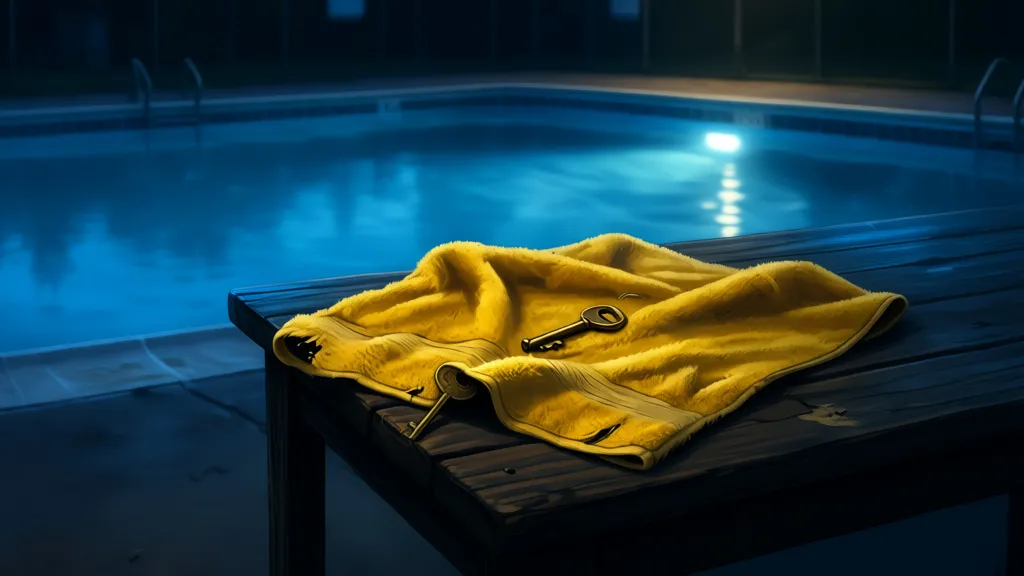
Aya Nakata shook out the last of the children’s towels over the lost-property table and heard something small and heavy strike wood.
It was not the sound of a coin. Coins skipped. This landed with a private certainty.
She unfolded the towel again. It was yellow once, though the pool and the dryers had argued with the colour. Near one corner, where a parent had mended a tear with blue thread, the hem looked thicker than the rest. Aya pressed it between finger and thumb. Something narrow and rigid sat in the lining.
She fetched the small scissors from the first-aid drawer and cut three careful stitches. A brass key slid into her palm.
It was warm from the dryers.
The key had no tag, only a stamped number: 47.
Aya looked at the towel, then at the key, then at the sheet of paper clipped to the lost-property board. One pair goggles, pink. One child’s towel, yellow. One left sandal, frog motif. Reopening week had filled the municipal pool with excitement, complaints, and damp objects with no future.
The yellow towel had been handed in after the children’s lesson at three-thirty by a mother in a sun visor who had said, with the clear relief of a person ceasing to care, “If anyone wants it, they may have it.”
Aya set the key on the table. It left a faint dark crescent where the brass had held heat.
The pool had reopened that morning after six weeks of repairs. The changing rooms smelled of fresh paint laid over old chlorine. The office door still stuck at the bottom. Half the regulars had come to inspect the work as if they were a committee of suspicious ducks.
Aya had spent the day blowing her whistle at boys who believed reopening meant the cancellation of gravity.
Now, with the late session ending and only the lane swimmers left, she took the key to the front desk.
Mizuki Sano, who sold tickets, counted the cash drawer with the air of a magistrate discovering society inadequate.
“A key from inside a towel,” Aya said.
Mizuki held out a hand. “How literary.”
“It was sewn into the hem.”
That made her look up. She turned the key over. “Locker?”
“Forty-seven.”
“The children’s changing room only goes to thirty-two.”
“The women’s side ends at fifty.”
Mizuki’s eyebrows rose. “A child carrying a women’s locker key inside a towel. That is either innocent or very annoying.”
“Most things are.”
Mizuki checked the rack behind the desk where spare keys hung on hooks with white plastic discs. There was no 47. Reopening had left the place only partly orderly. Several discs were blank. Two keys had no hooks. The labels had been rewritten in a hand that was not Mizuki’s and therefore offended her.
“Manager’s work,” she said, in confirmation of this insult. “He reissued the locker keys after the repairs. New barrels on some of them. Said he had a system.”
“Did he.”
“He always says that just before more work appears.”
Aya glanced toward the office. The manager, Koji Tanimura, had gone out at five with a folder under his arm and the distracted haste of a man whose life consisted of apologising in advance. He had not returned.
The public address system coughed politely and announced closing in ten minutes.
Aya said, “I’ll check 47 before someone claims not to know anything.”
“Take care. If a body appears, I am off duty.”
“There won’t be a body.”
Mizuki considered. “No. It would have been labelled.”
The women’s changing room was almost empty. A grandmother in a floral cap was still blow-drying her granddaughter’s hair with the thoroughness of a person preparing silk for export. Three lockers stood open. Four were padlocked with private locks. Aya passed them and stopped at 47.
It was locked.
The brass key turned easily. That, more than anything, suggested recent use. Pool lockers resisted all human plans on principle.
Inside lay a white envelope, warped from damp. On the front, in black marker, someone had written only one word.
Koji
Aya took it out. The paper was soft at the edges, and cold despite the warm key. Inside were receipts folded twice. They smelled faintly of chlorine and stronger of wet paper beginning to surrender.
She carried them to the bench under the mirror, where the light was better.
Most were from ordinary places within walking distance: a stationery shop, a convenience store, a pharmacy. Two were older than the rest, creased into habit. One was from a hardware supplier in town for brass hooks, replacement screws, and waterproof adhesive. Another, from four weeks earlier, was from the Suzuki Inn up on the mountain road: one night, one room, cash.
Aya knew the name. Everyone did, vaguely. People were always going up there to think or to avoid being thought about.
The important receipt was the newest. It was from a pawnshop near the station, dated the previous afternoon. The item was described simply as men’s wristwatch, silver, inscription inside case. Beneath that was the amount paid, and under the amount a signature in blue ink.
Not Koji.
Aya did not need to read the name twice. She had seen it on the emergency contact forms pinned in the office when the manager had updated staff records after reopening.
Haru Tanimura.
Koji’s younger brother had been missing for eleven days.
Not officially, exactly. Aya knew because small public workplaces ran on notices no one meant to spread. Koji had asked if anyone had seen Haru. He had asked the swimming instructors, the cleaner, the man who repaired the vending machines. He had done it lightly, in the way people asked while trying not to become the kind of person who asked. His brother was thirty-two, unreliable, and perfectly old enough to disappear for a while. That was the public version. The private one was visible in the manager’s tie, which had not been straight for a week.
Aya looked again at the envelope. Koji. Not Manager. Not Mr Tanimura.
A lane rope thudded against tile beyond the wall. Somebody laughed in the pool hall. The ordinary sounds made the receipts feel less ordinary.
She took the envelope and the key to the office.
Koji’s desk looked as if paper had attempted migration and failed. Maintenance invoices, rotas, complaint forms. On one corner sat a framed photograph turned half away under a stack of leaflets. Aya moved the leaflets enough to see two men on a riverbank with fishing rods and expressions of equal disbelief at the fish they were not catching. Koji, broader and tidier even in old jeans. Haru, younger by very little and by a great deal, grinning at something outside the frame.
Aya put the photograph back exactly where it had been.
The office kettle clicked. It had clearly boiled some time ago and been abandoned in righteous silence. Aya poured tea from the pot beside it out of instinct, drank it, and found it cold enough to be educational.
Then she sat down and spread the receipts in date order.
The stationery receipt included one padded envelope, one black marker, one packet of sewing needles. The pharmacy receipt listed antiseptic wipes and sticking plasters. The hardware receipt was in Haru’s name; the handwriting on the signature slanted hard to the left. Aya compared it to the pawnshop receipt. The same hand. The inn receipt was cash, no signature, but the date sat between them.
Someone had gathered these things, written Koji’s name on an envelope, hidden it in a locker, and concealed the key inside a child’s towel.
Not hidden well, perhaps. Hidden urgently.
Aya heard the office door open behind her.
“Give me that key,” a man said.
She turned.
Haru Tanimura stood in the doorway, breathing too quickly for a place with so much sitting water. He wore a denim jacket over a white shirt buttoned wrong at the collar. A bruise spread darkly across his left cheekbone, fresh enough that the edges had not decided on a colour. His hair was damp, though he had not come through the pool hall.
Aya stayed seated. “Good evening.”
Haru’s eyes went to the envelope, then the receipts on the desk, then to the key in her hand. His face changed by careful degrees into something easier.
“I’m Koji’s brother,” he said. “That’s mine.”
“It says Koji.”
“Yes. I left it for him.”
“In locker 47.”
He smiled, a little. “You’ve solved that much.”
Aya was fond of men who mistook a sentence for flirtation. They made things simple.
She said, “Why was the key sewn into a towel?”
He glanced down, as if the floor might offer a rehearsal. “I didn’t sew it in. A woman here did. One of the mothers. I asked her to keep it safe for an hour. She had one of those little travel sewing kits. Very efficient type.”
“Name?”
“I don’t know.”
“Description?”
“A woman with a child.”
Aya let that stand between them. It looked unhappy.
Haru touched his cheek as if he had forgotten it. “I came to explain to Koji. I was going to. Then I saw a police car outside the station and thought perhaps not yet.”
“There is no police car outside.”
“No,” he said. “Well.”
A lie told too fast often left part of itself exposed. This one had not even buttoned its shirt correctly.
Aya said, “Where has your brother been looking for you?”
“That sounds accusatory.”
“It was geographical.”
He gave a short laugh and winced from the bruise. “Everywhere, I expect.”
“You’ve been in town.”
“You have receipts.”
“I do.”
“And?”
“And one from the Suzuki Inn, one from a pawnshop, and one from a hardware supplier. You bought sewing needles. If I had to guess, I would say you were planning to hide something, changed your mind about where, and were interrupted.”
Haru looked at her properly then. His expression was not surprise. It was calculation yielding to relief, which was more interesting.
“You’re a lifeguard,” he said.
“Yes.”
“That seems unfair.”
Aya folded the receipts back into the envelope. “Sit down. If you ask for the key before the police do, I assume the police may presently have an opinion. I would like yours first.”
He did not sit at once. People who meant to run almost never did. He looked at the door, at the window above the filing cabinet, and at the cold tea on Koji’s desk with a private resentment, as if life kept offering him examples.
Then he sat.
Haru told the truth in the manner of a man who had already tried several other arrangements and found them drafty.
Not all at once. Aya had to sort it from the softer things he placed around it.
He had borrowed money, first from a friend, then from a man who was not a friend, then from another man who was much worse because he insisted on calling himself practical. The debts were not grand enough to be glamorous and not small enough to ignore. Haru sold things. A guitar, a camera, finally the silver watch their father had left Koji, because Koji had lent it to him last winter for a job interview and had not asked for it back. That had happened yesterday. The bruise had happened today, courtesy of practicality.
“You might have led with the watch,” Aya said.
“I am not at my best when being hit.”
“Few people are.”
He smiled despite himself. It altered his face toward the photograph on the desk.
The rest came by inches. He had not meant to vanish. He had gone to the Suzuki Inn because it was cheap in the off-season and because nobody in town asked if he had work yet. He had planned to tell Koji after he had sorted things. That phrase, repeated, did a good deal of labour while accomplishing none.
At the inn he had realised he had taken the wrong folder from Koji’s apartment when he grabbed his own papers in a hurry. It contained maintenance receipts and an old locker schedule from the pool, plus a sheet listing which lockers had been rebarrelled during repairs. Koji had been using the apartment in the daytime while Haru borrowed the sofa at night. Their lives overlapped like badly stacked plates.
“I came back this afternoon to return it,” Haru said. “Koji wasn’t in the office. I saw him leave with a man from the city works department. I didn’t want to stand at the desk and explain myself to whoever was there.”
“Mizuki,” Aya said.
“Then certainly not. She looks as if she keeps records in a second notebook.”
“She does.”
“That seems right.”
He had used the old locker sheet to choose one he thought would be free. Locker 47 had a new barrel and, according to the sheet, no assigned spare key yet entered on the desk list. He put the folder in an envelope for Koji and wrote the name. Then, while buying a padded envelope and marker at the stationery shop, he noticed two men across the street: one practical, one decorative. Decorative men were often more dangerous because they enjoyed composition.
“I thought they’d followed me from the pawnshop,” Haru said. “Maybe they had, maybe they hadn’t. I left the pool by the side entrance. One of them caught up with me by the bicycle racks.” He touched the bruise again. “I still had the locker key. I didn’t want them to know I’d left something for Koji. There were parents coming out with children. One woman was gathering towels, everything mixed up. I gave her five thousand yen and asked her to hide the key in a towel hem for half an hour and leave it in lost property. I said it was part of a birthday surprise. She thought that was strange, but apparently not strange enough.”
Aya considered the yellow towel, the blue mending thread, the exhausted mother who had been happy to lose it to fate.
“That part is true, then,” she said.
“Mostly. I did know what she looked like. She was wearing a visor with strawberries. I forgot because my face hurt.”
“And then?”
“I circled back. By then the towel was gone from the bench, and I had no desire to explain to the front desk that my key had entered domestic circulation. I waited outside. Then I saw Koji’s car still missing and decided to come in through the staff side.”
Aya looked at the envelope. “Why not simply call your brother?”
Haru looked at her in genuine surprise. “Because he would answer.”
It was a foolish answer and an honest one. Aya had seen enough families to recognise the shape. Some people avoided love chiefly because it was efficient.
“Why leave receipts?” she asked. “If you wanted to apologise, one note would have done.”
“That was the point.” He lowered his eyes. “I wanted him to know where the watch went. And where I’d been. If those men found me first, I thought... at least he would have a path.”
There was, Aya thought, a particular kind of person who prepared to be mourned tidily. They were exhausting, and often beloved.
A tap sounded at the office door. Neither of them had heard footsteps.
Koji stood there, still in his work jacket, a folder under one arm, rain darkening the shoulders. His gaze moved from Aya to Haru, then to the bruise, then to the envelope on the desk. The movement was so controlled that it revealed more than alarm would have.
“You found him,” he said to Aya.
“No,” she said. “Your locker did.”
Koji came in and shut the door. He did not look at his brother again until the latch clicked.
“Are the police involved?” Aya asked.
Koji took off his glasses and cleaned rain from them with a handkerchief that had given up on keeping things dry. “Not yet. I spoke to an old school friend at the koban. Informally.”
Haru gave a tiny, miserable nod, as if he had expected at least informality from the state.
Koji put the glasses back on. “What happened to your face?”
“A practical man.”
Koji closed his eyes once. It was not dramatic. It was a filing action.
Aya rose. “I’ll make tea,” she said, because the room required some third object and because, now that she thought of it, there was no reason to be useful in the correct way.
The tea came out too hot. This was a talent. She poured three cups and set them down. Koji and Haru ignored theirs while performing a conversation so old it had become polished in the hands.
The watch. The debt. The inn. The stupid secrecy. The older brother’s anger, which was less furious than precise. The younger brother’s contrition, which was genuine and therefore aggravating. Aya stood by the filing cabinet and drank her tea too soon. It burned her tongue efficiently.
When Koji asked, very quietly, “Did they threaten you, or me?” the room altered.
Haru answered after a moment. “Me first. Then you, if I kept being expensive.”
Koji nodded once. “Names.”
“I know one.”
“Good. You can tell the police before they become formal.”
Haru looked up. “Koji—”
“No.” The word was not loud. It did not need to be. “You do not get to disappear, sell Father’s watch, leave me an envelope in a pool locker, and then negotiate the arithmetic. We are past arithmetic.”
Aya saw then, very clearly, why the envelope had been addressed with a given name. Haru had wanted not authority, not rescue exactly, but the original version of his brother, the one from before debts and rotas and municipal forms. He had wanted to step sideways into childhood and be found there. It was a common wish. It had never worked.
Koji took his tea. It was too hot. He drank it anyway.
“Miss Nakata,” he said, with a politeness sharpened by exhaustion, “would you call my friend at the koban? And then perhaps the stationer on Midori Street tomorrow morning. If a woman in a strawberry visor complains that someone paid her absurdly to vandalise a towel, I would prefer to reimburse her before she writes to the mayor.”
“I’ll do both.”
Mizuki, Aya thought, would enjoy that call for years.
It ended, as such things did, in paperwork and chairs.
The police came. They were not excited. Municipal mysteries rarely rewarded excitement. Haru gave a statement, this time in the plain sequence of events and with only two visible attempts at embroidery. Koji made another statement, corrected dates from memory, and accepted the return of the envelope as if it were merely one more damp file. The receipts went into an evidence sleeve. The key, after a brief discussion, stayed on the desk until morning.
At some point Mizuki opened the office door, took in the arrangement of brothers, police, and cooling tea, and said only, “Ah,” before closing it again. Her restraint was the most eloquent thing she had done all week.
When everyone finally left, the building settled into its night noises: pipes ticking, filters humming, the shy slap of water against lane dividers. Aya sat alone on the bench by the pool with a fresh cup of tea from the vending machine. It was somehow both too sweet and not warm enough.
Through the glass she could see the changing room corridor, the row of lockers with their painted numbers. Forty-seven looked exactly like the others. That was the nature of useful hiding places. They asked for nothing but ordinary attention.
Behind her, someone had forgotten a child’s kickboard shaped like a dolphin. On the lost-property shelf in the office, no doubt, lay the yellow towel with its cut hem and blue thread, less innocent now by the smallest possible amount.
Koji’s father’s watch was gone. Even if the police found the men who had wanted payment arranged more theatrically, the watch might not return. Haru would have to stay somewhere tonight where doors could be locked from inside. Koji would have to decide whether to be a brother first or a manager first in the morning, and then discover that small institutions allowed very little room for either.
Aya drank the rest of the disappointing tea.
The pool water held the ceiling lights in long broken bars. Outside, beyond the municipal parking lot and the vending machines and the dark line of cedars, the town went on with its compact vanities and debts and affections. People hid things in hems, in lockers, in jokes, in the wrong order of buttons. Sometimes they even hid them in envelopes with the right name written plainly on the front.
Aya set the paper cup beside her and listened to the filters turn the water over, again and again, trying for clarity.