The Warm Keys
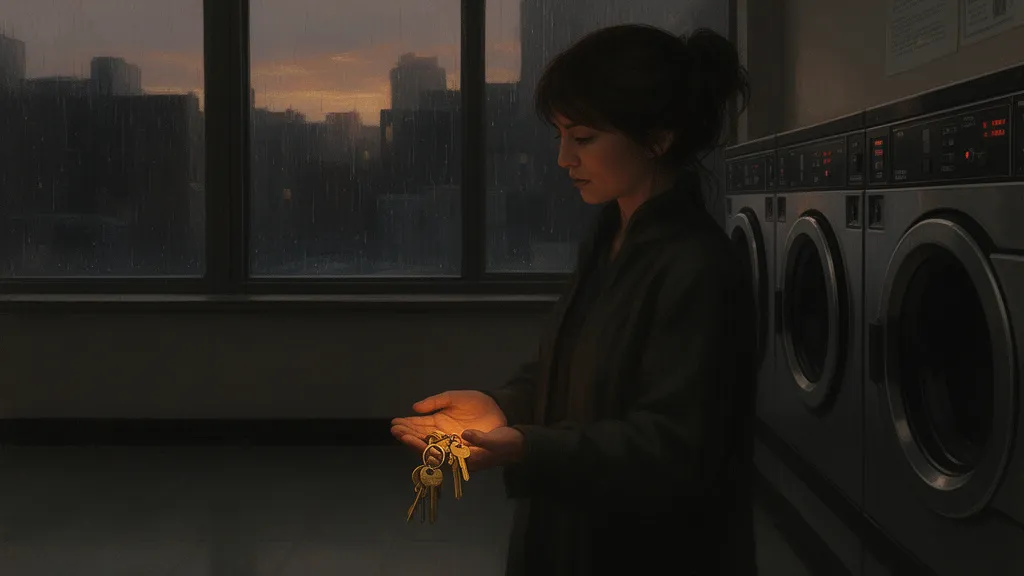
By four ten, the keys were hot enough to surprise her.
Matsuda Chiharu drew them out of the dryer’s coin slot with two fingers and then shifted them into her palm, where they clicked together with the small, intimate sound of objects that had spent a long time in pockets. There were six of them on a brass ring, one with a blue plastic cap, one old iron key mottled with rust, three ordinary apartment keys, and one very small silver key of the kind used for cabinets, diaries, and other places where people kept what they did not trust themselves to leave in plain sight.
The dryer itself hummed in the basement laundry room of Midori Heights, door rattling gently as if offended by the interruption. Someone had fed in coins and not fully turned the slot. The ring must have been pushed in after, then caught by the lip of the mechanism. The metal had sat there half inside the heat for at least a cycle.
Chiharu turned the handwritten sign on the machine from Out of Order to Temporarily More Out of Order, which was as accurate as she could make it, and looked at the ring again.
There was a white plastic tag on it. In neat blue ink: Mizuno, 4B.
She put the keys in the breast pocket of her work shirt and climbed from the basement with the wire basket of unsorted circulars under one arm. Midori Heights was six storeys of concrete optimism from the late seventies, now settled into a narrower ambition. It housed two retired teachers who were at war over balcony plants, a violinist who practised scales without conviction, three graduate students in a state of permanent domestic negotiation, and Mr. Handa in 2A, who believed all corridor bulbs failed because of moral decline.
At the first-floor mailbox wall, she stopped.
Each brass flap carried a black plastic name strip. 1A Saito. 1B vacant. 2A Handa. 2B Kuroda. 3A and 3B side by side, a married couple who no longer admitted the category and therefore received separate mail with admirable regularity.
4B was empty.
Not merely missing. The strip had been slid out entirely.
Chiharu set down the basket. She looked at 4A, at 5A and 5B above, and then again at the blank space. This was not impossible. Tenants left. Tenants forgot to notify anyone. Tenants believed names detached themselves naturally from buildings once rent ceased. But she had seen Mizuno Sanae on Tuesday evening carrying leeks and a florist’s paper-wrapped parcel up the stairs. Today was Friday.
The front entrance opened behind her with its usual heavy complaint.
Mizuno Sanae came in carrying a laundry bag against her hip. She was twenty-eight or twenty-nine, slight, with straight black hair cut exactly to the line of her jaw and a face composed with such care that the care itself became visible. She worked part-time at a flower shop near the station and smelled, often and unexpectedly, of damp stems. Today she smelled of soap and outside air.
“Ah,” Chiharu said. “Good. I was looking for you.”
Mizuno’s gaze went at once to the basket on the floor, then to Chiharu’s face, then nowhere at all. “Was there a problem with the rubbish schedule again?”
“Nothing so national.” Chiharu brought out the ring of keys.
For one second Mizuno did not move. Then she smiled with effort that was almost admirable. “Those are mine. I thought I’d lost them.”
“In the dryer’s coin slot?”
“I must have dropped them.”
“Into it,” Chiharu said.
Mizuno gave a small laugh, because one was expected. “Yes. Strange.”
People lied in different textures. Some lied with speed, hoping to pass before inspection. Some added details at once, like parsley over weak broth. Mizuno lied by making her face slightly too blank, as if expression itself might be evidence.
Chiharu handed her the ring but did not let go at once. “This little one,” she said, touching the silver key. “What is it for?”
Mizuno glanced down. “I don’t know. It was on there when I moved in.”
“That is interesting. Because the landlord gives me the key sets. There was no cabinet key on yours.”
The care in Mizuno’s face tightened by a single thread. “Then perhaps it’s old.”
“Perhaps. Shall we test it?”
“Test it?”
“In your medicine cabinet. Most of them in this building still have the original lock.”
Mizuno’s eyes flicked up too quickly. “My medicine cabinet doesn’t lock.”
“4B’s does.”
“I mean,” she said, “I’ve never used it.”
“Never entered the bathroom?”
Mizuno’s laugh this time had no life in it at all. “Obviously entered. I meant the cabinet.”
Chiharu let the ring go. “Of course.”
Mizuno closed her hand around the keys at once, so tightly the tag vanished inside her fist.
“There’s one more thing,” Chiharu said. “Your mailbox name is gone.”
Mizuno turned to the wall with such convincing surprise that for a second Chiharu almost respected it. “Gone?”
“You didn’t remove it?”
“No.”
“Has anyone been troubling you?”
Mizuno hesitated. The hesitation was genuine, which made it more useful. “No one,” she said, too softly.
Not no. No one.
“Very well,” Chiharu said. “If you remember how your keys entered machinery, you may tell me later. It would improve my opinion of appliances.”
Mizuno inclined her head. “Thank you.”
She moved toward the stairs, then changed her mind and crossed to the lift, though she disliked lifts and had once waited eight minutes rather than share one with Mr. Handa and his opinion on summer mould. The change was small. Chiharu noticed it anyway.
When the doors shut, Chiharu looked again at the blank mailbox slot.
Someone had removed the name carefully. No scratch marks. No hurry.
She replaced the circulars in the basket and carried them to the office beside the entrance, where the electric kettle sat under a calendar from a plumbing supplier. She poured tea into a cup. It was, by longstanding arrangement with the universe, too hot to drink.
By the time it had cooled into disappointment, curiosity had become work.
At five o’clock she took the duplicate cabinet key box from the office drawer.
There were twenty-four tiny labelled envelopes inside, most empty because small keys had lives of their own. 1A medicine, 1B meter, 2A cabinet, 2B gone, and so on. 4B’s envelope held nothing. That told her very little. Things disappeared from building offices by erosion, not event.
She locked the drawer again and carried a mop bucket to the fourth floor as camouflage. A superintendent who stood in a corridor listening looked suspicious. A superintendent with a bucket looked inevitable.
The corridor of the fourth floor was narrow and dim in the hour before the automatic lights thought evening serious enough to matter. 4A belonged to Professor Tobe, classics, divorced but still sharing umbrellas with his ex-wife, an arrangement Chiharu considered either mature or disastrous. 4B sat opposite the stairwell. Its doormat was plain coir. To the left of the door stood a ceramic pot with no plant in it, only dark soil and two snapped lily stems laid crosswise as if discarded in haste.
She knocked.
No answer.
She knocked again, then heard movement from 4A. Professor Tobe opened his door in a cardigan that gave up halfway through buttoning.
“Ms. Matsuda,” he said. “Has the hot water resigned?”
“Not yet. Have you seen Mizuno today?”
He thought. “Coming in around one. No, perhaps a quarter past. Carrying flowers.”
“She works at a florist.”
“Yes, but these were not arranged. Loose stems. Lilies, I think.” His face altered in the involuntary way faces did when lilies entered the mind. “Very forceful things.”
“Did anyone visit her?”
“A man at noon. Or just after. He rang once, then let himself in.”
“With a key?”
“I assume so. Unless 4B has become permissive.”
“Did you know him?”
Professor Tobe smiled faintly. “I know almost no one when they wear expressions like that. He was about forty. Office worker. One of those men who seem apologetic even while standing still.”
“Did he leave?”
“Yes. At...” He looked up into memory with the solemnity of scholarship. “Twelve twenty-seven, because I was burning garlic and saw him from the kitchen clock. He was carrying nothing.”
“Thank you.”
“Has something happened?”
“Not yet,” Chiharu said.
Tobe considered that. “That is a very superintendent answer.”
She left the bucket by the stairs and went down to the entrance hall. Above the mailboxes, mounted in an acrylic dome yellowed by age, the hallway camera looked toward the door. The feed reached only the landlord’s office across town and almost never helped anybody, but its existence improved behaviour in theory.
Now a rectangle of white paper had been taped neatly over the dome.
Chiharu stood on the lobby bench to peel it off.
It was not plain paper but the lower half of a florist’s receipt, folded twice. The tape had been pressed hard along the edges. She flattened the paper on her palm.
Shirota Flowers
Tue 3:18 PM
white lily stems x 5
cash
No name, but it hardly needed one. Mizuno worked at Shirota Flowers. Chiharu had seen the dark green paper sleeves often enough.
The tape was still slightly tacky. The receipt had not been there long.
She looked up at the camera again. If someone entering or leaving had wished not to be seen, they had either believed in cameras more than was warranted or known just enough to fear old machines irrationally.
She put the receipt in her pocket and went back upstairs.
This time she heard something before she reached the fourth floor. Not movement. Water.
A faint, intermittent sound, like someone whispering against tile.
At the top of the stairs, a thin line was working its way from under 4B’s door and along the corridor grout. Clean water, not grey. It had reached the foot of the opposite wall and begun, with determination out of all proportion to its volume, to turn toward Professor Tobe’s umbrella stand.
Chiharu set down the bucket and knocked hard. “Ms. Mizuno.”
Nothing.
She bent and touched the water with her fingertips. Lukewarm.
The chain of decisions was very short. Call the police, call the landlord, fetch the emergency master key, wait, explain, apologise, perhaps find an overfilled tub and an irritated tenant. Or open at once under the building’s emergency clause and discover whether the unpleasantness had shape.
She disliked telephoning before she understood what she was telephoning about.
From inside 4A, Professor Tobe opened his door again, sniffed, and said, “Oh dear.”
“Please stay here,” Chiharu said.
“Certainly not. I have dry towels.”
“That is exactly why you should stay here.”
She went down one flight at speed that made the kettle tea in her stomach feel morally opposed, unlocked the office, took the emergency ring from its nailed box, and returned. The fourth-floor corridor now smelled distinctly of lilies.
Not from the stems in the pot, she thought. Fresher. Newly cut, newly broken.
The master key opened the lower lock. The upper one was dead-bolted from inside.
Professor Tobe, hovering with towels in his arms like a nervous stage ghost, said, “Can one do something with a card?”
“With films, yes. With this building, no.”
She examined the gap. The old doors in Midori Heights were not well-fitted; light showed around the frame. The chain was not in place. Only the dead bolt. That was useful.
“Stand back,” she said.
Professor Tobe blinked. “I am forty-nine and teach Greek verbs. I have been standing back for years.”
She hit the door beside the lock with the flat of her shoulder once, twice. The frame groaned with a complaint older than either of them. On the third blow the bolt plate tore from soft wood and the door opened six inches against pooled water.
The smell came out first: lilies, bath soap, and the sharp bitter trace of spirits.
Then the apartment itself.
The entry was neat. Shoes aligned. An umbrella stand empty. On the kitchen counter sat a florist’s bucket with three lily stems stripped of leaves. Water spread from the bathroom down the hall in a bright sheet.
“Mizuno?” Chiharu said.
No answer.
The bathroom door stood open.
Mizuno Sanae lay half in and half out of the bathtub, one arm hanging over the side so that her fingers touched the tile. The tub faucet ran in a narrow steady stream. Water had risen to the lip and escaped only recently; the floor nearest the threshold was glossy, but the bathmat beyond it had not yet fully darkened. Her clothes were damp at the shoulder and sleeve where they had taken the first overflow. Her face was turned away.
Chiharu crossed the room, shut off the tap, and touched the wrist. Warm still, though slack. On the sink beside an uncorked half-bottle of white wine stood a tumbler with cloudy liquid in the bottom and a faint undissolved crescent of white clinging to the glass.
Behind her, Professor Tobe made a small sound and then, to his credit, stopped making any others.
On the wall above the sink, the medicine cabinet door stood open.
Its tiny lock was turned.
Inside were not medicines but bundles of letters tied with florist’s twine, a bankbook, and a shallow dish containing two apartment mailbox name strips: Mizuno, 4B and beneath it, older, Okabe, 4B.
The dish also held a folded note, weighted by a lipstick tube.
Chiharu read the first line only.
I did not know where else to put your name.
She folded it closed.
“Now,” she said quietly, “we call the police.”
The police came by six ten and improved the corridor with shoes, forms, and a degree of official excitement the building had not enjoyed in years.
Sergeant Nishimura was a broad man with a moustache carefully too modest for his face. He had the patient expression of someone who had discovered long ago that almost everybody lied, and had forgiven them in advance for the effort. Chiharu liked him at once, which was inconvenient in a policeman.
He heard her account in the office while an officer upstairs spoke with Professor Tobe and another attempted to keep Mr. Handa from becoming part of the investigation through sheer determination.
“The note?” Nishimura asked.
“In the cabinet. I did not finish reading it.”
“Why not?”
“It seemed either private or evidence. Possibly both. I find the distinction safer when made by others.”
He nodded. “You mentioned a man seen entering at noon.”
“By Professor Tobe. Grey coat, key, left at twelve twenty-seven.”
“Ms. Mizuno was alive after that?”
“I spoke with her at approximately four fifteen.”
Nishimura’s eyebrows rose. “Alive, then.”
“And lying, which is not the same thing.”
“What did she lie about?”
Chiharu set the florist’s receipt on the desk. Then the blank plastic mailbox slot she had found in the rubbish under the bench when she had gone to fetch the emergency ring; she had thought to bring it down. Then she described the keys in the dryer coin slot, still warm, and the small silver one.
“She said she had never entered the medicine cabinet?” Nishimura said.
“She said she had never used it, then corrected herself badly.”
“And the ring had a key to it.”
“Yes.”
Nishimura looked at the receipt. “If this is suicide, it has tidied after itself strangely.”
“People often do.”
“Not usually with camera lenses.”
He tapped the paper once. “Who else had keys to 4B?”
“Landlord. Me, emergency set. If there was another, it was unofficial.”
“And Okabe?”
“The prior tenant. Left eight months ago. Officially transferred to Sapporo. Unofficially transferred without paying two weeks’ rent.”
“Male?”
“Female. Okabe Yui. Thirty-six. Piano teacher with two identical raincoats and a taste for men unsuited to either money or truth.”
Nishimura looked up. “You know that last part?”
“I know the rent part. The rest was corridor acoustics.”
He smiled despite himself.
An hour later he sent for her again, this time to 4B itself. The body had been removed. The apartment had the stunned vacancy rooms acquired as soon as they ceased belonging to one person and became interesting to many.
On the low table in the main room lay the contents of the cabinet, now spread under a lamp: letters, bankbook, note, mailbox strips. The letters were in two hands. One narrow and slanted, likely Mizuno’s. The other rounder, impatient, perhaps Okabe’s. Chiharu did not need to read them all to see that they were not about business.
Nishimura stood by the table. “The note is not a suicide note,” he said. “It is addressed to Okabe Yui. Ms. Mizuno writes that she found the letters after moving in, hidden in the medicine cabinet behind a false back panel. She kept them. She says she should have thrown them away, but could not. She says a man came today asking for them.”
“The noon visitor.”
“Yes. She does not name him. She says he had loved Okabe badly and was now standing in the apartment where she had once lived, asking for proof that she had loved him at all.”
“That sounds like a man.”
Nishimura gave her a level look. “It sounds like several.”
He indicated the open cabinet. Behind the shelf, a thin board had indeed been lifted away from a recess in the wall. “This was where the letters were hidden. The cabinet key opens only the outer lock. Not the panel. The panel slides by pressure here.”
“So the key’s importance was not what it opened,” Chiharu said. “Only what it connected.”
Nishimura waited.
“She had put the key on her ring because it belonged to the cabinet where she found the letters. Not because she used the lock daily. A souvenir, almost. Or a warning. And when I asked, she panicked because she knew it tied her to the hidden compartment if anyone looked further.”
“Very possible.”
“Did the man take anything?”
“No letters. They are all here. Some cash is missing from a kitchen envelope, but not enough to matter except morally. There are bruises on her arm. Medical examiner says the wine contained crushed sleeping tablets, enough to incapacitate quickly on an empty stomach. Not instant death; collapse first, then drowning. She likely drank it not long before you found her. The water overflowed only after she was already unconscious.”
“What time?”
“Between four forty-five and five. That part, at least, fits your corridor.”
Chiharu looked toward the bathroom. There, among rinsed cups and florist twine, stood the half-bottle of wine and the cloudy tumbler now bagged for evidence.
“Self-administered?” she asked.
“For now, perhaps. But there are difficulties.”
He pointed to the table again, not at the note but at the mailbox strips.
“She removed her own name,” he said. “And kept the old tenant’s name. Why?”
“To make 4B belong to no one,” Chiharu said after a moment. “Or to the wrong person.”
“Go on.”
“She expected someone else. Not the noon man. Someone later. Someone who would check the mailboxes.”
Nishimura’s moustache considered this. “And the camera?”
“To let that person come unseen.”
“Or to hide her own actions.”
“Yes. But if she intended to die privately, why cover the camera after speaking with me? Why not before? She had only become afraid then.”
Nishimura said nothing.
Chiharu looked again around the room. The lilies in the bucket. Three stems only. The receipt said five. Two broken stems outside in the ceramic pot. That made five exactly, which was the trouble: all five had been accounted for, yet the smell in the corridor when she returned had been stronger than five stems, and fresher than the three standing stripped in the kitchen bucket. On the drainer sat a florist’s knife, wiped but not perfectly; green streak at the hinge. A second cup in the sink. On the shoe shelf by the door, one wet footprint on the tile beyond the lined-up slippers, larger than Mizuno’s.
No leap. Only objects.
“She had a visitor after I saw her,” Chiharu said.
“We think so.”
“Not the noon man. Another one she expected enough to hide the camera for.”
Nishimura nodded once. “A neighbour has now remembered hearing voices around five. One woman, one man. No shouting.”
“Did Mizuno and Okabe live together?”
“No record of it.”