The Warm Locker
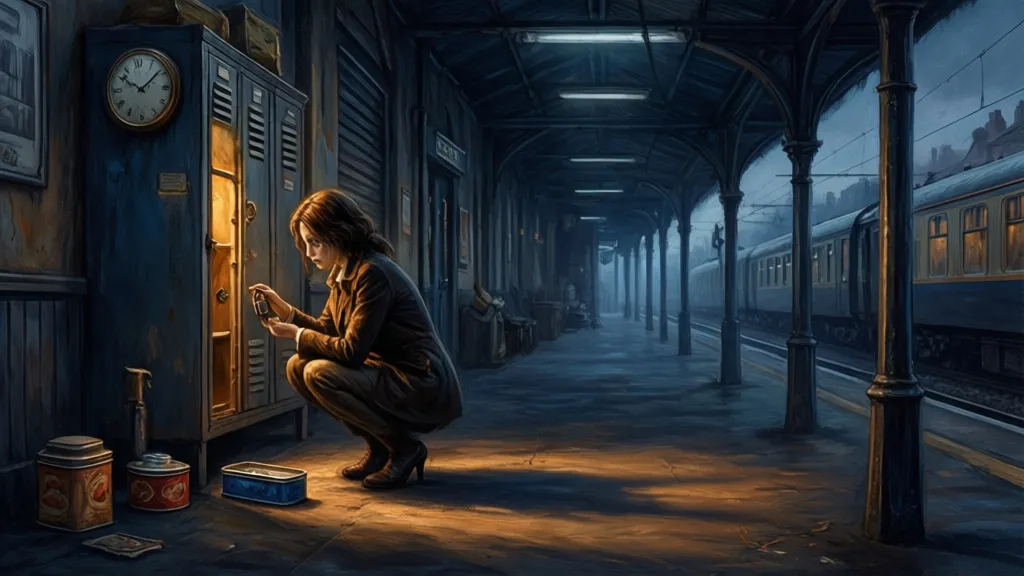
At six eighteen, Hoshino Rei was putting away her pick set when Station Clerk Murata came into the service corridor with the expression of a man who had already explained himself too many times and had not been believed once.
"You are still here," he said, as if this were a personal kindness done to him.
Rei looked at the wall clock, then at the small tin of cold tea beside her toolbox. She had been called in that afternoon to replace a bent latch in the women’s waiting room. The tea had been brought by a porter with apologetic ceremony at four and had not improved since. She drank it anyway.
"Barely," she said. "What is it?"
Murata took off his cap, put it on again, and said, "Locker 47. The key will not turn. The owner filed a claim this morning that he had misplaced it. He was to come before five. He did not come. I should leave it until tomorrow, but now I would rather not."
"Rather not" covered a great deal. Murata was a careful man. He disliked unfinished things in the station the way some men disliked loose teeth.
Rei shut her toolbox. "Is there a reason?"
He hesitated. "There is a reason for everything. Come and see it."
The station had passed through the last commuter rush and was settling into its evening shape. The ticket hall was no longer crowded, but it was not yet empty. Voices travelled farther. Shoe leather clicked. Somewhere a child cried because a sweet had been denied. Beyond the barriers, the rails held a thin metallic light.
The coin lockers stood in a row beside the left luggage office, thirty on top, thirty below, painted a green that had once intended cheerfulness. Number 47 was a lower locker. A paper claim slip had been pasted beside it in Murata’s neat hand.
"The owner is Fujisawa Kenji," Murata said. "Three-day rental. Began Monday morning. Due to expire tomorrow. He reported the key missing through his office, not in person. Said he would collect the contents before departure."
"Departure?"
Murata made a small face. "Officially, he left town three days earlier. That is the reason."
He led her into the office and pulled out the ledger. Murata loved records with the embarrassed devotion some people reserved for music. The entry was exact: Locker 47. Fujisawa Kenji. Address in Nakanomachi. Receipt signed. Monday, 10:12 a.m. There was also a note from the stationmaster, added in another hand: Mr Fujisawa boarded the 2:40 express to Sendai on Tuesday. Seen off by colleagues.
"And after that?" Rei asked.
"Nothing. But at eleven this morning, his office boy came with a message. Mr Fujisawa had mislaid the key and would retrieve the luggage this evening after business. Then no one came." Murata’s mouth tightened. "At five-thirty I telephoned the office. They said Mr Fujisawa is away on assignment and has been since Tuesday. They know nothing about any locker."
"And no one else has access."
"Quite so. The duplicate keys are sealed. I checked. No seal broken, no record of opening." He lowered his voice, although there was no one in the room to overhear. "And yet someone has been at this locker. I am not a novelist, Ms Hoshino. I only have facts. But I do not care for facts that begin to arrange themselves into nonsense."
Rei nodded. She did locksmith work for half the businesses around the station and had observed that nonsense was merely a practical problem in a dramatic hat.
"Stand aside," she said.
She knelt before Locker 47. The lock was not damaged. The keyway was smooth, with a scratch near the lower ward. Not old. Today, perhaps. She worked a tension tool in with one hand and a pick in the other. A cheap locker lock usually gave up from vanity rather than force. This one resisted for half a minute, then clicked with the relief of a man who had wanted to confess for some time.
Murata exhaled through his nose.
Rei opened the door.
Inside lay a dark wool coat folded once, not carefully but quickly. On top of it sat a glass preserving jar with a screw lid, three-quarters full of matchsticks. In the corner was a paper ticket folded into a square no larger than a coin.
The first thing Rei noticed was not the objects. It was the heat.
A soft warmth came out of the locker, faint but distinct, carrying the smell of wool, stale tobacco, and air recently breathed. She put the back of her fingers to the coat collar. It was still warm.
Murata said, after a moment, "That is impossible in a way I dislike very much."
Rei touched the locker walls. Metal, cool. Not heated by the room. She lifted the coat. It was a man’s, good quality, charcoal, with rain darkening still not wholly gone at the shoulders. The inside pocket held nothing. The lining at the collar was warmest.
She set it over her arm and picked up the folded paper. Murata leaned in. It was not a rail ticket but a baggage check from the parcel office at the north exit, issued that afternoon at 5:56 p.m., for one item, payable on collection.
"There," Murata said. "This afternoon."
Rei looked at the station clock through the office window. Six twenty-two.
"What is in the parcel office now?" she asked.
Murata had already moved. They crossed the hall at a pace just short of running, dignity preserved only because Murata wore it like a second uniform. The north parcel office was staffed by a young woman with a fringe cut too bluntly to be accidental.
Murata showed the check. "The corresponding parcel. Quickly."
She looked up the number and brought out a long paper-wrapped package tied with string. It was the size of an umbrella or rolled picture, too light for either.
"Who deposited this?" Rei asked.
The young woman considered. "A man. Brown hat. Ordinary face. If you ask me to improve upon that, I cannot."
"At five fifty-six?"
"Yes. He was in a hurry, but everyone is in a hurry after six."
Rei took the package. It gave slightly in the middle.
"Open it?" Murata asked.
"Not yet." She looked again at the baggage check, then at the coat, then at the jar of matches in Murata’s hand. The station sounds seemed to sharpen around her, as if the building had become attentive.
"When is the next train?"
"The six-thirty-four local."
Twelve minutes.
Murata said, "If this is theft, there are procedures."
"If it is not theft, what is it?"
He opened his mouth, shut it, and seemed to dislike all available answers.
They returned to the office. Rei spread the objects on the desk as if arranging a lesson. Coat. Folded check. Jar of matchsticks. Parcel. Murata hovered. The young parcel clerk had followed them as far as the door and now remained there, unwilling to intrude and more unwilling to leave.
Rei unscrewed the glass jar. It smelled of sulfur and tobacco. The matchsticks were all ordinary wooden safety matches, except that several near the middle had blackened tips but no burned shafts, as if struck and immediately shaken out. At the bottom of the jar was a little grey ash.
Murata said, "Why keep used matches in a jar?"
"To stop the smell escaping," Rei said. "Or to stop something else escaping."
She held the jar near the coat collar and then near the sleeves. The smell matched at the collar, less so elsewhere. Someone had held the open jar close to the wearer’s neck.
She unfolded the coat fully. There, on the left cuff, was a faint smear of something white. Chalk? Flour? No. She rubbed it. The grains were fine and slightly waxy.
"Platform marking chalk?" Murata suggested.
"Soap." She looked up. "Lavatory soap, perhaps. Or hand soap from a washbasin."
The parcel was tied with station twine in a simple bow. Rei undid it and peeled back the paper. Inside was a cardboard tube used for carrying architectural plans. Empty.
Murata stared. "Now that," he said, "is merely offensive."
Rei smiled despite herself. It vanished almost at once.
An empty tube. A baggage check placed in the locker. A warm coat. A jar of matches. A man officially gone from town before any of it should have happened.
And twelve minutes becoming ten.
Rei asked Murata for the ownership record again. Fujisawa Kenji, thirty-eight, assistant accountant at Hasebe Shipping. Nakanomachi address. She knew the district: narrow houses, practical wives, clerks who apologised to potted plants when brushing past them.
"Who saw him leave on Tuesday?" she asked.
"His office, apparently. They walked him to the platform. The stationmaster remembers him, because one of the colleagues made a speech inappropriate to the setting."
"Did anyone see him on the train?"
Murata considered this. "The stationmaster saw him board. After that, no. We are not in the habit of following passengers to Sendai to confirm their honesty."
"Quite right. What office boy brought the message?"
"No office boy came in person. A telephone message. The porter wrote it down. I was careless in summary, not in fact."
That mattered. A message by telephone was only a voice and confidence.
Rei looked at the warm coat again. Warm at the collar. If a coat had merely been in a warm room, it would keep heat more generally. If worn, the collar held body heat longest. Someone had worn this coat very recently, then taken it off and put it into Locker 47.
But if no duplicate key had been used, then someone had either had the original key or opened the locker otherwise. She examined the scratch in the keyway again in memory. Awkwardly made. Not by an experienced locksmith. A quick amateur opening, perhaps with a filed bit of metal. Enough to open once, not elegantly.
"Who knew the locker belonged to Fujisawa?" she asked.
Murata spread his hands. "Anyone who saw him rent it. Anyone who looked over my shoulder in a regrettable spirit. Why?"
"Because the owner may be irrelevant. The locker may have been chosen because it was already occupied on paper. If a missing key were reported later, confusion would do the rest."
Murata gave her a look that acknowledged both the usefulness and the bad manners of this thought.
From the hall came the first bell for the six-thirty-four.
The young parcel clerk at the door said, "Excuse me. There is a woman asking whether she may collect the tube she checked in."
Murata said, "There is no tube."
"Quite," the young woman said. "Still, she is asking."
Rei turned. "A woman?"
"Tall. Blue scarf. Very calm. Which is suspicious in a railway station."
"Keep her there," Murata said.
Rei was already moving.
The woman stood at the parcel counter with one gloved hand on the wood. She was perhaps thirty, perhaps younger; good skin could lie. Her blue scarf was expensive enough to suggest either money or very particular taste. She looked toward them without surprise, then at the open paper wrapping under Rei’s arm, and her eyes changed almost invisibly.
Not alarm. Calculation.
"You have opened property that is not yours," she said.
"It was empty," Murata said. "A disappointment to us all."
"Then I have wasted a journey."
"Have you?" Rei asked. "Who gave you the claim check?"
The woman held out her hand. "Since the parcel is gone, I suppose I may have the check back."
There were people close enough now to notice that something was occurring. The woman noticed them too. Her expression did not alter, but she withdrew the hand.
"My brother asked me to collect it," she said. "He has already left town."
"Fujisawa Kenji?"
A pause too slight for most people.
"Yes."
"You are not Fujisawa’s sister," Rei said.
The woman’s mouth turned at one corner. It was not a smile. "Families are various."
"Indeed. Where is your brother now?"
"On business. If you wish to be rude, at least be efficient."
Murata said, dry as paper, "Madam, efficiency is the one comfort left to us."
The second bell rang.
The woman glanced—not toward the exit, but toward Platform Two.
That was enough.
Rei said, "Murata-san, ask someone to watch Platform Two and stop anyone carrying a plan tube, umbrella case, or rolled parcel from boarding the six-thirty-four. Especially a man in a brown hat with an ordinary face."
Murata did not ask for proof. This was why she liked him. He snapped an order to a porter, who ran.
The woman in the blue scarf gave a short laugh. It had no mirth in it. "You are late," she said.
"Perhaps," Rei said. "But not by much."
She stepped closer. The woman smelled faintly of the same sulfur-and-tobacco mix as the coat collar, though overlaid with perfume. Not a smoker, then. Someone who had stood close to the jar.
"The coat in the locker was a decoy," Rei said. "Something recently worn, to make us think a man had been there. The baggage check in the locker sent us to the parcel office. The parcel in the parcel office was empty, because the real object had already been moved elsewhere. The person who deposited the empty tube needed us looking in the wrong direction while another person carried the real one to the train."
The woman said nothing.
"The warm collar was too deliberate," Rei went on. "You warmed it with the jar of just-struck matches. That is why there is ash in the jar and sulfur on the cloth. Body heat smells one way. Match heat smells another. You tried to imitate one with the other. It would have passed, if not for the collar being warmer than the rest. A recently worn coat keeps heat in the shoulders too."
Murata returned, not out of breath but only because pride was holding his lungs in place. Behind him came the porter and, between them, a small man in a brown hat carrying an actual cardboard tube under his arm. He looked exactly like someone the eye would forget from politeness.
The woman shut her eyes once.
The porter said, with satisfaction, "He was boarding."
Murata took the tube. This one had weight. He removed the cap. Inside were rolled documents tied with red tape.
He looked at the outside label first, then at the woman, then at the little man. "Hasebe Shipping accounts," he said. "Private ledgers."
The little man spoke for the first time. "I was only carrying it. She said it was hers."
"And people always say true things on platforms," Murata said.
Rei looked at the woman. "Fujisawa did not leave on Tuesday, did he? He boarded the express where his colleagues could see him, then got off before departure from the far-side door while they were still bowing and congratulating themselves. Someone else carried his bag onward to be noticed. Your office likes ceremony; it does not like detail."
The woman’s composure held, but only with effort now. "That is inventive."
"Not especially. He needed to remain in town without Hasebe Shipping knowing. He had access to the private ledgers. You needed those ledgers removed before an audit or a scandal reached the wrong desk. He used the station because a railway station is the best place in the world to hide movement: everyone is carrying something, everyone is leaving, everyone is expected elsewhere."
The little man had gone pale. Murata noticed and filed it somewhere in his mind.
Rei continued, "Locker 47 belonged to Fujisawa. Convenient. But the key was missing because Fujisawa had it. Or had it until today. You could not use the duplicate without leaving a record, so someone opened the locker crudely, left the coat, jar, and check, and locked it again with a skeleton piece. You meant the station to discover it after the train had gone, or not until morning. By then the real tube would be far away."
"And Fujisawa?" Murata asked quietly.
That was the point at which the woman’s face altered altogether. Some women cried beautifully; she did not. She merely became tired.
"At the Suzuki Inn," she said.
Murata blinked. "The mountain ryokan?"
"Do not look at me as if that were absurd. He needed somewhere no one from the office would think to search. He has been there since Tuesday. He was going to take the ledgers tonight and go on to Morioka. He lost his nerve. So I arranged the transfer instead."
"Why?" Rei asked.
The woman looked at the tube in Murata’s hands. "Because if those books are opened in the proper way, the wrong man is ruined and the right one merely retires." Her voice remained level. "Fujisawa altered entries for years under instruction. Everyone who gave the instructions has a wife, or a seat on a board, or a son at university. Fujisawa has a furnished room and gastritis."
Murata said, "You are very sympathetic to him."
She turned to him. "I have known him since we were nineteen. You may arrange that relation under whatever heading suits your forms."
Murata, who loved forms but did not worship them, said nothing.
The third bell rang. The six-thirty-four began to take passengers with that air of mild impatience trains always had, as if human feeling were an avoidable delay.
In the stationmaster’s room, with the tube on the table and statements beginning to grow like weeds, the explanation became smaller and clearer.
Fujisawa had pretended to leave town on Tuesday, disembarking unseen before the express departed. He hid at the Suzuki Inn while deciding whether to expose his superiors with the ledgers he had copied from the office. The woman in the blue scarf, whose name was Maki Shizue and who was not his sister, had been helping him. Today, fearing he would lose courage, she arranged to send the copied ledgers to a journalist in Morioka by trusted hand.
The station locker was meant as a relay point. A confederate would open it, leave a decoy coat warmed by a jar of recently struck matches, and a parcel check to draw attention toward an empty tube. Meanwhile the real tube, identical in appearance, would be carried separately onto the six-thirty-four by the little man in the brown hat, a messenger too incurious to be dangerous.
It was tidy enough to please a criminal of administrative temperament. Only the warm collar had been overdone. People imitating reality generally were.
Murata listened to the whole account with the patience of a man hearing floorboards creak and identifying which member of the household had caused it.
When Shizue finished, he said, "So the station was to become an accomplice through confusion. I dislike that almost as much as nonsense."
She inclined her head. "I am sorry for the inconvenience."
"Madam," Murata said, "that word has become inadequate."
Rei accepted another cup of tea from the stationmaster’s wife, who had materialised in the manner of all wives attached to public institutions: silently, at the point of greatest need, and with excellent disapproval. The tea was scalding. Rei burned her tongue at once and continued drinking.
No one remarked on it. Everyone had larger discomforts.
There would be police, naturally. There would be Hasebe Shipping, and statements, and a train sent on without one paper tube that had expected to travel. Whether the ledgers would save Fujisawa or bury him more neatly was not a question for locksmiths. Nor, strictly, for station clerks. But both had become involved in the way respectable people often did: by wanting a thing on the premises to make sense.
Later, when the room had thinned and the sounds of official procedure moved to another part of the station, Murata sat opposite Rei at the narrow table.
"You knew about the collar before the rest," he said.
"Only that it was wrong."
"That is most of knowledge." He looked at his hands. "Do you think the man meant to expose them? Or only to frighten them into kindness?"
Rei considered. Through the window she could see Platform Two almost empty now, rails shining under lamps. A porter was wheeling away a trolley with the solemnity of a funeral.
"Both, perhaps," she said. "People rarely separate justice from the hope of being spared by it."
Murata accepted this.
On the table lay the wool coat, cooling at last into mere cloth. It had been chosen carefully: respectable, forgettable, the sort of coat any office man might own. For ten minutes it had stood in place of a body, and nearly in place of a decision.
Now it was only evidence.
Rei set down her cup before it could scald her again. Somewhere in the station, a whistle blew, faint and final.
Fujisawa would be brought down from the mountains. Shizue would go with the police. The little man in the brown hat would protest his innocence until he began to suspect it himself. Hasebe Shipping would deny everything while preparing to sacrifice someone very carefully chosen.
The train had left without the package it was meant to carry. That was all. Yet something had gone all the same.
The possibility, perhaps, that any of them might leave