The Warm Rice Bowl
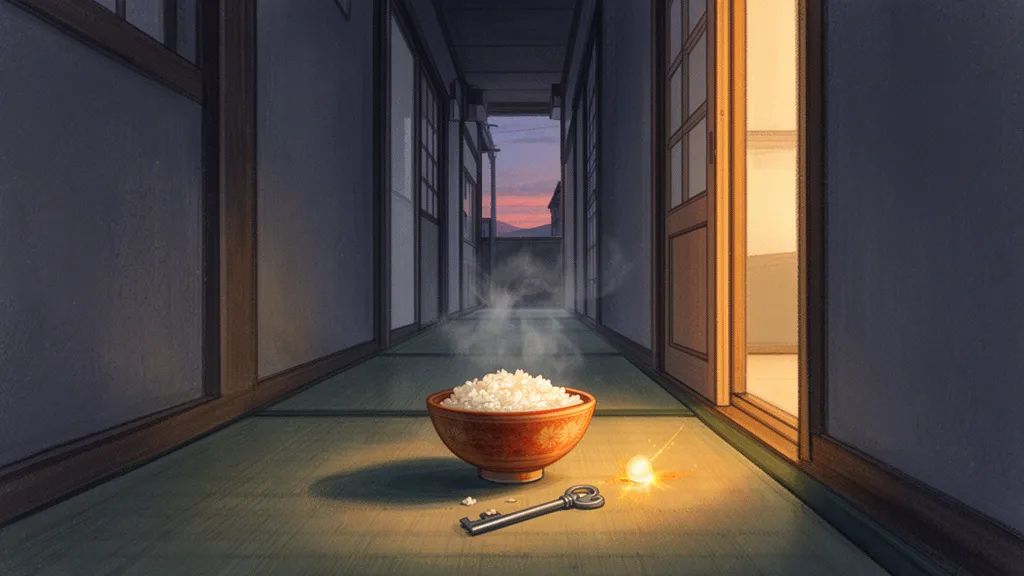
At seven twelve, while the corridor still held the day’s heat like a grudge, Morita Eri found the key under a warm rice bowl.
She had gone up to 3B because Mrs. Nakase from 2A had complained, with her usual sense of civic drama, that something had been dripping from the balcony above onto her basil. Eri had expected an overturned planter, or a damp towel, or the sort of small domestic negligence that formed the true architecture of apartment management. Instead she found a ceramic bowl on the floor outside 3B, set neatly beside the door as if placed there for a cat. It was upside down. Steam no longer rose from it, but when she lifted it, the glaze was still faintly warm against her palm.
A key had been taped beneath it.
Not a spare key in an envelope, not a note asking forgiveness. Just the brass key, fixed there with two strips of transparent tape. On the masking tape label tied through its head, in careful block letters, was written:
3B
Eri stood for a moment, bowl in one hand, key in the other, and looked at the shut door.
The tenant of 3B, Aizawa Riku, had been missing since morning.
Missing was the word the police had used when she called at noon, after his sister telephoned from Saitama to ask why he had not come to meet their mother at a clinic appointment. Routine disappearance, the officer had said. Adult male, thirty-four, lives alone, no sign of struggle, perhaps he had gone away for the day. The room had been locked then. Eri had checked because she had a manager’s passkey and knew what neighbors were like. The chain had not been on, but the lock had turned against her key as if another key already sat inside.
Now the only key, apparently, had been waiting under a dinner bowl.
She set the bowl down again with more care than it deserved.
From the stairwell drifted the clatter of slippers and the carrying voice of Mr. Tsuchiya from 1C, who conducted all ordinary remarks as if addressing the back row of a school hall. Soon people would be returning. By eight, they would notice Eri on the third floor and come to see why. By nine, someone would suggest burglary. By ten, someone would suggest murder. Small apartment blocks were closed communities only in the sense that steamers were closed; pressure built quickly.
She crouched and examined the lock. Old cylinder, replaced ten years ago after a break-in at 2B. Standard enough, except that the building’s original carpenter, now dead and still missed chiefly by doors, had been fond of filing things to fit his own ideas. Some of the old storage closets could be opened by keys that had no business opening them. Eri knew this because she had inherited the building’s ring, and with it several decades of poor decisions.
She inserted the labeled key into 3B.
It went in cleanly.
Before she turned it, a voice behind her said, “If you open that alone, they’ll say you arranged the scene.”
Eri stood. On the landing below was Kurobe Sachi from 2C, carrying a mesh bag of laundry and looking up with the calm interest of a woman who taught part-time ethics at a cram school and never wasted a chance to observe people violating it.
“They will say that anyway,” Eri said.
“That is true.” Sachi came up the last steps. Her hair, cut bluntly at the jaw, clung damply to her neck. “But if you wait much longer, they’ll gather. Then whatever is inside becomes public property.”
Eri looked at the door again. She disliked crowds and explanations. She disliked, even more, explanations delivered to crowds. “I called the police already. They told me not to make this difficult.”
“A practical philosophy.” Sachi shifted the laundry bag to her other hand. “What is the bowl?”
Eri showed her.
Sachi touched the ceramic lightly. “Still warm.”
“Yes.”
“And he has been gone since morning.”
“Yes.”
Sachi’s brows moved, a very small acknowledgment that the facts had begun to object to one another.
A door opened below. Mrs. Nakase called up, “Manager Morita? Is it the basil murderer?”
“No,” Eri said.
“That’s exactly what one says before it is murder,” Mrs. Nakase replied, with some satisfaction.
Eri closed her eyes for a second. “I’m opening 3B,” she said quietly to Sachi. “If there is anyone inside, I would prefer to meet them before Mrs. Nakase does.”
She turned the key.
The lock clicked. The door opened inward three centimeters and stopped against the chain.
For the first time that evening, Eri felt something cold move through the heat.
The chain was on.
Mrs. Nakase had reached the second-floor landing by then, wearing gardening gloves and an expression of almost festive alarm. Behind her came Mr. Tsuchiya in his undershirt, and behind him little Kana from 1A because children always arrived exactly where adults did not want them.
“Stay there,” Eri said.
She bent and peered through the gap. The genkan was dark except for the corridor light falling across one shoe, a folded umbrella, and a white plastic grocery bag. There was no foot visible, no body, no movement. A faint sour smell hung inside: old miso, laundry not dried properly, and under it something metallic enough to trouble her.
“Can you see him?” Sachi asked.
“No.”
“Then perhaps,” said Mrs. Nakase helpfully, “he has dissolved.”
Mr. Tsuchiya muttered, “Don’t say idiotic things in front of the child.”
Kana said, delighted, “What dissolved?”
Eri straightened. The chain changed everything. If Aizawa had locked himself in and vanished, they were in the territory of jokes and impossible stories. If someone had fixed the chain from outside, that was another matter. She knew one thing at once: the labeled key under the bowl was not a kindness. It was a message.
“I need everyone downstairs,” she said. “Now.”
Naturally, nobody moved.
By eight ten she had, through the combined authority of her position and Sachi’s dry insistence, got the residents into the ground-floor entrance hall. The police, having heard the words chain locked and possible body, promised to send someone when available. This translated, in Eri’s experience, to: before midnight if fortune was in a generous mood.
The hall smelled of wet umbrellas and fried mackerel. Someone had brought a folding stool. Someone else had brought melon soda. Mrs. Nakase had brought theories.
Eri sat behind the manager’s desk and tried the tea Sachi had made from the electric pot. It was so hot it seemed to remove the skin from the inside of her mouth by negotiation rather than force. She drank it anyway.
“Who ate recently?” she asked.
Three people looked offended. One looked guilty. This turned out to be Mr. Tsuchiya, who always looked guilty when fed.
“I mean,” Eri said, “who saw Aizawa today?”
No one had, after nine in the morning, when the postman passed him on the stairs carrying a net bag with daikon and eggs. Mrs. Nakase had heard a washing machine around eleven, but in Yamabiko Heights that meant little; sound traveled according to principles the architect had not troubled to respect. Sachi had left for tutoring at one and returned at six thirty. Mr. Tsuchiya had napped through most of the afternoon by his own cheerful admission.
“What about visitors?” Eri asked.
A pause. Then Kana said, “The lady with the red shoes.”
Her mother from 1A covered her mouth too late. “Children say things.”
“They do,” Sachi said. “Often because they have seen them.”
Kana swung her legs from the plastic chair. “The clicky lady. She came when I was drawing fish. Red shoes go tok tok tok.”
“What time?” Eri asked.
“After the bread song.”
This required translation. The bakery truck’s tune passed at four.
Mrs. Nakase leaned in. “A woman, then. He did have that sort of face.”
“He had a face,” said Sachi.
Eri wrote it down. Aizawa was not sociable, but he had once asked whether Sachi lived alone and, on another occasion, whether Eri thought jasmine was too obvious a scent for a gift. These were not proofs, merely traces of a man arranging himself around someone else’s attention.
The laundry room was beside the bicycles, hot as a boiler. Eri went there because she had remembered Mrs. Nakase’s complaint: dripping from 3B. If someone had been in Aizawa’s room after he disappeared, and if washing had been done near eleven, then perhaps not by Aizawa at all.
Machine two still smelled faintly of detergent and damp cotton. There was lint caught round the gasket, and in the filter trap, when Eri unscrewed it with irritated fingers, there lay three yen coins, a shirt button, and a small key.
She held it under the fluorescent light.
It was not a room key. It was narrower, old-fashioned, with a round bow and two uneven teeth. The kind used for interior cabinet locks, desk drawers, mailboxes, old padlocks, certain utility closets. On a fresh scrape along one edge, brass showed where dark lacquer had been worn away recently.
Sachi, who had followed without asking permission, said, “That should not be there.”
“No.”
Eri looked toward the service corridor, where the doors to the meter cupboard, rooftop stairs, and old boiler storage stood in a row. In buildings of a certain age, keys bred. They were cut, copied, mislabeled, inherited, trusted long after trust had become absurd.
She tried the small key first on the meter cupboard. It did not fit. On the roof door, no. On the old boiler storage at the corridor end, yes.
The lock turned with a stiff complaint.
Inside stood paint cans, a broken fan, a stack of obsolete tenant ledgers tied with cord, and on the top shelf a wooden key cabinet Eri had not opened in two years. It belonged to the period before she took over management from her uncle. He had once said, while coughing over grilled saury, that there were some arrangements in old buildings best left old.
She had thought he meant wiring.
The small key opened the cabinet.
Inside, hooks held duplicate keys in yellowing tags. 1A. 1B. 2A. 2C. 3A. Storage. Roof. Meter. 3B.
The 3B hook was empty.
Eri felt, not surprise exactly, but the unpleasant settling of parts into place.
“There was never only one key,” Sachi said.
“No.”
“And someone knew where these were kept.”
Eri closed the cabinet and stood very still.
Her uncle had managed Yamabiko Heights for thirty years. He had also, she now remembered with distaste, arranged discreet entries for residents with problems that disliked daylight: a student locked out after curfew, a husband wishing not to wake his wife, a wife wishing not to wake her husband, a woman from 2B who had stored letters in another tenant’s closet because her own son opened drawers he should not. The old secret of the building was not dramatic. It was worse. It was ordinary and therefore widely usable: there had long been a hidden set of duplicate keys, and more than one resident had known, over the years, where to find them.
“Who knew?” Sachi asked.
Eri laughed once, without amusement. “That is the problem with secrets kept for convenience. They become community property.”
Then she thought of the warm bowl, the taped key, the chain set inside, and saw a narrower path.
“Not everyone,” she said. “Only someone who knew enough to make the room impossible.”
At nine twenty-three, the police still had not come. The residents had migrated back toward the stairs in a flock held together by appetite and nerves. Eri asked Kana, with her mother’s permission and a packet of crackers, about the red shoes.
“The lady from upstairs,” Kana said.
“There is no lady upstairs,” her mother said automatically.
Kana frowned at adults. “The flower-smell lady. She bent down and asked if I liked fish. I said yes because my fish was blue.”
“Flower smell,” Eri repeated.
“Not old flower,” Kana said. “Sharp flower.”
Jasmine, Eri thought.
There was only one resident who wore perfume with that bright insistence: Fujino Mei of 3A, who lived across from Aizawa and sold vintage clothing online from a room so full of silk blouses that opening the door felt like entering a polite avalanche.
Mei came down when called, in a cream blouse and no red shoes. Her expression was annoyed but not surprised. “If this is about Riku, I already told the officer at noon we were not dating.”
“No one asked whether you were,” Sachi said.
“People always ask eventually.” Mei folded her arms. “We were friends. Occasionally.”
The adverb sat there with perfect composure.
“You went to his room this afternoon,” Eri said.
Mei looked at Kana, then at the adults, and made the simple mistake of choosing a lie too small. “No.”
“The child saw your shoes.”
“I own red shoes. Half the ward owns red shoes.”
“And jasmine.”
Mei’s mouth changed. Not much. Enough.
Eri said, “The chain is on inside. The key to 3B was left under a warm bowl outside the door. A second key, one that opens the hidden duplicate-key cabinet, was found in the washing machine filter. Someone entered 3B using the duplicate key, left by the front door, and then made it appear impossible to have left. You know how?”
Mei said nothing.
“Because the chain was not set when the door closed,” Eri said. “It was already partly extended. The old chain plate in 3B is loose; everyone on the third floor knows that because it rattles when the door shuts. If the chain is laid across the jamb and the door pulled hard from outside, the slider can jump into the catch. Not every time. But enough. Then the key is left as a taunt, under something warm to insist on false time.”
Sachi glanced at her. “The rice bowl from dinner.”
“From someone else’s dinner,” Eri said. “Not Aizawa’s.”
Mei let out a breath through her nose. “You’ve been in too many apartments.”
“It is my profession.”
A longer silence followed. In it, Mr. Tsuchiya managed to open his melon soda with a small explosive crack that made everyone except Kana flinch.
Mei looked suddenly tired. “He called me at ten thirty,” she said. “He asked me to come over. I did. We argued.”
“About what?”
“My brother.” She smiled once, briefly, at no one. “My brother lives in Osaka with his wife and tells everyone he has only one sister, the dead one. Riku knew that because he was kind in the nosy way of lonely men. He had seen my brother here last week. He thought perhaps I should reconcile with him.”
“That seems unlike him,” Sachi said.
“It was unlike him. That was the problem.”
The story came out in pieces, each one too plain to be theatrical. Aizawa had received a letter by mistake, tucked into his mail with an old forwarding label. It was from Mei’s brother, asking for money and threatening, in the tender vocabulary of family, to tell their mother where Mei lived if she refused. Their mother believed Mei had gone abroad years ago. In truth she had left home after her father’s death, and her brother had found it useful to mourn her socially while borrowing her silence privately.
Riku had read enough from the envelope and from Mei’s face to understand. He wanted her to stop paying. He wanted, absurdly and earnestly, to fix it. They argued. She said cruel things because he was there and because cruel things are often nearest to hand. He said he would speak to her brother himself.
“Then what?” Eri asked.
Mei looked at the stair rail. “He collapsed.”
No one moved.
“He just sat down and then fell against the cupboard. I thought he was pretending at first. He wasn’t.” Her voice remained level by force. “There was medicine in his kitchen. I called the clinic number on the packet. They knew his name. Heart condition, they said. Call an ambulance. By then I understood what it would look like: me in his room, after an argument, with half the building enjoying the view.”
“Enjoying is too strong,” said Sachi.
Mei ignored her. “I panicked. I left. Then I came back. I thought if the door was locked, they would say he had died alone. Which was true enough.”
“And the bowl?” Eri said.
“My dinner. To keep the key from showing.” Mei gave a short, disgusted laugh at herself. “And perhaps because I wanted it to mean he was alive later than he was. I don’t know. It seemed clever for almost six minutes.”
“The small key?”
“I took the duplicate from the old cabinet. I washed my shirt sleeve because I’d knocked over tea. The key was in the pocket. I didn’t know it had come off there.”
Tea. Of course. A domestic spill, not blood. The metallic smell through the doorway had probably been the wet umbrella and old pipes. Eri felt the shape of the evening alter; not lighter, exactly, but less lurid.
Sachi said, “You left a man dead because you feared gossip.”
Mei turned to her. “No. I left a man dead because he was dead. Then I behaved shamefully because I feared gossip. These are different failures.”
That was accurate enough to be unhelpful.
At last the police arrived, apologetic and damp with sweat. There followed the necessary opening of 3B, the necessary witnessing, the necessary statements. The chain was exactly as Eri had said. Aizawa lay in the kitchen passage near the cupboard, one hand under him, one flung toward the phone. There was no violence. The doctor, later, would say what Mei had already known.
By midnight the corridor was empty again.
Eri sat alone at the manager’s desk with another cup of tea gone cold before it reached her. Through the open entrance, the air had thickened into the sort of summer darkness that seemed to perspire. Somewhere in the distance thunder considered itself.
On the desk lay the small key, now bagged and labeled, and beside it the inventory list she had begun for the old duplicate cabinet. In the morning she would surrender every key, every arrangement, every inherited convenience. It would be troublesome. Residents would complain. Some of them would look betrayed by the loss of a system they had never admitted using.
Sachi came down the stairs quietly and leaned one shoulder against the frame. “You kept the building’s oldest secret for almost three hours,” she said.
“I was deciding whether I wanted the truth or merely the absence of spectacle.”
“And?”
Eri looked at the cold tea. “They are not the same thing.”
Sachi nodded. She did not come farther in. Their friendship had always had the shape of a doorway, occupied but not crossed. “Will you sleep?”
“Eventually.”
“Good.”
She went up again.
Eri remained where she was. Above her, in 3A, a floorboard creaked. In 3B there would now be official tape, official forms, and tomorrow, family. Aizawa had tried, clumsily, to be useful to someone cornered by an old lie. That impulse had not saved him. It had, perhaps, doomed him to die with company and still be left alone.
She lifted the tea and drank it. It was unpleasantly cold.
Outside, at last, the rain began.