Three Permits in Rain
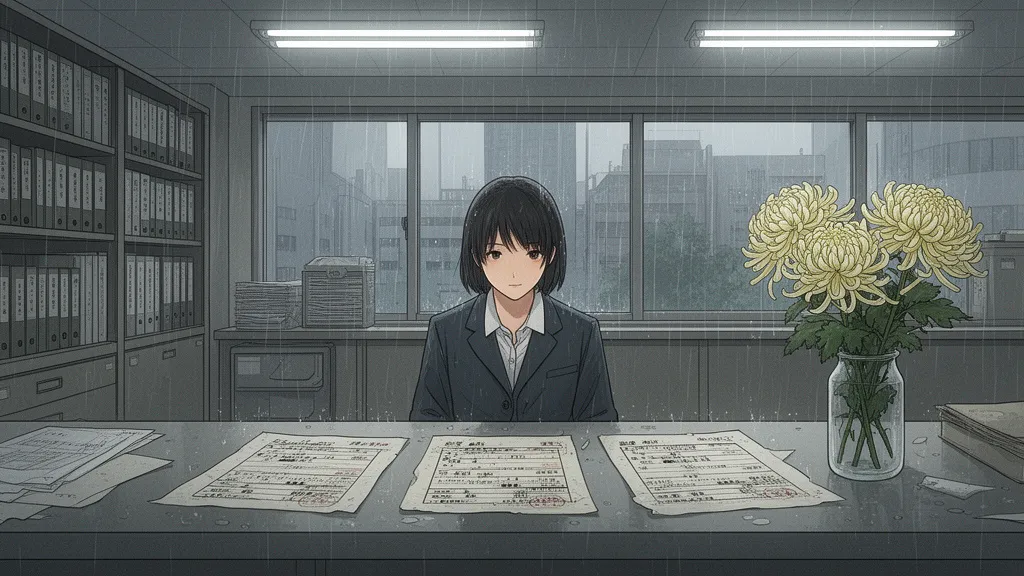
By nine ten on Tuesday morning, the third permit had made Kuroda Mina stop turning pages.
She sat at the long counter in Municipal Records with her finger resting on the line where the applicant's name had been written. Outside, rain moved down the windows in patient sheets. Inside, the office smelled of damp paper, old toner, and the chrysanthemums that Section Chief Hattori insisted improved morale. They improved very little, though they did collect dust with admirable dedication.
Mina pulled the first two permits closer.
All three had been filed in the same week, six years before. All three concerned small renovation work: a rear extension on a narrow house in Minamicho, a conversion of a storage room into an apartment in Kita Third Street, and an interior alteration in a low building above the old arcade. Different addresses, different contractors, different supporting stamps. The signatures were plainly in different hands.
The applicant's name, however, was the same on every page.
Odagiri Reiko.
Mina knew the name because she had typed it into the death register herself three months earlier, while correcting a date discrepancy between hospital notice and crematorium report. Odagiri Reiko, female, sixty-one, no spouse listed, no surviving children. Place of death: Suzuran General. Usual address: 4-11 Kita Third Street.
She put her pencil down.
Across from her, Yanagi from drainage maps was folding a paper crane from a rejected memo. He had folded thirty-seven since April and claimed to be improving. The cranes suggested otherwise.
"You have the look," he said, without glancing up, "of someone who has found either fraud or a staple in the wrong place."
"Possibly both," Mina said.
She stacked the permits in order of filing date. Monday, Thursday, Friday. Three signatures, three addresses, one dead woman who had still been alive at the time, certainly, but who by all accounts had lived alone and had not owned three properties scattered across town. The address in the death register matched only one of the permits: Kita Third Street.
She checked the request slip attached to the file bundle. Local tax inquiry. Routine cross-reference before reassessment.
Routine, in municipal work, was where the trouble liked to put on slippers and come in through the front door.
Mina rose, took the permits, and went to the back office where the older files were logged before retrieval from basement storage.
Section Chief Hattori was standing at the electric kettle with the fixed expression of a man who felt personally wronged by water in all its forms. His tie was patterned with tiny carp. The carp were swimming uphill.
"Chief," Mina said, "do we have originals for Building Permits, Heisei twenty-nine, week twenty-four?"
"In basement archive C. If the basement still exists."
"Has something happened to the basement?"
"Rain," he said. "What else ever happens? A pipe joint gave up during the night. Facilities says only the south row is affected, which is the sort of sentence that means the opposite. Take care with anything down there. If you ruin a file, they will say it was already ruined. If you save a file, they will say of course you did."
He looked at the permits in her hand. "Do I want to know?"
"I don't know yet."
"Excellent. That is the proper stage at which to involve no one."
He poured tea into two cups. He handed one to Mina. It was too full, offensively hot, and slopped onto her fingers as soon as she accepted it.
She set it down on the nearest flat surface before it could complete its campaign.
"Thank you," she said.
"Bring me facts," Hattori said.
The basement corridor smelled of concrete and wet cardboard. Someone had set a bucket under a leak, but the leak had declined the arrangement and was falling mostly beside it. At the archive door Mina found the facilities foreman, Tsujimoto, in rubber boots, lifting plastic sheeting over a row of steel cabinets.
"If you're here for anything south wall, pray first," he said.
"Building permits, week twenty-four, six years ago."
"Then pray efficiently."
He let her in.
The water had receded from the center of the room but still stood in a shallow skin along the far side. Drawer labels blurred where moisture had licked them. A box fan worked at the air with the useless energy of a small dog barking at weather.
Mina found Cabinet C-7, second row from the wall. The bottom drawers were wet through. Week twenty-four was in the third drawer from the bottom.
The file jackets inside were swollen and cold. She carried the relevant bundle to the only dry table. One permit page had already begun to bleed at the edges; blue ink feathered into the paper like drowned moss. She could still read the address and the name. Another day, perhaps another hour, and she might not.
She laid out the three originals.
The copies upstairs had been accurate. Three addresses. Three signatures. The permits shared only the applicant's name and one other thing Mina had not noticed before: all three listed the same emergency contact phone number.
There was no phone number in the death register. Of course there wasn't. There almost never was.
Mina copied it into her notebook.
Then she looked more carefully at the signatures.
The first, on the Minamicho house extension, was a broad impatient scrawl by someone accustomed to signing receipts while standing. The second, on the Kita Third Street storage conversion—the dead woman's own address—was neat and old-fashioned, each character separated, as if written by someone who had once believed forms ought to be grateful for legibility. The third, on the arcade building alteration, was stylish to the point of self-admiration.
Different hands, yes. But the second signature, the neat one, had one odd feature. The surname was written as Odakiri, not Odagiri; the central stroke was faintly crossed. On the permit copy upstairs the scan had blurred that difference away. Here, on the original, the hesitation was visible.
Someone had corrected herself while writing her own name, or someone writing another person's name had nearly missed it.
Mina looked at the date stamps again. Monday, Thursday, Friday.
Same week, same contact number, same applicant, three hands.
Not normal. Not even municipal-normal.
She slid the wettest page into a protective sleeve and signed the emergency preservation log. Tsujimoto, seeing the expression on her face as she emerged, offered her a square of industrial paper towel that felt like thin felt and absorbed almost nothing.
"Bad?"
"Potentially," Mina said.
"That means yes." He jerked his chin at the bundle. "If someone's hoping water solves a problem, tell them the plumbing here is too honest. It ruins everything equally."
Upstairs, she made one call before deciding whether to report the discrepancy.
The number rang four times.
A man answered, cautious and smooth. "Hanawa Architecture."
Mina looked at the first permit. Contractor: Hanawa Design and Repair.
"Municipal Records," she said. "I'm verifying archived building applications. Could you tell me whether Odagiri Reiko was connected to your Minamicho extension six years ago?"
A pause, then: "No. That was Seki residence. Why?"
"Was Ms. Odagiri present when the application was filed?"
Another pause. "I filed that for Mr. Seki. The owner was elderly and didn't like offices. There was an administrative representative. Wait—"
His voice changed, not much, but enough. Recognition, followed by caution sharpened to a point.
"Who is asking?"
"Kuroda, Municipal Records."
"I see. If this concerns archived errors, I would prefer to speak in person. Some names were used for convenience at the time."
Convenience was a better word than most people deserved.
"At what time?"
"This afternoon?"
Mina said she would call back and put down the receiver.
If Hanawa was the broad impatient signature, he was still alive and already steering toward whatever version of events could best survive daylight. She considered taking the file straight to Hattori.
Instead, she called the address from the death register directory and asked for occupant details on 4-11 Kita Third Street. The current resident was listed as vacant. Previous tenancy records required in-person request. Of course they did.
At eleven thirty she put on her raincoat, left a note saying field verification, and took the permits with her in a waterproof sleeve.
The rain had settled into the sort of steady fall that made every street look resigned. Kita Third Street was a narrow run of mixed houses and cramped shops behind the old bus route. Number 4-11 was on the second floor above a shuttered stationery shop. The stairwell smelled faintly of mildew and soy sauce.
A single red slipper lay on the entry mat outside the apartment door.
Not a pair. One.
Mina stood looking at it for a moment. It was women's indoor footwear, cheap, vinyl, the color slightly darkened by age. The mat beneath it was dry except at the edges where rain from shoes had reached. The slipper itself had no dust on top.
Someone had placed it there recently.
She rang the bell.
After a delay, the door opened on the chain.
The woman peering out was perhaps fifty, with silver-dyed hair escaping a clip and an expression prepared equally for salesmen and tragedy. She wore a man's cardigan over a flowered dress and regarded Mina with practiced suspicion.
"Yes?"
Mina showed her identification. "Municipal Records. I'm verifying an old building permit associated with this address. Were you acquainted with Odagiri Reiko?"
The woman looked down the corridor before answering. People often did that when they intended to lie, as if checking whether the truth had arrived first.
"I rented this place after she went into hospital," she said. "Sublet arrangement. Through Mr. Teraoka downstairs. I didn't know her."
"How long have you lived here?"
"Two years. Nearly three."
"Was this apartment created from a storage room?"
She frowned. "No. It's always been an apartment. Tiny, but ambitious."
That dry little phrase interested Mina more than the answer.
"May I ask about the slipper?"
The woman glanced down. For the first time, her poise slipped. "That isn't mine."
"Do you know whose it is?"
"No. It was there this morning. I thought perhaps the girl from next door had lost it, but she wears larger shoes and stronger opinions." She hesitated. "Should I be concerned?"
"Only if slippers begin arriving in sequence," Mina said.
The woman almost smiled. "If they do, I shall move at once."
She gave her name as Fujishima Mie. When Mina asked about Teraoka downstairs, Fujishima said he collected rent for the building owner and spent his days in the former stationery shop sorting old magazines as if they might confess to him.
He was there when Mina descended: a soft man in a beige vest, with wire-rim spectacles and the beard of someone who wished to be mistaken for a novelist and occasionally succeeded from behind.
He denied remembering any permit.
"Storage conversion? No, no. That room upstairs has long been a dwelling. Reiko-san lived there more than ten years. Quiet lady. Paid irregularly, but charmingly."
"Charming irregularity is not a legal category," Mina said.
"Towns run on it." He spread his hands. "What was she to me? A tenant, a friend, a nuisance. We had tea. She knew things about everybody and almost all of them were true, which made the remaining lies very effective."
"Did she own any property in Minamicho or above the old arcade?"
"Certainly not. She owned a cardigan with pearl buttons and a very expensive silence."
Mina took out the permit copies. "Do you recognize this handwriting?"
Teraoka peered. He tapped the neat signature on the Kita Third Street permit.
"That is hers, almost. She always misspelled her own surname when annoyed. Her late father wrote it one way on old insurance papers and another on new. She said identity was a local custom."
"And this?"
She showed him the stylish Friday signature.
He became attentive too quickly. "No."
"You answered before looking."
"Then I saved us both time."
"Who uses the arcade building?"
"Second floor? Atelier, lessons, temporary enthusiasms. Ask Manager Kase if you're collecting disappointments."
He folded his hands over his vest. It was a closing gesture.
Mina thanked him and left.
The building above the old arcade contained, on the second floor, a pottery studio, an empty unit with paper over the glass, and a room with a brass plaque: Igarashi Voice and Deportment. The permit concerned interior alteration, unit 2B.
Manager Kase kept accounts in a tobacconist's at street level and wore eyeliner so exact it gave his tired face the dignity of architecture. He examined the permit copy with professional distaste.
"Unit 2B belonged to Ms. Igarashi then," he said. "She wanted a changing room, a basin, extra mirrors. She paid late and flirted in several directions. This was not original, but she did it with commitment."
"Did Odagiri Reiko apply on her behalf?"
He gave Mina a long look. "Absolutely not. Reiko had keys. That is different."
"To the unit?"
"To several units, for cleaning, for opening, for arriving early where others would prefer not to be observed arriving late." He leaned one elbow on the counter. "You have the expression of a person approaching scandal through stationery. Am I right?"
"Often, yes. Who signed this permit?"
Kase looked at the stylish signature and sighed.
"Igarashi Sumire. Still alive, regrettably for some, triumphantly for herself. She teaches on Tuesdays and Thursdays now, two streets over. If you mean to accuse her of paperwork, wear boots."
Mina thanked him and, because she had now been in the rain for an hour and had begun to resent every civic surface in town, stopped at a tea room near the arcade to review her notes.
The tea arrived lukewarm, which was a novelty and therefore suspicious.
Three permits in one week.
One apparently signed by contractor Hanawa for Seki residence in Minamicho, using Odagiri's name for convenience.
One genuinely connected to Odagiri's own apartment, except the apartment had not in fact been converted from storage.
One signed by Igarashi Sumire for alterations to a studio, but again filed under Odagiri's name.
Same contact number on all three.
Reiko had keys to the studio. She knew everyone. She lived above the stationery shop. Teraoka had recognized her near-signature and lied, or nearly lied, about Igarashi's.
A pattern stood out if one set aside the addresses and looked instead at the nature of the work. Rear extension. Storage conversion. Interior alteration. Three small jobs of the sort people often began before asking permission, then regularized later by submitting papers adjusted just enough to soothe the town.
Who regularized them?
Not the owners, perhaps. Not reliably. Someone who knew forms. Someone who knew whose names could be used without immediate protest.
Mina paid and went to see Igarashi Sumire.
The voice teacher's current premises occupied the upper floor of a former clinic. A piano was audible before Mina reached the landing, striking scales with the determination of a person climbing a hill she regretted.
Igarashi Sumire opened the door herself.
She was in her late forties, beautiful in the expensive-maintenance way that made one think of lacquer. Her dark hair was cut sharply at the jaw. She wore a linen shirt and men's trousers, and a ring shaped like a coiled branch. Two students inside pretended not to listen while listening with opera-level commitment.
When Mina introduced herself and mentioned the old permit, Igarashi's face changed not to fear but irritation.
"At last," she said. "I told Reiko this would surface if she kept things in biscuit tins. Come in."
This was not the tone of an innocent person, but innocence had very little to do with municipal matters.
Igarashi led her to a narrow office. On the wall hung a framed program from a recital twenty years old. On the desk was a ceramic ashtray containing hairpins.
"Yes," she said, glancing at the signature copy. "That is mine. And no, I did not sign Odagiri Reiko's name. Reiko filled the forms. I signed where she folded the page to show me. She said she was filing a batch and that this was easier. Easier for whom, I asked. Easier for those already ashamed, she said."
"Ashamed of what?"
"Of not having permits in order. Of using rooms for one thing while claiming another. Of existing one inch outside the approved line. You know how people are. They want the town's protection and none of its attention."
"Why would they use Reiko's name?"
Igarashi lit a cigarette, then remembered the students and put it down unlit. "Because she offered. Because she knew how to make applications travel through offices attached to smiles and cakes and old acquaintance. Because she had once done clerical work and could imitate official language without understanding that this was sorcery. Because she liked being necessary. Choose any or all."
"Was she paid?"
"Of course. Not much. Enough to keep everyone indebted and no one grateful."
"What was your relationship with her?"
Igarashi looked mildly amused. "Complicated, in the lazy vocabulary of people who dislike precision. We were friends. We were occasionally in love. We were repeatedly disappointed. We exchanged keys and lies. Is that sufficient?"
It was, and it was not.
"Did she prepare a permit for her own apartment?" Mina asked.
"Yes. That one was fiction in the opposite direction. The room had always been an apartment, but at some point in the dark middle ages of property ownership, taxes favored declaring part of it as storage. When the owner wanted to clean up the books, Reiko said she would solve it."
"The owner being Teraoka?"
Igarashi gave her a quick sharp look. "Nominally. Beneficially, no."
"Who, then?"
"You should ask him. It will improve his circulation."
Mina stood. "One more question. Did Reiko keep copies?"
"Always. In a red file with elastic string. She liked red. It made concealment feel theatrical."
"Would it still be at her apartment?"
"If Teraoka has not performed grief on it, perhaps."
By the time Mina returned to Kita Third Street, the rain had thickened again. Fujishima Mie let her in at once, eager in the way of people who have spent several hours with a mystery on their doormat.
"The slipper has acquired significance," she announced. "I can tell by your face."
"Everything has acquired significance," Mina said.
Inside, the apartment was indeed tiny but ambitious. A sliding shelf had been built over the sink. The bed folded into the wall. A half-height partition made a private corner near the window. Nothing about it suggested former storage except the ceiling vent, too large for the room.
Fujishima showed Mina the closet where old papers had been left when she moved in. Most were utility bills, expired medicine envelopes, and a package of postcards tied with ribbon. At the back, behind a stack of magazines, was a red file with elastic string.
"I considered reading it," Fujishima said. "Then I remembered that curiosity without authorization is merely a hobby."
Mina opened the file.
Inside were carbon copies of applications, handwritten notes, rent receipts, and a small memo book. The memo book contained names, dates, and figures in Reiko's neat hand. Some entries were clearly personal loans. Others matched permit fees plus something extra. Several names corresponded to addresses on the applications. Seki. Igarashi. Two more. Beside Teraoka's name, however, was not a fee but a sequence of monthly amounts underlined twice.
Next to them, on three dates in the rainy week six years ago, Reiko had written:
H. signed Monday.
S. signed Friday.
T says his cousin will cover the apartment if needed. Do not trust cousin.
There was no cousin among the filed permits.
Mina read the rent receipts next. The landlord line did not say Teraoka. It said Naruse Fumiyo, with an address in Minamicho.
A woman in Minamicho. The same district as the house extension.
Mina looked up. "Did anyone come here after Ms. Odagiri died? Looking for papers?"
Fujishima hesitated. "A man, once. He said he was checking old utility matters. Beige vest. Poet's beard. I didn't let him in. Then, this morning, before you came, someone left that slipper. I heard steps but by the time I opened the door the corridor was empty."
"Did you see whether it belonged left or right?"
Fujishima blinked. "Left. Why?"
Mina stepped to the mat and looked down again. A left slipper placed toe inward, as if its owner had removed it before entering.
Not a lost shoe. A message.
In older apartment houses, people sometimes left one slipper or one umbrella to indicate I have been here or we need to speak privately without knocking under watchful eyes. A remnant custom, nearly gone. Reiko, who liked theatrical concealment, would certainly have known it.
Someone connected to her