Tomorrow's Envelope
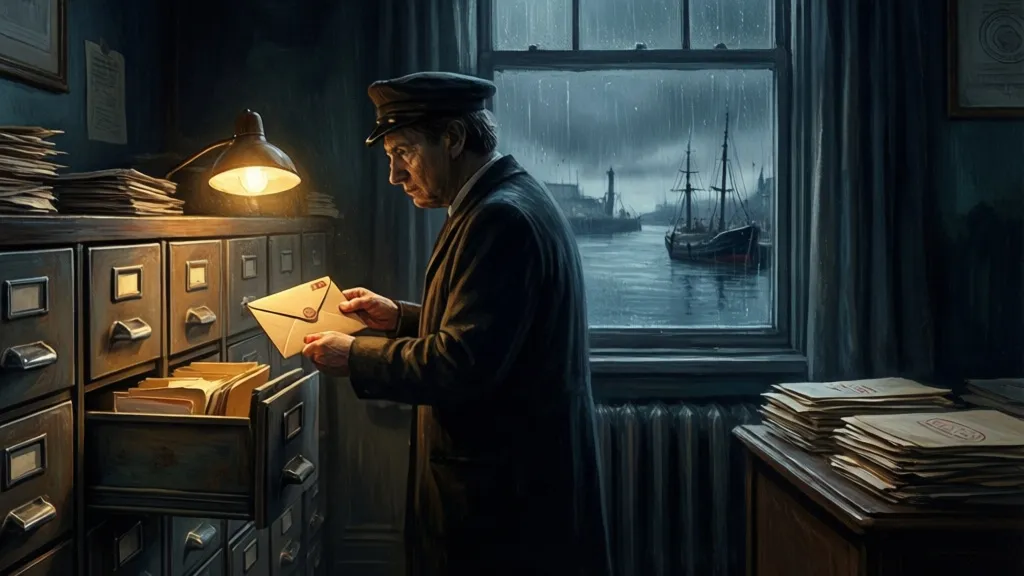
At four-ten, with the rain making the harbor windows black before their time, Arai Natsumi found the envelope in the drawer for tomorrow.
The date tabs in Municipal Records were metal, old enough to have softened at the edges. The folders beneath them had their own smell: paper, paste, dust awakened by damp. Natsumi was closing the day’s intake before the office shut, moving stamped notices from the sorting tray into the dated drawers, when her fingers touched one envelope too many under the nineteenth.
Tomorrow was the nineteenth.
She drew it out and looked first at the red municipal stamp, because that was the part that ought to make sense. Received, Sakurahama Town Hall, 15:32. Correct. The filing mark in blue pencil, small and severe in the upper right corner, was also correct. General registry, deferred opening. Someone had followed procedure with irritating precision.
Then she saw the name.
To Mrs. Arai Fumiko.
Her mother had been dead for eleven years.
Natsumi stood very still with the envelope in her hand. Beyond the records room, someone laughed in the tax office, then coughed as if to deny it. Rain stroked the long windows. The harbor bell gave a sound like a spoon against a chipped cup.
There were, she knew, several women in town named Arai. There had even been another Fumiko, once, who ran a stationery shop before moving inland to live with a son who sold mattresses. But the address written beneath the name was the old one on Minato Slope, the narrow house where Natsumi had grown up and where nobody had lived since the roof failed in the typhoon seven years ago.
The handwriting was careful and old-fashioned, neither obviously male nor female. It was not her mother’s. That at least spared her one species of foolishness.
She turned the envelope over. The flap had been sealed with paste, not wax. No sender’s name.
“Are you leaving, Arai-san?” called Sugimoto from the corridor.
“In a minute.”
Her voice sounded ordinary. She was absurdly pleased by that.
She slipped the envelope under the stack she was carrying, set the drawer right, and took the papers to the front desk. Sugimoto was already in his coat despite the office being heated to a level only a lizard could love. He was a small man with a large tiepin and a heroic opinion of his own sinuses.
“You should go before the steps flood,” he said. “The lower quay was already half under at three. There’ll be complaints, of course. There are always complaints. As if the town controls the sea.”
“It likes to suggest otherwise.”
He gave her a solemn look, uncertain whether she had made a joke. Most people were uncertain with Natsumi for one reason or another. She had a face that invited confidence and a manner that discouraged embroidery.
“Was that all for tomorrow’s registry?” he asked.
“Yes.”
Another lie entered the archive of small municipal lies and sat down quietly among its cousins.
She left with the envelope in her satchel and rain needling the side of her face. Sakurahama, in wet weather, looked as if it had been drawn in ink and then rubbed at the edges with a thumb. The road down to the harbor shone. The fish market shutters were closed. Across the bay, the old seawall ran in a dark line, built of stone blocks and later repairs, patched over decades with whatever had been cheap or urgent or at hand.
Her mother had disliked that wall.
“It was built by committees,” she used to say, which in Fumiko’s view was nearly a criminal method of construction.
Natsumi did not go home. She went instead to the small reading room behind the archive, where the public maps were kept in wide drawers. The building should have been locked in ten minutes, but Sugimoto’s departures were theoretical. He would still be discussing the weather with the night guard in another quarter of an hour.
She took the envelope out, looked at it once more, then opened it carefully with the bone folder she kept in her pencil cup.
Inside was a single folded sheet torn from plain writing paper.
It was a hand-drawn map of the old seawall and the harbor steps. The line of the wall had been sketched in black ink. A section near the northern bend, where the fishermen once tied up before the new concrete pier was built, had been marked with a neat red X. Beside it, a circle of red wax had been pressed onto the page and flattened with some plain object. No seal. Just wax.
There were no words except one, written in the lower corner.
before high tide
Natsumi laid the map beside a survey chart from the records drawer. The mark on the sketch corresponded, not exactly but closely enough, to a repaired stretch of the old wall where mixed brick had been used to fill a storm breach thirty-two years ago.
Her mother would have known that repair. Fumiko had worked in the harbor office then. She knew the town’s breakages better than its celebrations.
Natsumi folded the map again and became aware that someone was looking at her.
The reading room had a tall window onto the side lane. Outside, under the overhang where rain came down in silver cords, a figure stood with an umbrella tilted low. The glass threw back the room’s weak light; she could not see the face. But the posture was not that of someone sheltering idly. It had the particular stillness of a person who had chosen to wait.
When she moved toward the window, the figure turned and went down the lane.
Sugimoto put his head through the door at once, as if summoned by timing rather than sense. “Still here? Ah. I knew it. Records people are unnatural. I’m locking up.”
Natsumi slid the map into her satchel. “Did anyone bring in a hand-delivered letter this afternoon?”
“Several. Old women with drainage complaints, one petition about gulls, and a man who wished to explain in prose why his cousin should not have inherited a retaining wall.”
“That sounds local.”
“Profoundly. Why?”
“No reason.”
He looked at her more closely. “If this is work, it can wait until morning.”
“It may not.”
He considered this, then sniffed. “Nothing municipal should ever need haste. It encourages error.”
He left, and she followed a minute later because he would otherwise lock her in with public administration and old maps, which was not how she intended to spend the night.
Outside, the rain had eased to a fine mist. The tide, however, had not eased at all. Water climbed the harbor steps in patient grey sheets. At the corner tea shop, where she stopped because one always stopped there and then regretted it, the widow Kagawa handed her a paper cup so hot it could have been used to anneal metal.
“You look pale,” Mrs. Kagawa said.
“I work in records.”
“That is not an occupation. It is a symptom.”
Natsumi carried the tea away, burnt her tongue, and drank it anyway.
She could go to the police station on the hill. She knew the desk sergeant, who had once lost an entire week of dog licences and found them, after exhaustive search, in his own lunch satchel. He would listen. He might even take it seriously. But a map with an X on a wall was not, yet, a crime. A letter to a dead woman was not, by itself, one either. It might become one if she was slow. It might become nothing if she was foolish.
At the mouth of the side lane she stopped under the eaves of the closed marine supply shop and looked across to the old seawall.
A light moved there.
Not a fixed lamp: a hand torch, muffled and wavering, low against the stones.
Then it vanished.
Natsumi set down the tea on a crate, where steam rose from it in offended coils, and crossed the street.
The old wall was slick with rain. Weeds grew in the seams where mortar had receded. The marked section lay beyond the harbor steps where the tide slapped almost level with the fourth stair. She walked quickly, skirts catching at her knees, and found the place at once because one brick among old repairs had been prized outward and left canted like a loose tooth.
Someone had already opened it.
The cavity behind was empty.
A strip of dark silk, no wider than a finger, hung from the jagged mortar where it had snagged. Natsumi touched it lightly. It was good silk, not scarf-shop brightness but something older, heavier. Wet now, and shining.
She heard footsteps and turned.
A woman stood three paces away, breathing from haste rather than fear. She was in her late fifties, broad-shouldered, umbrella folded under one arm as if it had offended her. Natsumi recognised her after a beat: Shiba Reiko, proprietor of the flower stall near the station, notorious for funeral arrangements so tasteful that some people were suspected of dying to deserve them.
“You got here too late,” Shiba said.
Natsumi looked at her. “Did you file the envelope?”
“Yes.”
The directness was almost rude. Natsumi found she preferred it.
“Why address it to my mother?”
“Because if I addressed it to you, you might have shown it to the police first. Your mother disliked police interference in practical matters.”
“She’s been dead for eleven years.”
“I am aware. I went to the funeral. The lilies were mine.”
This was true. Natsumi remembered now the uncompromising white of them.
“Then why involve me at all?”
“Because I thought you would understand a file stamp, and because I could not come myself until after closing.” Shiba looked at the empty cavity and gave one brief, furious click of the tongue. “I misjudged the speed of somebody else’s guilt.”
“Whose?”
“That is what I meant to find out.”
Natsumi held up the silk strip. “You know this?”
Shiba’s expression changed very slightly. “I know where I have seen that kind of silk. On the lining of Reverend Tsugawa’s rain cloak.”
“The priest from Kannon Hall?”
“Yes. He inherited expensive tastes from a poor family and a talent for piety from no one at all.”
Natsumi looked back at the wall. “What was hidden here?”
Shiba was silent long enough to qualify as a decision.
“At first,” she said, “I thought it was letters. Then I thought I had been sentimental. It was a key box.”
“A box?”
“A tin cash box, wrapped in oilcloth. Your mother put it there twenty-nine years ago, after the storm that damaged the north sheds.”
Natsumi had not expected her mother to enter the evening in this manner, as if from behind a screen she had merely gone to straighten. “How do you know?”
“Because I helped her.”
Rain ticked softly on the wall and the umbrella handle under Shiba’s arm. The harbor was very quiet, which was one of its ways of becoming dangerous.
“My mother worked in the harbor office,” Natsumi said.
“She did. She was also having an affair with Reverend Tsugawa’s sister, who kept the temple accounts and despised loose papers.”
Natsumi absorbed this. It fitted, after a pause, with several things she had never understood and one she had. Her mother’s long evening walks. The absence of men from the category of explanation. The fierce privacy that had outlasted joy.
Shiba went on in the same practical tone. “The sister’s name was Emiko. They were not discreet in the way people imagine such matters are discreet. They were simply in a town that preferred not to know itself too well. During the storm, the temple account books and certain harbor ledgers were moved for safekeeping. Emiko discovered that Tsugawa had been taking memorial funds and replacing figures after donations came in. Your mother found copies in his desk. There was enough to ruin him, not enough to convict him cleanly. He begged, lied, prayed, and wept in no useful order. Emiko wanted to expose him. Your mother wanted to hide the papers until after the old chief priest died. She said scandal would kill him sooner than shame would improve Tsugawa.”
“And the papers were hidden here.”
“In the cash box. With one key held by Emiko, one by your mother.”
“What happened to Emiko?”
“She died the next spring of a fever. Your mother kept the other key and never used it. Tsugawa survived, prospered, and developed opinions about humility.”
Natsumi looked again at the empty hole. “Why now?”
“Because Tsugawa is retiring to a larger temple inland, and because last week, while arranging chrysanthemums for his farewell dinner, I saw him wearing a key on a black cord under his robe. Not a temple key. A harbor cash-box key; I know the shape. Your mother once showed it to me, gloating like a schoolgirl over sin. I thought: if he has one key still, he may be going to recover the box before he leaves. So I tested it.”
“With the map.”
“Yes.”
“You wanted to see whether he would come.”
“He came.”
Natsumi thought of the figure outside the archive window. Umbrella low. Waiting for her to take the bait, perhaps; or waiting to be certain the envelope had been opened and the wall searched too late.
“Why not tell me all this from the start?”
Shiba gave her an unfriendly look that was very close to honesty. “Because your mother would have preferred I told you nothing. She believed children should be spared the interior design of their parents’ errors.”
The phrase was so exactly Fumiko’s that Natsumi almost laughed.
Instead she said, “If Tsugawa has the box now, where would he take it?”
Shiba glanced up toward the hill road. “Not to the temple. Too obvious, and too many farewell visitors. There is one place in town where people hide in plain sight when the weather is bad and the boats are not running.”
“The Suzuki Inn,” Natsumi said.
Shiba nodded. “Room tea, damp yukata, and no one asks useful questions.”
The Suzuki Inn sat above the northern quay with its veranda half blind in rain. Natsumi had been there only twice, both times for municipal conferences that managed to make coastal erosion sound moral. The lobby smelled of cedar and wet wool. A display vase held branches arranged with the kind of airy severity that announced Shiba’s hand even before she said, “Mine,” under her breath.
The proprietor met them with alarm polished into courtesy. Reverend Tsugawa, yes, had arrived an hour ago to wait out the weather. He had taken tea in the rear sitting room. No, he was not there now.
“His cloak?” Natsumi asked.
The proprietor blinked. “Hanging to dry.”
The silk lining was dark plum. One edge at the hem had torn recently; several wet threads curled where a strip had been pulled away.
“He still has the box,” Shiba said quietly.
“How do you know?”
“Because if he had opened it, he would have burned the papers at once.”
Natsumi considered. “Unless he no longer has both keys.”
Shiba turned to her. “You think your mother’s key remains?”
“She kept things in obvious places if she believed nobody would think them important.” Natsumi remembered, with sudden clarity, a brass tea caddy in the old Minato Slope house that had never held tea at all. Her mother hated tea. “Wait here.”
The proprietor, who had been pretending not to hear anything that would oblige him to remember it later, produced a pot and two cups as if from conscience. By the time Natsumi returned from the kitchen passage with a ring of assorted lost-and-found keys and no success at all, the tea on the table had gone cold.
She drank half a cup in one resigned swallow.
Then she saw it.
On the tokonoma shelf in the sitting room stood a small bronze paperweight in the shape of a plover. The inn used them to keep guest comment cards from wandering in drafts. One card lay beneath it now. Reverend Tsugawa had written on it in careful brushlike script:
Grateful for shelter. Regretfully departed by the rear path.
The sentence was absurd. Nobody left notes on comment cards unless they wished to be theatrically discovered. The plover paperweight sat not over the card’s centre but over its lower left corner, where there was no danger of drift. The opposite corner lifted slightly.
Natsumi moved the weight and turned the card over.
Taped to the back was a small key.
Shiba made a sound of deep and personal contempt. “He wanted us to know he could still direct the scene.”
“Or he wanted to delay us while he looked for the other key and failed.” Natsumi closed her hand around the taped key. “If he had both, he would not leave one.”
“Then where is your mother’s?”
Natsumi looked at the cold tea, and because memory was perverse, remembered the brass caddy at once: square, dented, kept on the highest shelf because no one wanted what was in it. Coins, string, buttons, and once, when she was twelve, a small key wrapped in old silk. Her mother had taken it away before she could ask. After the funeral, the contents of the house had come to Natsumi in boxes, then to storage, then, in most cases, to disposal. But not all.
“I know where to look.”
By the time they reached the Minato Slope house, the tide had begun to turn, though the lower road still lay under shining water. The house leaned slightly inland, as if reconsidering. Natsumi had kept one room sound enough for storage and stubbornness. Inside, damp and old plaster greeted her like relatives.
The brass tea caddy was exactly where memory had left it, on the top shelf of the kitchen cupboard behind a chipped bowl. Inside were coins, string, two buttons, and a key wrapped in faded blue silk.
Shiba took one sharp breath. “Emiko’s silk.”
No one said and your mother kept it all this time because the room said it for them.
They found Reverend Tsugawa in the shed behind the house, where rain tapped on the corrugated roof and the beam from his lantern shivered over an opened oilcloth bundle on the floor. He had chosen the place because he knew the house, then. Because he had once come here. The thought did not wound Natsumi as she might have expected. It merely completed a line in an old drawing.
The cash box sat between his knees. He looked up, saw the key in Natsumi’s hand, and closed his eyes once.
“I wondered which of you would understand first,” he said.
“Not repentance, certainly,” said Shiba.
He smiled at that with exhausted accuracy. “No.”
Natsumi did not bother with speeches. “You filed the envelope under tomorrow because the registry clerk would find what had not officially arrived yet. You watched the archive window to make sure I did. You went to the wall as soon as I had the map.”
“Yes.”
“Why not take the box before sending it?”
“I did not know whether the wall had survived the latest repairs. I wanted confirmation without putting my own hand there first.”
“Elegant,” said Shiba. “Cowardly, but elegant.”
Tsugawa looked from one woman to the other, perhaps measuring which of them had become his judge. “I meant to burn them. The papers, I mean. There is no money left to recover. There is only disgrace.”
“For whom?” Natsumi asked.
He did not answer.
She gave him the second key. For a moment his hand shook too much to use it. Then the lock clicked. Inside, wrapped in oilskin gone brown at the folds, were ledger pages, letters, and a narrow packet tied with blue silk ribbon to match the cloth from the caddy.
Tsugawa stared at the ribbon as if it were the true indictment.
“Those are hers,” he said quietly.
“Whose?” Natsumi asked, though she knew.
“Emiko’s. To your mother. I thought Fumiko had destroyed them.”
Shiba said, “She hid what mattered and left the rest to weather. A sound principle.”
Natsumi lifted the packet. It was light in the hand. Too light, probably, for what it had cost.
“We go to the police,” she said.
Tsugawa bowed his head. It was not graceful. It was merely final.
Afterward, there were statements, and a desk sergeant who took everything seriously in the offended manner of a man who prefers dog licences. The old temple accounts would be reviewed. The farewell dinner was cancelled, to the private distress of three committee members and the public delight of the remaining eighty-seven residents of Sakurahama. By midnight, Natsumi was allowed to leave with the packet of personal letters set aside from the evidence on the understanding that they concerned no fraud except the ordinary kind by which people conceal love from neighbours.
She did not go home at once. She sat instead on the sheltered bench outside the police station where one could hear the harbor without seeing it. The tide had turned fully now. Water withdrew from the steps in soft, resentful sounds.
Mrs. Kagawa’s second cup of tea, fetched by a constable who admired her and feared her equally, had gone cold before it reached Natsumi. She drank it anyway.
In her lap lay the blue ribbon and the first of the letters, unfolded but unread. She knew she would read them. Not tonight. Tonight it was enough to know that her mother had once hidden not only another person’s shame but another woman’s tenderness, and had kept both with that severe loyalty which could look, from the outside,