White Irises at Opening
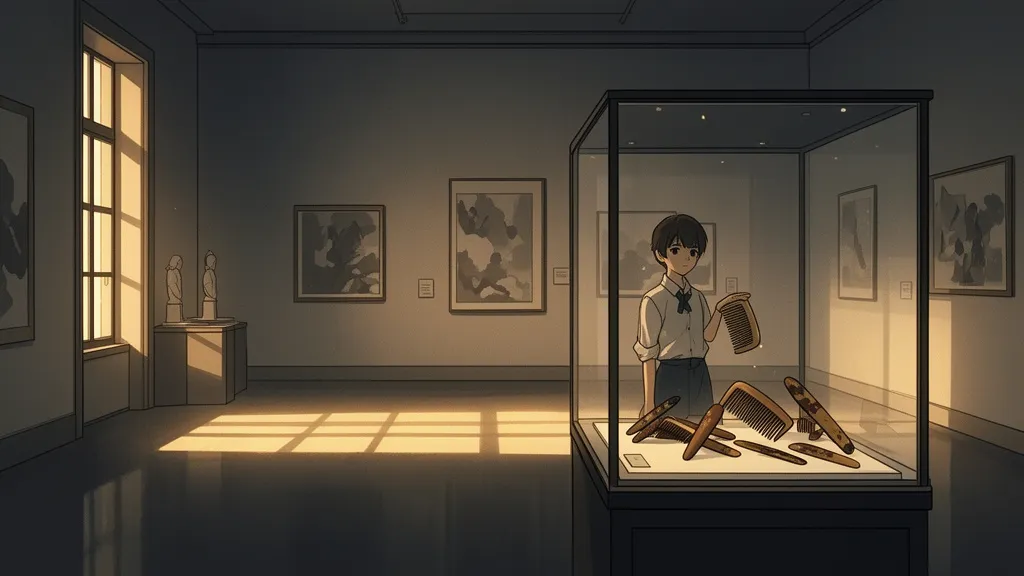
By seven twenty, Senda Aoi had already decided that the combs were wrong.
She stood in front of Case Four with her satchel still on her shoulder and the morning register tucked under one arm. The East Gallery was dim except for the narrow blades of sun that had slipped through the high windows and settled on the polished floor. In that half-light the lacquered combs should have looked like a row of dark sleeping birds. Instead, one had turned its back.
Aoi unlocked the case and bent nearer.
There were twelve Edo-period combs in the display, arranged by material and workshop: black lacquer with gold grass, red lacquer with scattered shell inlay, one severe piece in plain brown so perfectly finished that it looked almost modern. She had set them herself on Tuesday afternoon after three indecisive meetings, a leaking humidifier, and a volunteer who believed labels were improved by enthusiasm. She remembered where each one lay because she remembered everything she had touched while irritated.
The third comb from the left, top shelf, had been replaced.
What lay there now was a child’s plastic hair clip, pale pink, with a moulded rabbit face and one rhinestone eye missing. It did not belong in any century that interested the museum. Aoi touched it with the back of one finger.
Warm.
Not room warm. Not the stale trapped warmth of a closed case. Warm in the way an object was warm after sitting in sunlight.
She straightened and looked over her shoulder toward the service corridor that led, eventually, to the loading dock. The dock received the first sun. The gallery did not.
“Of course,” she said to the empty room.
The tea she had bought from the station kiosk and abandoned on the registration desk was already cooling. This seemed, in the circumstances, consistent.
She set the hair clip on a sheet of acid-free paper, then counted the remaining combs again. Eleven. No sign of the twelfth tucked behind a mount or slid under the velvet. No broken glass. No scratch around the lock.
A cleaner’s trolley rattled faintly somewhere beyond the screens. Opening was at nine. The deputy director would arrive at eight ten, scented and cheerful and useless. The police, if called, would be offended by the phrase possibly stolen before opening hours. Before any of that, there was the matter of the warm plastic clip.
Aoi took it by one edge and walked into the corridor.
The service passage behind the East Gallery was unlovely in the manner of all museum backs: painted cinder block, old notices curling at the corners, a framed evacuation map nobody had updated since the café moved. The air there was cooler than the gallery. On the grey linoleum, near the fire door to the loading dock, she found a small crescent of dried mud with a child’s tread pressed into it.
Not a child’s shoe, she thought a moment later. Too narrow. A woman’s indoor sandal, perhaps, with a playful sole. The rabbit clip in her hand had encouraged the first assumption.
The fire door was shut but not fully latched. Sun leaked bright around its edge.
Outside, the loading dock held its usual assortment of practical melancholy: stacked crates, flattened cardboard, the museum van, a pallet waiting to be useful. The eastern wall reflected light so strongly that the concrete itself seemed heated. Aoi stepped into it, felt the clip grow more ordinary in her fingers, and scanned the ground.
Near the threshold, among grit and a dead beetle, lay one white petal long and curved as a nail paring.
Iris, she thought.
It was the sort of flower people gave at openings when they wished to seem refined without being original. White irises had stood in three tall vases in the entrance hall the previous evening, sent by donors for the small reception after the new textile exhibition. But those had been downstairs and public. This was the back dock, where bouquets had no business at all.
She went in again and followed the corridor toward storage.
The museum’s object rooms occupied an older wing, where each door had acquired two labels over the years: one official, one handwritten by staff who actually needed to find things. ARCHIVE B / Flat Things. Textiles Overflow / Do Not Add Textiles. Temporary Photography / It Isn’t. The floor showed faint wheel marks from crates. On an ordinary morning the place smelled of paper, cardboard, and old silk. Today it smelled faintly, absurdly, of cut stems.
In the anteroom outside Archive C, a trolley stood at an angle. Aoi did not remember leaving it there. On its lower shelf lay a pair of nitrile gloves, one folded inside the other, and beside them another white iris petal.
Archive C was locked.
That in itself meant nothing. Archive C was always locked. It held donor files, accession records, correspondence too boring to destroy and too dangerous to lose. The key should have been in the registrar’s office downstairs, signed out only when required.
Aoi looked at the lock anyway. No damage. The brass was clean except for a thin dark line just above the keyhole, as if something narrow had grazed it.
She exhaled once through her nose. Then she went downstairs for the key ledger.
The ledger informed her that no one had signed out Archive C after four thirty the previous afternoon. This was the kind of information that comforted administrators and irritated anyone interested in fact.
The key hung on its hook.
She took it, returned upstairs, and opened the archive.
Inside, nothing had been overturned. Nothing had even been made dramatically untidy. The room was lined with metal shelving and document boxes, all in disciplined grey. A reading table stood under the single window, the blind half lowered against light. On the table lay one cream envelope, slit neatly across the top.
Aoi knew that envelope. She had catalogued the donation herself six months earlier: papers from the late Kanzaki Reiko, collector of women’s hair ornaments and donor of the lacquered combs now one short. The sealed envelope had come with a note in the hand of her lawyer.
To remain unopened for one year from date of donation, unless required for provenance or legal dispute.
The year was not complete.
Aoi set the pink clip down on the table and put on gloves. The cut on the envelope was very fine, not ragged with scissors. A scalpel, perhaps, or a paper knife kept sharper than most people deserved. Inside was a folded letter and, beneath it, a small photograph.
She drew them out carefully.
The photograph showed a much younger Kanzaki Reiko in a summer kimono, laughing at something beyond the frame. Beside her stood another woman in plain dress, carrying a cluster of white irises wrapped in newspaper. On the back, in blue ink, was written: To Chizu, who should have had it first.
The letter was shorter than Aoi expected.
If this packet is read, then either a year has passed, or someone has become impatient. I leave the maki-e comb of pampas grass not from sentiment but from correction. It was never mine by right. I took it in 1968 from Chizu Mori at the Seishin Women’s College exhibition room, after she said she would not run away with me and I said something unforgivable in return. She died before I could return it. If any of her family can be found, the comb should go to them. If not, let this confession sit with my reputation and do it no further harm.
Aoi read it twice. Then she looked again at the display in her mind: the missing comb, black lacquer, gold pampas grass.
So that was the one.
Behind her, in the doorway, someone said, “Ah.”
Deputy Director Nagamine had arrived without making any sound until the precise moment she could be ornamental. He was carrying her tea.
“I saw this downstairs,” he said. “It appears to have died heroically.”
The tea had indeed become cold.
Aoi took it. “Thank you. We have a theft, or a recovery, and a private archive has been opened.”
Nagamine, to his credit, stopped smiling. “How bad?”
She showed him the letter.
He read, pursed his mouth, and said, “How inconvenient of the dead.”
“It usually is.”
“Police?”
“In a moment. First I want to know who was here last night.”
“The reception ended at seven thirty. Staff left by eight. Security closed at ten.” He glanced at the table. “Mori. That name is familiar.”
“Professor Mori Chizuru donated the ethnographic dolls last winter,” Aoi said. “Department of literature, retired. Daughter-in-law, I think, or niece by marriage. I’d need the file.”
Nagamine considered this with the careful expression of a man arranging his face around possible scandal. “And the night guard?”
Aoi lifted the pink clip. “I was about to ask him.”
Shibata Tetsuo sat in the security office with both hands around a paper cup of miso soup as if it might advise him. He had retired three months earlier, then returned on a part-time basis because his successor had quit after discovering that empty museums made too much noise. Shibata was seventy-two, compact, polite, and increasingly unsure of where yesterday had gone.
He looked at the rabbit clip with grave distaste.
“I saw someone,” he said. “I know that much.”
Aoi sat opposite him. Nagamine hovered by the door, trying to seem absent. “When?”
“After nine. Before ten.”
“That is an hour.”
He nodded apologetically. “I was doing the west corridor, then the alarm panel showed East Gallery opened and shut. Very quickly. I thought perhaps one of you had forgotten something. I went to look.”
“And?”
“The corridor lights were low. I saw a person crossing near storage. Carrying flowers.” He frowned. “White flowers. Large. Like hands. No, not hands.”
“Irises,” Aoi said.
“Yes. Perhaps. The person held them upright. Strange way to carry flowers. I called out. They turned the corner. By the time I reached it there was no one.”
“Man or woman?”
He made a helpless movement. “Average. In a pale coat, perhaps. Or a cardigan. I remember the flowers more clearly than the person. There was a smell. Green.”
“Did you check the archive rooms?”
“I checked doors. All shut.”
“Locked?”
“I do not remember trying each one.” His face tightened, with anger this time rather than confusion. “You think I forgot and made trouble.”
“I think someone counted on you remembering the flowers and not the coat,” Aoi said.
That eased him a little. He looked down at his soup. “There was another thing.”
“Yes?”
“On the desk in security, later, I found a note in my own handwriting. It said: East corridor resolved. Delivery flowers collected by Ms Mori.”
Nagamine said, “What?”
Shibata flinched.
Aoi held out a hand. “May I see it?”
He passed over a square of museum memo paper. The handwriting was his: careful, elderly, each character separately responsible. Aoi studied it.
“Did you write this?”
“I must have.”
“Must?”
“I don’t remember writing it. But it is mine.”
Aoi turned the note over. On the back, pressed hard enough to leave an impression, was another line from a previous sheet:
Professor Mori — 8:30, donor file.
She looked up. “Who had an appointment at eight thirty?”
Nagamine cleared his throat. “Professor Mori Chizuru. She came yesterday evening before the reception. She wished to consult material related to Kanzaki Reiko for a memorial essay.”
Aoi let the silence stand a moment.
“Did she view Archive C?”
“I authorised supervised access,” he said. “Through the registrar. I had forgotten.”
“You forget only useful things,” Aoi said.
“Selective talent.”
Shibata said, “Professor Mori is small. The person I saw was not especially small.”
“People are larger when they carry bouquets,” Aoi said. “And cardigans are larger than conscience.”
Nagamine looked at her, almost smiling despite himself.
“Call Professor Mori,” Aoi said. “Ask her to come in before opening. Say there is a question about wording in the memorial label. If she has any sense, she will hear the lie and come anyway.”
Professor Mori Chizuru arrived at eight fifteen in a dove-grey suit and flat black shoes with narrow soles. There was dried mud in one groove of the right sole.
She was perhaps sixty, with a face arranged into scholarly composure and eyes that moved too quickly over objects she wished not to notice. Aoi received her in the small study room beside the archive, where the opened envelope lay on the table and the pink rabbit clip beside it like a joke too cheap for the setting.
Professor Mori stopped at the sight of the clip first. That, Aoi thought, was instructive.
“You wished to discuss a label?” she said.
“No,” Aoi said. “A comb.”
Professor Mori sat down without being invited. “Then I advise accuracy.”
Aoi liked her at once, which was inconvenient.
“The pampas-grass comb is missing from the East Gallery,” Aoi said. “This was found in its place. Archive C was opened in the night and the sealed letter from Kanzaki Reiko read. A witness saw someone carrying white irises through the corridor. Yesterday evening you consulted the donor file.”
Professor Mori folded her hands. “You could have sent that in writing.”
“You would have had more time to prepare.”
Nagamine, standing by the shelves, looked unwell. He was not built for directness before breakfast.
Professor Mori’s gaze moved to the letter. “Then it said what I thought it might.”
“You suspected the comb had belonged to your family?”
“My husband’s aunt. Chizu Mori. I had heard the story in pieces.” She gave a small, almost embarrassed shrug. “Old women and grudges preserve history better than institutions.”
“Did you take the comb?”
“No.”
It was said promptly, without flourish. Aoi believed she had not taken it with her own hands. That was not the same thing.
“Did you open the envelope?”
“No.”
Another clean answer. This one she did not quite believe.
Aoi placed the photograph on the table. Professor Mori’s expression changed very slightly when she saw the younger woman with the irises.
“You knew there would be a photograph,” Aoi said.
“I guessed there might be one. My husband kept a torn half of a picture in a drawer for years. He never said who the second person was, but his mother once called her that iris woman.”
“Why the flowers last night?”
Professor Mori looked at the rabbit clip. “Because my granddaughter was with me at the reception. Because she lost that absurd thing in the car and cried as if the family line depended on it. Because I promised to look for it when we left.”
Nagamine blinked. “Your granddaughter was in the museum?”
“For twenty-three minutes, under my daughter’s supervision, during a donor event overrun with elderly women discussing silk. She survived.”
Aoi said, “And the irises?”
“Were in the entrance hall. My daughter took one bouquet because no one wished to carry flowers home on the train and because she lacks reverence. She waited in the car while I came back in to ask Mr Shibata whether a child’s clip had been handed in.”
Aoi considered the sequence. “At what time?”
“After nine. Closer to nine fifteen.”
Shibata’s memory of flowers, then, could be true and useless at once.
“Did he let you into the back corridor?”
“Yes. I looked near the cloakroom and lavatory. Not in the galleries. I was carrying the bouquet because my daughter refused to stop arranging it and dropping petals.” Professor Mori’s mouth tightened, not quite with annoyance. “Mr Shibata seemed tired. I told him I had found nothing and left.”
“And the note?”
“I asked him to write down that I had collected the flowers, because he appeared troubled by rules. He wrote it in front of me.”
That explained the note and, neatly, why it existed at all.
Aoi looked at the shoes again. “Your sole pattern matches the mud at the loading dock.”
Professor Mori glanced down. “Naturally. I went there. My daughter had parked badly and wished to know where crates should not be blocked. If this is becoming comic, I assure you I am not enjoying it.”
“No,” Aoi said. “Nor the person who used your flowers.”
Nagamine said, “Used?”
Aoi turned to him. “The bouquet was visible. Distinctive. Anyone in that corridor carrying white irises would become the person with flowers in Mr Shibata’s memory. If someone had already seen Professor Mori with such a bouquet earlier in the evening, the association would be stronger. A very economical disguise.”
Professor Mori said quietly, “Who knew I had come for the file?”
Nagamine looked stricken. “The registrar. Miss Kuroe. And perhaps...” He stopped.
“And perhaps the person who supervised your access,” Aoi said.
The registrar, Kuroe Mina, was twenty-eight, efficient, and in love with procedures the way some people were in love with unsuitable musicians. She had supervised Professor Mori’s consultation at eight thirty, then assisted at the reception, then remained late to finish packing returns. She arrived in the study room with a ring of keys on her belt and indignation prepared in advance.
By the second question it had begun to leak.
“No, I did not steal a comb,” Mina said. “I don’t even like lacquer.”
“Many crimes begin in indifference,” Aoi said.
Mina flushed. “Professor Mori asked specifically whether there was sealed material in the donation. She said families are always the last to know what dead collectors think is important.”
Professor Mori inclined her head. “I did ask that.”
“And after the reception?” Aoi said.
“I was upstairs until nearly nine, then in registration until ten past. I locked Archive C after consulting another file for Mr Nagamine.”
“Which file?”
“Kanzaki correspondence. He wanted donor wording.”
Nagamine opened his mouth, then closed it. He looked at the floor with uncommon attention.
Aoi said, “Did you open the sealed envelope?”
Mina stared at her. “Of course not.”
“Then why is your scalpel missing?”
Mina’s hand went involuntarily to the pocket of her cardigan. Empty. She looked genuinely surprised.
Aoi had not known it was missing until that moment. People often answered the sharper question than the one they were asked.
Mina sat down.
“Because I lent it,” she said at last.
“To whom?”
Silence.
Aoi waited. It was one of the few parts of her work she enjoyed without reservation.
Mina said, “To Assistant Curator Hayase. He said he needed to trim a mount for the reception labels and had left his tools in the annex.”
Nagamine muttered something that might have been prayer.
Hayase Jun came in smelling faintly of cologne and panic. He was handsome in a soft, unfinished way and had the particular expression of a man who had relied too long on being found plausible. When he saw Professor Mori, he went pale; when he saw the letter, paler still.
“I only wanted to know whether the rumour was true,” he said before anyone had accused him. “That means this is not theft, exactly.”
“Then explain exactly,” Aoi said.
He did, with more dignity than she expected.
He had been cataloguing Kanzaki Reiko’s old correspondence for a proposed publication and had found references to a quarrel, a college exhibition, a comb not hers. He mentioned it to Professor Mori during her visit because he liked to seem informed. Professor Mori’s reaction told him enough to make him curious. Later, after the reception, he borrowed Mina’s scalpel, opened the sealed envelope in Archive C, read the confession, and decided at once that the museum could not afford a public dispute over provenance. The simplest solution, he thought, was to remove the comb quietly and speak to Nagamine in the morning.
“Why not simply leave the envelope unopened and report your suspicion?” Aoi asked.
Hayase looked at her with tired honesty. “Because I wanted to be the one who solved it.”
There it was. Vanity was rarely original, but it remained serviceable.
“And the rabbit clip?”
He closed his eyes briefly. “I found it in the corridor after Professor Mori had been through. I thought if the comb’s absence was noticed immediately, the clip would suggest... nonsense, really. A prank, a child. I needed a moment.”
“The flowers?”
“I took one stem from a bouquet left by the cloakroom and carried it through the corridor when I returned to the archive. Then I saw Professor Mori’s larger bouquet by the security desk and understood Mr Shibata had seen her earlier. It seemed useful. I went back and took the rest from the desk.”
Professor Mori said, with precise contempt, “You framed me with flowers.”
Hayase winced. “Temporarily.”
Aoi said, “Where is the comb now?”
“In my desk drawer.”
No one spoke for a moment.
Then Nagamine sat down heavily on the nearest chair, as if his legs had filed a separate complaint. “Jun,” he said, “you have managed to combine theft, tampering with donor material, false implication of a donor’s family, and the exploitation of an elderly guard’s memory, all in aid of avoiding bad publicity.”\