Das Kleid, das wiederkehrte
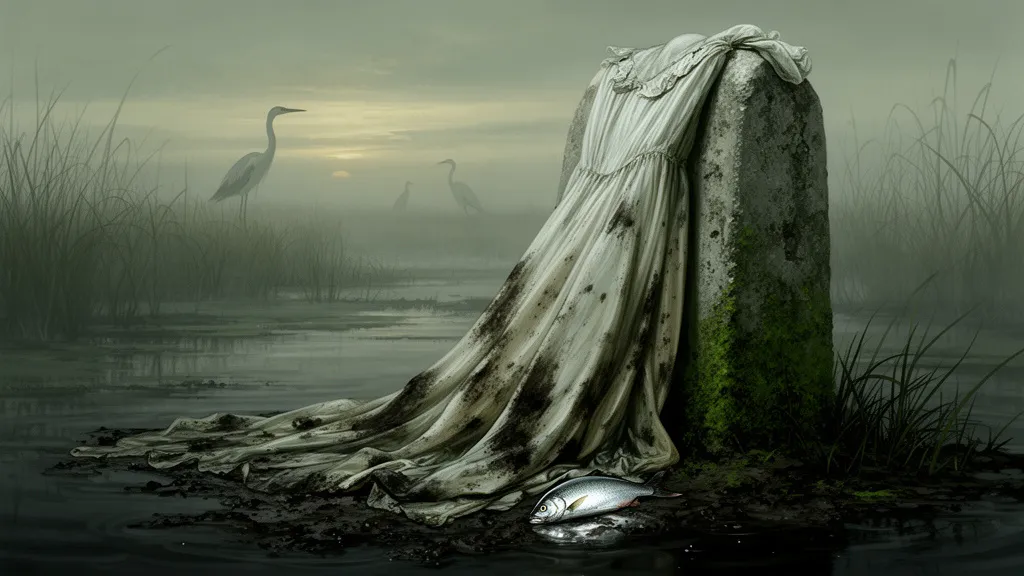
The dress arrived with the morning tide, draped across the old stone marker at the edge of the marsh where Mara's mother used to count herons. It was still recognizably silk, though the estuary had made its own amendments: river mud in the seams, a faint green stain where algae had considered the bodice, and — caught in the hem like a deliberate ornament — a silver fish ringed with barnacles, its eye still bright.
Mara had buried her mother three years ago in this dress. The grave was two miles inland, in consecrated ground that had never flooded, not even in the winter the sea had tried to reclaim the village and take the chapel with it.
She lifted the dress carefully, and the fish came with it, embedded in the fabric as though it had grown there. The barnacles were old, concentric, the kind that took decades to accumulate. The fish itself was long dead, but it smelled of salt and the particular green darkness of deep water, not decay.
The dress still fit, which was the first impossible thing.
The second was the sound that began the moment she fastened the last pearl button: a rhythmic knocking from beneath the floorboards, patient and deliberate, like something that had been waiting a very long time for someone to finally answer the door.
The house had been built on stilts, the way all the houses in the village were, though most families had left after the winter the sea came too far and stayed too long. Mara's mother had refused to go. She had stood on the porch watching the water rise and said, with perfect calmness, that the marsh had given her everything she loved, and she would not insult it by leaving the moment it asked for something in return.
What it had asked for, in the end, was her.
She had walked into the estuary one morning at low tide and simply continued walking. They found her three weeks later, tangled in the reeds near the old chapel, which had been abandoned when the congregation realized the sea was listening to their prayers more carefully than the god they were addressing. Mara had cut her mother free, carried her inland, and buried her in this silk dress — the one she had been wearing when she walked into the water, the one that had always been her favourite, the one she had been married in.
Mara had not expected it back.
The knocking was not random. Three beats, a pause, two beats, a longer pause, then the pattern repeated. It came from different places beneath the floor — first the kitchen, then the threshold, then the space beneath the bed where her mother used to keep a chest of letters Mara had never been permitted to read.
Mara knelt and pressed her palm to the floorboards.
The knocking stopped.
Then, very deliberately, something knocked back directly beneath her hand.
She pulled up the board. The space below was dry, which should have been impossible this close to the marsh at high tide, and empty except for a single object: a key, green with verdigris, tied to a piece of driftwood with a length of fishing line that had calcified into something closer to rope.
The key was shaped like a fish.
Mara had seen it before, though she could not remember where. It had the weight of a recurring dream, something half-remembered from childhood that might have been real or might have been the estuary telling her stories the way her mother used to, in the hours between sunset and true dark when the tide was turning.
The chapel was a mile down the coast, accessible only at low tide when the causeway surfaced. Mara walked it in her mother's wedding dress, the dead fish swaying gently in the hem, the key heavy in her pocket.
The chapel had been beautiful once. Now it was a place where water pooled in the nave and the walls grew long green beards that moved even when the wind did not. The door was locked, though the lock itself was so old it had become part of the door, metal and wood grown together through decades of salt and patience.
Mara fit the key into it anyway.
The lock was rusted solid, the mechanism frozen, but when the key turned — not mechanically, but the way a word turns meaning when you finally understand it — the door opened. Not because the lock had yielded. Because the chapel recognized what was being asked.
Inside, the water was waiting.
Not flooding, not seeping — waiting. It filled the chapel to the height of the pews, perfectly still, perfectly clear, and so cold the air above it was visible, a thin mist that moved like breath. The surface reflected nothing, though Mara stood directly over it.
She knelt at the edge.
The water knocked back: three beats, two beats, the same pattern from beneath her house.
Then, very slowly, something rose.
Not her mother.
Not exactly.
The thing that surfaced was the shape her mother had been wearing the day she walked into the estuary, but made of water, animated by it, held together by intention or memory or some combination that the marsh had learned to sustain. It wore her mother's face the way the sea wears the moon's attention: imperfectly, but with absolute fidelity to the idea.
It did not speak. It extended one hand, palm up, and in the palm was a question Mara understood without language.
The marsh was rising. Had been rising for years, patient and inexorable, the way tides are when they have stopped pretending to be temporary. It would take the house by morning, whether Mara answered or not. The water was coming.
But the water in the chapel was not the water outside. This water had been trapped here since the congregation locked the doors, tried to contain what they had invited in and then feared. It had been held here, separate, remembering, while the marsh outside grew restless and the estuary forgot how to be gentle.
The key had opened the door. But doors were only architecture.
What the water-mother was offering was permission. Not to enter — Mara had already entered. Permission to leave. To rejoin the estuary, to teach the rising marsh how to move with intention instead of hunger, to take the house and the village the way the estuary had taken her mother: as a gift willingly given, absorbed into something larger that had loved it all along.
If Mara refused, the chapel water would remain as it was — trapped, separate, remembering — and the marsh would take everything anyway, but the way winter takes things. Indifferent, thorough, leaving nothing that remembered.
The water-mother's hand remained extended.
Mara looked down at the dress, at the fish caught in the hem, at the barnacles that had been growing for longer than she had been alive. She thought about the chest of letters beneath her mother's bed, the ones she had never read. She thought about the morning her mother had walked into the estuary and not returned, except she had returned, hadn't she, in every tide, in every knock, in this dress that kept coming back no matter how deep the grave.
She reached out and took her mother's hand.
The water was very cold and not cold at all.
And between them — between the touch of Mara's hand and the water-mother's palm — the boundary dissolved. Not broken. Dissolved. The chapel water recognized permission when it felt it, and it began to move.
The marsh came in at dawn, the way her mother said it would, eventually, when Mara was very small and asking questions about whether they would always live in the house on stilts. It rose through the floorboards gently, the way sleep rises, and by the time the sun cleared the headland, the house was a reef, and the chapel water was flowing again, pouring out into the estuary with a sound like gratitude.
Mara stood on the causeway in her mother's wedding dress as the tide turned, watching the house settle into its new shape. The water around her ankles was warmer than it should have been, and it moved in patterns, deliberate swirls that might have been currents and might have been something acknowledging her presence.
The fish in her hem was gone. In its place, a single barnacle, still growing, anchored to the silk as though it had always belonged there.
She walked back toward the mainland as the causeway began to sink, and behind her, in the nave of the chapel, the water was already beginning to sing.